Make a Girl (メイクアガール, Gensho Yasuda, 2024)

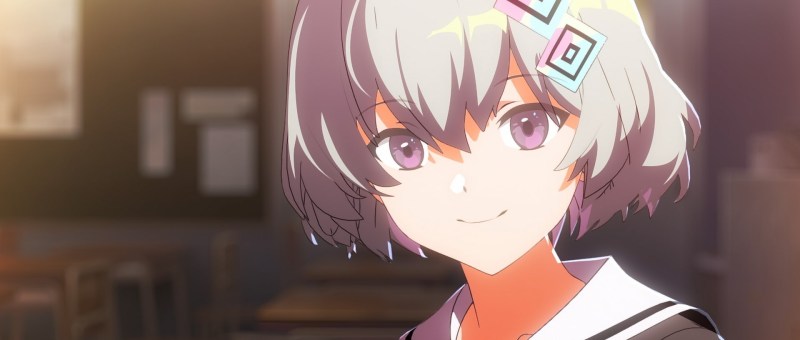
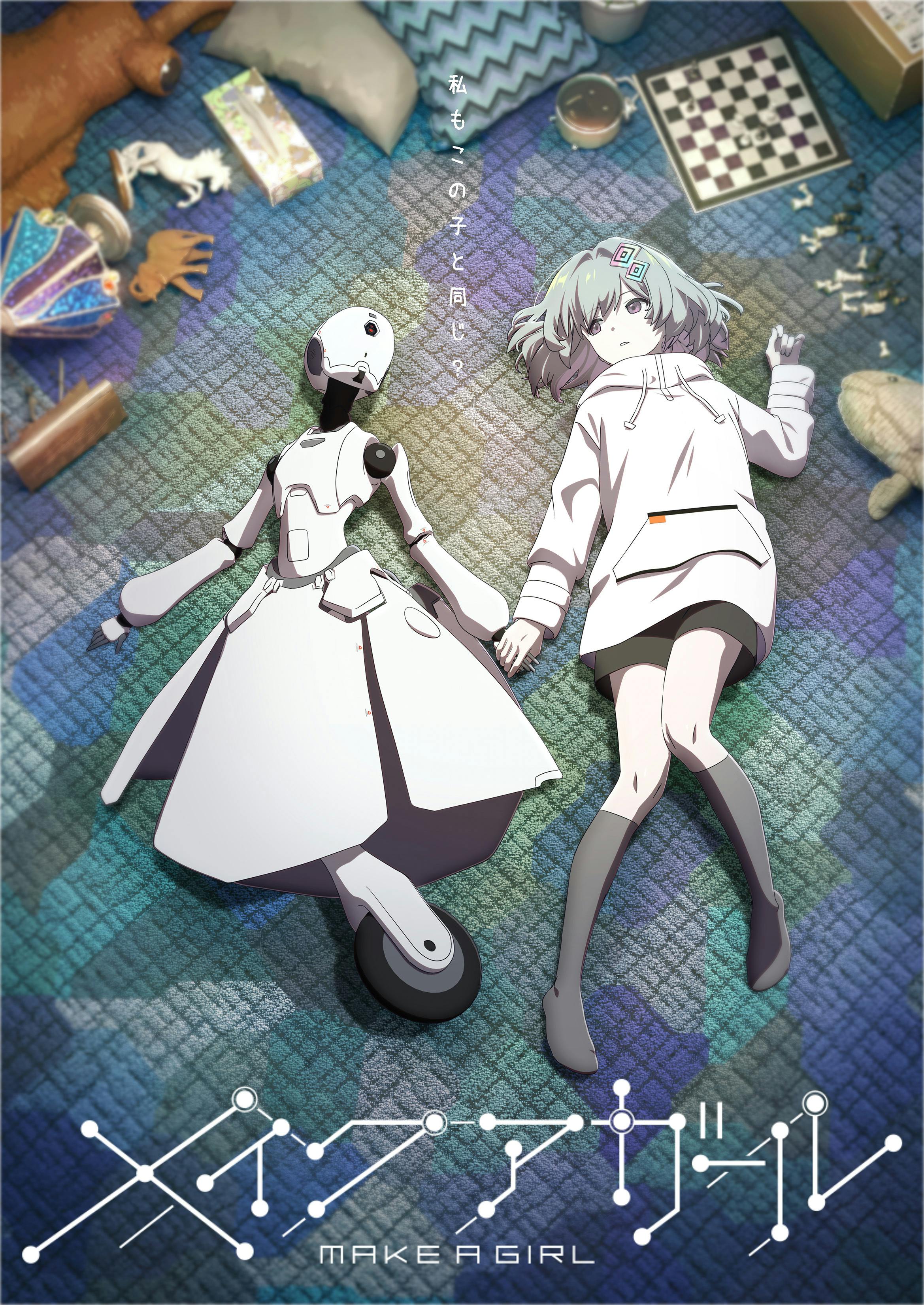
A socially awkward teenage scientist takes a friend’s advice too literally and builds himself a girlfriend in Gensho Yasuda’s indie animation, Make a Girl (メイクアガール). The central irony is that Akira (Shun Horie) makes Zero (Atsumi Tanezaki) to improve his productivity, but in fact ends up learning how to interact with people from her. Nevertheless, consciously or otherwise, he’s started off from a questionable position given that his notions of what a girlfriend should be are bound up with his unresolved feelings for his late mother along with outdated sexist attitudes. 

Akira’s mother Inaba was a genius scientist who passed away of an illness sometime previously leaving Akira alone with only their huge lab and a drive containing her memories. Fearing he can’t live up to his mother’s legacy, Akira’s inventions are largely useless time-wasting devices which make ordinary tasks take longer than they would if done in the normal way. That’s why he’s so taken with his friend’s story about how getting a girlfriend has improved his productivity at his part-time job. Not really understanding why his friend’s productivity improved, he decides to create a “girlfriend” for himself, but is only doing so in the hope that she will magically allow him to level up. She is then a sentient being that exists solely to support him by being cute and sweet while he otherwise puts nothing at all into the relationship.

Zero’s desire to fit into the stereotypical “girlfriend” role is signalled by her learning to cook so that she and Akira can eat together, while when she tries to go on a stereotypical date with him, she opts to go clothes shopping and says that she’s realised that she likes it when he makes all her choices for her. Akira is really in the awkward position of being both a paternal figure and a boyfriend, branded a “father” to his creation by his mentor while at the same time associating Zero with his late mother even as he tries to “date” her, albeit in a curiously asexual way. It turns out that his mother’s AI coding contained several safeguards which effectively mean that Akira has total control over Zero and if she attempts to defy him, she automatically tries to strangle herself. When he begins to find her annoying because her desire to spend more time with him gets in the way of his research, he simply gets her an apartment and says he just wants to be friends.

Led into a quagmire of existential questioning both by Akira’s indifference and the probing of his friends, Zero begins to wonder who she really is and if she only “likes” Akira because he designed her that way. Though she desperately tries to get Akira back by being an even more perfect girlfriend, which is after all her life’s purpose, she begins trying to claim her identity by overcoming her programming, which is to say escaping his control to be her own self. Akira, meanwhile, finally realises that what he felt for her wasn’t “annoyance” but “love”, if only if still rooted in all the things she can do for him rather than an acceptance that what his friend meant was that falling in love had given him an eagerness for life through the mutual exchange of emotion, care, and support. 

In any case, Zero’s actions take on a misogynistic quality as if Akira were, in a way, attacked by a “crazy girlfriend” who was only ever going to mess up his life because women always get in the way. The fact that the antagonist is also a woman who is jealous of his genius and a kind of rival to Zero further rams the idea home that women only cause trouble and are a threat to a man’s autonomy, even as Akira is still clearly overly attached to the memory of his late mother. The voice of reason is his wiser than her years friend Akane (Sora Amamiya), though even she at times seems jealous of Zero and shares many of the same outdated notions about what a woman should be. It’s almost as if Akira too is a construct who was only turned on yesterday which is why he has no idea about human feelings or how to interact with other people and is, in effect, learning them vicariously through Zero, who is mainly picking them up from Akane but getting a double dose of patriarchal programming that proves much harder to break than any of Akira’s code.


Make a Girl screened as part of this year’s Camera Japan.

Trailer (no subtitles)
SPY x FAMILY CODE: White (劇場版 SPY×FAMILY CODE: White, Takashi Katagiri, 2023)

The irony at the centre of the Folger family is that they cannot communicate effectively because they’re each afraid of blowing their cover. Adapted from the manga by Tatsuya Endo, Spy x Family was the smash hit anime of 2022 and now makes its way to the big screen with an epic adventure which threatens the foundations of a “fake” family which has become increasingly real to the extent that it may have come to eclipse the reason it was created.

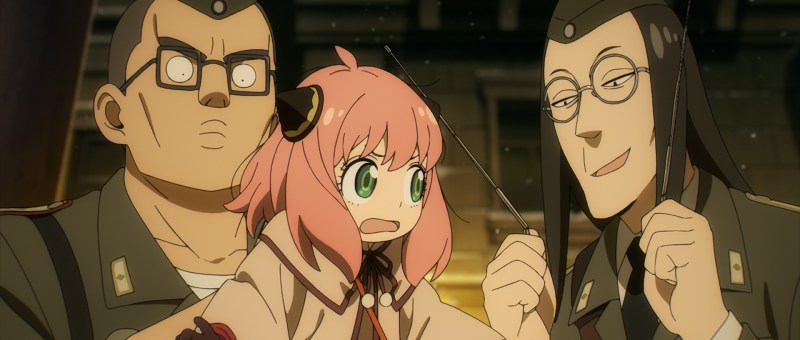
Newcomers to the franchise need not fear as the film is broadly standalone and gives a brief explanation of its setup in not dissimilar fashion to the voiceover intro of the TV anime. Codenamed “Twilight”, spy Loid Folger (Takuya Eguchi) has adopted a little girl, Anya (Atsumi Tanezaki), and married a local woman, Yor (Saori Hayami), in order to infiltrate an elite boarding school with the aim of targeting a reclusive politician through forging a connection with his younger son, Damian. What Loid doesn’t realise is that he’s completely in the dark about his new family. Anya is the only one who knows the whole truth as she is a telepath, while Yor is a secret assassin who agreed to fake marriage as cover to avoid detection by the authorities. Even the family dog, Bond, is a canine clairvoyant who was the product of an experimental program to breed super intelligent dogs. 

The mission is compromised by the fact that Anya is less than academically gifted and unlikely to gain all eight stars needed to join the elite group of students that would get her close to Damian and Loid close to his father. Having made so little progress, Loid’s handler reveals Operation Strix may be taken away from him and given to a political crony which would necessarily mean he’d have to give up the new family life to which he’s gradually become accustomed. But the family is also threatened by Yor’s insecurity and conflicted feelings for Loid, well aware their arrangement is “fake” but still anxious that Loid is having an affair and worried he’ll divorce her for not being good enough at the domestic life she too has come to value. Anya, meanwhile, obviously wants to keep to her new family together while helping her parents with various missions but can’t say anything for fear of exposing herself as a telepath and Bond as a clairvoyant. 

Echoing the extended cruise arc from the anime, the film follows the Forgers on a mini break to nearby Frigis in search of a regional dessert they hope will help Anya win another star only to end up swept into local politics. The long-form format of the feature surpasses that of the TV series in shedding its bitty, episodic structure for something more substantial though that may of course detract from its charms for those taken by the isolated vignettes of the show. Even so, the film doesn’t stint on quickly humour gaining the ability to deepen its ongoing gags culminating in a fantasy sequence animated like a kids drawing in which Anya meets the God of Poop and is rewarded for excellent service. 

Though what’s really about is once again the Forger family who must finally turn the wheel together in order to avoid certain death. Though fighting parallel battles, unable to simply explain what they’re doing and ask for help, the gang eventually end up in the same place united in their missions and also as a family having faced off various threats and reaffirmed their bonds which have by this point become very much real. Loid continues to struggle with the mechanics of his mission, frequently unable to read Yor’s insecurity and unwittingly fuelling it, and exclaiming that he doesn’t understand children nor have much clue how to manage Anya’s often madcap behaviour. The irony is that if he succeeds, the family will have to disband and he’ll lose this new sense of domesticity that’s becoming used to, but if he fails his nation may go to war and thousands of people will die. But until then his biggest problem is figuring out how Anya can win a baking contest and survive yet another impromptu family holiday without becoming embroiled in an international conspiracy. 


SPY x FAMILY CODE: White is in UK cinemas now courtesy of All the Anime.

UK trailer (English subtitles)

Images: © 2023 SPY x FAMILY The Movie Project © Tatsuya Endo/Shueisha

Liz and the Blue Bird (リズと青い鳥, Naoko Yamada, 2018)

Liz and the Blue Bird poster 1If you love it, set it free. For most accepted wisdom, but hard to practice. The heroine of Liz and the Blue Bird (リズと青い鳥, Liz to Aoi Tori) finds herself facing this exact dilemma as she puts off facing the inevitable changes in a childhood friendship with adulthood lingering on the horizon. A Silent Voice’s Naoko Yamada returns with another delicate examination of teenage relationships, this time a spin-off to the popular Sound! Euphonium franchise, in which her fragile heroines struggle to address their true feelings as they subsume themselves into the titular piece of music but fail to master it even as it strikes far too close to home.

Our heroine, Mizore (Atsumi Tanezaki), nervously waits outside the school as if too shy to head in alone, eventually trailing along behind the comparatively more extroverted Nozomi (Nao Toyama). The two girls have been tasked with playing a movement known as Liz and the Blue Bird, inspired by a storybook of which Nozomi is particularly fond. Liz, a lonely young woman living alone in the forest, bonds with a mysterious girl who arrives one day and seems to be the human incarnation of the blue bird she longingly gazed at in the sky. Though the two women bond and live together in blissful happiness, Liz begins to feel guilty that her love has trapped the blue bird on the ground and forces it away to fulfil itself in the sky.

To begin with, it’s difficult to tell if Mizore and Nozomi are really friends at all or if Mizore’s painfully obvious longing is a completely one-sided affair. Mizore herself remains hard to read, either intensely shy and anxiously self-conscious or wilfully aloof as she rejects overtures of friendship from some of the other girls and devotes herself to Nozomi alone. Nozomi, meanwhile, is outgoing and gregarious, a natural leader well liked by the other band members and with plenty of (superficial at least) friends though perhaps lonely and confused in her own way. There is a kind of awkwardness between them, a tension neither seems quite able to address, which finds expression in the failure of their musical performance as it continually fails to find its proper harmony.

The story of the blue bird takes on extra significance for each as they cast themselves, perhaps mistakenly, in their respective roles from the fairytale. Talking things over with a sympathetic teacher concerned that she hasn’t turned in her career survey, Mizore declares herself unable to understand the story, not comprehending how Liz could have brought herself to release the blue bird rather than cage it to ensure it would be hers, and hers alone, forever. Fearful that Nozomi will fly away, she wants to tether her close but again does not quite know how. Nozomi, meanwhile, is conflicted. She feels a responsibility towards her friend’s feelings, but is insecure in her own talents and unsure she could follow Mizore on her chosen path even if that was her independent will. In fear of disappointing each other, they begin to pull away rather than face the inevitable end of their peaceful high school days.

Yamada’s camera is painstakingly astute in capturing the awkwardness of adolescent interaction from the slight tension in Mizore’s shoulders as Nozomi draws too close to the way she plays with her hair when nervous, glancing plaintively at hands and calves or the swishing motion of Nozomi’s ponytail, but always hanging back. Unlike Mizore, Nozomi understands the moral of the story but feels the ending is too sad, convincing herself that if the blue bird is free to fly then it’s also free to return. Having been forced to confront their individual troubles, the girls are better placed to see themselves in relation to each other, breaking the tension but perhaps with melancholy resignation as they commit to enjoying their remaining time together in the realisation that they may soon part. A beautifully observed portrait of teenage friendship and awkward adolescent attraction, Liz and the Blue Bird is an infinitely subtle exercise in emotional intensity as its heroines find the strength to accept themselves and each other in acknowledging that they were each made to fly through perhaps not quite yet.


Liz and the Blue Bird was screened as part of the 2019 Nippon Connection Film Festival.

US trailer (Japanese with English subtitles)