Many Happy Returns (教祖誕生, Toshihiro Tenma, 1993)

Cults, or “new religion” organisations as they’re euphemistically known, proliferated in Japan after the war. Though people may have joined them out of loneliness in search of new families or communities, the numbers only seemed to increase in the era of high prosperity as a sense of spiritual emptiness countered the age of consumerism. Coming in 1993 and based on Takeshi Kitano’s own novel, Many Happy Returns Toshihiro Tenma’s (教祖誕生, Kyoso Tanjo) approaches the issue with a genial humour that likely became impossible two years later with the involvement of Aum in the Tokyo subway attack.

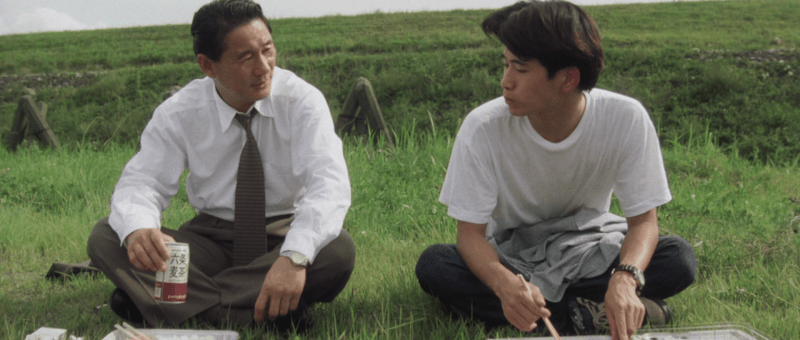
Kazuo (Masato Hagiwara), a wandering young man, asks himself why people join join cults while insisting that all looks so fake but later becomes fascinated with them himself. He can tell that the elderly woman who can suddenly walk again after an encounter with the leader (Masami Shimojo) is probably a plant, but is intrigued rather than outraged. Shiba (Takeshi Kitano), the actual “leader” of the group, tells him that it doesn’t matter. The leader healed the lady before at some point in the past, and they’re just reenacting it to show the power of god, which doesn’t really make sense, but it seems to satisfy Kazuo for the moment. 

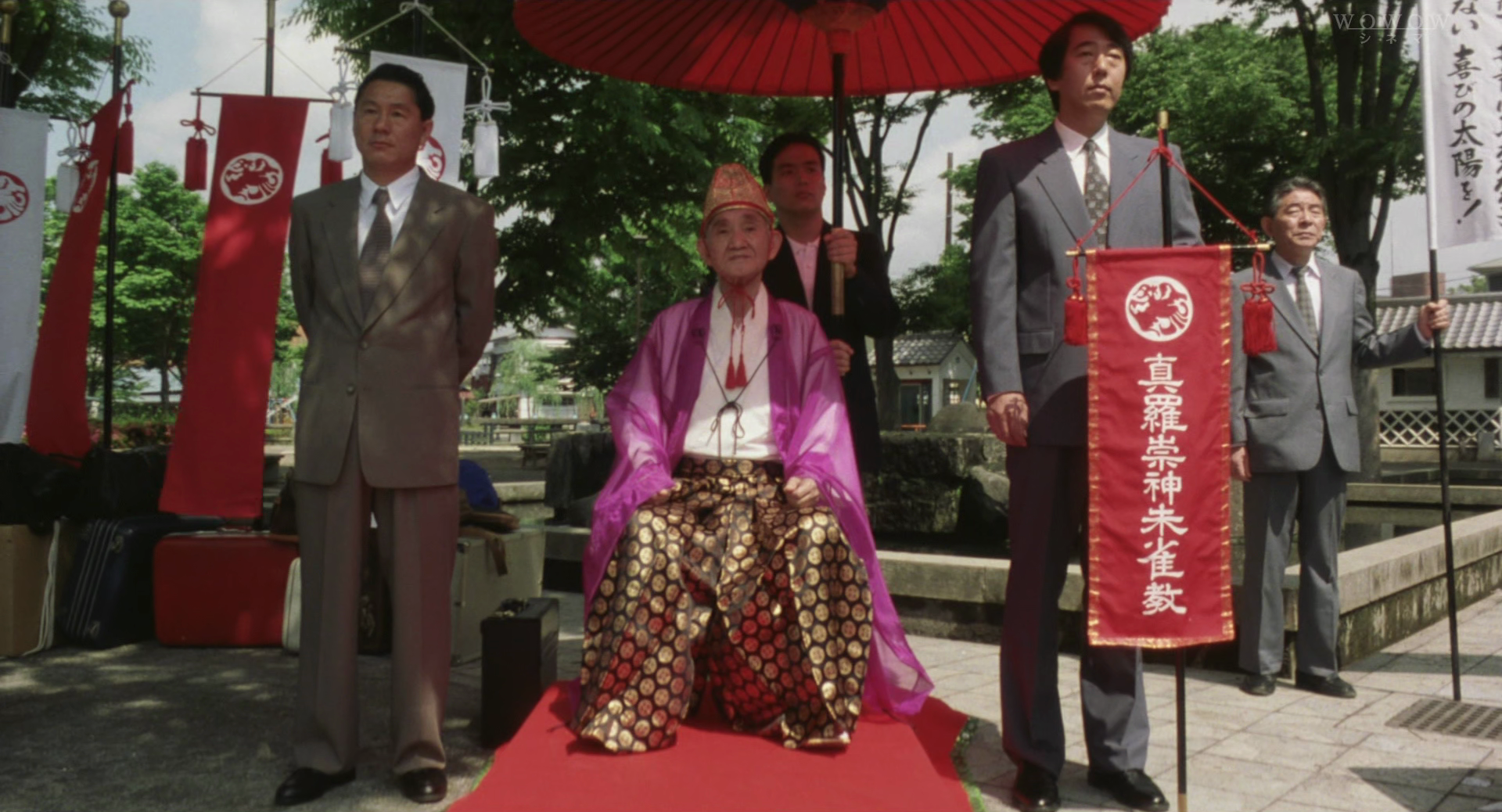
Of course, Shiba and Go (Ittoku Kishibe) are just a pair of yakuza types running a religious cult as a business to fleece money out of vulnerable people in the countryside by making them think their leader can make all their problems better. The only thing is, Shiba and Go seem to be the only ones who know it’s all fake while current leader has started to believe that he actually has real healing powers despite using an electricity generator to create the sparks of energy flying from his hands during his healing sessions. Though the old lady in a wheelchair is a plant, the leader sometimes agrees to heal other people who request it, which could end up backfiring if Shiba can’t find a way to fake the miracle.

After becoming alarmed that the Leader is too into his religious speeches and has fallen victim to his own patter despite obviously knowing that it’s all made up, Shiba and Go pay him to leave the cult but are then left with a dilemma over how to appoint a successor. Komamura (Koji Tamaki), who’d tried to undermine Shiba’s leadership, is a religious zealot who joined the cult to be closer to god. He objects to Shiba’s godless ways, and while Shiba briefly considers making him the leader to keep him quiet, ends up appointing Kazuo who only recently started tagging along with the cult.

Though Kazuo was originally only interested in the cult precisely because it was fake, once he becomes the leader he starts to think it’s real too. He takes his responsibilities seriously, which means of course that he threatens Shiba’s position and is torn between the real nature of cult which he knows to be a cynical way of making money by exploiting vulnerable people, and the genuine religiosity of Komamura. To look the part and boost his confidence, he starts undertaking ascetic practices such as bathing in waterfalls and going on long, isolated retreats during which he also fasts. Shiba and Go, meanwhile, stuff their faces at a local Chinese restaurant in an orgy of consumerism.

Kazuo asks Shiba if the believes in god, but Shiba counters him by asking what his idea of “god” is. Kazuo believes that “god” heals the sick and helps those in trouble, but Shiba points out that that’s never actually happened, while at least their made-up religion helped some people, so in a way it’s more godlike than actual god. In any case, Shiba’s god is probably consumerism, but unlike Go it seems he has a degree of uncertainty and entertains the possibility that some kind of god really exists and will punish him for his wrongdoing and lack of faith. When he is attacked and ends up killing someone, Kazuo tells him that it’s his punishment for denying god and chasing after money which Shiba eventually concedes to be true. Nevertheless, the closing scenes find him starting again by reuniting with the previous leader, now dressed as a catholic priest, to offer the same patter about healing miracles while warning about false cults and fake religions. Kazuo, meanwhile, has fully accepted the role of an emissary of god by kicking out Go for not taking the religion seriously while preparing to meet his own apotheosis in a sold out show attended by people who, like he once was, are spiritually lost and ironically looking for something that means more than money in this increasingly empty society.


Trailer (no subtitles)
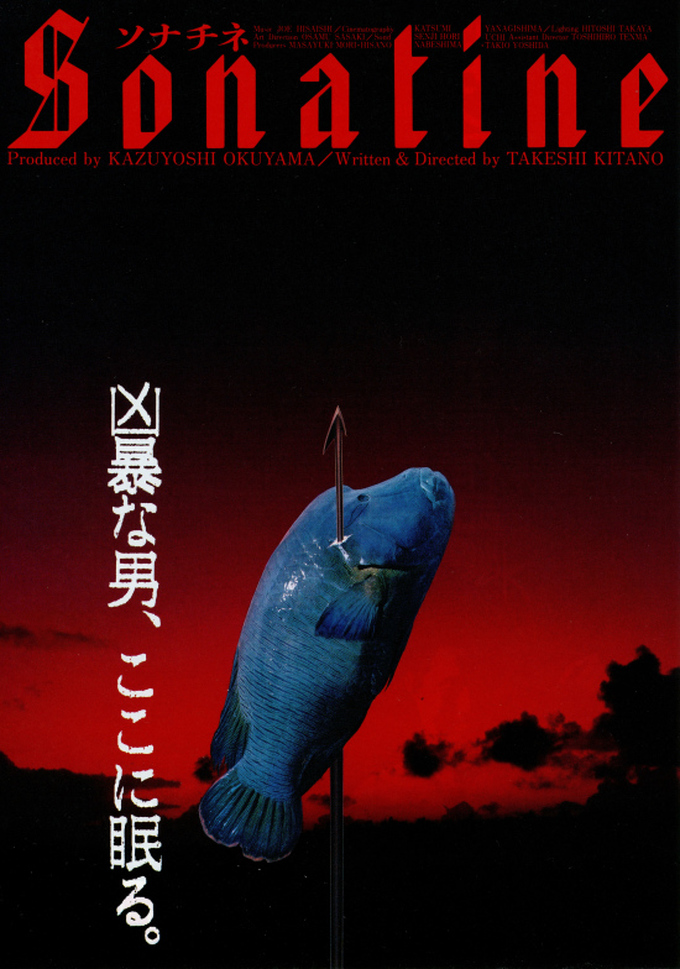
Sonatine (ソナチネ, Takeshi Kitano, 1993)

The problem with being a yakuza is that there is never any rest. Staying alive means constant vigilance, make a mistake and it could be the end of you or, conversely, get too good at your job and place a target on your own back. The hero of Takeshi Kitano’s Sonatine (ソナチネ) declares himself tired, not just of the life but life itself. By his fourth picture, Kitano was perhaps feeling something similar, later describing the near-fatal motorcycle accident he encountered some months after the film’s completion as an unconscious suicide attempt. For years he’d been one of Japan’s top TV personalities working a breakneck schedule that left him little time for other outlets such as painting, novels, and acting for others, but still he longed to be taken more seriously as an artist in his home nation where audiences largely stayed away from his “serious” films, as they did with Sonatine which flopped at the box office and put an end to his arrangement with Shochiku who had distributed his first two features in which he had also starred. 

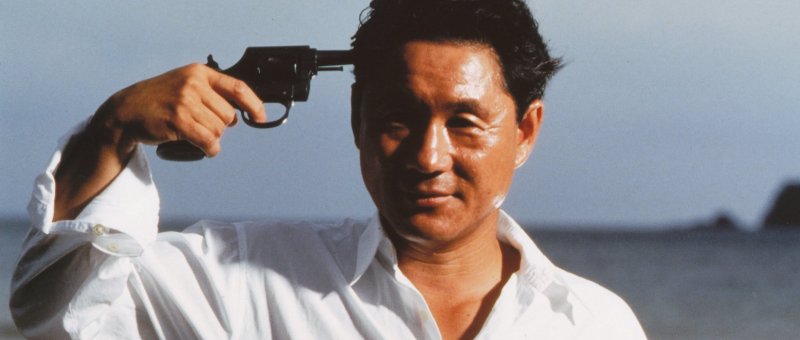
For this third film, A Scene at the Sea, Kitano remained behind the camera and distanced himself from the themes of crime and violence which defined his early career, crafting instead an intensely melancholy tone poem about a deaf surfer falling in love with the ocean. In Sonatine he casts himself as the lead for the first time since Violent Cop, this time as a gangster experiencing extreme existential malaise when confronted with the futility and emptiness of his life in organised crime. Murakawa (Takeshi Kitano) is aware he has probably reached the zenith of his career as a mid-tier gang boss working as a, by all accounts, unexpectedly successful enforcer in a rundown area of the city. His first crisis concerns the owner of a mahjong parlour who thinks the yakuza are an outdated institution and refuses to take their threats seriously. He sees no need to pay them the customary protection money and assumes they’ll back off he simply tells them he’s not interested, but he is very wrong. Murakawa has him kidnapped to teach him a lesson, observing while his minions attach him to a crane and threaten him by dunking him in a large pool of water. Immediately apologetic, the man sees the error of his ways, but Murakawa doesn’t really care about the money anymore and so they dunk him again to see how long it takes a man to drown, barely shrugging as they realise he really died. 

Either because he’s an unusual man, or because he is simply tired of everything, Murakawa no longer bothers to abide by the rules of petty gangsterdom. He doesn’t do deference, smoking away long before his boss offers permission to do so and feeling unafraid to voice his reluctance when he’s ordered to take some of his guys to Okinawa to settle a nascent gang war involving one of their affiliates. Murakawa doesn’t want to go because he lost three men in a similar job in Hokkaido, but in reality has little choice. Later events prove he was right to be suspicious. The Okinawan gang boss tells him that he reported some minor friction with another gang out of courtesy and is confused he’s been sent reinforcements, not that he’s not glad to see them. As soon as they arrive, however, the tension rises and Murakawa and the guys are forced into hiding, holing up at the beach as they await orders from head office or word on a possible truce. 

Murakawa, his two right-hand men, and the Okinawan gangsters adjust to tranquil island life, playing on the beach and taking the time to master the art of Okinawan folk dance, but the grim spectres of death and violence present themselves even here in empty games of Russian roulette and Murakawa’s childish prank of digging sand traps for the guys to fall into as if into their graves. While he’s busy admiring the night sky, the silence is ruptured by a local tough chasing a young woman onto the beach where he proceeds to rape her. Murakawa doesn’t intervene but is challenged anyway and then forced to kill the puffed up youngster while the young woman, Miyuki (Aya Kokumai), becomes strangely attached to him, impressed by his cool dispatch of her attacker. 

Murakawa’s somehow innocent relationship with the young woman creates a minor rift with his men who resent the absence of his leadership at a time of crisis while he ponders alternate futures outside of the gangster brotherhood. But deep down he knows that his idyllic beach holiday cannot last forever and that he will have to leave this liminal space eventually for a destination of which he is all too aware. As he explains to Miyuki, when you fear death so intensely you begin to long for it if only for an end to its terrible anxiety. 

The title “Sonatine” is apparently inspired by the “sonatina”, a short, tripartite piece piano players attempt to mark an attainment of skills before choosing the future direction of their musical career. Murakawa undergoes three distinct arcs, from the city to the beach and back again, but perhaps knows there is no future direction in which for him to travel only the nihilistic fatalism of a life of violence. As for Kitano, it does perhaps draw a line in the sand marking the end of an apprenticeship and its associated compromises as he fully embraces an authentic personal style, like Murakawa no longer prepared to be deferent in an admittedly exhausting world. 


Sonatine is the third of three films included in the BFI’s Takeshi Kitano Collection blu-ray box set and is accompanied by an audio commentary by Chris D recorded in 2008. The first pressing includes a 44-page booklet featuring an essay on Sonatine and introduction to Kitano’s career by Jasper Sharp,  an essay on Violent Cop by Tom Mes, a piece on Boiling Point from Mark Schilling, an archival review by Geoff Andrew, and an appreciation of Beat Takeshi by James-Masaki Ryan.

The Takeshi Kitano Collection is released 29th June while Violent Cop, Boiling Point, and Sonatine will also be available to stream via BFI Player from 27th July as part of BFI Japan.

Original trailer (English subtitles)