Strangers (Kenta Ikeda, 2024)

Naoko, the heroine of Kenta Ikeda’s Strangers, says she’s been pretending all her life. She’s been pretending to be what everyone wanted her to without really knowing or thinking about what it was she wanted to be or who she really is. On a baseline level, Ikeda suggests that we are and remain strangers to ourselves while equally confused about those around us, seeing what we want or expect to see rather than who they really are.

In part that may explain why Naoko has stayed with her unfaithful fiancé Takeo who got a colleague pregnant and then seemingly abandoned her. Shimizu then began harassing Naoko, stalking her and making silent calls. To make matters worse, Takeo is often away on “business trips”. He’s not currently responding to her phone calls or messages and has just embarrassed her by not turning up to a family event. Naoko’s sister thinks she should leave him and doesn’t understand why she hasn’t already. But Naoko just sighs that she’s decided not to expect too much from life and seems prepared to put up with this degradation because she doesn’t think she deserves anything better. 

That might be why she’s so drawn to her enigmatic colleague Yamaguchi who waltzes in past noon wearing a distinctive blue dress that floats in the air behind her. The other ladies at work gossip that their bullying boss Satome, who is married with two children, got her the job after picking her up on a dating app and the reason why she can get away with such unprofessional behaviour is because she’s sleeping with him. But Naoko later discovers that Yamaguchi’s dating app activities are a kind of side hustle in which she participates in idealised dating scenarios pretending to be the lover of lonely men who pay her handsomely for a few hours of fantasy romance.

Or as Yamaguchi describes it, the opportunity to experience only the good parts of love before you get sick of each other and run out of things to say. It sounds more than a little like the logic of someone who’s decided not to expect too much from life, and while it seems Yamaguchi may be trying to avoid her own grief and loneliness, it’s true that she otherwise remains a cypher. After losing contact with Yamaguchi and being left with her smartphone, Naoko receives a call from her handler who tells her that it doesn’t matter who she is or why she has “Yamaguchi’s” phone, all that matters is turning up at the appointment and never letting it slip that it’s all just role-play.

On her dating app profile, Yamaguchi’s face is blurred so that you only really see the image of her in her distinctive blue dress which Naoko too later starts wearing. The people around Naoko are often shot in soft focus so that we can’t really be sure of their identity beyond using their clothing to infer who they are. Men in particular are often shot from behind or with their faces out of frame as if they were all just a much of a muchness. We never even meet Takeo, who apparently does not return from his “business trip”. In any case, in agreeing to the fantasy date, Naoko is gradually taken over by the Yamaguchi persona. The spread of the graze she sustained at the beginning of the film seems to indicate the gradual erasure of her identity, yet in another sense becoming Yamaguchi also gives Naoko an excuse to stop pretending and accept herself or at least to start expecting more from life. She becomes more assertive, flirtatious, and confident in confronting Shimizu only to realise that she may not have been the mysterious force she felt watching her after all. 

In her Yamaguchi persona, Shimizu describes Naoko as a like a colourless and doorless detergent, but she replies she’s been hiding all her life. She ran ran away from her problems, refused confronting Takeo or Shimizu, avoided being honest with her family and simply played up to the image they had of her of a shy and obedient woman. There might be something in the fact that Yamaguchi kisses her suggesting that Naoko may have been running away from her sexuality, but equally it could just be that this is how the Yamaguchi curse is passed from woman to woman. Having once assumed it, Naoko now must try to shake it off but that too might not be as easy as she might assume. Meanwhile, those around her also have their own secret lives and faces they keep hidden from others. Ikeda creates a atmosphere of eeriness and hovering violence amid the faceless city where it doesn’t matter who you are so long as you show up and everyone is to some extent participating in a temporary fantasy in order to overcome the disappointment of life in which as Naoko had told herself it seems better not to expect too much.
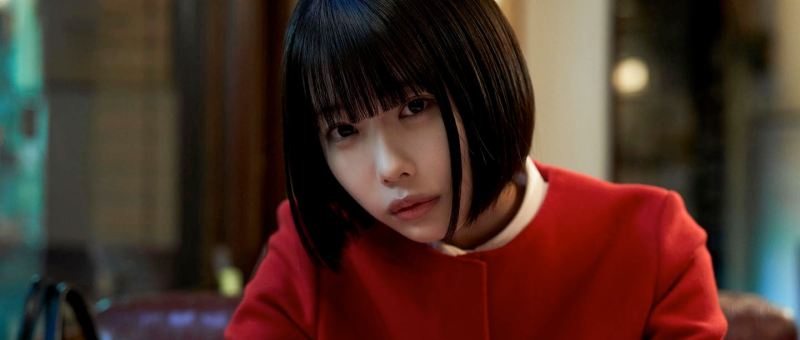
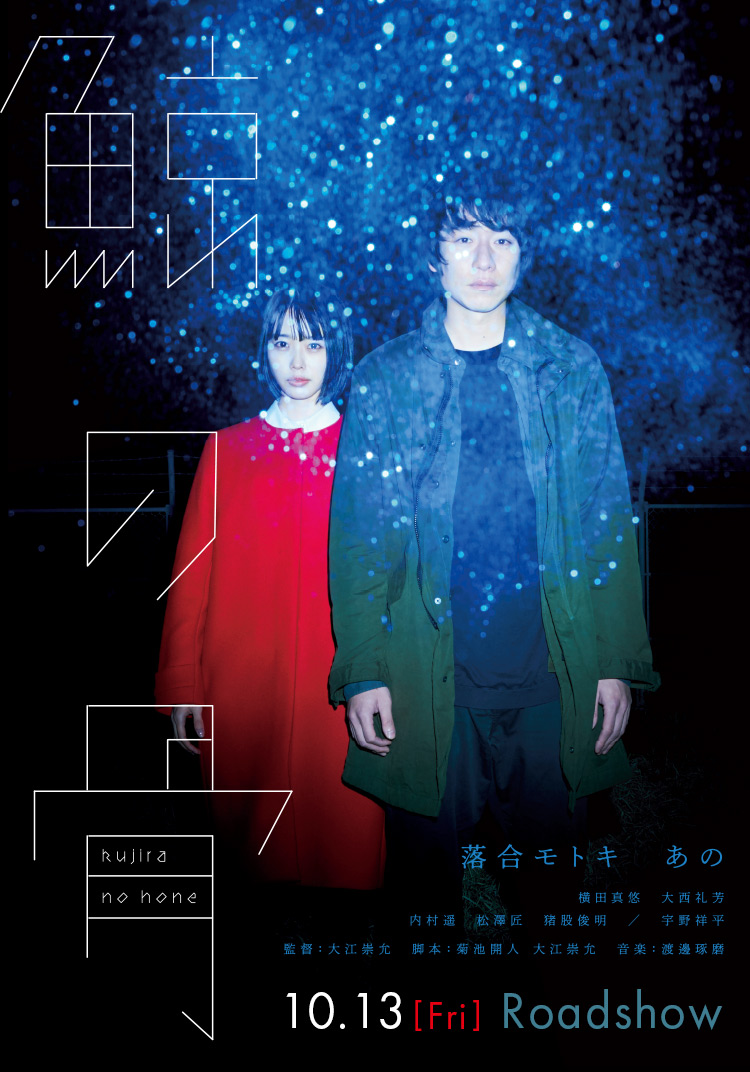
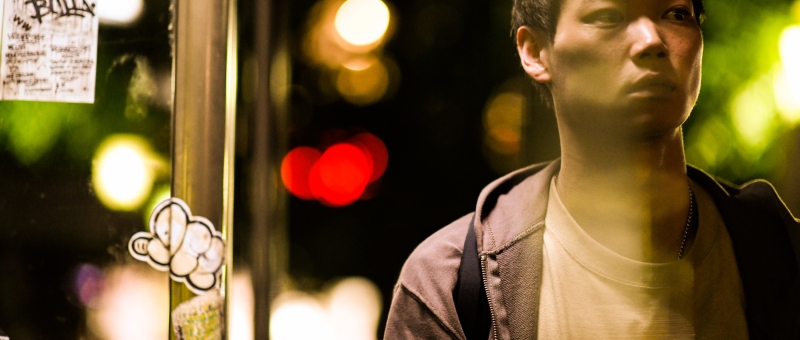
Whale Bones (鯨の骨, Takamasa Oe, 2023)

The augmented reality scavenger app at the centre of Takamasa Oe’s Whale Bones (鯨の骨, Kujira no hone) is littered with a series of digital ghosts endlessly re-enacting the past. Its selling point is that the content can only be accessed in a specific location, what its users call “holes” into which they “bury” their unpleasant thoughts, the irony being that they don’t so much rid themselves of them as ensure their survival on some other plane.

The hero, Ken, intended to bury something in a more literal sense after hooking up with a high school girl on dating app who apparently takes her own life in his apartment. Ken drives into the mountains and digs a hole, but the girl, Aska, disappears from the boot of his car leaving him wondering what exactly happened while experiencing a kind of breakdown that leads him to the Mimi app and Aska’s buried videos. In a way, he’s chasing a ghost. Trying to find out who Aska was and what might have happened her while trying to absolve himself of guilt and responsibility over her apparent death and his reaction to it. 

In a video he finds she talks about her late father and remarks that believing he’s out there somewhere gives her hope, much as her spectral existence in the Mimi app becomes a kind of beacon for the other users and bears out the way she both exists and doesn’t as a ghostly avatar of a constructed online identity. Rin, one of her followers, explains that Mimi started as a venting app where people threw away all of their unkind thoughts but quickly gave rise to a small, cult-like community of mutually supportive digital archaeologists intent on digging up all Aska’s holes as if attempting to excavate her identity. 

Of course, Ken has a different reason for wanting to dig up Aska and his quest is also an act of self-preservation. Before hooking up with Aska, he’d been jilted by his fiancée and was perhaps wounded and resentful, though his decision to take a high schooler back to his apartment in the first place doesn’t cast him in a very good light nor does his subsequently shady behaviour though it’s true enough that he begins to wonder if Aska was ever really “real” in the first place or some kind of digital ghost. People around him seem to just disappear, there one minute and then not, but then in a later moment of irony he realises the person he’s chasing is merely hiding rather than having blinked out of existence.

Ken’s work friend also fears that he will “disappear” from the office, becoming yet another soulless drone even as his obsession with Aska grows and his metal heath declines. It may be that he too is a ghost, trapped in the past and unable to move forward while feeling sorry for himself about his broken engagement. An attempt to explain his situation only raises the suggestion that perhaps he himself is an author of this mystery rather than its victim, which as his ex Yukari points out is his preferred way of seeing himself. In any case, what he’s confronted with is the dualities of the “real” and “digital” worlds in the way we become different people, burying parts of ourselves in hastily dug holes in an attempt to paper over the cracks in our lives.

These tiny fragments are themselves like the whalebones of the title, feasted over by tiny creatures who scuttle away as the soon the glittering stops and a new day begins. Oe lends his constructed reality a note of noirish eeriness in Ken’s ghostly quest for the “real” aska while hinting at the contradictory nature of social media which can at times be cruel and hateful, a place to spill bile forgetting that there are real people on either side, and also spark genuine connections among lost and lonely people looking for comfort and community otherwise unavailable to them. As Aska had said, thinking that her father was out there somewhere gave her hope, echoing the way that our digital ghosts may survive us but also provide a comforting sense of permanence in a transient and lonely world.


Whale Bones screens in New York July 14 as part of this year’s JAPAN CUTS.

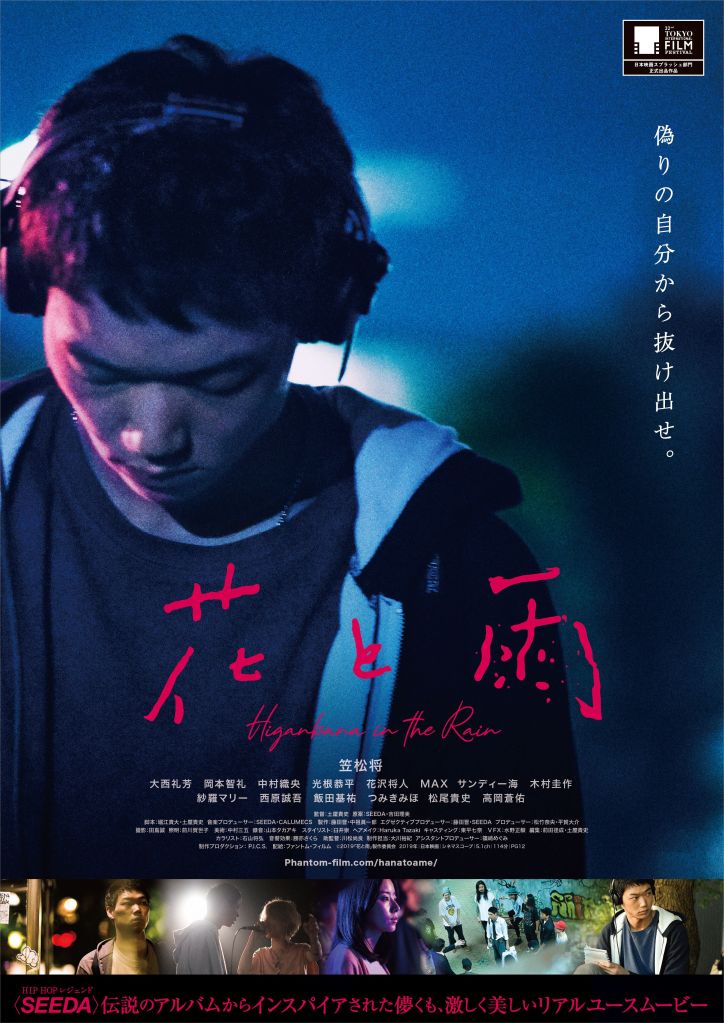
Flowers and Rain (花と雨, Takafumi Tsuchiya, 2019)

A troubled young man seeks fulfilment in hip hop glory but his self-involved insecurities frustrate his dreams in Takafumi Tsuchiya’s stylish coming of age drama Flowers and Rain (花と雨, Hana to Ame). Inspired by the album of the same name by real life rapper SEEDA, Tsuchiya’s film finds its conflicted hero consumed by a sense of internalised rage and cultural displacement as he struggles to find his place in conformist Japan after a childhood spent abroad realising only too late that he was not the only one struggling and that his self-absorbed inferiority complex has cost him dearly. 

Hakuhiro (Sho Kasamatsu) spent his early childhood in London where his father was working at the time. Whilst there, he was sadly subject to common racist microaggressions from other children who tried to put him down by showing off to their friends with ugly playground chants. Nevertheless, Hakuhiro and his older sister Saki (Ayaka Onishi) profess that they prefer living in the comparatively less stressful UK than in conformist Japan and it is indeed Saki who seems to have the most difficulty when they are forced to move back after the financial crisis. She is determined to return to the UK for university, but as we later see ultimately remained in Japan. Hakuhiro meanwhile has become a sullen and distant teen, bullied by the high school delinquents for being a returnee student. He gives them the same treatment as he gave the playground bullies, ignoring them until he is able to ignore them no more. Mostly he just keeps to himself, listening to hip hop on cassette via his retro walkman and vintage headphones. 

Hakuhiro dreams of becoming a top rapper by rapping in English, but a small circle of likeminded friends including a fellow high school student, Aida, are unconvinced. Though he actually comes from quite a wealthy family and still lives at home supported mainly by his parents, Hakuhiro wants to rap about the same things as his heroes such as street life and social oppression, none of which rings true to those around him who are painfully aware that he is somewhat uncomfortably appropriating the struggles of others and pretending to be something he’s not. He blames his friend Aida for his lack of success in not writing good enough beats for his words and Japan as a country for failing to “get” true hip hop. His sense of insecurity eventually tips over into belligerent arrogance that sees him taken in by an unscrupulous promoter who allows him to humiliate himself during a live rap battle with his high school bullies resulting in the probable end to a credible career as an underground rapper. 

To get more experience of what he sees as “the life”, Hakuhiro has also gotten himself involved with drugs firstly by growing cannabis and then by trafficking cocaine on behalf of a shady street gang. His relationship with his family has obviously suffered and though he’s nominally gone back to uni he doesn’t seem very invested in his studies. Saki, herself troubled in repeatedly failing to pass the final exams for her MBA, tries to talk some sense into him but Hakuhiro repeatedly fails to notice that she is also in distress and trying to tell him something important. A brush with the law pushes him back towards the straight and narrow, but does not exactly humble him and he is still blind to the various ways in which his self-absorbed and arrogant behaviour ruins his relationships and with them his chance of ever making it in the music business. 

Only tragedy finally awakens him to his failings. As Aida had tried to tell him, his problem was a refusal to face reality as reflected in the inauthenticity of his lyrics. If he wants to make it as an artist he’ll have to face himself from a position vulnerability and give up the macho posturing of his adolescence for something a little more “real”. Drawing inspiration from SEEDA’s life and music, Tsuchiya is unafraid to allow his hero to appear unsympathetic even while emphasising the lingering traumatic echoes of a sense of displacement and rejection that prevents him from stepping into adulthood with a fully formed identity, but eventually allows him to find a sense of peace in art even if too late to repair fractured relationships with those he loves.


Flowers and Rain streamed as part of this year’s online Nippon Connection Film Festival.

Original trailer (no subtitles)

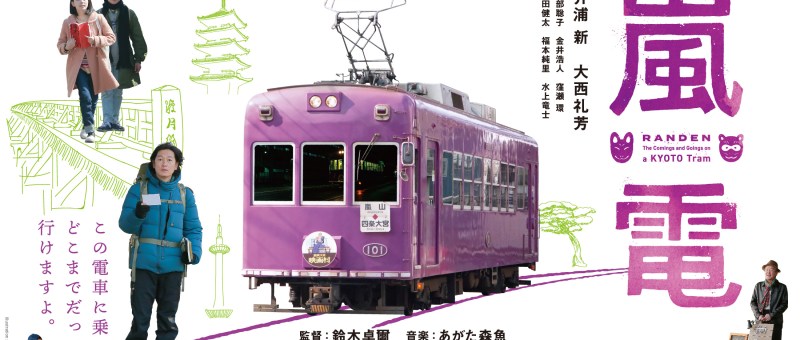
Randen: The Comings and Goings on a Kyoto Tram (嵐電, Takuji Suzuki, 2019)

Randen posterStill running over a century later, the Randen tram line is the only one in Kyoto and connects a series of Japan’s most popular tourist destinations in the famously “historical” city. It is also, of course, a key method of public transportation much loved by locals. Randen: The Comings and Goings on a Kyoto Tram (嵐電, Randen) fits neatly into that subgenere of Japanese films which might as well have been funded by the tourist board, but even so has real affection for its anachronistic street cars as they traffic a series of romantically troubled souls towards the places they need to be with a little help from the supernatural.

Chief among them, Eisuke (Arata Iura) is a blocked writer specialising in real life strange tales. He’s come to Kyoto, rich with culture and history, in search of local mystery but finds himself preoccupied with thoughts of home and the Kyoto-born wife from whom he fears he may have grown apart. Meanwhile, Kako (Ayaka Onishi), a painfully shy woman working in a bento shop finds herself unexpectedly sucked into the world of showbiz when she is persuaded to help a Tokyo actor, Fu (Hiroto Kanai), run lines in a Kyoto accent. Back on the platform, high school girl Nanten (Tamaki Kobuse), on a school trip from Aomori, falls for aloof high school boy Shigosen (much to the consternation of her friends) but unfortunately for her trains are “everything” for him.

Mimicking the linearity of the tramline, Randen takes us through three ages of love with three variously troubled lovers each trying to find the right stop. Teenagers Nanten and Shigosen struggle with their feelings in the normal way. She is certain, he (more romantic than he seems) is not – denying his feelings in the anxiety that requited love evaporates where the suffering of unreciprocated attraction does not. Kako, meanwhile, is struggling with quite different issues in that she lacks self confidence and has decided she’s no good with people. She rebuffs Fu’s straightforward attempts at romance out of shyness and confusion, unable to parse his non-committal replies and wondering if he finds her line of questioning irritating, in which case why is hanging around with her. Eisuke, meanwhile, does something much the same as he recalls a “failed” trip he took with his wife to Kyoto sometime ago and ponders the various ways each of them will change in the time they are apart.

Through it all, the rail station cafe owner (Ryushi Mizugami) is there to dispense his wisdom and knowledge of the city. Picturesque as it is, the tramline is also pregnant with local superstition – the teenagers believe catching sight of the “Yuko” train and its distinctive retro livery means a couple will stay together, while accidentally catching sight of a train staffed by kitsune and tanuki will lead a couple to part. Superstition is as superstition does, but there may indeed be some truth in it if only as a self-fulfilling prophecy. The presence of the contrary trains does, however, prompt true emotions to the surface if only to avoid a negative outcome born of getting on the wrong train at the wrong time and ending up in an unwelcome romantic destination.

Sometimes the train takes you where you want to go, and other times you need to get off and rethink. Shigesen bought his camera to film the things he likes, but worries now it’s more that he likes the stuff he films. There might be room in his heart for something other than trains, but he’ll have to put the camera down for a minute to find out. Nanten’s friends busy themselves the touristy stuff – the Jidaigeki movie theme park and putative trips to feed monkeys, but for her Kyoto is the city of love and she doesn’t want to leave it without fulfilling her romantic destiny. A loving tribute to the iconic, appropriately historical, method of mass transit and to the charmingly, picturesque town itself, Randen: The Comings and Goings on a Kyoto Tram exists at the intersection of past and present as its conflicted lovers make ghosts of themselves riding the tram into eternity and fading into the city as just another part of local history, running the lines forevermore.


Randen: The Comings and Goings on a Kyoto Tram was screened as part of Japan Cuts 2019.

Original trailer (English subtitles)

Initiation Love (イニシエーション・ラブ, Yukihiko Tsutsumi, 2015)

initiation loveMost romantic comedies don’t come with warnings about twist endings and a plea not to give them way, but Initiation Love (イニシエーション・ラブ) is not your average romantic comedy. Set in the early bubble era, Yukihiko Tsutsumi’s double sided feature is itself a wry look at the problematic nature of nostalgia. Harking back to a perhaps more innocent era in which lack of political and economic turmoil left plenty of time for romantic confusion coupled with the corruption of the consumerist dream, Initiation Love pits innocent romance against cynical success but subtly suggests that grown up love is a kind of compromise in itself.

Side A: In the summer of 1987, Yuki Suzuki (Kanro Morita) – a geeky, overweight young man who is shy but has a kind heart, is unexpectedly invited to a college drinking party where he earns some major white knight points for interrupting the increasingly inappropriate grilling of new invitee Mayuko (Atsuko Maeda). Mayuko is pretty, sweet, and cute if in a slightly affected way. She is way out of Suzuki’s league, but later confesses that she’s looking for someone a bit different, like Suzuki, an awkward-type who won’t lie to her or play around. Bonding over a shared love of reading, the pair grow closer, Mayuko rechristens Suzuki “Takkun”, and he vows to spruce himself up to become “worthy” of her.

Side B: Takkun (Shota Matsuda), now slim and handsome, is given a surprise promotion to Tokyo. Rather than suggest marriage or that Mayuko come with him, he settles on long distance and promises to come back to Shizuoka at weekends while waiting to be approved for a transfer back home. In Tokyo, however, Takkun’s personality begins to shift. Seduced by city sophistication and the promises of an elite salaryman lifestyle, Takkun draws closer to upper-class career woman Miyako (Fumino Kimura) whose jaded straightforward confidence he regards as “grown up” in contrast to the innocent charms of Mayuko waiting patiently at home.

The overarching narrative is provided to us via a melancholy voice over and accompanied, in the manner of a classic mix-tape, by a song from the era which is deliberately on the nose in terms of its aptness – a song about giving up on summer just as the couple are stuck in a traffic jam on the way to the beach and about to have a gigantic row, or a song about lucky chances coming up on TV just as our hero is plucking up the courage to allow himself to be bamboozled into going on a date with the girl of his dreams. The carefully placed positioning of the songs reminds us that we are inside someone’s carefully curated memories. Just as Takkun’s vision of Mayu-chan is one surrounded by flowers and light, the early days of romance are a condensed and romanticised version of real events seen entirely from one perspective and coloured with the gradual fading of time. Nostalgia is an unreliable narrator, recasting real life as Hollywood fiction.

The warm and fuzzy glow of Side A is undercut by the subtly questionable actions of Mayuko and our own prejudices about why she might be with a guy like Takkun. Self-consciously cute, Mayuko makes needling suggestions – dress better, get contacts, learn to drive, which, objectively speaking, might all help Takkun to gain some much needed confidence if only he were not doing all of them solely because he fears losing a woman like Mayuko. If Mayuko wanted a guy she could remake and boss around, she might have come to the right place but she does, at least, also try to insist that she likes Takkun anyway and so any changes he makes to himself will make no difference to her.

Side B, by contrast, turns the dynamic on its head as Takkun’s Tokyo persona becomes increasingly violent, resentful, and cruel while Mayuko seems genuine, innocent, and hurt by the increasing distance between herself and the man she loves. Seduced by city sophistications, Takkun leans ever closer to dumping the innocent country bumpkin, a love he has now outgrown, for a leg up into the middle-classes by marrying the elegant daughter of a wealthy Tokyo businessman. He is, however, torn – between the nostalgic glow of first love’s innocence, and the realities of adult life, the certain past and the uncertain future.

This is the philosophy ascribed by Miyako (apparently given to her by her own first love) that the first failed romance is a crucial part of growing up, an “Initiation Love” that breaks your heart by revealing the idea of true love as a romantic fallacy, allowing you move into the adult world with a degree of emotional clarity. A sound idea, but also sad and cruel in its own way. The final twist, offered as a cynical punchline, can’t help but feel cheap, carrying mildly misogynistic undertones dressed up as a kind of joke aimed at cowardly men who are incapable making clear choices and refuse to see their romantic partners as real people rather than the self created images of them they maintain. Takkun remains torn, between past and future, town and country, old love and new but nostalgia is always a trap – a false impression of a true emotion that impedes forward motion with a promise of a return to something which can never be delivered.


Screened as part of the Japan Foundation Touring Film Programme 2018.

Screening again:

  • QUAD – 10 February 2018
  • Brewery Arts Centre – 2 March 2018
  • Filmhouse – 9 March 2018

Playlist: Side A

Yureru Manazashi (Kei Ogura)

Kimi wa 1000% (1986 Omega Tribe)

https://www.youtube.com/watch?v=MeEEOrOFYuw

Yes-No (Of Course)

Lucky Chance wo Mo Ichido (C-C-B)

https://www.youtube.com/watch?v=zUzkzxGR9sw

Ai no Memory (Shigeru Matsuzaki)

https://www.youtube.com/watch?v=OHX1d6sObf4

Kimi Dake ni (Shonentai)

https://www.youtube.com/watch?v=KlLcKJL6jeE

Side B:

Momen no Handkerchief (Hiromi Ota)

https://www.youtube.com/watch?v=ylF3dNFrAio

Dance (Shogo Hamada)

https://www.youtube.com/watch?v=LX6Kx-NWy0o

Natsu wo Akiramete (Naoko Ken)

Kokoro no Iro (Masatoshi Nakamura)

https://www.youtube.com/watch?v=JXqwzYXMDLc

Ruby no Yubiwa (Akira Teruo)

https://www.youtube.com/watch?v=HgLaQKp8EaA

Show Me (Yukari Morikawa)

https://www.youtube.com/watch?v=7DzpcRHsIWg