
Seaside Serendipity (海辺へ行く道, Satoko Yokohama, 2025)

As we follow the road that leads down to the beach in the presence of a black cat, there’s a sign at the beginning of Satoko Yokohama’s Seaside Serendipity (海辺へ行く道, Umibe e Iku Michi) that lets us know that this town welcomes artists. Adapted from the manga by Gin Miyoshi, the film is another in the idyllic summer adventure genre with its tranquil, almost magical setting that even one of its temporary residents describes as somehow different from other places, but also contemplates the nature of art and its ability to influence the environment. 

This is certainly a very creative place where strange things happen and people mostly seem to do their own thing. Then again, Risako (Ayame Goriki) rents out apartments to artists looking for quiet retreats to practise their art in a peaceful environment but mainly ends up with those arriving for other reasons whose “art” is more like subterfuge. A young couple arrive running a bizarre scam selling fake knives that won’t even cut tofu after a couple of days. A stone sculptor she ends up dating is on the run from a loan shark, who just happens to be an old friend who said her job was in “sales” rather than admit she works as a debt collector chasing failed artists who always have an excuse as to why they can’t pay or haven’t yet produced anything.

A mysterious man gives Megu (Koharu Sugawara) a canary-shaped whistle that’s supposed to chirp in the presence of a true artist and make an unpleasant noise in the case of a false one. But as the kids eventually put it, all artists are self-proclaimed. The only requirement for calling oneself and artist is that you make something you consider to be “art” even if others disagree. Art can take many forms, as in the weird structure Ryoichi (Toma Nakasu) constructs made out of all the spoons he’s bent in his life. Sosuke (Kōnosuke Harada), meanwhile, attracts the attention of another mysterious man calling himself “A” who commissions him to make a model of a mermaid from a painted scroll. Sosuke dutifully makes it with a few additions such as the ability to remove the mermaid’s left breast and extract her heart. A interprets this as an expression that one cannot hide anything in art, whether things about themselves the artist wanted to conceal or things that they simply did not know. 

But Sosuke’s friend Teruo (Shun Aoi) also lets him in on the idea of mimesis, that they aren’t trying to reproduce something exactly as it appears but understand its true essence and recreate that. Teruo uses the art of mimesis to create a realistic mask modelled after the late husband of an elderly woman who says that it was foretold to her in a dream that he would come to her on her birthday. Though it might be a questionable gesture, he did it out of a desire for her dream to be true and to bring comfort to a lonely person whose family were unable to communicate with her, perhaps because they did not have the ability to lipread as Teruo apparently does. Nevertheless, they accuse him of stealing her money, insulting the purpose of his art. 

The art club’s art is also misused in a way when Ritsuko bizarrely asks them to create a hole she can say her boyfriend used to escape, like in a cartoon. This appears to be the sort of place where one can get away with such a ridiculous conceit. Trying to tell the truth, meanwhile, backfires for an aspiring journalist who uncovers suspect goings-on at the local nursing home where a nurse forces elderly people to sing songs out in the summer heat and prevents them from eating lunch as a means of staving off dementia. When her teacher leaks the video she recorded to social media, she’s annoyed to have missed the scoop and also that the teacher didn’t investigate properly opting for mob justice instead. The young woman worries the nurse may kill herself because of what she uncovered which is perhaps only a version of the truth. Meanwhile, everyone else is hot on the trail of mysterious animals appearing in the town that are somehow repelled by Teruo’s mystery art project. Even so, everything continues as normal in this strange little town as Sosuke pursues his artistic dreams painting tranquil visions of peaceful destruction from the deserted jetty, seemingly paying it no mind.


Seaside Serendipity screens in Chicago March 22nd as part of the 20th edition of Asian Pop-Up Cinema.

Trailer (English subtitles)
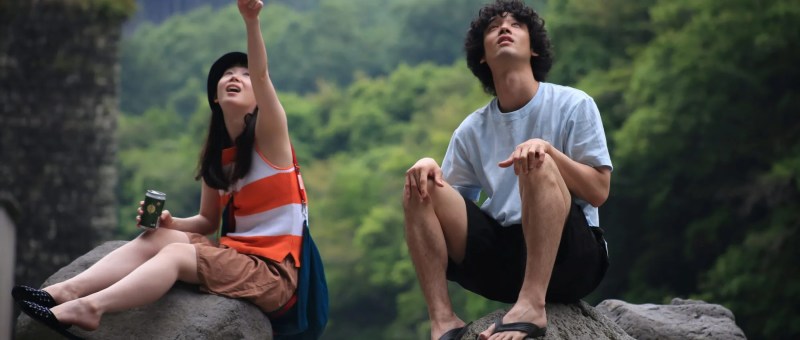
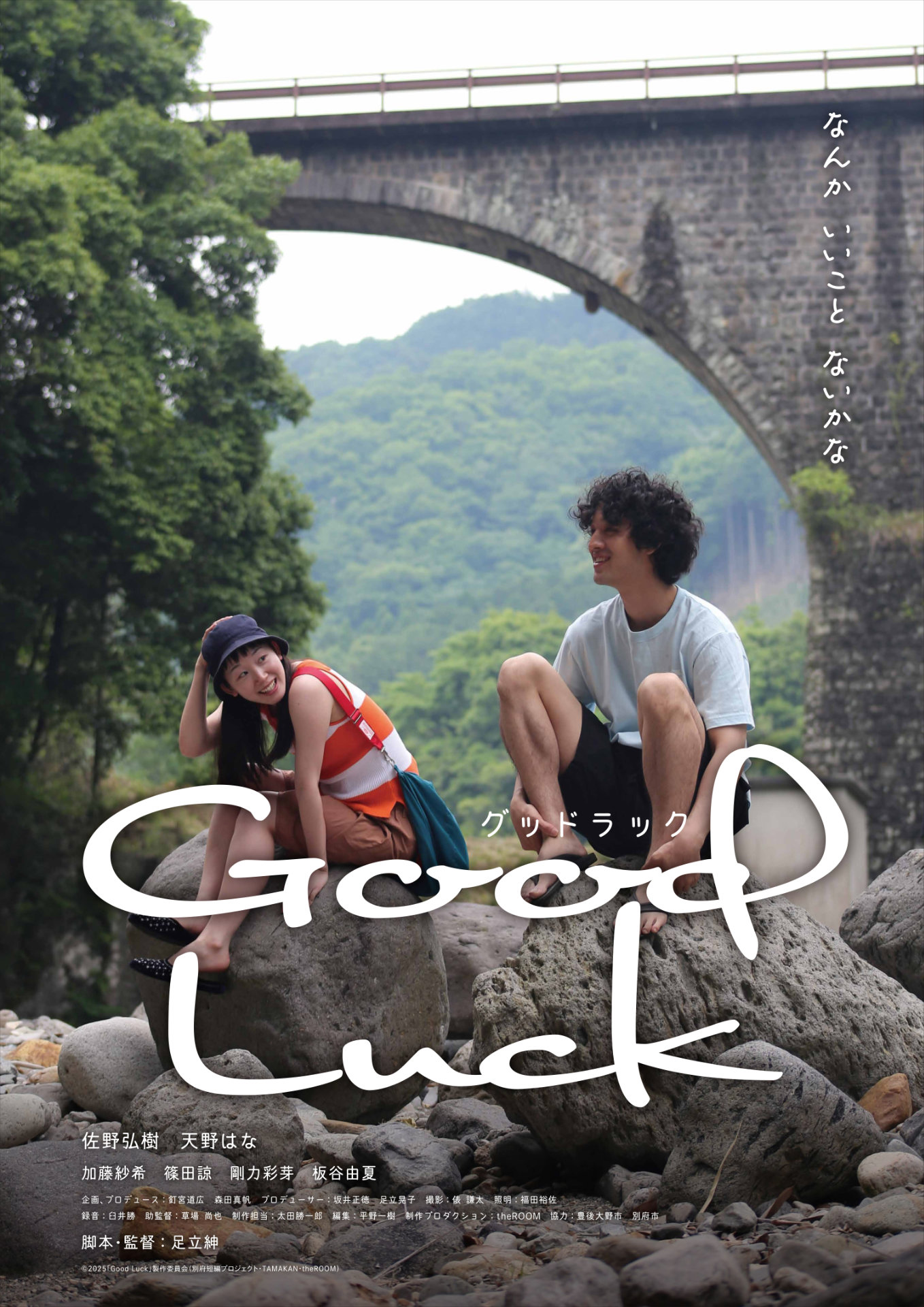
Good Luck (グッドラック, Shin Adachi, 2025)

Taro’s (Hiroki Sano) problem as far as he sees it, is that he lacks self-confidence and is unable to understand why other might like him, though he fears few do. That’s especially true of his girlfriend/financial backer Yuki (Saki Kato) about whom he makes a short documentary because he thought it would be good to make a film about the person who’s most important to him. But Yuki fires back that the person who’s most important to him is himself, so he should turn the camera around, but that’s exactly what he doesn’t want to do even if the film is really about himself anyway. 

To that extent the film backfires in that, when he’s unexpectedly invited to a festival in Beppu and and convinced by Yuki to go because she’s irritated by just how little effort he seems to put in, all anyone can talk about is Yuki who they say must love him very much or at any rate has a lot of patience and understanding. This is doubly true of the lady running the Bluebird Theatre who says out loud live during the Q&A that his film was boring, and she only chose it because of the contrast between how mediocre the film was and Yuki’s force of personality. She suggests that Taro doesn’t know what sort of films he wants to make, or even why he’s making them in the first place, and she’s right.

Awkwardly, this sense of confusion seems bound up with his relationship with Yuki which is unbalanced in his mind because she asked him out rather than the other way round. As he tells Miki (Hana Amano), an extremely extroverted young woman with an amazing laugh that he meets on his travels, his biggest regret in life is not being able to tell he girl he liked that he liked her in high school. This indecision and lack of confidence have left him directionless in his film career and uncertain in his relationships while it seems clear Yuki is not really his muse despite what others might say about her star quality if only by virtue of how sorry they feel for her for having to put up with Taro.

But then again, he’s basically swept away Miki too who hijacks his last couple of days touring the saunas around the hot springs resort. She explains that she likes to travel alone because she difficulties interacting with other people, though she gets along much better with strangers which is why she clicks so quickly with Taro even if he’s only hanging out with her by virtue of being too polite/spineless to decline her invitations. The pair end up echoing Before Sunrise in their walking tour of the natural attractions of the area, while Miki tells him that her biggest regret in life is that she hasn’t achieved anything that society values even if there are things that she’s good at and fears that she won’t be able to do the things that she wants to do before she dies. 

Truth be told, Taro doesn’t really do much for Miki or ask any real followup questions while simultaneously beginning to fantasise about her as recounted through an incrediblely meta sequence taking place in his treehouse room. Nevertheless, he begins to see in her the kind of muse he’s been looking for along with discovering why he wants to make films and what kind of films he wants to make. But in then in true Adachi fashion, maybe Taro is just as superficial as he says he is and later drawn to another pretty woman on a train all while not making that much of an effort to get back to Yuki whose father has had a heart attack to which Taro seems mostly indifferent. There are certainly lots of strange women around Taro from the gloomy innkeeper in Beppo to the gaggle of ladies at a shrine convinced he’s an old high school friend, but as much as he has a talent for encountering the surreal, Taro doesn’t seem to know what to do with it and remains a somewhat passive observer to afraid to voice his feelings, simultaneously making films only about himself that nevertheless express nothing of his own soul.


Good Luck screened as part of this year’s Camera Japan.

Trailer (no subtitles)

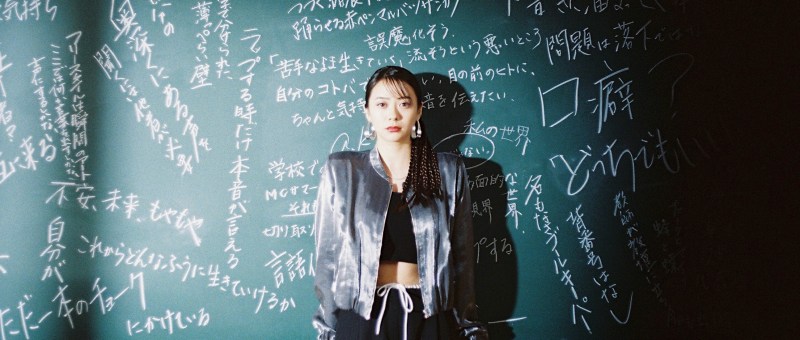
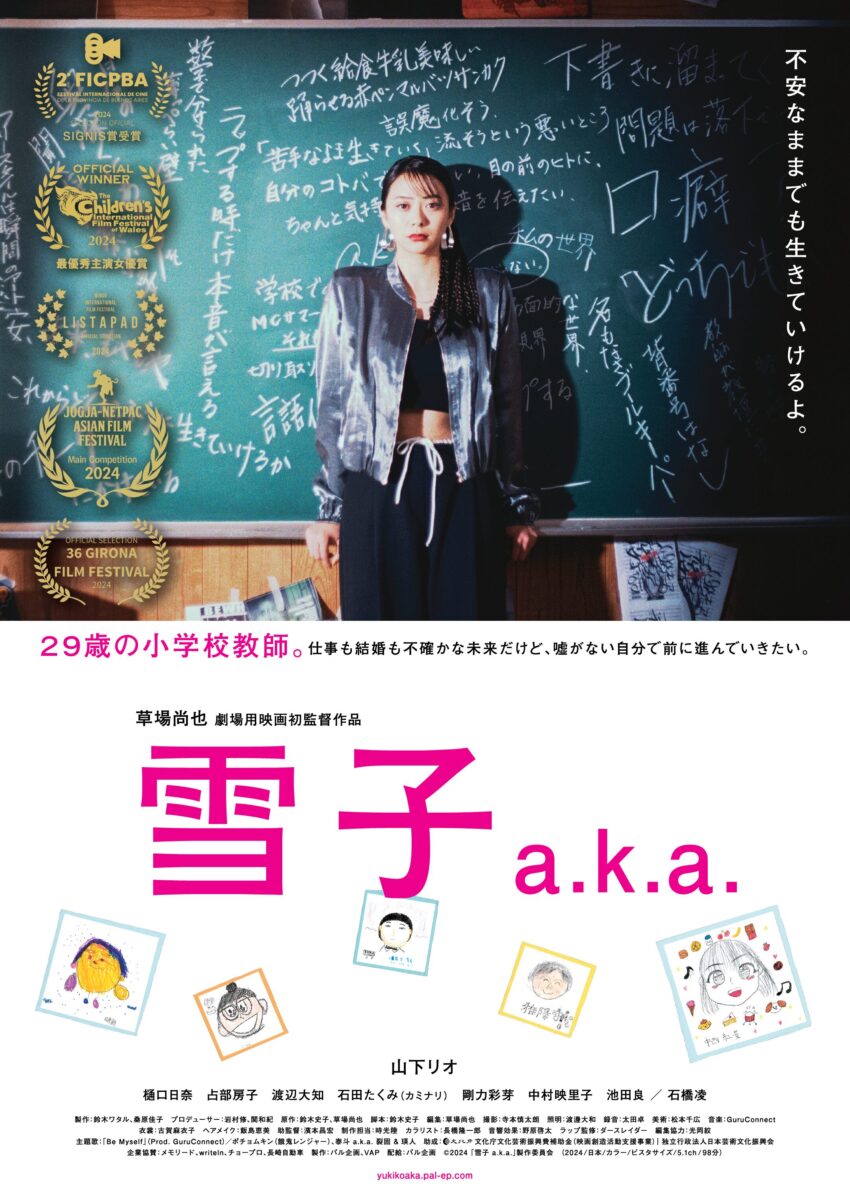
Yukiko a.k.a (雪子 a.k.a., Naoya Kusaba, 2024)

“Leave no one behind,” is the theory underpinning the SDGs that primary school teacher Yukiko (Rio Yamashita) is teaching to her students, but it’s also a practice that she unconsciously puts into practice only largely tends to forget to include herself. Timid and insecure, she makes little mark on the world around her and is afraid to express herself which she fears also interferes with her ability to interact with the children worrying that her reticence to speak up because she’s too worried they’ll say it’s all her fault prevents her from asking them if they’re alright or they need any help or guidance. 

It’s only through the possibly surprising hobby of rap music that she finds an outlet where she can be herself and say everything that’s on her mind, only most of her raps are all about her anxiousness and inability to communicate. She has however found a supportive community in a local park where there are a group of rappers who seem to have her back and encourage her to get more into the hobby by participating in rap battles so she can express herself more. It seems though that part of her anxiety stems from a sense that she’s approaching a crossroads in life and is in many ways dissatisfied. She’s been in a long-term relationship with another teacher, Kodai (Daichi Watanabe), she met when they were both students but as he’s been assigned to another school a long way away, they only meet up at weekends.

All around her, her friends are getting married and it seems Kodai may also be ready to pop what seems to most an inevitable question, but there’s something that seems to be holding her back. Kodai later tells her that he doesn’t like the her that does rap, which suggests in a way that he doesn’t really want the version of her that can express herself or is confident in saying what she does and doesn’t want. He’s much more interested in the timid Yukiko who meekly goes along with what he wants and is too afraid to rock the boat. A fellow teacher, Riho (Hina Higuchi), has an ambition to be married with a child before 30, which is surprising to Yukiko and often criticised for being old fashioned. Yet what the film seems to insist is that neither perspective is wrong, merely different, and largely a matter of what suits each individual. Riho is cool in her own way for living her life the way she chooses even if it conflicts with the prevailing attitude of the contemporary society and it’s this sense of empowerment that Yukiko is really seeking as an older teacher, Ohsako (Fusako Urabe), explains. With her short hair and serious demeanour it might be assumed that the kids wouldn’t like Ohsako, but she’s actually their favourite and perhaps precisely because of her self-assuredness. In contrast to the ultramodern Riho she likes to hand write and draw her teaching materials as a means of transmitting sincerity and integrity to the children while acting as a voice of authority between the teachers. 

Indeed, it’s Ohsako who largely teaches the film’s lessons and Yukiko how to embrace herself so that she can communicate better with the students explaining that her ability to pick up on the same anxieties in them is much more valuable than anything else. Locking eyes with a distressed young girl during a PE lesson, she quickly figures out that she’s experiencing menstrual cramps and is able to take her to the nurse’s office for some positive help and support. Meanwhile, she struggles with two boys in her class one of whom has become a school refuser and hikikomori. She visits Rui at his home every week with handouts but fails to make a breakthrough until she too is brave enough to expose her own fears and doubts. His deskmate Kotaro is now forced to join in with the girls either in front or behind when they’re asked to do pair work because of the painfully empty seat next to him.

But then unbeknownst to Yukiko, times have changed. Rui is not completely isolated but has been communicating with his friends, including Kotaro, through video games which as Kotaro’s father says is just as real to the children as talking in person. He’s also got really into educational apps and might have actually learned more by himself at home, which isn’t great for Yukiko’s self-esteem but at least he’s doing alright even if she might be becoming obsolete. Meanwhile the school still insists on making the kids read out loud to their parents who are then supposed to fill in a comment sheet but Kotaro writes those himself because his mum’s too busy. Nervously challenged by Yukiko, Kotaro’s mother asks what the educational point of the exercise is. She says she has her own way of communicating with her son and doesn’t have time for this meaningless bit of form filling. Yukiko’s insistence that it’s only 10 minutes belies a lack of understanding that Kotaro’s mother, who seems to be a working lone parent, simply doesn’t have another 10 minutes in her day. Still, the point is that Yukiko doesn’t really know the educational point of the exercise but has only been doing it because it’s what you do without giving it any real thought. 

But as Ohsako had said, maybe neither way is wrong, it’s just a matter of personal taste. Through her rap music hobby,  Yukiko begins to accept another side of herself while gaining the courage to be more confident and express herself more freely. She realises that it doesn’t really matter if she wins a rap battle or not because even putting herself out there was a minor victory that convinces her she has the power to do things with her life and live it in a way that best suits her while teaching similar lessons to the children and finally listening to her own advice.


Yukiko a.k.a screens in Chicago 22nd March as part of the 19th edition of Asian Pop-Up Cinema.

Trailer (English subtitles)