The Brightest Sun (時には懺悔を, Tetsuya Nakashima, 2025)

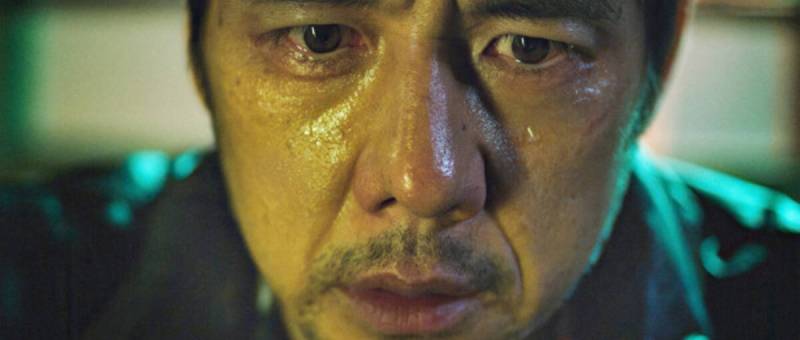
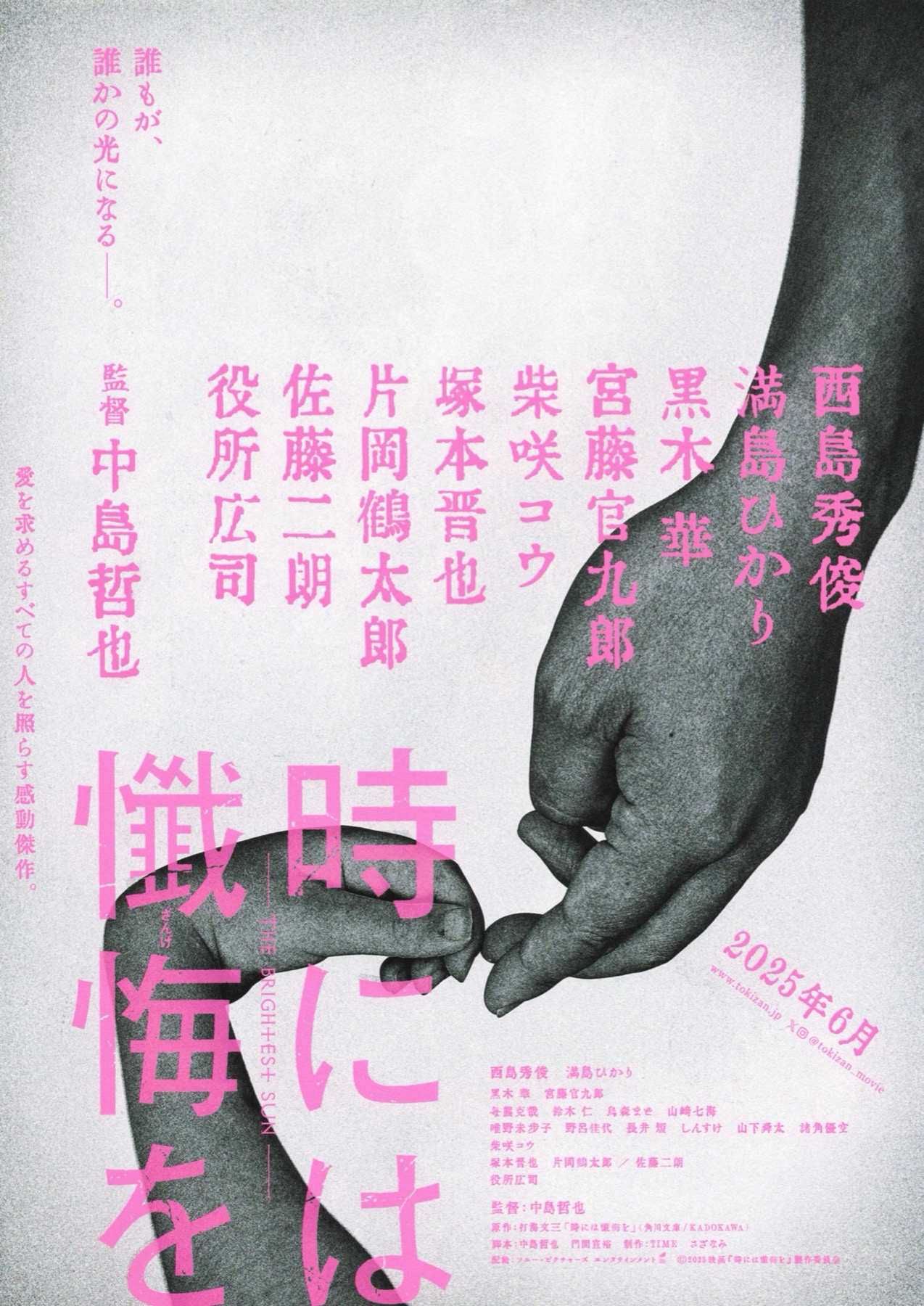
Tetsuya Nakashima’s more recent films have often dealt with more controversial subjects. His latest, Brightest Sun 時には懺悔を, Toki ni wa Zange wo), adapted from the novel by Bunzo Uchiumi and delayed from last year due to allegations made by an actress on World of Kanako that nude footage was used without her consent, is not so much a film about disability as the taboo of parental selfishness or a sense of disconnection from one’s biological children.

Nevertheless, the way the film approaches it subject matter may seem insensitive to some in that it often reduces the existence of disabled children to a burden that must be born by someone and preferably by a biological parent. Though rookie detective Satoko (Hikari Mitsushima) raises the issue of the child’s subjectivity and quality of life, others struggle to see him as anything more than an object for which someone must accept responsibility. This is doubly true for her reluctant partner, Satake (Hidetoshi Nishijima), who has taken to drink and is riddled with guilt over his ambivalent feelings regarding his own disabled son who has since passed away. His wife (Ko Shibasaki) has fallen into depression and is living in a psychiatric facility while he is seemingly incapable of caring for their teenage daughter who has become resentful of both parents, feeling as if they were unable to care for her because all their attention went to her brother while she too now feels guilty that she did so little for him and left his care entirely to her mother.

At times, the film is critical of this tendency to force women to accept full responsibility for childcare while men remain otherwise absent from the domestic space, but seems to walk this back in the closing moments. In any case, Satake’s rejection of his son is mirrored in that of Tamie’s (Haru Kuroki) husband who openly declares that it would have been better if Taku had not been born, blaming Tamie for giving birth to a disabled child. His embarrassment makes plain a lingering stigma towards disability or difference in the wider society, as if having a child he sees as imperfect reflects badly on him personally. Tamie, meanwhile, seems as if she may have been suffering from a kind of post-natal depression and is clearly affected by her husband’s resentment along with her own inability to bond with the baby. Though she witnesses her child being kidnapped, she does nothing to stop it with implication being that perhaps she is glad to be relieved of the burden. 

Satoko too has become estranged from her young daughter who struggles with the trauma of witnessing her stab her abusive husband. The implication is that this resentment is born of having seen through her mother and realised that she did not do this out of a desire to protect her, but merely out of selfish rage. The fact is that her desire to protect Shin/Taku is a displacement activity. Everyone’s actions are to one extent or another a vicarious attempt to atone for something they are otherwise unable to address in their own lives. 

This appears to have been true for the man whose murder they are supposed to be investigating, Yonemoto (Jiro Sato), who is said to have been the worst of the worst. Someone who really was “better of dead” as Satoko puts it, though we never really find out why exactly everyone had such a low opinion of him and the detective company itself does not actually seem as sleazy as one might expect. Satake suspects he may have planned to blackmail Tamie, who has since remarried and has two step-children, over the discovery of her son, but in fact he was apparently quite moved by the tender care the kidnapper provided to Shin/Taku all these years and though knowing that he should turn him in, wanted to ensure the child would continue to be well cared for. 

This is apparently where Yonemoto found the redemption centred in the Japanese title and explained in an opening title card. Satake similarly is forced to face his complicated emotions towards his son and family, trying to do the best for Shin/Taku as means of assuaging his guilt much as Satoko shifts her maternal anxiety onto Tamie. The film’s conclusion seems to undercut the idea presented by the policeman that blood ties may not be that important, having witnessed the care and devotion the kidnapper showed to a child that was not his by blood and had complex needs, in its concerted efforts to force Tamie to accept her maternity. Nevertheless, the film does its best to extend sympathy and understanding to all, suggesting that the best thing to do in this situation might have been to leave well alone, but for various reasons that won’t be possible. Opting for a noirish aesthetic, Nakashima abandons his pop aesthetics for something a little more subdued but maintains his fast-paced editing style, drip-feeding us the mystery while pondering the nature of the bonds between parents and their children.


The Brightest Sun screens as part of this year’s New York Asian Film Festival.

Trailer (no subtitles)

Seaside Serendipity (海辺へ行く道, Satoko Yokohama, 2025)

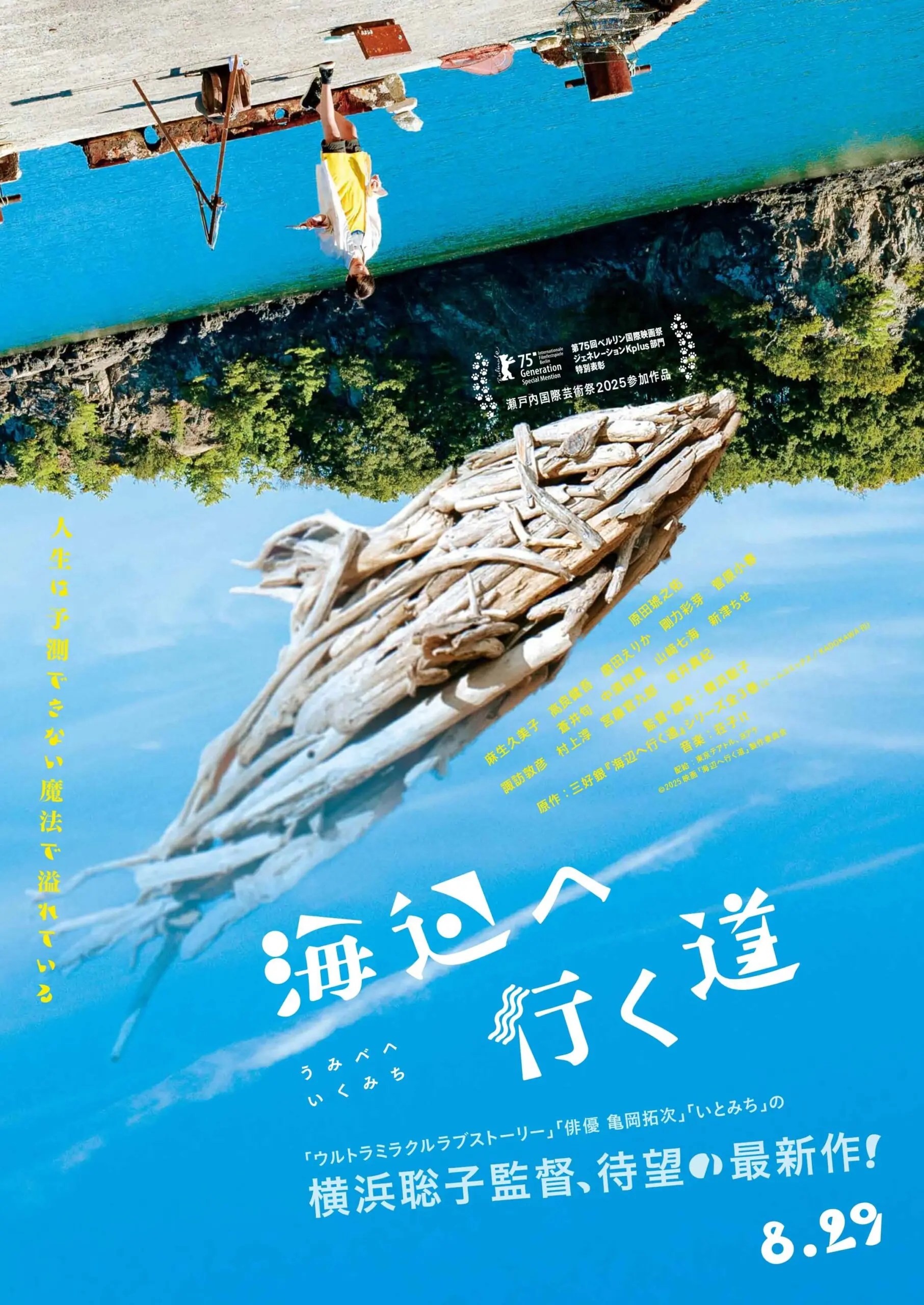
As we follow the road that leads down to the beach in the presence of a black cat, there’s a sign at the beginning of Satoko Yokohama’s Seaside Serendipity (海辺へ行く道, Umibe e Iku Michi) that lets us know that this town welcomes artists. Adapted from the manga by Gin Miyoshi, the film is another in the idyllic summer adventure genre with its tranquil, almost magical setting that even one of its temporary residents describes as somehow different from other places, but also contemplates the nature of art and its ability to influence the environment. 

This is certainly a very creative place where strange things happen and people mostly seem to do their own thing. Then again, Risako (Ayame Goriki) rents out apartments to artists looking for quiet retreats to practise their art in a peaceful environment but mainly ends up with those arriving for other reasons whose “art” is more like subterfuge. A young couple arrive running a bizarre scam selling fake knives that won’t even cut tofu after a couple of days. A stone sculptor she ends up dating is on the run from a loan shark, who just happens to be an old friend who said her job was in “sales” rather than admit she works as a debt collector chasing failed artists who always have an excuse as to why they can’t pay or haven’t yet produced anything.

A mysterious man gives Megu (Koharu Sugawara) a canary-shaped whistle that’s supposed to chirp in the presence of a true artist and make an unpleasant noise in the case of a false one. But as the kids eventually put it, all artists are self-proclaimed. The only requirement for calling oneself and artist is that you make something you consider to be “art” even if others disagree. Art can take many forms, as in the weird structure Ryoichi (Toma Nakasu) constructs made out of all the spoons he’s bent in his life. Sosuke (Kōnosuke Harada), meanwhile, attracts the attention of another mysterious man calling himself “A” who commissions him to make a model of a mermaid from a painted scroll. Sosuke dutifully makes it with a few additions such as the ability to remove the mermaid’s left breast and extract her heart. A interprets this as an expression that one cannot hide anything in art, whether things about themselves the artist wanted to conceal or things that they simply did not know. 

But Sosuke’s friend Teruo (Shun Aoi) also lets him in on the idea of mimesis, that they aren’t trying to reproduce something exactly as it appears but understand its true essence and recreate that. Teruo uses the art of mimesis to create a realistic mask modelled after the late husband of an elderly woman who says that it was foretold to her in a dream that he would come to her on her birthday. Though it might be a questionable gesture, he did it out of a desire for her dream to be true and to bring comfort to a lonely person whose family were unable to communicate with her, perhaps because they did not have the ability to lipread as Teruo apparently does. Nevertheless, they accuse him of stealing her money, insulting the purpose of his art. 

The art club’s art is also misused in a way when Ritsuko bizarrely asks them to create a hole she can say her boyfriend used to escape, like in a cartoon. This appears to be the sort of place where one can get away with such a ridiculous conceit. Trying to tell the truth, meanwhile, backfires for an aspiring journalist who uncovers suspect goings-on at the local nursing home where a nurse forces elderly people to sing songs out in the summer heat and prevents them from eating lunch as a means of staving off dementia. When her teacher leaks the video she recorded to social media, she’s annoyed to have missed the scoop and also that the teacher didn’t investigate properly opting for mob justice instead. The young woman worries the nurse may kill herself because of what she uncovered which is perhaps only a version of the truth. Meanwhile, everyone else is hot on the trail of mysterious animals appearing in the town that are somehow repelled by Teruo’s mystery art project. Even so, everything continues as normal in this strange little town as Sosuke pursues his artistic dreams painting tranquil visions of peaceful destruction from the deserted jetty, seemingly paying it no mind.


Seaside Serendipity screens in Chicago March 22nd as part of the 20th edition of Asian Pop-Up Cinema.

Trailer (English subtitles)

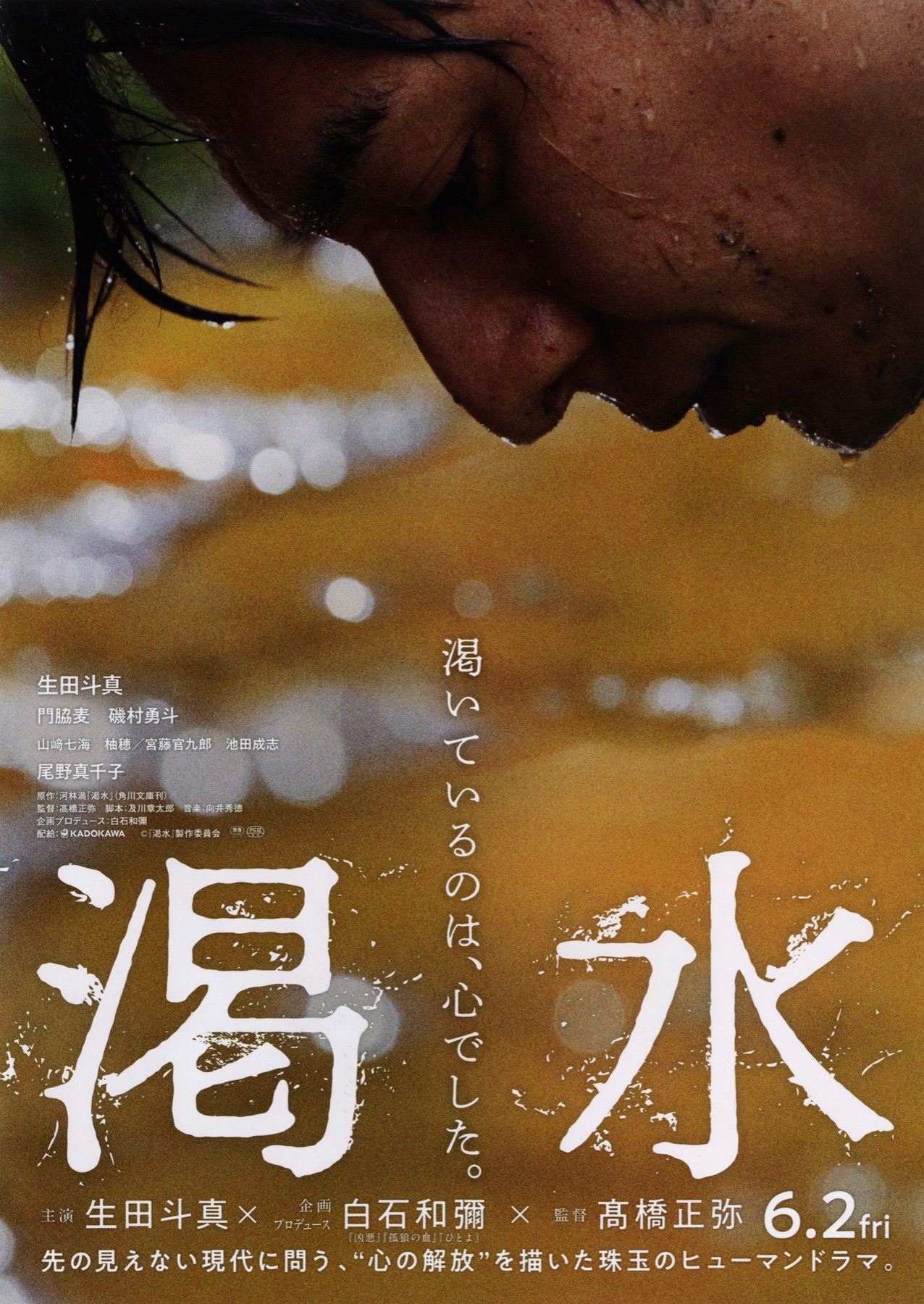
The Dry Spell (渇水, Masaya Takahashi, 2023)

A literal drought becomes a metaphor for bureaucratic heartlessness in Masaya Takahashi’s empathetic social drama The Dry Spell (渇水, Kassui). Inspired by Mitsuru Kawabayashi’s 1990 novel, the film puts a contemporary spin on prejudice and poverty as a collection of officials from the waterboard point at airconditioners and mobile phones while asking why the residents have fallen into arrears with their water payments only to reflect that yes, water like air and sunlight should be free.

The argument that one of Iwakiri’s (Toma Ikuta) colleagues makes, is that they have a right and a duty to charge for the water supply to support the nation’s infrustructure along with their advanced purifcation system which keeps people safe. Iwakiri isn’t so sure about that, but as others later say of him he’s a man who’s made of water himself. He doesn’t like his job but he doesn’t really dislike it either and justifies himself that it’s not him turning people’s water off so much as it’s a natural consequence of them not paying their bills and all they need to do to get it turned back on is settle them. But then as another colleague who eventually refuses to continue cutting people off suggests, every time you do it you lose a little piece of your soul. 

Iwakiri may not have had much of a soul to begin with. He’s as dried up as the town in the middle of a recordbreaking drought and heatwave. Having endured a difficult childhood, he’s become alienated from his wife and son who have decamped to her hometown with no clear indication of when or if they’ll return. That may be one reason he finds himself empathsithig with a pair of sisters who have been abandoned by both parents and are living alone in a house that has already had its gas and electricity supplies cut off. Iwakiri turns off their water supply because it’s the rules, but begins to hate himself for doing it and develops a desire to go against the flow for the first time in his life.

Keiko (Nanami Yamazaki) and Kumiko (Yuzuho) are a pair of water babies who have a yearning for the sea and the father who was apparently once a sailor but seemingly disappeared a year previously while their disappointed mother does her best to support the family through sex work which is as she points out the only line of work open to a single mother with limited qualifications. Iwakiri advises her to apply for benefits but she refuses on the grounds that she doesn’t want them poking around in what she describes as a complicated family situation which makes plain her predicament. But even as Iwakiri begins to meditate on his own paternal failures, his partner Kida (Hayato Isomura) flows in the opposite direction keener to hold onto his job after he learns he’s a baby on the way and unwilling to rock the boat despite how much he may also feel that water should be free. 

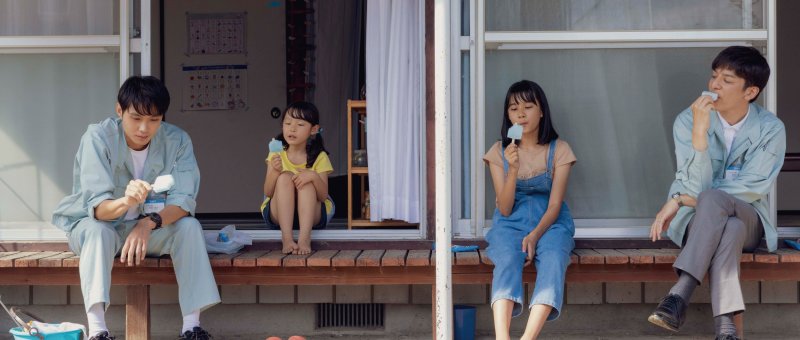
In any case, Iwakiri is trying to un-dam himself, waiting for the great big rain that Kumiko says will make everything go back to normal. Except it won’t, at least not literally  though it will in some senses open the flood gates liberating Iwakiri from his emotional repression and the girls from their illusions accepting that they are now alone but will always have each other. As he points out, they are just watermen and there’s not much they can do for the struggling people whose supplies they’ve cut off. It wouldn’t help to pay their bills for them even if they could, and in a better world water should indeed be free though it becomes much harder for them to justify their complicity with a heartless system that can arbitrarily remove access to something so essential for life. Takahashi flits between cheerful scenes of ice lollies in the sun to the cruel realities of the lives of Keiko and Kumiko who continue to long for the sea as does Iwakiri in struggling to repair his relationships with his wife and son while trying to escape the legacies of own traumatic upbringing. The film doesn’t offer any easy answers, but does perhaps suggest that the rain will bring change and the promise of a better future.


The Dry Spell screened as part of this year’s Camera Japan.

Original trailer (no subtitles)