
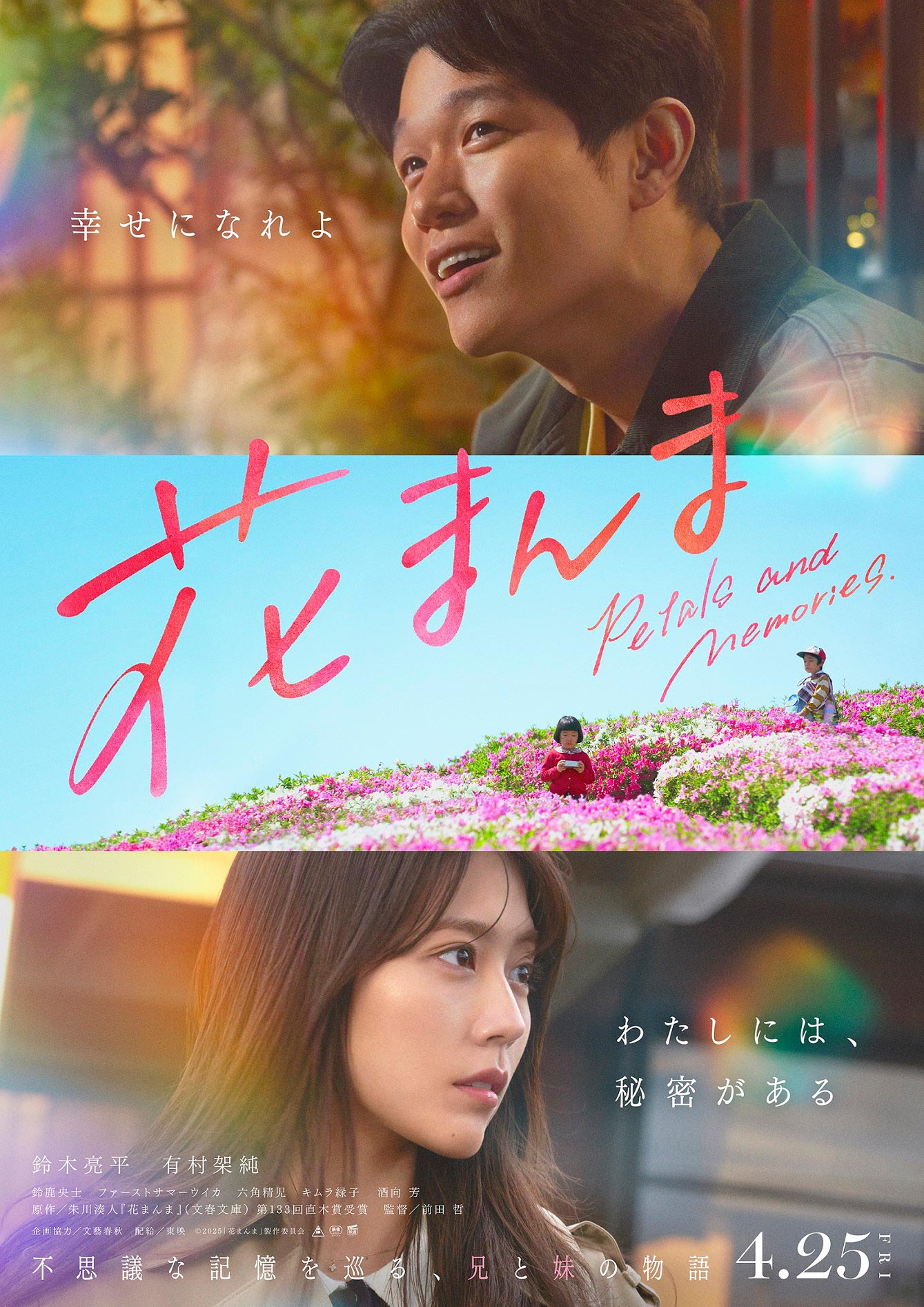
Petals and Memories (花まんま, Tetsu Maeda, 2025)

In many Japanese family dramas, there is an inherent sense of impending tragedy born of the notion that one family must necessarily be broken for another to be formed. Cultural sensibilities might insist that someone can only be part of one family at any time and any attempt to play a part in another is an act of betrayal. But reality is not so clean-cut and just because a woman gets married, it doesn’t really mean that she becomes a stranger to the people who raised her nor that they must completely sever ties with her even as they wish her well as she transitions to a new stage of life.

This is though what older brother Toshiki (Ryohei Suzuki) fears in Tetsu Maeda’s supernaturally tinged familial drama Petals and Memories (花まんま, Hanamanma). Adapted from a short story by Minato Shukawa, the story has an old-fashioned quality in which it could easily have been set back in the Showa era were it not for the fact that Kiyomi, the spirit that his sister Fumiko (Kasumi Arimura) claims to carry, was killed in the climatic year of 1995 which saw both the Kobe earthquake and sarin gas attack on the Tokyo subway. In any case, Toshiki has a distinctly Showa-era vision of masculinity and remains incredibly protective of his sister even if Fumiko has moved up in the world with her job in a university and engagement to a young professor who has the ability to converse with crows.

After their truck driver father was killed in an accident and their mother passed away in Toshiki’s teens, he’s essentially been forced into a parental position. Toshiki left school early and got a job in the factory where he still works in order to fulfil his father’s dreams of sending Fumiko to university. As such, he occasionally paints himself as a martyr and is keen to remind people how difficult it was for his mother to raise them on her own and that he’s sacrificed his future to provide for Fumiko. Her upcoming marriage is then to him a minor betrayal even if it’s also, culturally speaking, the fulfilment of his parents’ hopes for their daughter and thereby the end of his obligation.

The problem with that is Toshiki himself doesn’t have much of an identity outside of “big brother,” and is unable to see Fumiko as anything other than his little sister. When she tells him that she has memories of a previous life, he rejects them and says that he can’t bear to see his sister as “someone else”, repeatedly reasserting that she’s the daughter of his parents rather than those of Kiyomi. But Fumiko is also fiancée to Taro (Oji Suzuka) and friend to Komako (First Summer Uika). As she tries to counter him, more than anything she is simply herself which is something else Toshiki rejects in his categorisation of her only as his sister. Nevertheless, when she tells him that interacting with Kiyomi’s grieving father Mr Shigeto taught her what it was like to have a father seeing that she has no memory of her own is insensitive given that Toshiki has essentially been a father to her for most of her life. 

In clinging to his identity as a big brother, Toshiki may really be attempting to stave off his own fear of orphanhood as a man with no other family, but what he’s forced to reckon with is that his sister is “someone else” after all and not merely an extension of himself. In coming to terms with Kiyomi’s presence and extending compassion to her bereaved family rather than reacting in fear that they were trying to take his sister away from him, Toshiki begins to realise both that he didn’t actually raise Fumiko all alone but benefitted from the extended family of a community and that in her marriage his world is actually expanding rather than contracting. As the old adage goes, he’s not losing a sister so much as gaining a brother. In the “hanamanma” flower bento of the Japanese title, it becomes clear that Kiyomi’s love for her family transcended death and that she is not really lost to them even this most final parting but remains with them in spirit and memory. 


Petals and Memories screens as part of this year’s Japan Foundation Touring Film Programme.

Trailer (English subtitles)
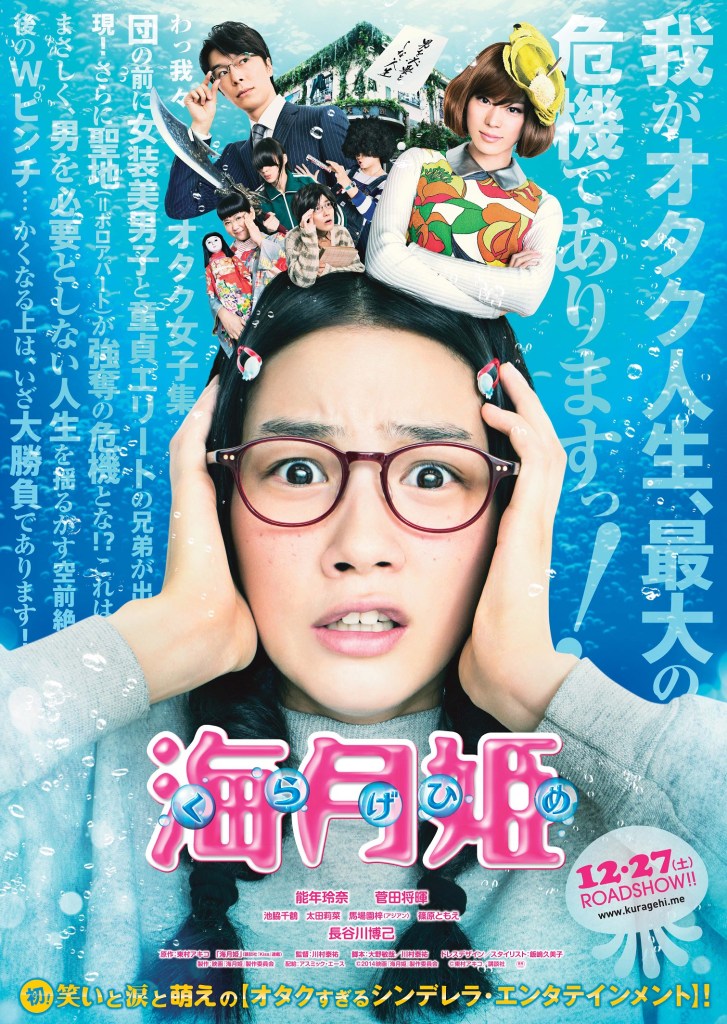
Princess Jellyfish (海月姫, Taisuke Kawamura, 2014)

b7dec6a631e5ad87baf2ff601d6b4872Originating as an ongoing manga series by Akiko Higashimura which was also later adapted into a popular TV anime, Princess Jellyfish adopts a slightly unusual focus as it homes in on the sometimes underrepresented female otaku.

Tsukimi is an extremely awkward young woman who has an all encompassing obsession with jellyfish. Luckily for her, she’s managed to find a group of likeminded women of a similar age to room with. That is, they aren’t all as crazy about jellyfish as she is, but they all have their particular order of special interest, are fairly socially awkward with an extreme fear of “fashionable” women, and no formal form of employment. At the Amamizukan boarding house, the girls can all enjoy their otaku lives together (well, kind of separately) and, crucially there are no boys allowed!

However, one day Tsukimi finds herself at a crisis point when she notices one of the jellyfish she likes to visit at a nearby pet shop is in danger! The idiot shop boy has only gone and put a Moon Jelly in with a Spotted Jelly – does he just not know how dangerous that is?! Tsukimi will need to act fast to save her friend, but the guy behind the counter is a clueless pretty boy – absolutely the worst case scenario for Tsukimi. Despite her extreme anxiety she valiantly marches into the shop yet her confused mini lecture on jellyfish keeping only succeeds in convincing the shop boy that she’s some kind of nutcase. On being expelled from the shop, Tsukimi finds herself at the feet of an extremely glamorous looking woman who comes to her defence. What kind of strange parallel world is this? Tsukimi’s universe is about to undergo a sea change!

Though based on a manga and intended as a comedy, crucially, Princess Jellyfish casts its series of “different” heroines (and hero) in a favourable light – they are never the butt of the joke and sympathy is always placed with those who experience difficulty in their lives because they feel themselves to be different. Each of the girls is so deeply involved in their own particular obsession that they find it difficult to fit into the regular world and particularly to cope with conventional femininity. Tsukimi herself finds it particularly difficult to talk to men and the fact that no men are permitted at Amamizukan makes it clear that she is not alone in her fears.

This brings us to her new friend who is apparently a fashionable young woman – the sort who would never usually be seen dead talking to the likes of Tsukimi. However, this one not only acknowledges Tsukimi’s presence as another human of equal standing, but even lends her confidence and power as an attractive woman to Tsukimi’s predicament. There is, of course, more to this mysterious saviour than there might seem at first sight. In addition to being a fabulously well dressed lady, Kuronosuke is also a boy. This is something of a problem for Tsukimi as she only realises after letting him stay over at the strictly no boys allowed residence. The ruse also has to be maintained a little longer when Kuronosuke decides to stick around, eventually becoming known as “Kuroko”.

The situation intensifies as the girls’ secret haven comes under threat when a gang of ruthless developers want to buy up most of the town and redevelop the area. The group home is owned by one of the girl’s mothers who is also an otaku only her obsession is with top Korean actor Lee Byung-hun and she’s skipped off to Korea to be able to stalk him better. There’s no telling what she might do if it brings her closer to the object of her affections and things are looking a little desperate. Eventually a possible solution is found which plays to everyone’s strengths and offers the faintest glimmers of hope for the girls (and boy!) of Amamizukan.

Princess Jellyfish is the ultimate tale of acceptance, both in personal and societal terms. The residents of Amamizukan may be a little different, but that doesn’t mean they have nothing to offer the world and there’s no need for themselves to maintain a position of self imposed exile if the only reason is a belief in their own inferiority. This is a lesson taught to them by the exuberant rich boy and politician’s son with a traumatic past of his own, Kuronosuke. Truly unafraid to be who he is, Kuronosuke teaches the girl’s that almost any obstacle can be overcome with a combination of forthrightness and sincerity.

Though it runs a little long and gives in to some very over the top performances and melodramatic plotting, Princess Jellyfish is an enjoyably offbeat manga inspired tale. Very much not interested in demonising anyone other than those who seek to suppress individuality, it’s a cheerful celebration of the value to be found in difference offering plenty of laughter and warmth along the way. Perhaps not for those who prefer their cinematic experiences on the subtle side, Princess Jellyfish is nevertheless a fun filled film which carries its message of universal acceptance right into the closing credits.


The anime adaptation of this is actually really fun too.