
Tales from the Occult: Body and Soul (失衡凶間之罪與殺, Frank Hui, Daniel Chan Yee-Heng, Doris Wong Chin Yan, 2022)

The second in a series of horror-themed anthologies, Tales From the Occult: Body and Soul (失衡凶間之罪與殺) takes fairytales as its theme but truth be told none of the episodes has very much in common with the most well known version of their respective stories. What they do have in common is a rather grisly view of the nighttime city perhaps inspired by classic Cat III shockers though mediated through a strong sense of irony. “I like it a bit dark” one of the heroes exclaims and it’s certainly a sentiment shared by each of the three directors. 

The first instalment, Frank Hui’s Rapunzel finds former idol star Maggie (Michelle Wai) trying to prop up her flagging career while constantly written off as a has been best known for a cheesy pose in a dated shampoo commercial. Her manager sends her to an obnoxious rich kid’s birthday party where the women are so young they weren’t even born when she was a star and relentlessly mock the weird “aunty” and her “retro” movies. One of the guys sets fire to her hair which is even more of a problem for her because she’s supposed to have an important meeting with a producer in the morning and he’s not going to hire her with a less than perfect appearance. Maggie’s desperation eventually draws her into the orbit of a hair fetishist serial killer from whom she must try to escape while attempting to rescue her hair and save her career. A secondary strain of social community places the killer’s creepy all night salon in a building that’s about to be torn down for urban renewal leading him to be bullied by gangsters to move out but not wanting to for obvious reasons. Maggie meanwhile eventually makes a surprising decision in order to fix herself which is in its own way cannibalistic at least of the female image when it comes to the idea of perfect hair. 

You couldn’t say that Daniel Chan’s Cheshire Cat really has that much to do with the classic Alice in Wonderland character either, though Chan does throw in something like a Mad Hatter’s tea party and leave his heroine trapped in a cage suspended above the air. Nora (Cecilia Choi Si-Wan) works in a cat rescue centre and is particularly upset by the idea of people hurting her feline friends, especially as her own cat Bobo was recently murdered. After agreeing to rescue a kitten trapped under a van she unwittingly passes into a grim haunted house adventure with a death metal vibe. In a series of atmospheric shots, Chan frames Hong Kong in an angry red tint capturing the increasing resentment of Nora as she continues to take out her rage on those who would harm poor defenceless creatures. 

Doris Wong’s The Tooth Fairy perhaps ironically subverts its title while toying with the interplay of sadomasochistic fetishes. Dental nurse Sammi (Karena Lam Ka-Yan) is being relentlessly harassed at work by sleazy dentist Steve (Tommy Chu Pak-Hong) who won’t take no for an answer. On her way to the bank, she comes across a fight between two young men in which one bites off the other’s ear, and invites the biter to her clinic to get his swollen cheek looked at. Steve, however, does not take kindly to this after seeing he and Sammi flirt with each other, extracting a healthy tooth without anaesthetic as if teaching him a lesson, but clearly deriving sexual pleasure from his pain just like the sadistic killer on the news. In any case events soon escalate following some cake-related triggering and not just for its capacity to ruin your teeth. The killer may claim they’re setting people free from their earthly suffering but is clearly in part at least killing for the thrill. 

In any case, danger seems to lurk behind every corner with potential serial killers apparently all around us as the heroes find out during their various quests. Their stories may not have much in common with their inspiration but each have a strangely ironic quality curiously mimicking B-movie cinema in terms of colour palette and production design, Frank Hui eventually opting for a neon-coloured nightmare lair while Nora and the gang chase through a haunted Hong Kong and Sammi does her best to extricate herself from the unwanted attentions of her sleazy boss who is perhaps the real monster in the shadows. 


Trailer (English subtitles)
Everyphone Everywhere (全個世界都有電話, Amos Why, 2023)

Have we become too dependent on our phones, allowing them to divide rather than connect us? For those at the centre of Amos Why’s zeitgeisty comedy Everyphone Everywhere (全個世界都有電話), they do seem to have become a double-edged sword. Yet in the end, it’s a series of handsets that reconnect them with their youth if only to remind them of the disappointed hopes of a defeated middle-age given additional an weight by subtle hints of post-Handover despair. 

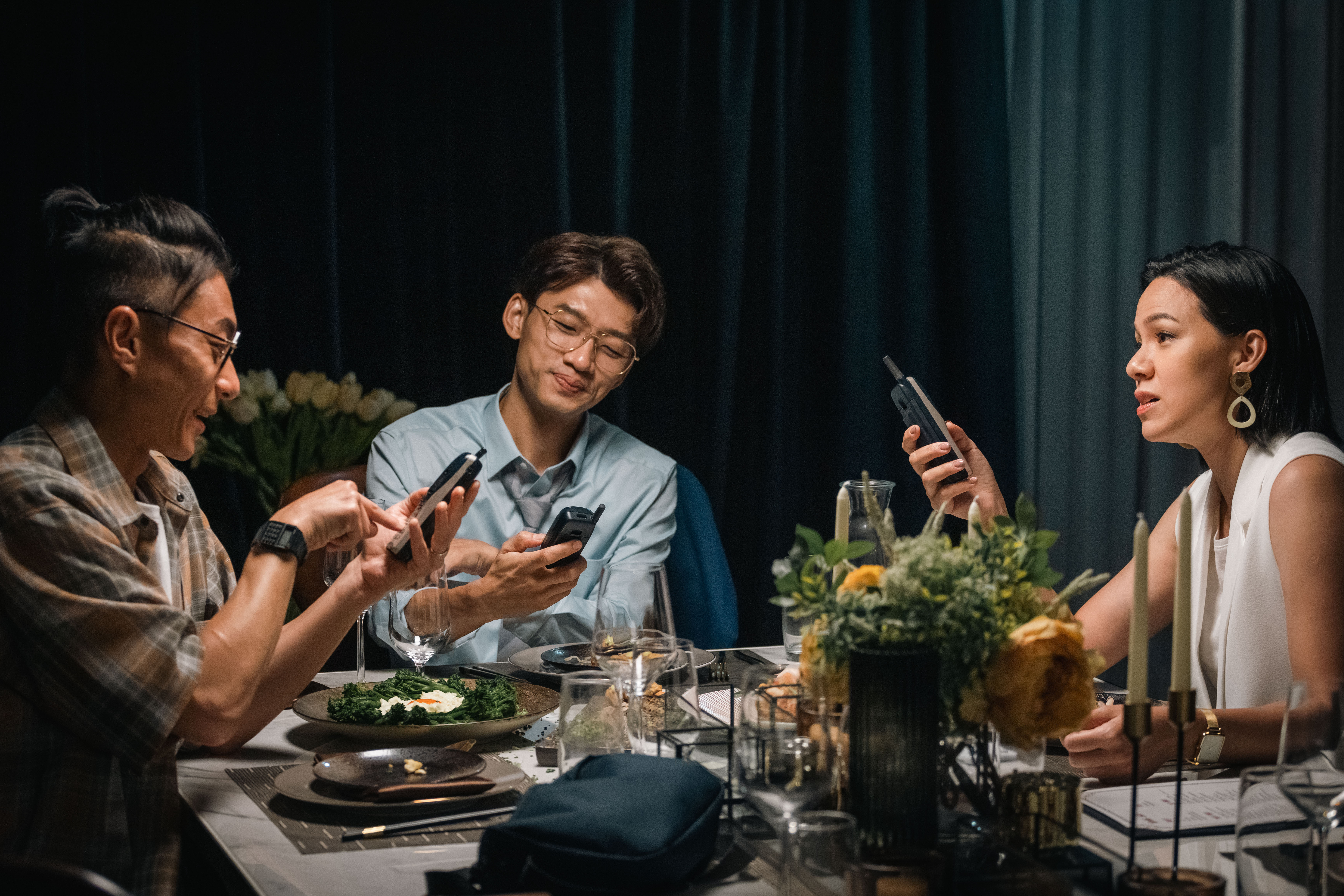
Asked why he’s decided to move to the UK, Raymond (Peter Chan Charm-Man) replies that everybody’s doing it even if he resented being sent away to study in Aberdeen, Scotland as a teenager in the wake of the Handover. The real reason is that he’s got himself involved in a lot of shady stuff and has just had his phone hacked so he fears blackmail or arrest. He’s organised a farewell dinner with old high school friends Chit (Endy Chow Kwok-Yin) and An (Rosa Maria Velasco), but nothing quite goes to plan in the curious ways the lives of three former friends remain entwined even if they’ve all been in some sense corrupted by the changes in their society. “All is well as long as we never change” reads a teenage message to a future self, but of course it’s a promise that can’t be kept even if in the end, “life must go on anyway.”

Still, the society itself is fairly corrupt given the prevalence of scams many of them connected to our phones. Raymond failed to get his hacked phone fixed and opted for a new number instead, but Ana in particular keeps getting weird calls from him she later realises must be an attempt to scam her out of money by someone posing as Raymond and explaining that he needs money desperately. But Ana is also the victim of another “scam” in the form of Chit’s new business strategy of getting a “monthly fee” from clients rather than be reliant on work for hire arrangements. Even the restaurant itself along with its “Japanese” chef seems to be fraudulent, while An remains preoccupied with her husband’s womanising and Raymond ironically with his series of bad decisions that culminate in tax fraud. Meanwhile Raymond’s daughter Yanki (Amy Tang Lai-Ying) is also indulging in a kind of scamming selling intimate pictures to nerdy guys via telegram and smartphone apps and ironically remarking that she doesn’t want to get scammed again when discussing ever increasing payment options with her hapless targets.

Yet as Chit discovers when he leaves his phone at home, everything seems inconvenient when you’re phoneless. In a running gag, he repeatedly tries to borrow someone’s landline but is refused leaving him wandering around the city looking for a “restaurant” in one of three very similarly named redeveloped blocks. His wife’s is the only number he remembers by heart, but she remains resentful of his meeting up with Ana, his first love, whom he previously described as a “gullible” auntie and is on some level “scamming” by convincing her to keep him on a monthly retainer. Raymond’s phone threatens to expose him, Ana uses hers to spy on her husband and stepson, and Chit’s in a sense incapacitates him, leaving him alone and disorientated in his own city no longer certain how to travel around it amid the rapidly changing landscape and seemingly identical redevelopment projects.

Life hasn’t turned out the way any of them thought it would, recalling their carefree days 25 years previously in pre-Handover Hong Kong. Banners advertise a “New Era”, but the trio are trapped in the past with which they are eventually reconnected thanks to the retro handsets that unlike the technology of today still work and contain a series of time capsule messages to their future selves. History in a sense repeats itself as Raymond prepares to leave, but each is able to come to terms with their unfinished business and begin making concrete decisions about their futures. Suddenly “can we meet on Saturday?” takes on a new sense of poignancy when everyone seems to be leaving but then again, perhaps our phones really do connect us even if they sometimes connect us to scammers or people we don’t really want to talk to. Subtly hinting a sense of disappointment which runs a little deeper than middle-age malaise, Why looks back to the carefree days of 1997 allying the broken dreams of youth with the “New Era” of today but nevertheless grants his heroes a sense of new sense of possibility even the face of their despair. 


Everyphone Everywhere screens July 20 as part of this year’s New York Asian Film Festival.

Original trailer (Traditional Chinese / English subtitles)

Images: © 2023 Dot 2 Dot Creation Limited. All Rights Reserved.

A Light Never Goes Out (燈火闌珊, Anastasia Tsang, 2022)

A mother and a daughter take very different paths in trying to come to terms with grief in Anastasia Tsang’s poignant drama, A Light Never Goes Out (燈火闌珊). A tale of loss in more ways than one, the film is also a deeply felt lament for the old Hong Kong which finds itself slowly erased as symbolised by the movement to remove the “dangerous” neon signage which was once such a part of the city’s identity. 

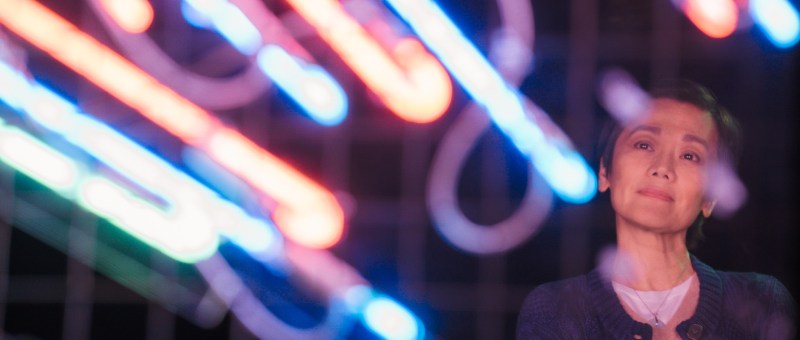
Heung’s (Sylvia Chang Ai-Chia) late husband Bill (Simon Yam Tat-Wah) had been a master craftsman of just such signs though as far as Heung knew had retired a decade previously as the industry continued to decline. Where once the city was full of neon, modern businesses prefer cheaper LED signage. Now that Bill is gone, Heung struggles to find direction in her life. She continues cooking for three even though they’re only two and sadly reflects on how dark and sad the streets now feel as she witnesses the signs that Bill spent so much of his life crafting unceremoniously dismantled. While all she wants to do is hang on to the past, her daughter Prism (Cecilia Choi Si-Wan) takes the opposite path insensitively getting rid of her father’s things without her mother’s knowledge while secretly planning to move to Australia with her fiancé Roy. 

In some ways the two women represent a set of opposing views with the mother standing in for those who decide to stay and fight for the soul of Hong Kong, and the daughter those who decide their future lies abroad in her case in Australia where she believes there is “more creative freedom”. When Heung tells some construction workers that “your new laws are illegal”, it sounds as if she’s talking about more than just building ordinances while exasperated by the idea that something which seemed very ordinary just a short time ago is deemed against the law because of a sudden and arbitrary introduction of additional legislation. 

It might be assumed that the neon lights fade because young people do not care for them, but Heung’s greatest allies are the young apprentice, Leo (Henick Chou), she belatedly discovers Bill had taken on before he died and a young woman who fiercely protects the neon sign that hangs above her bar. It’s she who also points out that Bill supported her during the SARS crisis when her family’s business was suffering, bearing out his humanity in helping those in need while suggesting that it is spirit of the neon lights that has kept Hong Kong going during its darkest days. Bill had been a bit of a dreamer, fond of encouraging those around him to wish upon a star while insisting that nothing’s predetermined and if you wan’t something you can make it happen all of which sounds like a subtly subversive advocation for the fight for Hong Kong. 

As he later says, his signs may have been torn down but they can be built again while Heung and her daughter eventually find a way to reconcile in their grief and she gains a surrogate son in the earnest Leo who encountered rejection all his life until discovering a calling in the art of neon signage. Leo’s commitment suggests that something of the neon lights can be preserved and brought into a new era while there is a genuine poignancy in the significance of the sign reading “myriad lights” which eventually guides each of the heroes towards their resolution in attempting to fulfil Bill’s dying wish of recreating a sign which had long since disappeared but held a memory for another couple that another one long departed had held for he and Heung. 

Tsang often cuts back to stock footage of a neon-lit Hong Kong in the 60s and 70s before contrasting it with the comparatively empty streets of today which appear almost soulless in their slick modernity. It is in a sense nostalgia, a yearning for another Hong Kong which is fast disappearing or perhaps being deliberately erased as symbolised in the final, post-credits shot of the famous floating restaurant with its vibrant exterior and giant green “Jumbo” sign which capsized in June 2022 after being towed out of Hong Kong for storage in Cambodia. A poignant tale of grief and healing, Tsang’s moving drama nevertheless suggests a flame still burns in the flickering lights of the old Hong Kong which continue to illuminate the night sky in defiance of those who might seek to extinguish them. 


A Light Never Goes Out opens in UK cinemas on 12th May courtesy of CineAsia.

UK trailer (Traditional Chinese / English subtitles)

Beyond the Dream (幻愛, Kiwi Chow Kwun-Wai, 2019)

Two troubled souls battle illusionary love in Kiwi Chow Kwun-Wai’s existential romance, Beyond the Dream (幻愛). What is love when divorced from fantasy, and once you know do you have the courage face it? That’s a question asked by each of the mirrored protagonists who’ve convinced themselves they are unworthy of love while struggling to extricate themselves from past trauma and present insecurity as they find the sands of reality constantly shifting beneath their feet. 

Chow opens with a street scene, the evening crowds gently parting to find a woman in distress, Ling (Wong Lam), who eventually begins to take off all her clothes. While passersby stare and film her public breakdown, a man, Lok (Terrance Lau Chun-Him), who recognises her from a support group for sufferers of schizophrenia, comes to her rescue as does a mysterious woman who wraps her cardigan around her giving her both modesty and warmth. Helping Ling into an ambulance, Lok ends up with the mystery woman’s cardigan somehow captivated by her, touched by the way she came to Ling’s rescue when everyone else was intent on ridicule. Sometime later he is surprised to realise that the woman lives on the floor above him on his estate. Returning her cardigan he discovers her name is Yanyan (Cecilia Choi Si-Wan) and she lives with her violent drunk of a father (Ng Kam-Chuen). The pair become a couple and Lok starts to wonder if he should tell her about his struggles with mental health only for his symptoms to begin resurfacing. Much to his horror he realises that his relationship with Yanyan is nothing but a vivid fantasy, a figment of his illness which exists only his mind. 

Yet even fantasy is built on a grain of truth as Lok later discovers when “Yanyan” turns up at one of his support group sessions only she’s a post-grad psychology student by the name of Yip Nam who is looking for volunteers to participate in her research into erotomania in those diagnosed with schizophrenia. Nam hopes to find out if lack of love is a causal factor in the condition through the stories of those who become consumed by romantic delusion. Unfortunately, her project is rejected by her supervisor, Dr. Fung (Nina Paw Hee-Ching), on the grounds that she has no viable subjects. Lok would seem to be the ideal patient, were it not for the awkward fact of which Nam is still unaware that she herself is the subject of his fixation, the “real” woman who came to Ling’s rescue all those months ago. 

“Relationships are always your problem” Nam is warned, herself carrying the burden of a traumatic past which, according to her mentor Fung, has also convinced her that she doesn’t deserve love, mirroring Lok’s fantasy of Yanyan and her imprisonment at the hands of the abusive father who eventually keeps them apart. In her role as his therapist, she counsels him to “find your true love in reality”, interpreting his recurring dream as a metaphor for his desire to lose himself in the comforting fantasy of his illusionary love for Yanyan rather than take the risks concurrent with seeking happiness in the “real” world. But she herself is also seeking wilful oblivion in other kinds of illusionary romantic distraction pursued perhaps as a form of self harm or at least a means of blaming herself for something for which she has no need to apologise. 

For Lok, meanwhile, romance is still more uncertain, his sense of reality permanently impaired as he finds himself pulled between his idealised love for Yanyan and the problematic relationship with Nam while convinced that no one could ever love him because of his mental illness. “No matter who you really are, you’ll all leave me in the end” he sadly affirms, later advising Nam that “it’s time we wake up from our dreams” ironically advocating for a return to “reality” while simultaneously running from it. Continually divided in Chow’s elegant composition, forever gazing through mirrors and seeing only the reflection of unfulfilled desire, the lovers struggle to overcome their psychological barriers to move beyond the dream of love into something more concrete if perhaps no less illusionary, chasing self-acceptance in the eyes of another as they surrender to romantic destiny as its own kind of “reality”. 


Beyond the Dream screens at Chicago’s Davis Drive-in on Oct. 10 as the closing night of the 11th season of Asian Pop-Up Cinema.

Original trailer (English subtitles)