Deadline (自殺通告, Kiwi Chow Kwun-Wai, 2025)

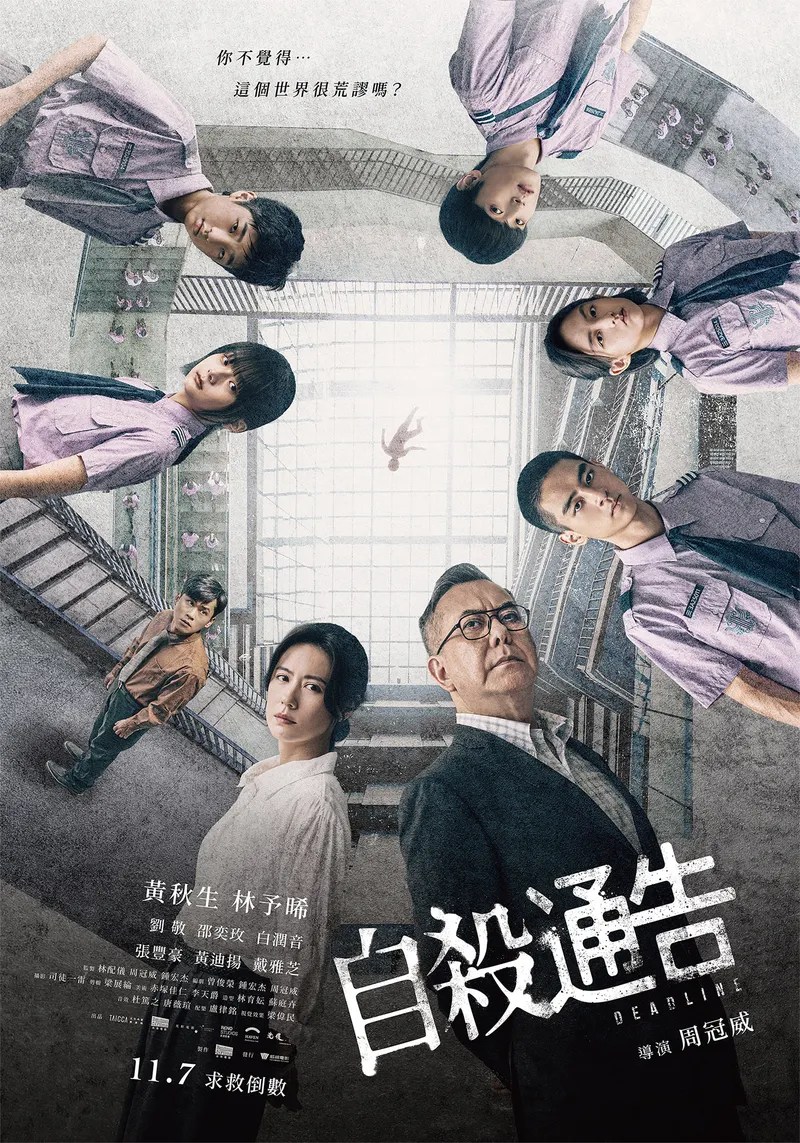
What does it mean to get “an education”? Is the school system only really there to brainwash the young into following accepted the path and prepare them to be receptive to authority, actively destroying both the ability and desire to think for oneself? The fact that Kiwi Chow’s Deadline (自殺通告, zìshā tōnggào) was not approved for release in Hong Kong on the grounds of “national security” may indicate the direction of its perspective on the interplay between the intensity of the education system and entrenched authoritarianism.

The mere fact that En Shan high school is described as “elite” already implies that it exists to perpetuate a kind of social inequality, though in other ways some might say that it also encourages social mobility in that the students come from all backgrounds and are selected for academic excellence rather than simply the ability to pay the fees. Education does seem to be life’s make or break. Students who don’t make it to university are perceived as being relegated to a kind of underclass from which there is no other escape. Yet at the same time, perhaps university isn’t right for everyone and not all of the pupils want to live a life dedicated to achieving conventional success that might otherwise leave them miserable.

Chun Chiu (Jimmy Liu) is one of the few brave ones who’s decided he doesn’t want to go to university and is happy enough pottering around with his plants. He doesn’t care if people look down on him because he knows he’s happy in himself, and they probably aren’t. Consequently, he’s also the only one to really see what’s going on at the school and to want to try to stop it. Despite its elegant name, there’s a kind of bloodthirstiness that underlines the survival of the fittest mentality at En Shan where they wear mildly fascistic uniforms and start the day with a haka-style dance in which they recite the school’s mantras about being the best of the best and that there’s no point coming second. These children are prevented from forming real friendships or developing social skills and empathy because they’ll always be rivals waiting for the ideal time to stab each other in the back.

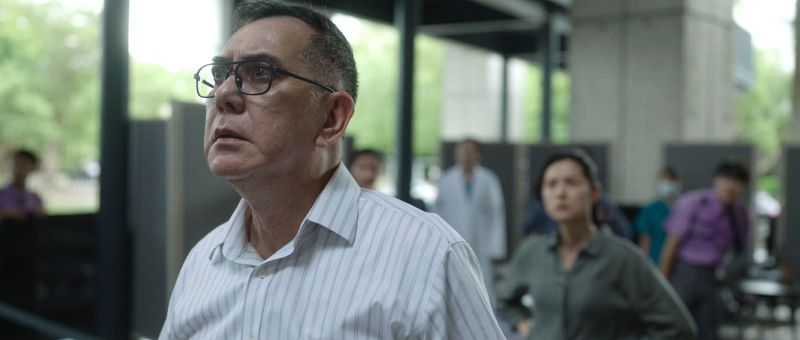
The school reinforces this sense of judgment and hierarchy through adopting a social credit-style system in which pupils’ “privileges” are linked to their performance and obedience levels. Chun Chiu is at one point locked out of the garden because his scores have fallen so low he’s not allowed outside the prison-like school environment. Everyone at the school, including the teachers, is under constant surveillance with an AI programme responsible for assigning grades and points. Headmaster Kung wants to get rid of Mr Gao (Huang Di-yang) because the system says his performance is poor, while star teacher Mrs Tien tries to defend him. To begin with, Gao seems as if he might be resisting in another way by giving care and attention to struggling pupils like Heng (Bai Run-yin) who is taking medication for ADHD. But it turns out that Gao is so worried about losing his job as he has to pay maintenance for his ex-wife and child that he’s been giving the kids performance enhancing drugs in the hope of boosting his own approval ratings in the app.

Heng is also getting bullied by some of the other pupils, not just because he’s different but because they resent it that they think he’s being given special advantages by taking medicine that helps him concentrate and being given extra time to finish exams. This leads Heng to try and and cancel his accommodations in a bid to avoid being singled out and in a mistaken gesture of solidarity with the other kids to prove he’s not being given any extra privileges. Meanwhile, they’re all taking similar medication that’s designed to aid concentration and reduce the need for sleep for they can study for longer. But the drugs also prevent them from sleeping when they want to and suppress their appetites so they don’t eat. They cause low mood and suicidal ideation, which, coupled with the already high-stress environment, is a recipe for disaster.

To combat this culture, someone drops a series of ominous flyers threatening the school that there will be a suicide if they don’t “stop poisoning us” by ending the practice of holding exams under medication. While headmaster Kung appears oblivious to the monster he himself has created and has no real idea what’s going on in the school, to his credit he does seem keen to find out if there are any pupils in danger of harming themselves rather than solely trying to silence the whistleblower or save the school’s reputation. He has no idea about the drugs and is shocked on realising how prevalent they’ve become in the school. When they start doing drug tests and discover that over half the pupils are taking them, the director of the board of governors, who has the real power, tells him to stop the testing before they find any more.

But it turns out that this problem extends far beyond the school as in some cases it’s the parents who are making their kids take these drugs, and the head of the student council, Mo (Michael Chang), that’s been selling them. After a few deaths have occurred, Tien and Kung want to stop the exams, but are prevented from doing so, in part because the education system is a national machine. The kids can’t just take the exam on another day because they can’t come up with all new papers just for them at short notice. In a truly chilling moment, Mo gets up on his chair begins chanting the nonsensical mantra “exams are a human right” while insisting on being allowed to take them even if it means that more pupils end up dying. After all, that’s just less competition for him. They’re already locked into this system and refuse to be cast out of it, in part because they’ve learned how to manipulate it so perfectly.

Then again, obsessive study doesn’t leave you with much time to think about anything else even if you’re not also sleep deprived and malnourished as a result of long-term drug use. Chun Chiu’s friend Peiching (Tai Ya-chih), the current number one, becomes conflicted in part because she realises that she does not really know who she is and is incapable of determining what she wants out of life. She said she wanted to be a doctor because that’s what her parents were so she thought she was supposed to be too, but doesn’t know if that’s actually what she wants. Peiching seems genuinely worried about rival Ruoyan (Mimi Shao Yi-mei) who self-harms out of frustration and feelings of inadequacy, but equally only perhaps because thanks to the drugs she stands a real chance of knocking her off  the top spot. Mrs Tien may secretly be thinking of moving abroad precisely because her own daughter does not suit this rigid educational system, but remains largely unable to change it while the students have, it seems, already internalised its tenets unable to let go of a world in which everything is defined by numbers and ranking without the intrusion of independent thought or human empathy.


Deadline screened as part of Hong Kong Film Fest UK and opens in UK cinemas 16th October.

Trailer (English subtitles)
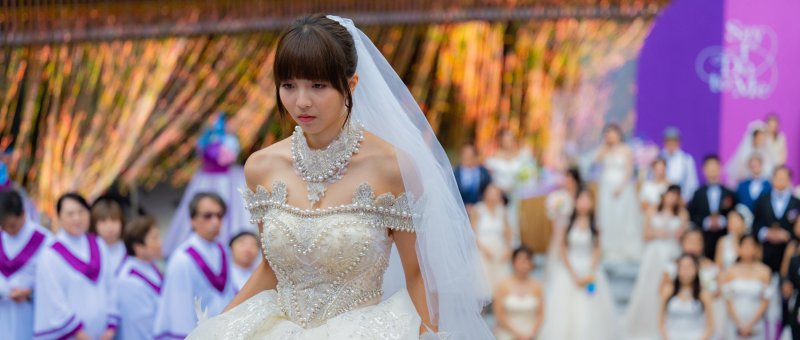
Say I Do to Me (1人婚禮, Kiwi Chow, 2023)

A struggling influencer’s bid for internet fame through marrying herself soon goes dangerously awry in Kiwi Chow’s anarchic take on contemporary social media mores and the need for authenticity, Say I Do to Me (人婚禮). Ping (real life YouTuber Sabrina Ng Ping) swears that she’s done with changing herself for others and is determined to enjoy life on her own terms, but the irony is she’s anything but honest with herself as she attempts to bury her abandonment issues and ambivalence towards marriage beneath her friendly clown persona. 

Despite telling all her followers that she sees no need to wait around for someone else to make her happy so she’s going to marry herself, Ping is in a longterm relationship with middle-school sweetheart Dickson (Hand Rolled Cigarette director Chan Kin-long) who handles the tech side of their YouTube channel. When their clown-themed videos failed to win an audience or pay the bills they started looking for something edgier, shifting their focus to their own relationship. When that too failed to set netizen’s hearts aflame, they started engineering fake romantic drama including a “real fake” wedding and Dickson cheating scandal. To get themselves out of the hole they’d dug, Ping comes up with the idea of “sologamy” in which she’ll get back at “cheating” Dickson with a solo wedding on the day they would have got married, while Dickson mounts a counter campaign wearing a giant monkey head to promote his “solo funeral” movement railing against fake affirmation of Ping’s embrace of “authenticity”.

Of course, authenticity is the one thing Ping isn’t selling. She’s telling everyone else they should be true to themselves, but has based the whole thing on a lie in still being in a relationship with Dickson while adopting a fake influencer persona of a woman who has herself together and is fully ready for commitment. The duplicity begins to eat away at her as she witnesses its effects on others including a middle-aged woman (Candy Lo Hau-Yam) she’d assumed to be in a perfect marriage who suddenly reveals she’s been unhappy for decades because she couldn’t accept her sexuality. Thanks to Ping, she’s decided to divorce her husband and live a more authentic life all of which leaves Ping with very mixed feelings. Meanwhile, she’s relentlessly pursued by a devoutly religious man who seems to be in love with her on spiritual level, and also comes to the attention of “Hong Kong’s last Prince Charming” who has hidden anxieties of his own. 

The film seems to ask if it really matters if Ping was “lying” when her example has made a “positive” difference in people’s lives in enabling to them to accept themselves and find true happiness even if in doing so they might necessarily hurt someone close to them. Dickson seems certain that the internet isn’t really real and you really don’t need to be “authentic” in your online persona, but is all too quickly addicted to the false affirmation of likes and shares and willing to compromise himself morally to get them, all while justifying his actions in insisting he’s only doing it to make Ping’s dreams come true. In the end, he is also playing a role for Ping but as she says coopting her dreams as his own just as her other suitors do. “No one here cares how I feel” she declares, realising her “fake” persona has become a kind of prop for others to hang their unfulfilled desires on. 

The problem is only compounded by the reckless actions of the solo funeral crew who quickly escape from Dickson’s control demonstrating the dark side of internet tribalism and accidental radicalisation. But Ping’s own worst enemy is herself, afraid to really look in the mirror and face her insecurity while simultaneously peddling the message that everyone’s lives will improve as long as they make a superficial gesture of self-love. What she discovers during a surprisingly violent cake fight, is that she’s not the only one battling internal insecurity to become her authentic self and there might be something in “sologamy” after all if it forces to you to confront the parts of yourself you don’t like and accept them too. Part absurdist treatise on the corrupting qualities of online validation and part surreal rom-com, Chow’s quirky comedy nevertheless comes around to its heartwarming message in allowing its heroine to make peace with herself and the world around her.


Say I Do to Me is in UK cinemas now courtesy of Haven Productions.

Original trailer (Traditional Chinese / English subtitles)

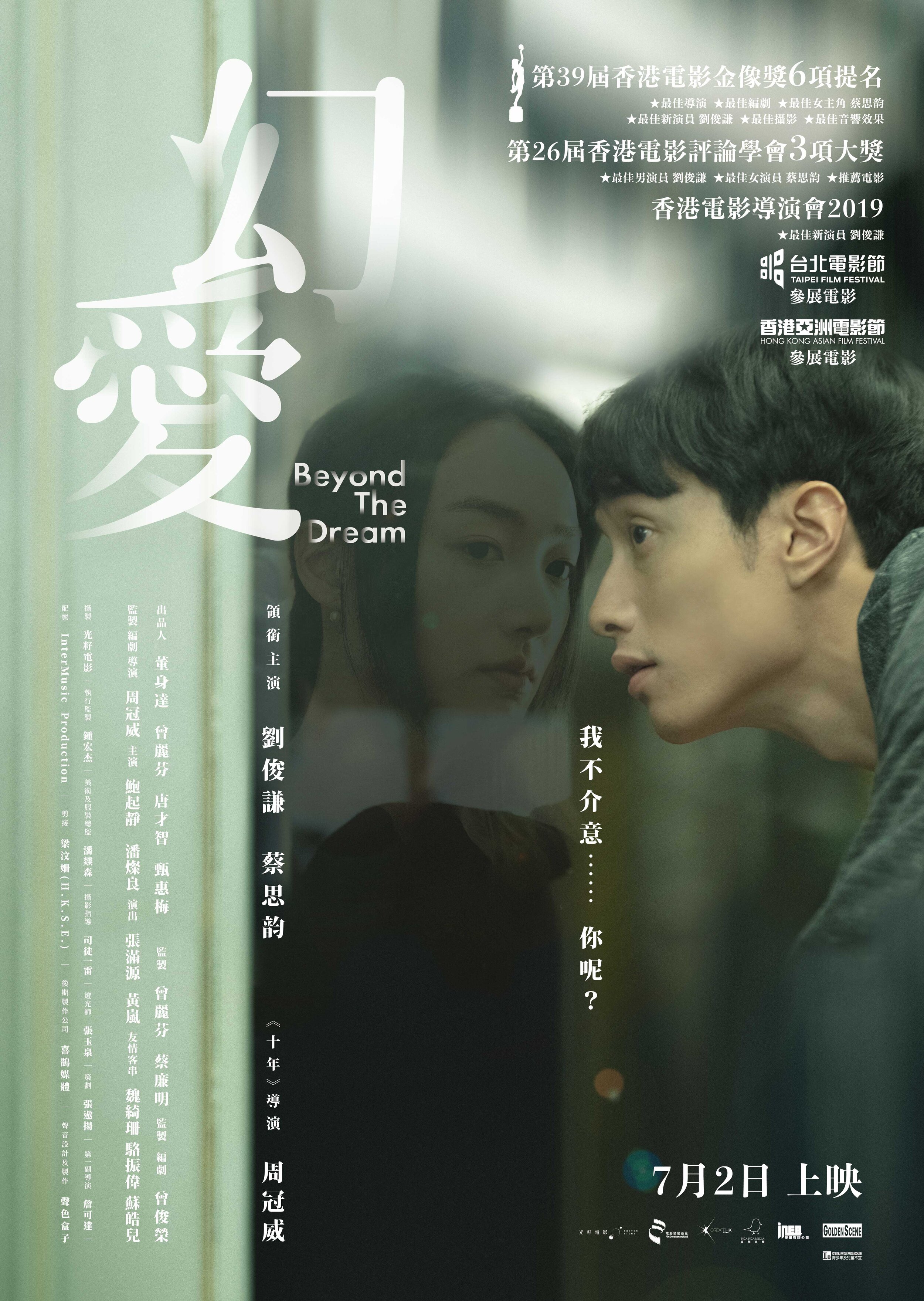
Beyond the Dream (幻愛, Kiwi Chow Kwun-Wai, 2019)

Two troubled souls battle illusionary love in Kiwi Chow Kwun-Wai’s existential romance, Beyond the Dream (幻愛). What is love when divorced from fantasy, and once you know do you have the courage face it? That’s a question asked by each of the mirrored protagonists who’ve convinced themselves they are unworthy of love while struggling to extricate themselves from past trauma and present insecurity as they find the sands of reality constantly shifting beneath their feet. 

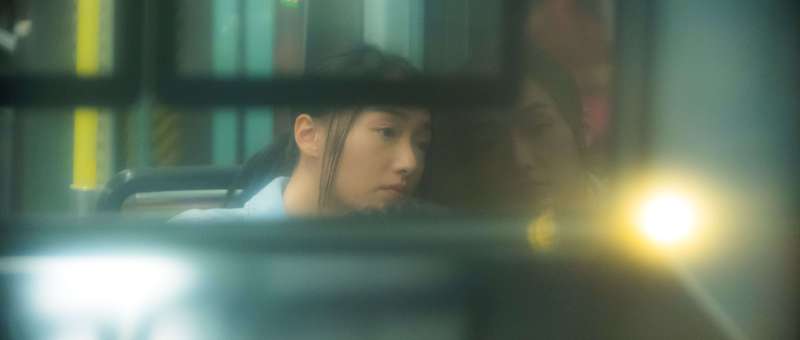
Chow opens with a street scene, the evening crowds gently parting to find a woman in distress, Ling (Wong Lam), who eventually begins to take off all her clothes. While passersby stare and film her public breakdown, a man, Lok (Terrance Lau Chun-Him), who recognises her from a support group for sufferers of schizophrenia, comes to her rescue as does a mysterious woman who wraps her cardigan around her giving her both modesty and warmth. Helping Ling into an ambulance, Lok ends up with the mystery woman’s cardigan somehow captivated by her, touched by the way she came to Ling’s rescue when everyone else was intent on ridicule. Sometime later he is surprised to realise that the woman lives on the floor above him on his estate. Returning her cardigan he discovers her name is Yanyan (Cecilia Choi Si-Wan) and she lives with her violent drunk of a father (Ng Kam-Chuen). The pair become a couple and Lok starts to wonder if he should tell her about his struggles with mental health only for his symptoms to begin resurfacing. Much to his horror he realises that his relationship with Yanyan is nothing but a vivid fantasy, a figment of his illness which exists only his mind. 

Yet even fantasy is built on a grain of truth as Lok later discovers when “Yanyan” turns up at one of his support group sessions only she’s a post-grad psychology student by the name of Yip Nam who is looking for volunteers to participate in her research into erotomania in those diagnosed with schizophrenia. Nam hopes to find out if lack of love is a causal factor in the condition through the stories of those who become consumed by romantic delusion. Unfortunately, her project is rejected by her supervisor, Dr. Fung (Nina Paw Hee-Ching), on the grounds that she has no viable subjects. Lok would seem to be the ideal patient, were it not for the awkward fact of which Nam is still unaware that she herself is the subject of his fixation, the “real” woman who came to Ling’s rescue all those months ago. 

“Relationships are always your problem” Nam is warned, herself carrying the burden of a traumatic past which, according to her mentor Fung, has also convinced her that she doesn’t deserve love, mirroring Lok’s fantasy of Yanyan and her imprisonment at the hands of the abusive father who eventually keeps them apart. In her role as his therapist, she counsels him to “find your true love in reality”, interpreting his recurring dream as a metaphor for his desire to lose himself in the comforting fantasy of his illusionary love for Yanyan rather than take the risks concurrent with seeking happiness in the “real” world. But she herself is also seeking wilful oblivion in other kinds of illusionary romantic distraction pursued perhaps as a form of self harm or at least a means of blaming herself for something for which she has no need to apologise. 

For Lok, meanwhile, romance is still more uncertain, his sense of reality permanently impaired as he finds himself pulled between his idealised love for Yanyan and the problematic relationship with Nam while convinced that no one could ever love him because of his mental illness. “No matter who you really are, you’ll all leave me in the end” he sadly affirms, later advising Nam that “it’s time we wake up from our dreams” ironically advocating for a return to “reality” while simultaneously running from it. Continually divided in Chow’s elegant composition, forever gazing through mirrors and seeing only the reflection of unfulfilled desire, the lovers struggle to overcome their psychological barriers to move beyond the dream of love into something more concrete if perhaps no less illusionary, chasing self-acceptance in the eyes of another as they surrender to romantic destiny as its own kind of “reality”. 


Beyond the Dream screens at Chicago’s Davis Drive-in on Oct. 10 as the closing night of the 11th season of Asian Pop-Up Cinema.

Original trailer (English subtitles)