The World of Love (세계의 주인, Yoon Ga-eun, 2025)

Lee Jooin (Seo Su-bin) is a cheerful young woman, always laughing and joking. She tells people she’s okay, though some of them think she shouldn’t be, as if she can’t be telling the truth or what happened to her can’t be all that bad if she’s otherwise unaffected by it now. It’s like they’re telling her that she has no right to be happy, but must continue to live in suffering to conform to their idea of what a traumatised person looks like, otherwise she must be making it up for attention. 

Put like that, it seems very unfair. But it’s true enough that director Yoon Ga-eun plays with our prejudices deliberately withholding whatever it is that happened in Jooin’s life until the truth of it gently unfolds and we witness the radiating effects it’s had on her family and those around her. We at first wonder if she might have done something bad she’s expected to atone for, especially with the talk of lawyers and court cases, the fact her friends and teachers seem to regard her as a compulsive liar, and her sometimes aggressive physicality that sees her rough house with the boys and repeatedly end up in altercations with classmate Su-ho (Kim Jeong-sik) whose sister Noori attends her mother’s daycare.

Later, we might wonder if Su-ho is carrying something difficult to bear too. His mother doesn’t seem to be around, and he’s stepped into a maternal role caring for his sister to a degree that may seem obsessive. He’s started a petition against a convicted child abuser being released back into their community and is fixated on getting the entire school to sign it, even though it’s not really anything to do with him and simply saying they don’t want him back here is not particularly helpful seeing as he’ll have to go somewhere. Su-ho thinks he’s doing a good thing, but Jooin refuses to sign because she doesn’t like it that he’s written that being a victim of sexual assault ruins people’s lives. She tries to explain to him why it’s offensive, that he’s robbing those who’ve experienced sexual violence of the right to assume agency and suggesting they must forever be defined by their victimhood. She resents his patriarchal attitude and insistence that someone’s life could be “ruined” beyond repair because of a traumatic event that occurred to them personally outside of the problematic framing Su-ho’s way of thinking lends it. Su-ho, however, does not really listen but merely forces her to sign the petition anyway to fit in with everyone else so he’ll get his unanimous numbers, not that it really matters. 

We might also start seeing some of Jooin’s behaviour as a trauma response. Her love of Taekwondo a means of self-protection, her prankster persona a way of rebelling against her sadness with aggressive cheerfulness, but in that we may not be much better than Su-ho. Perhaps she just likes Taekwondo and is a natural comedienne. Maybe she just doesn’t care for apples. Not everything in her life radiates from her trauma. Meanwhile, we catch sight of things in others that suggest they may be suffering too. When Jooin grabs her friend Yura’s arm, she pulls away as if it were injured, tugging at her sleeve as if trying to hide it. Someone keeps writing nasty notes questioning Jooin’s behaviour, which they find confusing, and her authenticity as if she might simply be playacting something which to them is real.

Not being believed is another aspect of Jooin’s trauma. Even when she tells the truth, others accuse her of lying. Other women around her experience something similar, asked why they accepted money from or did not cut of contact with a man they say abused them even if that man was a close family member. Jooin’s father has abandoned the family and does not reply to her messages, rejecting her because of his own sense of guilt, while her mother is doing the best she can but has taken to drink. She also has a younger brother, Hae-in, with a burgeoning career as a stage magician, who may at times get forgotten amid everyone else’s needs. As part of his act, he has a section where he asks the audience to write their fears and worries on a card so he can magic them all away. But as much as he’s been secretly protecting his sister, there’s no spell you can cast to make all of this disappear. Jooin, meanwhile, writes her vocation as “love” and is indeed surrounded by it. “You’ll never know who I am, but I’ll never forget you,” the note writer later signs off, thanking her for speaking out and making them feel a little less alone while simultaneously liberating Jooin from her sense of fear and isolation. “Lying makes it hurt more,” little Noori advises Jooin’s mother, while Jooin has at least unburdened herself and assumed control of the world around her.


The World of Love screens as part of this year’s BFI London Film Festival.

Trailer (English subtitles)

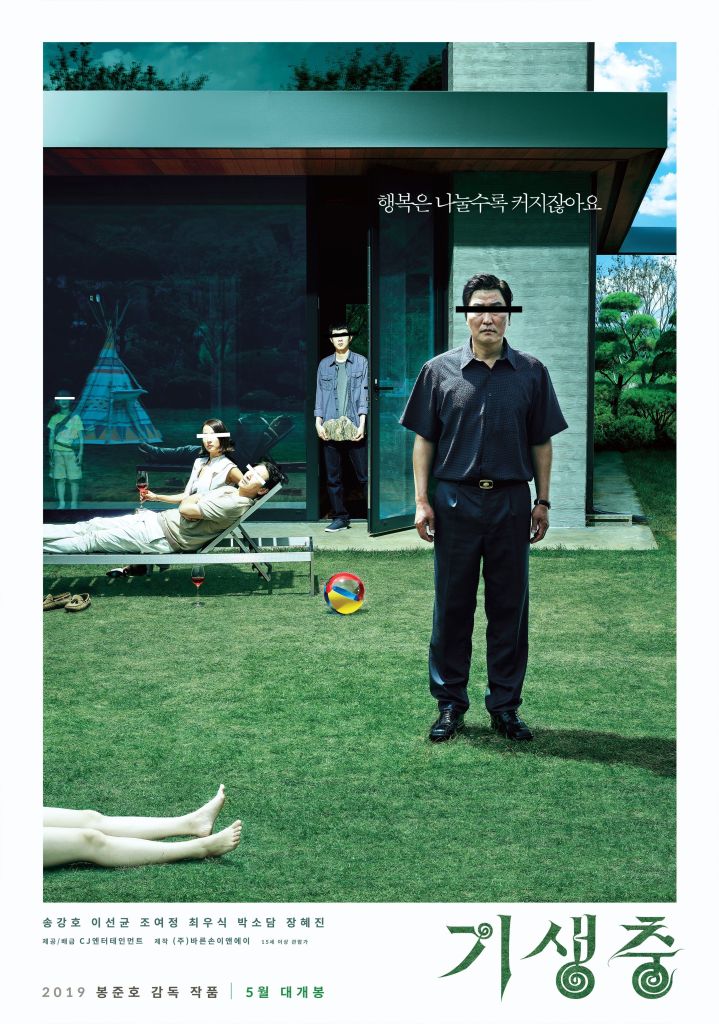
Parasite (기생충, Bong Joon-ho, 2019)

“So metaphorical!” the ambitious son at the centre of Bong Joon-ho’s class war melodrama Parasite (기생충, gisaengchung) is fond of saying, and he’s right – it really is. “Hell Joseon” rears its ugly head again, only it’s not just the young who can’t climb out but mum and dad too. Sticking together all the way, this enterprising family have realised that the only way they’re going to enjoy the fruits of the modern society is by becoming hangers on, feeding off someone else’s perhaps unfairly gotten success, and if that means stomping on a few others just like them to get there then so be it. There’s no room for love or fairness in a class war. 

The Kims – mum Chung-sook (Chang Hyae-jin), dad Ki-taek (Song Kang-ho), and grown up kids Ki-woo (Choi Woo-shik) and Ki-jung (Park So-dam), all live together in a tiny semi-basement apartment in a rundown slum. Unable to find steady jobs, the family make ends meet with casual jobs like folding pizza boxes while cadging wi-fi to look for better opportunities. Better opportunities only arise, however, thanks to Ki-woo’s upper middle-class college kid friend Min (Park Seo-joon) who brings them a special gift from his dad of a stone said to attract wealth, and a hookup for Ki-woo with a possible job coaching the pampered daughter of a superrich tech entrepreneur. After faking his credentials, Ki-woo gets the job, and wastes no time at all bringing in his sister as an “art tutor” for the couple’s apparently “troubled” young son. Together, they conspire to get the chauffeur fired so dad can take over, and then plot to do the same to the housekeeper so mum can come too, colonising the house and living alongside the wealthy Parks with a view to someday ousting them. 

The house, a fabulously modern take on the traditional designed by a famous architect who sold it to the Parks when he moved to France, is a kind of “host” in itself. We might not all admit it, but there are few of us who would not want to live in a house like this, especially if we feel it has been deliberately placed out of our reach. The Kims are envious, yes, but not perhaps malicious. They simply want a kinder life, one free of the anxiety of always having nothing and then getting that taken away from you too. In a running gag, a drunk keeps peeing right in front of the Kims’ window, and later they literally find themselves drowning in a river of shit when torrential rain causes the local sewer system to backup and flood their fetid, low-lying slum forcing everyone into a makeshift “evacuation” centre where insincere public servants try to make excuses about not being bothered enough to make sure those with no money don’t drown just because it rained. 

The Kims aren’t bad people, but their desperation means they can’t afford to be kind. The true “villains” of Parasite aren’t the Parks or the Kims themselves, but the system which forces one set of oppressed people to oppress another. The Kims know they’re responsible for displacing people just like them – getting the driver fired, going after the housekeeper, etc, but they can’t afford to think about it, pausing only to wonder if maybe they found other jobs once they themselves start to feel comfortable. “She’s rich but still nice” Ki-taek says of Mrs. Park (Cho Yeo-jeong), only for his wife to counter no, “she’s nice because she’s rich”. Mrs. Park can afford to be nice because she has plenty. She has no need to worry about taking things from others, and is secure enough not to have to worry about people taking things from her. That makes her easy pickings for a family like the Kims, but it also hints that “niceness” is the natural condition of being human, the way we’re supposed to behave to each other in an ideal world where none of us are hungry or afraid. 

Then again, the Parks are not wholly “nice” even if they are polite in a superficial, wholesome sort of way. Mr. Park (Lee Sun-kyun) in particular has a curiously feudal outlook in which he is perpetually preoccupied with the idea of his servants “crossing the line”, making it plain that there is a clearly defined border between those who rule and those who serve. The Parks’ young son is the first to notice that the Kims all smell the same even if he does so innocently, they all obviously use the same soap and detergent after all. Mr. Park, however, later takes it further, complaining about the way Ki-taek stinks up his car, resenting the smell of “poverty”, the mustiness born of living with damp and mould. To him, the Kims are not so much different from stink bugs, squatting in his home, members of “the great unwashed” unfit for his society. 

He does, however, need them. The Parks are as dependent on the Kims as the Kims are on the Parks, and they all need the house. Unfortunately, peaceful coexistence seems to be a distant possibility in a world of such fierce inequality as to encourage the most casual of cruelties. “All you have to do is walk up the stairs” Ki-woo later tells his father, but that’s easier said than done, especially when everything is telling you that you’ll always belong in the basement. 


Parasite is released in UK cinemas on 7th February.

UK release trailer (English subtitles)