Rebels of the Neon God (青少年哪吒, Tsai Ming-Liang, 1992)

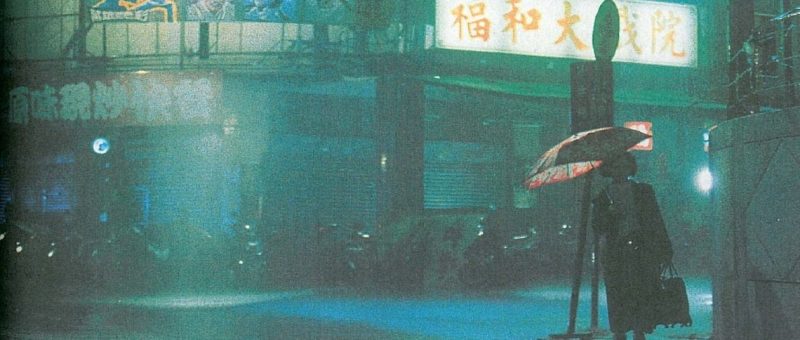
Towards the end of Tsai Ming-liangs’s Rebels of the Neon God (青少年哪吒, Qīngshàonián Nézhā), a young man exasperatingly stuffs a series of rags into the busted drain in his kitchen which has been relentlessly leaking water all over the apartment. In many ways it’s a kind of metaphor for his life as he attempts to staunch the flow of “bad luck” he’s been experiencing over the last few days, but like so many things for him it does not quite go to plan. 

As to why, it’s not exactly clear except that A-tze (Chen Chao-jung) is a kind of outcast beneath the neon skies of a changing Taipei. He and his friend A-ping (Jen Chang-bin) earn their money breaking into telephone boxes and vending machines for loose change before at one point stealing the motherboards from arcade consoles and unsuccessfully trying to sell them back to the person they stole them from. All they get for their pain is a literal battering while A-tze’s frustrated romance with sometime girlfriend Mei-kuei (Wang Yu-wen) similarly flounders in the wake of his ennui. 

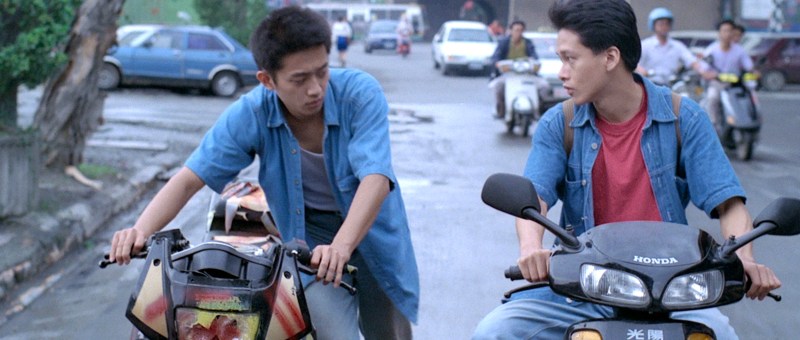
The karmic debt he bears is however mainly down to a random act of pointless violence in knocking the wing mirror off a taxi driver’s car for no real reason save momentary impulse. Even so, the taxi driver’s son Xiao-Kang (Lee Kang-sheng) had already been watching him and soon discovers a fascination with the rebellious young man that is ambiguous in quality. What becomes obvious is that Hsiao-kang is at odds with the world in which he lives. His mother (Lu Yi-ching) reveals that a fortune teller told her he is the reincarnation of “Neon God” Nezha, a chaotic child who later killed the authoritarian father with whom he could not get along. Hsiao-kang’s mother tells this to her husband (Miao Tien) as a kind of warning, advising that his authoritarian parenting style is doing his son no good, but Mr. Lee isn’t minded to listen. Finding out that Hsiao-kang has dropped out of cram school and kept the refunded tuition money for himself, Mr. Lee throws him out which of course leaves him free to follow A-tze all around Taipei day and night before childishly damaging his motorcycle. 

In disabling the bike, Hsiao-kang perhaps hoped to ruin A-tze’s freedom, symbolically taking from him independence and a sense of possibility. Then again, perhaps in another way he hoped to engineer a friendship. Riding around on his own scooter, he draws up behind A-tze pushing his to a garage and offers help but A-tze tells him to buzz off. In fact, A-tze never acknowledges Hsiao-kang. He never recognises him or realises that he’s being followed though he does later remember Mr. Lee and is struck by guilty futility not really knowing why he decided to arbitrarily ruin someone’s day while reflecting that all his days are ruined. The water in his apartment continues to rise all around him as if emphasising his mounting sense of despair. Mei-kuei tries to break up with A-tze before asking him to go away with her. They ask each other where they would go, but neither has any answer. 

A remorseful Mr. Lee later comes home and makes the point of leaving the front door ajar, symbolically open to his son’s return while Hsiao-kang remains lost. He visits a telephone dating service having heard Mei-kuei moonlight by answering one while working at the ice rink, but in the end cannot even pick up the phone. Staring at a picture of James Dean, he longs for the sense of rebellion he is drawn to in A-tze but is still the chaotic boy, dancing wildly like a wheelless Nezha and seemingly with no further sense of direction. In the end, it’s the city of Taipei which is the “neon god” of the title, arbitrarily ruling over each of the boy’s lives even as it ironically emerges from the authoritarian past into hypermodern urbanity. Hsiao-kang is little better off than the cockroach he ironically skewers on the point of his compass, and A-tze little than that which circles his overflowing drain carried inexorably on the current on a circular journey towards nowhere in particular. Many of Tsai’s key themes are already here, urban alienation, loneliness, futility, and the crushing sense of emptiness of life in the contemporary era even as he turns his gaze to the overcast skies of a city lit only by despair.


Rebels of the Neon God screened as part of this year’s Queer East .

Trailer (Traditional Chinese / English subtitles)

The Personals (徵婚啓事, Chen Kuo-fu, 1998)

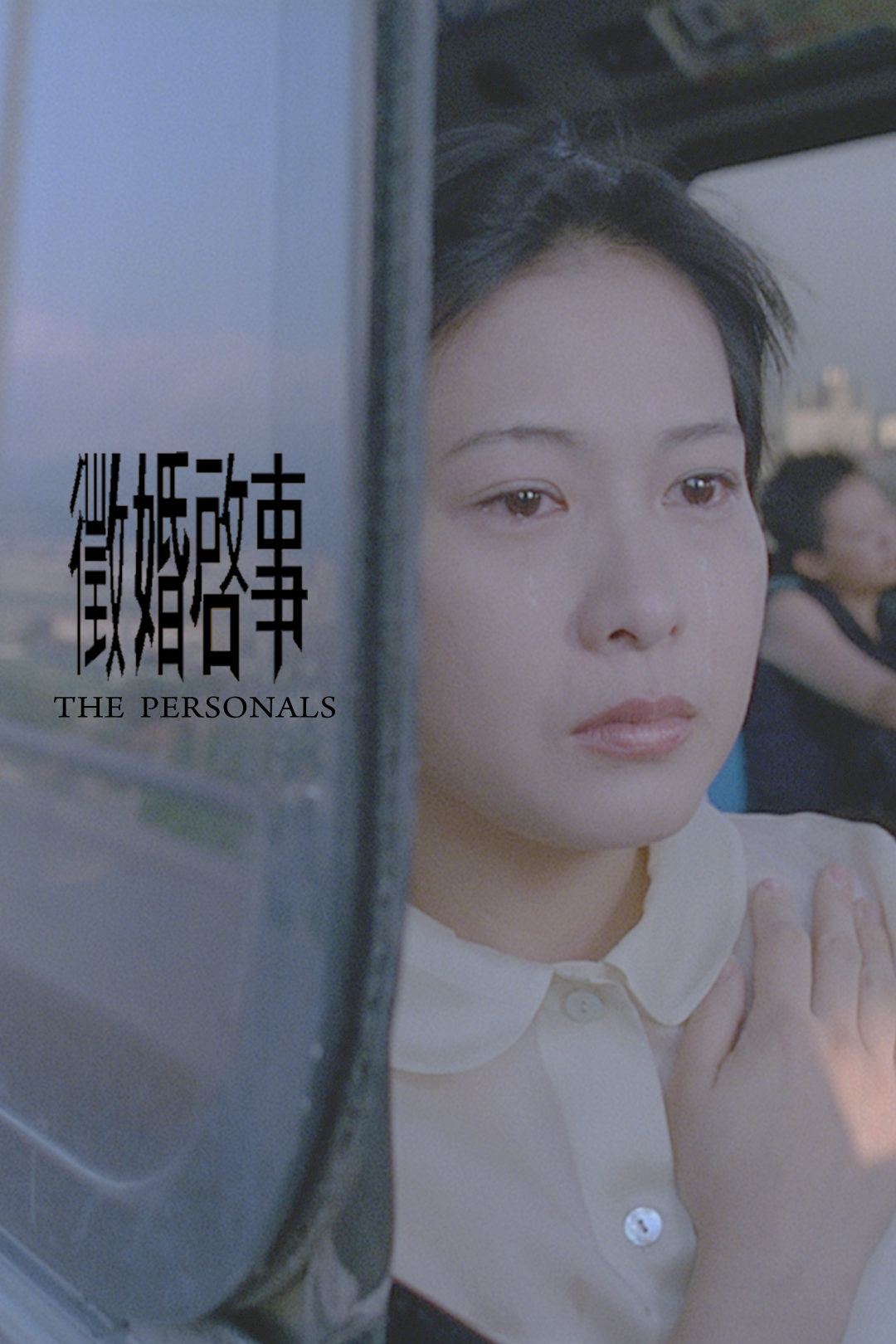
Looking for love in all the wrong places, a Taipei career woman suddenly decides to give up her life and place a personal ad stating that she’s looking for a husband, “Who knows, maybe I’ll find happiness” she unconvincingly explains. Chen Kuo-fu’s sophisticated dramedy The Personals (徵婚啓事, Zhēnghūn Qǐ Shì) sends its heroine on a dating odyssey through the contemporary capital but is at heart the story of a woman learning to see herself while grieving a failed relationship and the married ex who won’t return her calls. 

Tu Chia-wen (Rene Liu Ruo-ying) was a successful eye doctor at a Taipei hospital, explaining to a patient that some people lose the ability to produce enough tears after the age of 30, but abruptly quits her job later claiming that she wanted sever connections with her past which is another reason why she’s decided to place an ad rather than asking friends to set her up with eligible bachelors. Implicitly, it also seems that Chia-wen feels her status as a doctor may be intimidating to some men in the still patriarchal society, if also a clue to her true identity which she has otherwise chosen to keep hidden going instead by the name of Miss “Wu” which just happens to be the name of her lover’s wife. 

Of course, it’s illogical to use a false identity if your end goal is finding a life partner, a factor which later feeds in to Chia-wen’s half-hearted conclusion that it isn’t the fault of the men she’s been meeting that they didn’t hit it off but her own in that she’s so far failed to fully “open up” to any of them. Despite newspaper personal ads not featuring photos, Chia-wen receives 100 messages in the three days after her details are posted from a varied cross section of applicants some more suitable than others. One gentleman who unconvincingly claims to be in his 30s reels off his CV as if he were introducing himself at a job interview while wearing a cheerful farmer-style straw hat. A factory worker chews betel nut and smokes tobacco at the same time while exposing an insecurity over his financial situation in complaining that modern women are too materialistic. One suitor is a woman who struggles to explain her gender and sexual identity with the terminology of the time causing Chia-Wen a degree of consternation. Another potential date is a shoe fetishist with a large suitcase intent on some kind of cinderella role-play closely followed by an executive who enthusiastically explains his only hobby outside of drinking is an encyclopaedic knowledge of S&M porn, while a son brings his father as a potential match because his mum’s “gone abroad” and in a heartbreaking moment a worried mother tries to negotiate on behalf of her son who appears to have learning difficulties and might not be sure what’s going on, hoping to find someone to look after him when she’s gone. 

It may be a biased sample, but it doesn’t speak well for the men of Taipei and that’s without even getting into the guy trying to recruit Chia-wen as a high class call girl, the obvious married man after no strings sex, or the salesman trying to peddle women’s self defence equipment with a case full of tasers and pepper spray. Chia-wen pours out her frustrations in daily calls to her ex’s answering machine, leaving long messages she knows he won’t reply to but somehow it makes her feel close to him. Gradually through her monologues we begin to piece together the trauma that she’s struggling to accommodate while a late and unexpected twist keys us in to the cosmic tragedy of her frustrated romance. “Choose what you can endure” she’s advised by a professor friend who confesses to her that he’s chosen to suppress his homosexuality out of a desire for a “normal” life as a husband and father hinting at the still conservative nature of the contemporary society. 

It’s not until she’s caught off guard by a potential match seeing through her ruse that Chia-wen begins to reconsider her experiment, eventually captivated by a sensitive young man who’s not long come out of prison but has an endearingly awkward smile that reminds her of her own. She meets each of the men in the same cafe where she had her first date with her former lover, taking on a slightly different character as she attempts to interview them about their lives, getting to know their hopes and desires often tinged with a note of loneliness or despair. They seldom seem very interested in her, but instantly propose marriage or at least some sort of serious courtship without even finding out about her hopes and aspirations in life. Chia-wen’s often comical encounters from the teenage boys trying their luck to the old men taking their last chance each expose something of contemporary gender dynamics as well as hinting at increasing urban loneliness and romantic desperation but in the end it’s herself Chia-wen must face in learning to let go of past trauma in order to give herself permission to move on in her ever evolving quest for love.


The Personals streams in the UK 25th to 31st October as part of this year’s Taiwan Film Festival Edinburgh.

Trailer (Traditional Chinese / English subtitles)
Goodbye, Dragon Inn (不散, Tsai Ming-Liang, 2003)

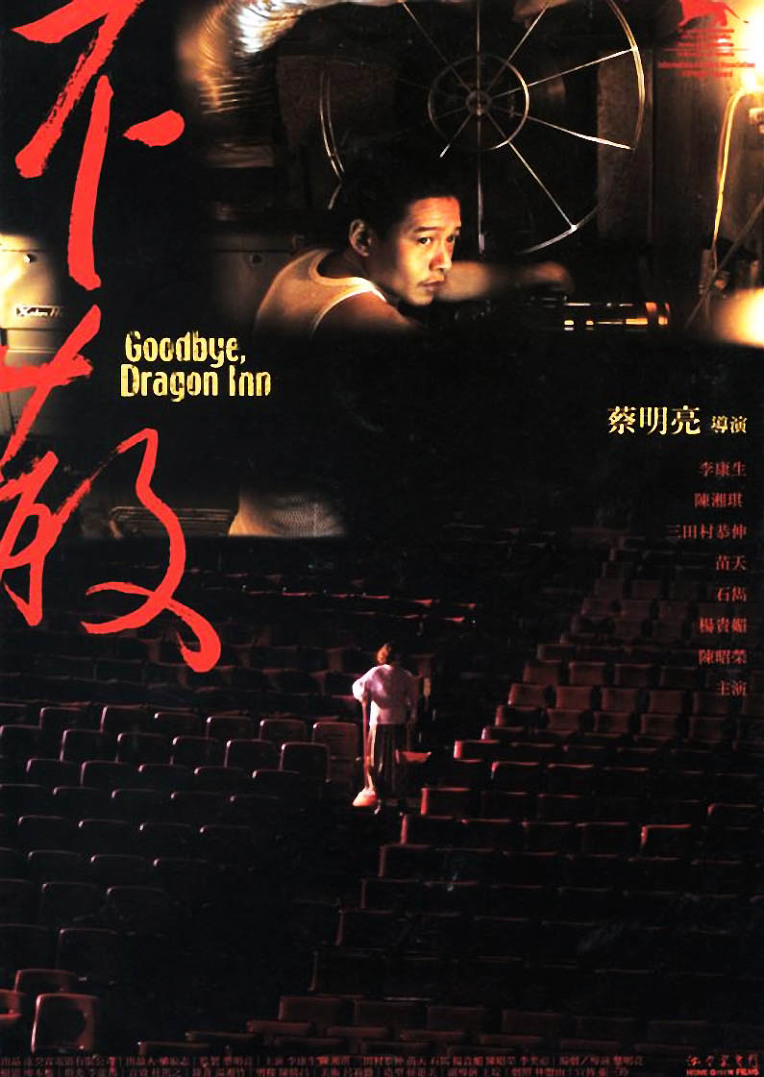
Goodbye, Dragon Inn poster“So much of the past lingers in my heart” laments the melancholy song which closes Tsai Ming-Liang’s Goodbye, Dragon Inn, (不散, sǎn) “I’ll remember with longing forever”. What is cinema if not an expression of irresolvable nostalgia, a kind of visual hiraeth for something that probably never quite existed but is so painfully missed. Everything in here stayed the same, but everything outside changed and now the present seems to be literally raining in leaving the last few fugitives from reality lost in halls of memory like lonely ghosts trapped on the wrong side of the screen.

On the wrong side of the screen is where we find ourselves. We begin in darkness with the opening narration from King Hu’s 1967 wuxia masterpiece Dragon Inn before the curtain in front of us begins to flicker and reveal an entire theatre filled with people. We pull back, and eventually the people are gone leaving just a few desperate souls returning to watch this now classic picture on what could be its very last evening as this theatre – now so unsuitable for the modern cinema environment, will be closing “temporarily” as soon as the reels stop turning.

Truth be told, no one much is even very interested in the movie. Some have merely come in to shelter from the rain, but unfortunately for them not even here is safe thanks to a leaky roof. The dazzling labyrinths of the backstage environment seem to have been co-opted by the local cruising community, men brushing past each other looking for another like them but needing to be sure their desires will be returned. Meanwhile they gaze at each other in the dim half light of the cinema screen, aching with unspeakable longing.

Longing is also something on the mind of an older gentlemen, seemingly the only one actually watching the film, who turns out to be one of its actors shedding a silent, solitary tear for time passed. Running into a friend much like himself outside he laments that “No one comes to the movies anymore”. Everyone has forgotten them, turning them into ghosts of cinema, immortal but unremembered. They have, in a sense, been attending their own funeral, entombed inside a moribund building lit only by spectres of the past.

All this is, however, secondary to the backstage drama of the lonely box office cashier (Chen Shiang-chyi) and her inexpressible crush on the projectionist (Lee Kang-sheng) who never seems to be around when she needs him. Sadly cutting into a celebratory bun, she saves half of it for him – the least ambiguous expression of love which seems to be possible within this space. Slowly climbing the stairs with a lame leg, she gazes fondly at the screen while the heroine fearlessly dispatches a series of bad guys, but the light cast on her face seems only to emphasise her lack of courage before she sadly retreats back to the ticket booth where no customers require her services.

Meanwhile, in the auditorium, a young woman (Yang Kuei-mei) munches peanuts and throws her legs over the backs of the seats in front much to the chagrin of the confused tourist whose confusion seems only to deepen when the crushing noise stops and the woman disappears (unbeknownst to him she’s on a mission to retrieve a lost shoe, or perhaps has evaporated into thin air). The first words spoken, which occur at the 45 minute mark, are to state that this theatre is haunted. Departed spirits all, the lonely denizens are indeed haunting the room and themselves as they attempt to escape the relentless march of the modern world through self-internment in a damp and crumbling mausoleum of cinema.

A lament for a dying world stripped bare by the passage of time, Tsai’s exploration of urban loneliness is a nostalgic elegy for a simpler age, filled with unresolvable longing and the ironic misconnection of an individualised communal activity. Stillness and solitude define all for these lonely, disconnected souls chasing oblivion. The past can never return, nor can the missed opportunities and brief moments spent bathed in celluloid splendour, but then perhaps you wouldn’t want it to anyway because then you couldn’t miss it. “I’ll remember with longing forever” – romanticism at its finest, but it’s a trap that’s difficult to resist.


Goodbye, Dragon Inn screened at Tate Modern as part of the Taiwan Film Festival UK 2019 and The Deserted film series.

International trailer (dialogue free)

Liu Lian by Yao Lee – the poignant song playing over the end credits.