Hero (英雄, Zhang Yimou, 2002)

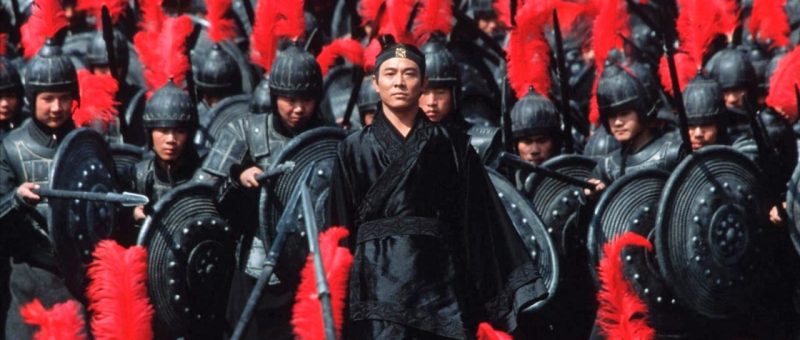
In the closing moments of Zhang Yimou’s Hero (英雄, Yīngxióng), what we see is an empty space. The outline of a person surrounded by arrows, or perhaps the doorway they protected with their body that nevertheless remains closed. On its initial release, Zhang’s film received criticism for what some saw as an overt defence of authoritarianism. After all, what we may come to understand is that the hero of the title is the Qin emperor (Chen Daoming), the founder of the modern China, but also in historical record a brutal tyrant whose tyranny is therefore justified in the name of peace, just as contemporary authoritarianism is justified in the name or safety and order.

This reading is only reinforced by the demeanour of Qin himself who condemns the nameless “hero” to death because he has chosen authority and this is what authority demands. No forgiveness, no compassion, only brutality and an iron first. Yet he cries because he is a compassionate man and understands the sacrifice he is asking his remorseful assassin to make. He does not do it because he is cruel or out of vengeance or anger, but because he believes it necessary to ensure peace for “all under heaven”. Now we may find ourselves asking again if the assassin is the hero after all because he willingly submits himself to and sacrifices himself for a tyrannous authority because he believes it to be the best and only choice that he can make for the wider society.

Nevertheless, there is something chilling in the vision of a thousand arrows flying toward one man who does not flinch while the man who ordered them sent appears to shake with his own power. The soldiers retreat, and the king is left alone, dwarfed by the immense architecture of the palace and the blood-red calligraphy of the character for sword reimagined by another potential hero whose name echoes his final conviction that in the end the apotheosis of the swordsman lies in the realisation that there is no sword. It’s this that leads him to abandon is own desire to assassinate the king and submit himself to a greater authority in the name of peace. In the end what he rejects is the tyranny of the sword itself, yet the king is also an embodiment of that tyranny because his authority is only possible through terrifying violence. 

In this way, the assassin, ironically named “Nameless” (Jet Li), may stand in for the everyman refusing to bow to the authority of a corrupt king who cares only for power. In one of the many tales he tells, Nameless remarks that he fought with the first of Qin’s three assassins in his mind and it’s true enough that what passes between the two men is a duel of words which is eventually won by the king. Qin tells Nameless of his desire to increase his influence beyond the other six kingdoms of Warring States China and create an empire that encompasses “all under heaven”, but Nameless later cautions him to remember those who gave their lives for the highest ideal, peace, and refrain from further killing. The closing title card is displayed over the Great Wall, making plain that Qin did in fact stop after conquering the six other kingdoms to unite all of China while building the wall to protect his citizens from “northern tribes,” or perhaps competing imperialists.

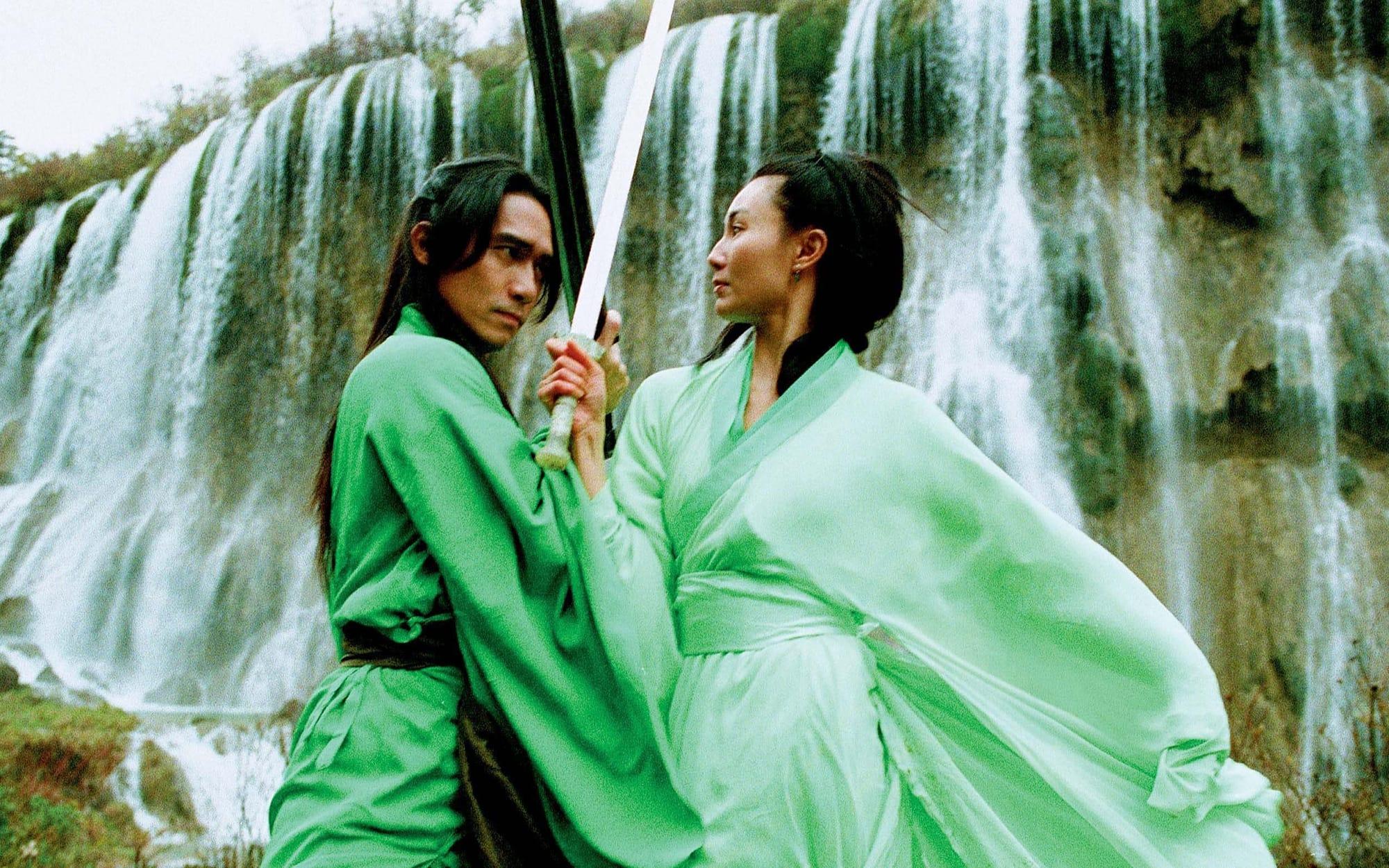
But walls keep people in as well as out and are in fact another facet of the king’s tyranny and a symbol of enduring authoritarianism. The problem is that it isn’t tyranny or authoritarianism that any of the assassins oppose for they are driven only by hate and vengeance and have no greater ideology or vision for the future. The argument is that peace under the iron fist of Qin is better than the chaotic freedom of the Warring States society, yet what we’re left with is nihilism. The love between assassins Flying Snow (Maggie Cheung Man-yuk) and Broken Sword (Tony Leung Chiu-wai ) is disrupted in each of the tales Nameless relates of them, firstly by romantic jealously and then secondly ideological divide. The conclusion that Broken Sword comes to is that they must not resist, but Flying Snow cannot live without recrimination with the past and the sealing of its tragic legacy. Her revolution fails, and as such “all under heaven” there is only death and only in death is freedom to be found.

The sense that these assassins are already dead is echoed in the choice of white for the final sequence of the film. Zhang frames each of his sequences in vibrant colour, the red of the first tale in which the lovers are destroyed by a supposed love triangle, the blue of the second in which tragedy and sacrifice do not so much destroy as deify it, the green of the penultimate in which jade curtains billow and fall inside the imperial palace, and finally the cold white of death in which the lovers eventually find their home leaving their surrogate child alone in a windy desert of futility. Yet each of these sequences is filled with an intense beauty and the romanticism found in classic wuxia. What remains in the mind is the balletic fight between the tragic heroine Flying Snow and the orphaned pupil Fading Moon (Zhang Ziyi) in an autumnal forest that’s suddenly drenched in red, or feet dancing across the water, an image of an idealised past and lost love among wandering ghosts with no home to go to. Here there are no heroes, only lonely souls and frustrated ideals. 
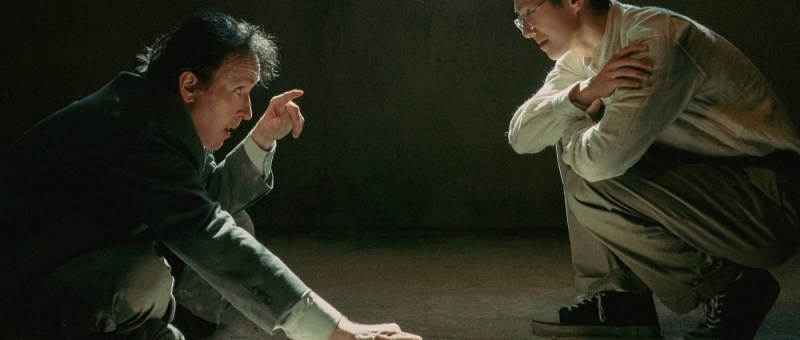

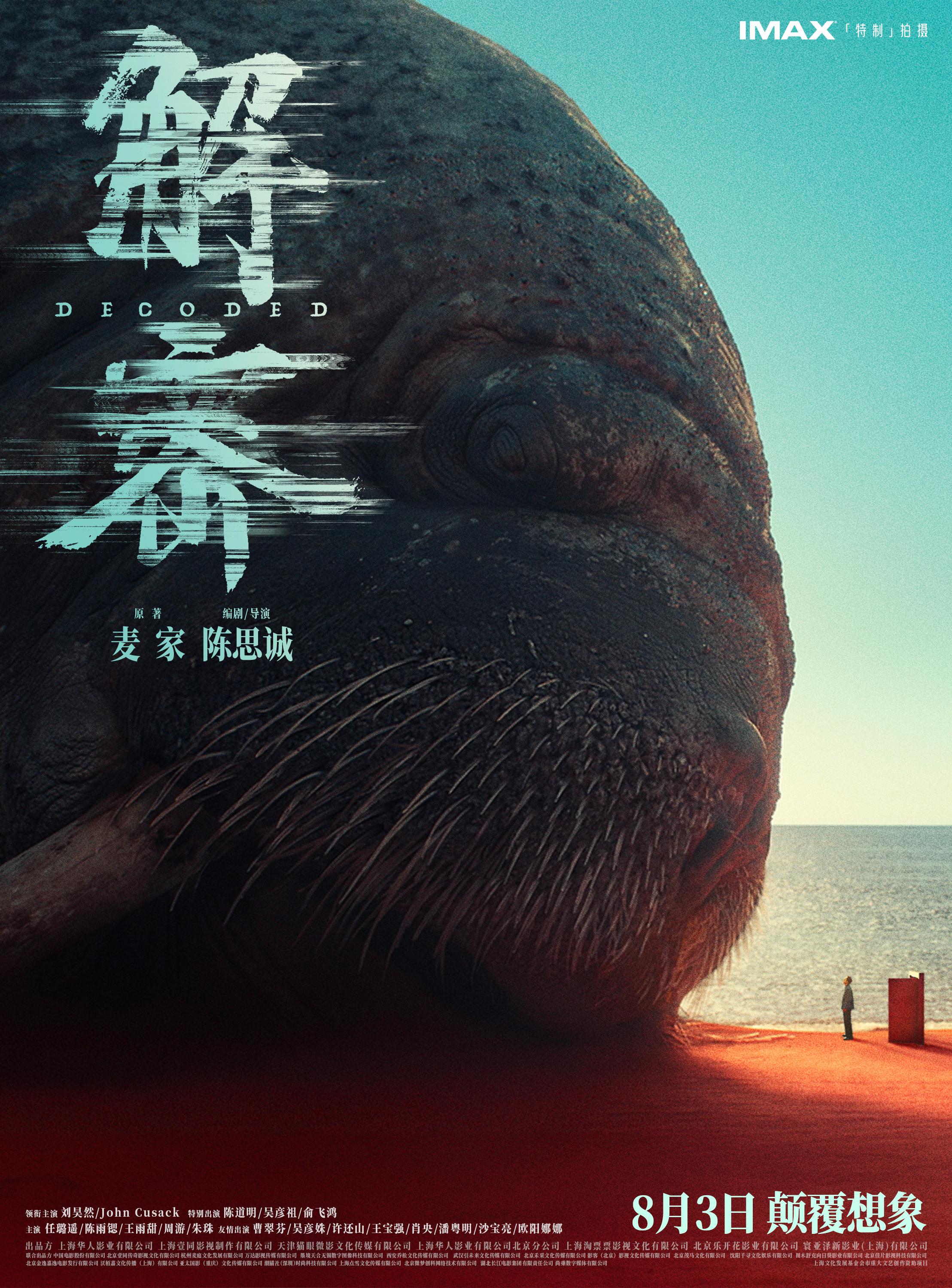
Decoded (解密, Chen Sicheng, 2024)

International geopolitics is reduced to a battle wits between two men, each in their way lonely exiles and perpetual outsiders in Chen Sicheng’s adaptation of the novel by Mai Jia, Decoded (解密, jiěmì). Originally an actor (and here making a meta self-cameo), Chen is best known as a director for the smash hit Detective Chinatown franchise which boasts both well-plotted mysteries and zany, lowbrow comedy. Decoded is a slightly different kettle of fish, displaying its own kind of whimsicality but also darker and stranger in its concentric enigmas.

The narrative’s timeline seems to be slightly hazy, but loosely follows an prodigious orphan born to a prominent family though his father, the black sheep, had already died before his mother too died in childbirth. A rather complicated set of circumstances led to Rong Jinzhen (Liu Haoran) being raised by an Austrian dream interpreter who for unexplained reasons kept him locked up in a small hut isolated from the world while teaching him all about dreams with the consequence that by the time the old man dies, 12-year-old Jinzhen is a strange boy with few social skills but a once-in-a-generation grasp of mathematics.

It’s this genius that sees him saved by distant relative Xiaolili (Daniel Wu) who was originally going to send him to an orphanage but decides adopt him instead. Jinzhen then gains early entry to university where he’s tutored by Liseiwicz, an exiled Polish professor who fled his homeland to escape persecution by the Nazis as a Jew. The film seemingly doesn’t mean to, but undermines this backstory through the casting of John Cusack who plays the part as all American and is not convincing as Polish man who ended up in China because he had nowhere else to go and is unable to return to his homeland thereby lessening the intended impact of his speeches about nationhood and patriotism which counter those Jinzheng has already been given by Xiaolili in addition to making him seem suspicious possibly long before she should. 

Nevertheless, this may also add to his sense of untrustworthiness and perhaps duplicitous treatment of Jinzheng which edges towards the exploitative in hoping to make use of his genius for his research into the evolution of computing. In the early days of the Chinese civil war, Liseiwicz is approached by agents from the PLA who want him to decode a telegram that may save thousands of lives. Liseiwicz claims he doesn’t want to get into politics though superficially supportive of the Communist cause only to later be exposed as a collaborator with the KMT on his return to the US where he designs encryption codes to be used between Chiang Kai-shek’s nationalists in Taiwan and the US troops backing him in the hope he’ll retake China and end Communism in Asia. 

Of course, Jinzheng gets picked up by the CCP to work in their secret spy division in which he becomes a virtual prisoner forbidden from leaving the compound while expected to spend all of his time breaking codes such as those designed by Liseiwicz. In truth, it becomes a kind of game between the two but one that the guileless Jinzheng little understands. It takes it him an unreasonably long time to understand that Liseiwicz is just messing with his mind, sending him misinformation as a distraction intended to drive him mad culminating in dispatching a copy of the The Beatles’ I Am the Walrus in order both to disrupt his political consciousness with decadent Western pop music and drive him out of his mind as he struggles to understand how this nonsense verse about egg men and marine animals is supposed to relate to the code.

Then again, there is something a little subversive in the celebration of Jinzheng’s ability to think about the box, instantly understanding that the correct answer to the entrance test is not to waste his time taking it because it’s obvious they’ve already cracked the code concerned. The use of dream interpretation taught to him by his adoptive Austrian father maybe simply be an ability to work things out on a deeper level of consciousness, but it’s also left him with a fragile mental state already unable to discern dream from reality. The strain of constant codebreaking further pushes him towards madness while he perhaps loses sight of his original mission, only later coming to realise that Xiaolili’s vision of nationhood was the correct one after all.

Though Chen appears to have been influenced by Christopher Nolan in his use of oneiric imagery, he crafts a number of beautifully designed, whimsical dream sequences some which later become hellish or strange but reflect an innate innocence in Jinzheng while disclosing to him something of the real world which he had not understood. It’s ironic in a sense that he’s forever trying to decode the world around him, such as in taking instructions from his adopted sister/cousin Biyu (Chen Yusi) on how to know if girls are interested which he nevertheless slightly misunderstands. The film goes to some surprisingly dark places such as in a brief sequence which Biyu and her mother seemingly if potentially anachronistically fall victim to the Cultural Revolution while Jinzheng is the victim of several assassination attempts by KMT agents well into the ‘60s. Even so his story emerges as tragedy more than triumph, a fine mind broken by the society around him and used as an unwitting tool in the nation’s path to perfecting an atomic bomb having seemingly decoded everything but his place within the world.


International trailer (English subtitles)

Under the Light (坚如磐石, Zhang Yimou, 2023)

The irony at the centre of Zhang Yimou’s Under the Light (坚如磐石, jiānrúpánshí) is that it takes place in a neon-lit city of eternal visibility, though of course where you have light you’ll also find shadows. Even so, it appears he’s trying to make a point in the plain sight nature of political corruption and it’s connections with organised crime. At heart it’s a tense cat and mouse game between two men who share some kind of sordid past, but also of how it’s the next generation that often pay in the infinitely corrupted paternity of the contemporary society.

Zhang opens with a hostage crisis as a man hijacks a bus and threatens to blow it up if he doesn’t receive a visit from deputy mayor Zheng Gang (Zhang Guoli). Zheng attends but his policeman son Jianming (Lei Jiayin), currently assigned to the tech division, notices that the bomb can be detonated remotely and it doesn’t appear the hostage taker knew that it was real. In any case, all is not as it seems and as Zheng is soon squaring off against shady businessman Li Zhitian (Yu Hewei) who invites Jianming to dinner and puts on a show by blackmailing another business owner with a sex photo before forcing him to put his hand in boiling oil. 

In contrast to his ruthless exterior, Zhitian dotes on his grown up daughter currently pregnant with her first child and about to be formally married to his business heir David (Sun Yizhou). Jianming meanwhile has a complicated relationship with his father by whom he feels rejected in part because he’s adopted. Zheng also appears to be meeting with a mysterious young woman for unclear reasons, later hinting that she’s a kind of daughter figure someone at some point asked him to protect. In a strange and probably unintended way, it’s this parental quality of protection that has been disrupted by ingrained corruption and is then re-channeled in a desire to protect society in general. When it’s all over, Jianming asks his bosses why they trusted him to make the right decision, and they tell him it’s because he told them he wanted to be a “true policeman” for the people.

Apparently stuck in limbo for four years because of censorship concerns, the propaganda thrust of the film centres on the crackdown against political and judicial corruption. Zheng is engaged in a political project to target corrupt officials but is heavily implied to be on the wrong side of the fence himself which would explain his connection with Zhitian, a supposedly self-made man who keeps a heavy pole in his living room to remind him of his roots as a lowly porter in a rural town before taking advantage of the ‘90s economic reforms to make himself wealthy beyond his wildest dreams. 

They each have hidden secrets which Jianming becomes determined to drag into the light while working with the anti-corruption officers in his precinct, as well as old flame Hui-lin (Zhou Dongyu). Zhang adds in some distinctly retro comedy vibes not least in the frustrated romance of Jianming and Huilin who at one point dangle dangerously off a building while she later bites back, “don’t deprive me of the chance to protect you. It’s what they call love” when firing a pistol at a bunch or marauding bad guys. Yet the comedy seems incongruous with infinite bleakness of the resolution in which once again the children are made to suffer as Jianming comes to a greater understanding of his origins. 

In an ironic touch, the villains are later revealed to have been dyeing their hair which is in reality already white though they are not really all that old. Playing into the themes of duplicity, it also hints at the central message that the older generation must recede and the young, like Jianming, learn to find an accommodation with their failures in order to reclaim a sense of justice. Then again, the film itself is quite duplicitous with a series of glaring plotholes including a giant one relating to the DNA identification of a missing woman whose body is finally dragged into the light. Huiling warns Jianming that there are some boxes it’s better not to open. At the film’s conclusion he may wish he’d listened, but his job is to drag truth into the light and not least his own. In any Zhang’s infinitely bright, ever illuminated city of neon and glass has a host of hidden darkness only temporarily exorcised by the unusually lengthy parade of the now standard title cards explaining that the wrongdoers were caught and punished while deprived of their ill-gotten gains no matter how much it might seem that crime really does pay.


International trailer (Simplified Chinese / English subtitles)

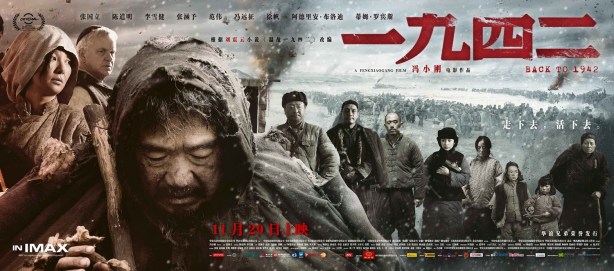
Back to 1942 (一九四二, Feng Xiaogang, 2012)

back-to-1942-poster08Review of this (slightly stodgy) war time starvation drama up at UK Anime Network.


Feng Xiaogang might not exactly be a household name in the West but at home he’s one of China’s most bankable directors. Dubbed the Chinese Spielberg (perhaps a little reductively) he made his name with a series of crowd pleasing comedy films that had audiences queuing ‘round the block in expectation. In recent years, he’s moved away from the comedy genre in favour of big budget, Hollywood style dramas centred around historical events like the 1976 Tangshan Earthquake in Aftershock or the Civil War themed Assembly. Back to 1942 sees him step back even further in time to one of China’s great hidden tragedies, the great Henan famine of 1942.

In 1942 China was in a precarious political position as it faced the ongoing Japanese incursion and came under increasing pressure to align itself with Japan’s enemies as part of the wider global conflict. A serious drought could not have come at a worse time as ever dwindling resources were pulled in several directions at once. The story here concerns the landlord, Fan, who had originally a sizeable grain store set aside to feed his family and retainers. However, after his village is raided by bandits he too is forced to travel westwards in hope of finding better supplies. Along with his wife, pregnant daughter-in-law, daughter and servant as well as another family from the village he faces increasing hardship as he tries to find food to survive. Meanwhile an American journalist employed by TIME magazine has got wind of the story and is trying to get something done about it but to no avail. The government has the war effort as its top priority – what does it matter if a few peasants die as long as the army remains well fed.

Politically speaking, you can get away with talking about ‘unpleasant’ historical events assuming that they happened before the communist revolution. The finger here is pointed quite squarely at Chang Kai-shek and his nationalist government who are portrayed not only as unfeeling and self interested but also as ineffectual when it comes to the business of conducting war with the Japanese. Indeed, at once point Chang suggests simply ceding Henan to the Japanese rather go to the expense of defending this barren stretch of land. Though it is clear he is aware of the extent of the famine, he does little about it until eventually sending “emergency supplies” to “the disaster area” to try and alleviate the damage to his reputation and diplomatic relations with other powers when news of the famine finally reaches them after the conflict. Though the local governor appears genuinely concerned and does his best to get help for the starving people (even if it’s only to alleviate the ridiculous burdens placed on them to supply grain for the army even though there is none) he is hamstrung by the top heavy hierarchical system.

No help is going to come from the government for Fan and his family. They might have been bigwigs once but now they’re in the same boat as everyone else – forced on a virtual death march through the arid land desperately trying to find anywhere that will yield to them the resources to survive. Bodies litter the landscape as the weaker succumb to starvation, donkeys and pack horses are eaten and finally wives and children are bought and sold in the hope of surviving a few hours more. Make no bones about it, Back to 1942 is almost two and a half hours of pure misery as one tragic yet inevitable event follows on the next. Unfortunately, Feng has laid the gloom on a little thick in this understandably bleak tale. The tone never wavers and somehow the constant nature of its sorrows fail to engage as they take on a sadly predictable air. Despite the obvious potential of the story, there’s precious little actual drama and the performances fail to capture the audience’s sympathies as Fan & Co. forced into increasingly degrading acts trying to ensure their own survival.

However, Back to 1942 was an expensive production and you can see all of that money on screen as the battle and action sequences rival those of any Hollywood blockbuster. Whatever reservations there may be with the plotting, it always looks good and you could never accuse it of skimping out on its production design. The only minor criticism may be that the performances of non-Chinese actors feel significantly under rehearsed with Tim Robbins’ priest being the obvious example as he struggles with a strange accent and unclear position in the narrative. Adrien Brody fares better as the idealistic reporter but still fails to convince. The film doesn’t quite seem to know where to put itself when it comes both to the role of religion and of other powers active in China at this time and though neither of those ideas are at the forefront of this film, they muddy the waters in ways other than intended by the filmmaker.
An often beautifully photographed film Back to 1942 is also a cold one and given its depressing subject matter something of a chore. The famine that struck the Henan region in 1942 and subsequent (non) reaction to it from the powers at be is indeed something that should be addressed and brought to light in the modern world but perhaps it doesn’t need to be in such a blunt fashion. The film is long, and wearing but ultimately fails to connect with the viewer in a non cynical way making its drawn out proceedings a little on the tedious side for most viewers. Those with a taste for sentimental melodramas with high production values may find a lot to enjoy with Back to 1942 but those who prefer a more nuanced drama will likely leave disappointed.