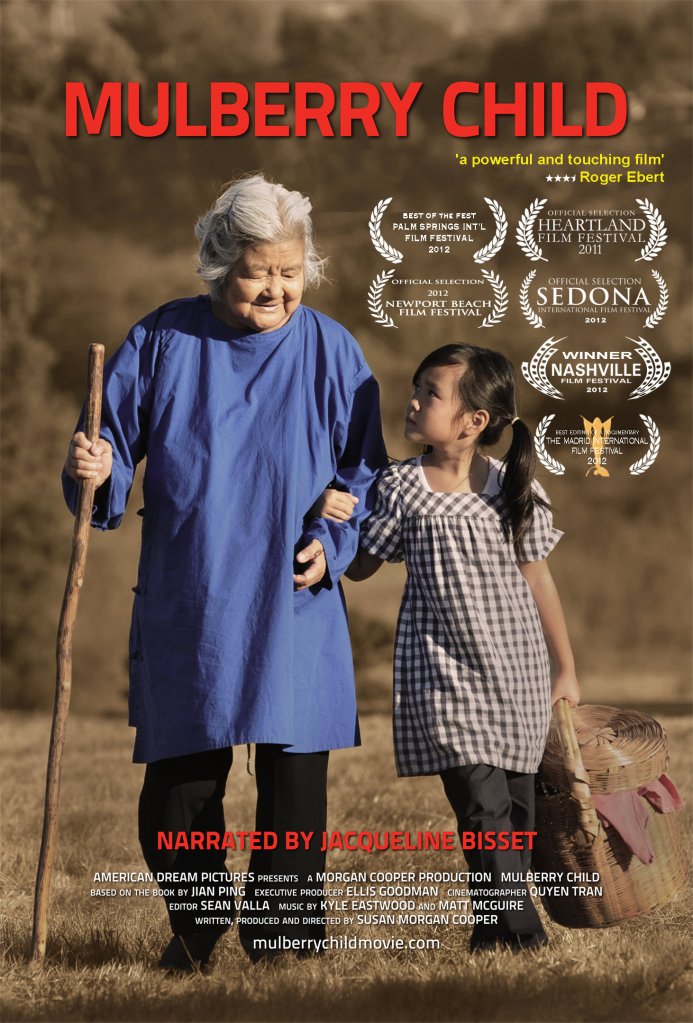
Mulberry Child (Susan Morgan Cooper, 2011)

Unavoidably, it can be difficult for parents and children to understand each other. They come from different times and places, and the relationship will always be strained by the weight of conflicting expectations. All these things are true no matter where each of you were born or raised, but they are perhaps exacerbated by a degree of cultural dislocation. Author Jian Ping, the subject of Susan Morgan Cooper’s documentary/drama hybrid inspired by Ping’s memoir Mulberry Child, attributes the distance between herself and her Westernised daughter Lisa to just this fact, worried that in bringing her to America for a better life she may have made a mistake. At once silently proud of everything she has achieved, she also fears that Lisa takes her easy life for granted and has “forgotten” the hardships her family once faced during China’s Cultural Revolution. 

It’s telling in some ways that Jian asks Lisa to read her book rather talking to her directly, hoping that by learning about the brutalisation of the Mao years and the echo of its affects in her family alone might help to explain something to her about why she is the way she is. There’s no getting away from the fact the relationship between the two women is strained beyond the normal degree, Lisa keen to defend her Americanised way of life and apparently unable to understand her mother’s attitude to money which she sees merely as a means to an end rather than something to be accumulated for its own sake. That might in part be less culture than class, in that Lisa at least appears to have enjoyed a high standard of life and it’s difficult to appreciate the powerful desire for material security if you’ve never been without it, but also leads back to a conflict between the two women’s ideals of a “good” life and the disconnect in the their essential ideals. 

Born in China but living in America since she was 4 1/2, Lisa claims not to feel resentful towards her mother for having temporarily left her behind in China with her grandparents while studying abroad. Nevertheless, she is very frank in voicing hostility, devastatingly stating that she feels like a guest in her mother’s home while later recalling a solitary childhood, leaving at 15 for boarding school. She feels as if she was raised to be self-sufficient and finds her mother’s “sudden” desire for closeness odd, declaring the 1.5 mile journey to her mother’s apartment too inconvenient to make with any regularity. Lisa also feels very little connection to her family in China whom she views as quasi-strangers, while Jian perhaps feels that the fact they are family is enough to bind them no matter what. 

What Lisa comes to understand through her journey to China is less a grasp of cultural history than that there are different ways of showing love and some of them are easier to understand than others. Jian too wrestles with the same thing, recalling her childhood with her own mother whom she regarded as cold and distant, preferring her warm and kindly grandmother whose feet were bound, knowing that her grandmother too was shaped by the times in which she lived in that she was raised to be loving and affectionate but mainly in order to serve men. Jian’s mother came of age during turbulent times and saw freedom in Mao’s promises of an end to feudalism which also included an end to cruel traditions such as foot binding and the promise at least of sexual equality. But the Party demanded total loyalty, and in times such as these emotion was a liability. Jian internalised the lessons of her mother and grandmother and learned to bear her sorrow in silence with grace and fortitude. Her grandmother told her to be strong like the mulberry tree so as never to break, emotional repression as a tactic for survival. She made sacrifices for a better life for her daughter, but her daughter resents her for a perceived emotional absence and for always expecting “better” in her maternal pride which, ironically, only fuels her sense of inadequacy. 

The film closes with an emotive moment of mother and daughter bonding over shared enthusiasm for the 2008 Beijing Olympic Games with Lisa suddenly declaring that China is the future as she begins to embrace her dual heritage, but does not stop to ponder how Jian’s parents, apparently also excited about the Games, felt about the modern China as those who had been among the more fervent supporters of a now abandoned Maoism. Nevertheless, Mulberry Child proves that greater intimacy can be forged only through a process of mutual understanding. Still sounding unconvinced, Lisa closes with the affirmation that they are at least “starting the process” as mother and daughter reflect on the legacies of trauma national, historical, and personal.


Mulberry Child is available to stream via Amazon Prime in the US and UK.

Trailer
Farewell My Concubine (霸王别姬, Chen Kaige, 1993)

farewell-my-concubine-1993
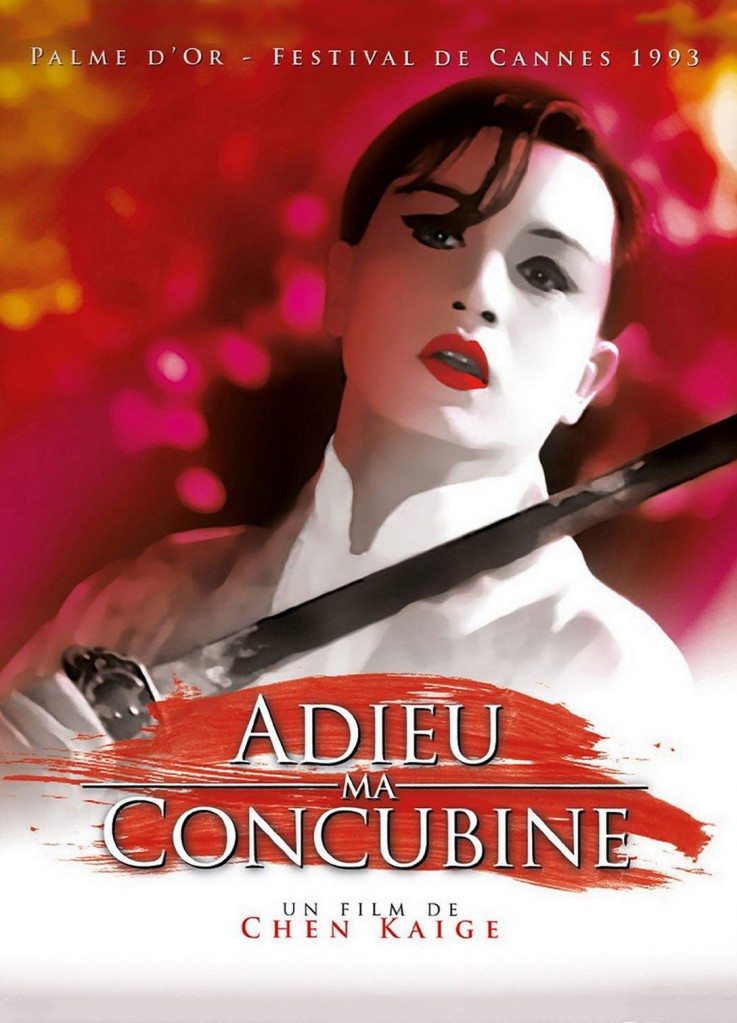
French DVD cover

Review of Chen Kaige’s 1993 masterpiece Farewell My Concubine (霸王别姬, Bàwáng Bié Jī) first published by UK Anime Network.


“Why does the concubine have to die?” Spanning 53 years of turbulent, mid twentieth century history, Farewell My Concubine is often regarded as the masterpiece of fifth generation director Chen Kaige and one of the films which finally brought Chinese cinema to global attention in the early 1990s. Neatly framing the famous Peking Opera as a symbol of its nation’s soul, the film centres on two young actors who find themselves at the mercy of forces far beyond their control.

Beginning in 1924, Douzi (later Cheng Dieyi) is sold to an acting troupe by his prostitute mother who can no longer care for him. The life in the theatre company is hard – the boys are taught the difficult skills necessary for performing the traditional art form through “physical reinforcement” where beatings and torturous treatment are the norm. Douzi is shunned by the other boys because of his haughty attitude and place of birth but eventually finds a friend in Shitou (later Duan Xiaolou) who would finally become the king to his concubine and a lifelong companion, for good or ill.

Time moves on and the pair become two of the foremost performers of their roles in their generation much in demand by fans of the Opera. However, personal and political events eventually intervene as Xiaolou decides to take a wife, Juxian – formerly a prostitute, and shortly after the Japanese reach the city. Coerced by various forces, Dieyi makes the decision to perform for the Japanese but Xiaolou refuses. After the Japanese have been defeated Dieyi is tried as a traitor though both Xiaolou and Juxian come to his rescue. The pair run in to trouble again during the civil war, but worse is to come during the “Cultural Revolution” in which the ancient art of Peking Opera itself is denounced as a bourgeois distraction and its practitioners forced into a very public self criticism conducted in full costume with their precious props burned in front of them. It’s not just artifice which goes up in smoke either as the two are browbeaten into betraying each other’s deepest, darkest secrets.

Farewell My Concubine is a story of tragic betrayal. Dieyi, placed in the role of the concubine without very much say in the matter, is betrayed by everyone at every turn. Abandoned by his mother, more or less prostituted by the theatre company who knowingly send him to an important man who molests him after a performance and then expect him to undergo the same thing again as a grown man when an important patron of the arts comes to visit, rejected by Xiaolou when he decides to marry a prostitute and periodically retires from the opera, and finally betrayed by having his “scandalous” secret revealed in the middle of a public square. He’s a diva and a narcissist, selfish in the extreme, but he lives only for his art, naively ignorant of all political concerns.

Dieyi doesn’t just perform Peking Opera, he lives it. His world is one of grand emotions and an unreal romanticism. Xiaolou by contrast is much more pragmatic, he just wants to do his job and live quietly. On the other hand, Xiaolou refuses to perform for the Japanese (the correct decision in the long run), and has a fierce temper and ironic personality which often get him into just as much trouble as Dieyi’s affected persona. The two are as bound and as powerless as the King and the Concubine, each doomed and unable to save each other from the inevitable suffering dealt them by the historical circumstances of their era.

The climax of the opera Farewell My Concubine comes as the once powerful king is finally defeated and forced to flee with only his noble steed left beside him. He begs his beloved concubine to run to sanctuary but such is her love for him that she refuses and eventually commits suicide so that the king can escape unburdened by worry for her safety. Dieyi’s tragedy is that he lives the role of the concubine in real life. Unlike Xiaolou, his romanticism (and a not insignificant amount of opium) cloud his view of the world as it really is.

It’s not difficult to read Dieyi as a cipher for his nation which has also placed an ideal above the practical demands of real living people with individual emotions of their own. Farewell My Concubine ran into several problems with the Chinese censors who objected not only to the (actually quite subtle) homosexual themes, but also to the way China’s recent history was depicted. Later scenes including one involving a suicide in 1977, not to mention the sheer absurd horror of the Cultural Revolution are all things the censors would rather not acknowledge as events which took place after the birth of the glorious communist utopia but Farewell My Concubine is one of the first attempts to examine such a traumatic history with a detached eye.

Casting Peking Opera as the soul of China, Farewell My Concubine is the story of a nation betraying itself. Close to the end when Dieyi is asked about the new communist operas he says he finds them unconvincing and hollow in comparison to the opulence and grand emotions of the classical works. Something has been shed in this abnegation of self that sees the modern state attempting to erase its true nature by corrupting its very heart. Full of tragic inevitability and residual anger over the unacknowledged past, Farewell My Concubine is both a romantic melodrama of unrequited love and also a lament for an ancient culture seemingly intent on destroying itself from the ground up.


Farewell My Concubine is released on blu-ray in the UK by BFI on 21st March 2016.

Original US trailer (with annoying voice over):

http://www.youtube.com/watch?v=VKHwZr6X3Og

Coming Home (UK Anime Network Review)

coming-home-film-decembre-2014-sortieZhang Yimou’s latest reviewed at UK Anime Network


Dealing with the recent past in mainstream Chinese film can be a difficult business. While you may be able to get away with making a comment on the present through looking at the pre-communist past, raising the spectres of some of the darker episodes in the post Mao Zedong China is, at best, taboo. That Zhang Yimou, more recently moving into the mainstream as one of China’s most bankable directors both abroad and domestically, has been able to make a film about the suffering endured by countless citizens during The Cultural Revolution is therefore a little surprising. However, Coming Home is far from an examination of the period’s horrors but rather a metaphor for modern China reframed as a melodrama of deep love and marital happiness frustrated by historical circumstance.

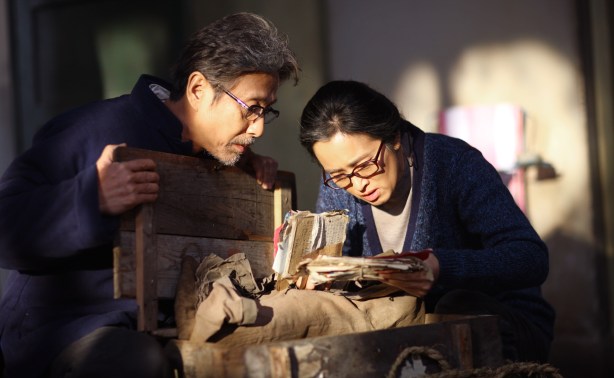
Based on The Criminal Lu Yanshi a book by Yan Geling, the central story focuses on the trio of Lu – a professor sent for “re-education” at the beginning of The Cultural Revolution, his wife Feng and their daughter Dandan. The first part of the film sees Dandan attending a ballet school and hoping to gain the lead in the upcoming propaganda ballet Red Detachment of Women. However, despite being the most talented dancer she learns she will not be chosen for a leading role because of her father’s disgrace – a situation further complicated because it transpires her father has escaped from the camp and may be trying to return home. Despite the warnings and the obvious danger, Feng is desperate to see her husband again though Dandan, who was just an infant when her father was taken away, is angry and resentful. Lu’s attempt to return ends in recapture and it’s not until the end of The Cultural Revoltion years later that he’s finally able to come home. However, Feng now suffers from mild dementia and refuses to recognise this much older version of the man she’s been waiting for all this time. Every fifth day of the month she goes to the station to wait for her husband completely unaware that he has already returned.

It’s the second half of the story that occupies the bulk of the running time as Lu’s original escape attempt becomes more or less a prologue to the main story. Having returned home, Lu tries to reawaken his wife’s dormant memories by reminding her of their shared past. Feng can take care of herself day to day though she forgets things and muddles up timescales, but is unable to acknowledge Lu as her husband. Along with the remorseful Dandan who only now understands exactly what her parents have been through, he tries to remind her of happier times by reading her letters or playing the piano as he used to do. In someways the political circumstances take a back seat here as Feng’s dementia could easily be solely of natural causes (though the film strongly suggests a blow to the head during Lu’s escape attempt and subsequent traumas maybe a partial cause of her memory loss) and Lu the loving husband trying to keep their past alive. However, the situation is further complicated as the couple have now been separated for over twenty years with no contact at all. There was immense suffering on both sides with Lu desperate to see his wife and daughter again but never knowing if he would, and his wife making great sacrifices to try and protect him in the hope that he would survive and one day return home.

The film never really goes into what Lu did, other than his having been a professor which might have been enough on its own, or probe into very much detail about his life being re-educated. Bar a final reveal and a general feeling of melancholy, it doesn’t much delve into Feng’s life other than her devotion in waiting for Lu. In fact, it sort of leaves The Cultural Revolution to one side as much as it can. However, its ambiguity is almost an analogy for the way modern China wishes to think about its past – both remembering and not at the same time. Lu endures all, suffers all only to return to a world where he doesn’t quite exist. Patiently, he tries to undo this painful knot of memory that has paralysed his wife’s brain so that he might regain something of what he’s lost but the more he tries to show her the less she seems to see. She can only recognise him as the man he is now, a kindly neighbour, and not as the man that was taken from her all those years ago and for whom she still waits. There are those like Lu who are desperately trying to reconcile the past with the present so they can move forward but there are also those like Feng who are unable to come to terms with everything they’ve suffered and accept the now for what is. The result being a kind of numb limbo which leaves everybody waiting at the station for a train which will never arrive.

Coming Home probably goes as far it’s allowed to go, but that still isn’t terribly far. As a film about China’s turbulent recent history, it’s a start but doesn’t begin to approach some of those darker themes with any kind of depth. That said, it’s really much more of an old fashioned melodrama about a faithful husband who comes home to his devoted wife after many years of enforced separation only to find that, far from having “forgotten” him, she can’t forget the him that was taken away long enough to recognise that he’s come home. Fans of romantic drama will find a lot more to like than those hoping for a hard hitting examination of horrors The Cultural Revolution but Coming Home does do what it promises in a typically polished style. A little bit stuffy and noticeably restrained, Coming Home is not exactly a late career masterpiece from the director of Raise the Red Lantern, but it does at least open a few doors.