Detective Conan: The Million-Dollar Pentagram (名探偵コナン 100万ドルの五稜星, Chika Nagaoka, 2024)

Now a sprawling multi-media franchise, Detective Conan began with Gosho Aoyama’s manga which published its first instalment in 1994 and is still going strong 30 years later. The series was released in the US in the 2000s under the name Case Closed and in a decision which was perhaps more common then than today anglicised all of the character’s names and settings (the Japanese publisher then began releasing its own English language translation of the manga maintaining all the original Japanese names and plot details). Meanwhile Detective Conan remains hugely popular across Asia and regularly tops the Japanese box office with the annual release of a feature film revolving around a major case for Conan in addition to the ongoing anime and manga.

Which is all to say it has a very well developed universe and vast cast of characters which weave in and out of Conan’s various adventures. The main thing to note about Conan himself, which is explained very briefly in a short introductory sequence to the movie, is that he’s actually a 17-year-old high school detective but his body was shrunk to the size of a small child when he was drugged by the mysterious Black Organisation after witnessing to of their agents getting up to something shady in a park. Only a handful of people know his true identity while he often works with the police solving crimes, and is common with Japanese crime fiction more often than not locked room mysteries.

The Million-Dollar Pentagram (名探偵コナン 100万ドルの五稜星, Meitantei Conan 100-man Dollar Michishirube), the 27th Conan movie, is somewhat different in this regard as it’s more of a treasure hunt in which Conan (voiced by Minami Takayama) and his associate Heiji (Ryo Horikawa) must attempt to figure out the mystery of some missing treasure which might have something to do with a pair of swords stolen by one of Conan’s arch nemeses, Kid the Phantom Thief (Kappei Yamaguchi). Like many of these kinds of stories, the mystery turns on historical detail in this case stemming back to the Meiji Restoration and legendary Shinsengumi boss Hijikata Toshizo, if by way of a long-dead industrialist who got rich quick during the pre-war goldrush in Hokkaido. Some of his estate apparently went missing after his death and now his grandson, who’s messed up the family business, wants to find it and so does Conan but for slightly different reasons. In any case, no one even knows what the treasure is and they may be disappointed when they find out especially as it might not show grandpa Onoe in a particularly good light. 

There is undoubtedly quite a lot going on with a prominent subplot focusing on Heiji’s crush on love interest Kazuha (Yuko Miyamura) and his rivalry with Kid the Phantom Thief with his big plan to finally confess his feelings aligning with the climax of the mystery taking place on Mount Hakodate. A port town in Hokkaido, Hakodate has not often been well served by cinema often appearing in indie films such as And Your Bird Can Sing, Sketches of Kaitan City, and Over the Fence as a moribund post-industrial centre the protagonists can’t escape, but here seems pleasant and relaxed as a kind of Northern Kyoto rich in period history. The film’s success has apparently spiked a mini tourist boom in the area.  

The filmmakers apparently did not want to destroy any of the town’s architecture even in animation, hoping to make the most of the city’s famous night scenes and beautiful scenery. Nevertheless, there are the usual series of impressive action sequences including one of Conan riding a jet-powered skateboard not to mention taking out a suspect with a football while Heiji fights another on the wings of a biplane. As for the mystery itself, it’s not the kind where the audience will be able to work it out seeing as it depends on very specific cultural knowledge that even Conan needs a hint to key into but eventually broadens into something more international involving arms dealers and corrupt businessmen. Long-standing fans of the franchise will want to stay put for a very interesting post-credits sequence and even newcomers will get a kick out of an unexpected punchline to the film’s closing moments. All in all another classic case for the Conan team peppering its key mystery with the humour and warmth the franchise is known for.


Detective Conan: The Million-Dollar Pentagram opens in UK cinemas 27th September courtesy of CineAsia.

Original trailer (Traditional Chinese & English subtitles)
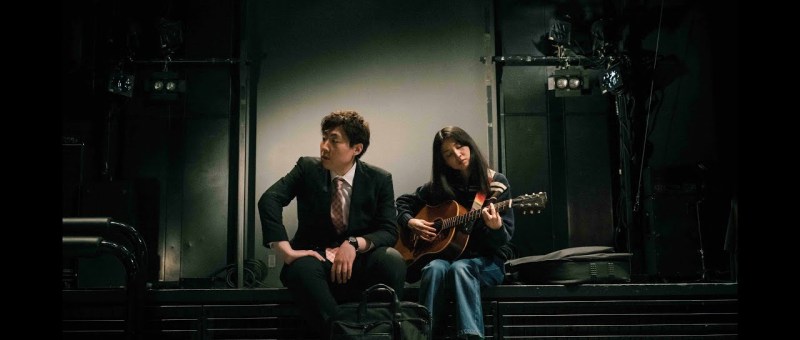
Tsujiura Renbo (辻占恋慕, Daisuke Ono, 2021)

Is there a point at which you should accept your artistic dreams won’t come true, cut your losses, and try to transition into a more conventional life? That’s the dilemma the heroes of Daisuke Ono’s Tsujiura Renbo (辻占恋慕) find themselves contending with while wondering if it’s better to compromise your artistic integrity and surrender to the realities of the contemporary entertainment industry or resign yourself to the idea of your art becoming merely a side gig rather than a full-time occupation. 

The dilemma is all the more acute for Shinta (Daisuke Ono) because he’s recently turned 30 and is experiencing a moment of existential crisis. The band he’s been in since college has never really got anywhere, and this particular evening his guitarist, Naoya, hasn’t even bothered to turn up. Luckily for him, a sullen young female folksinger, Emi (Saori), offers to accompany him for just the one track so that he can still try and rustle up some interest in a few CDs but it’s clear during their set that Emi has real star power effortlessly outshining him vocalising on his own song. Shinta thinks the gig is up, eventually deciding his efforts might be better placed in helping Emi receive the recognition she deserves becoming her manager after spending a weird night in her apartment which is also the office of her record label which has only one other artist and is essentially the last hurrah of an ancient retiree. 

Part of Emi’s problem is that she’s an old school folksy singer-songwriter with intense Meiko Kaji energy. Even those who support her worry her music’s too old-fashioned for a chart-obsessed industry while her tsundere personality is distinctly at odds with the traditional ways in which female artists are marketed in what is still an incredibly sexist environment. Emi had complained that the club at which she first met Shinta was populated largely by slightly creepy middle-aged men there to see the main act, underground idol star Azuki (Rena Kato) who specialises in upbeat yet bland pop and makes the majority of her money through meet and greet sessions with her top fans who are perhaps sometimes dangerously obsessed with her star persona. These kinds of fans aren’t generally interested in folk music, but even so Emi is repeatedly advised to go down the same path of selling handshakes and autographs to ticket buyers more interested in the fan experience than hearing anything she has to say.

To that extent, it’s odd that neither Shinta nor anyone considers harnessing her tsundere energy to hook a different kind of audience that might be attracted to her defiance rather than the bland cuteness represented by Azuki. Azuki meanwhile may be cynical but perhaps she’s also sensible, explaining to Shinta that after hearing he and the others earnestly discussing music she decided it was better to go in a different direction realising she’d soon age out of the underground idol demographic in which the average career might last only a few months, deciding to turn her idol persona into a marketable brand and more or less ignoring the musical part of her act altogether. Shinta begins to wonder if he’s been marketing her wrong, that he shouldn’t have tried to push Emi towards the mainstream but focus on her unique talent as an old school live act. 

Then again, each 30 years old and already exhausting their budget perhaps it’s simply too late to move beyond the live house circuit. A visit from a colleague of Emi’s at the callcentre where she works to make ends meet, herself an aspiring actress, warns him that Emi may be at her limit but unable to quit in part in fear of letting him down even as their relationship is constantly eroded by the pressures of trying to make their musical dream come true. She has real talent, but doing what it would take to become successful might kill it and her, a music critic from a big paper bluntly telling Shinta that though he can see her newer album is more “commercial” that’s only made it “bland” robbing it of everything that once made it interesting. If playing to crowds of weird old men who’ve only come because Azuki told them to is as good as it gets, maybe it’s best to accept defeat rather than watch Emi tear herself apart. As it turns out the reason Naoya never turned up to the gig was that he won big on pachinko and realised he had much more chance of making a life for himself on that than he ever had with music. Maybe it doesn’t work out in the end and all you have is “nostalgic love” for a period in time, but that might not be so bad in and of itself and the music will always be there for you whether anyone’s listening or not.


Original trailer (no subtitles)

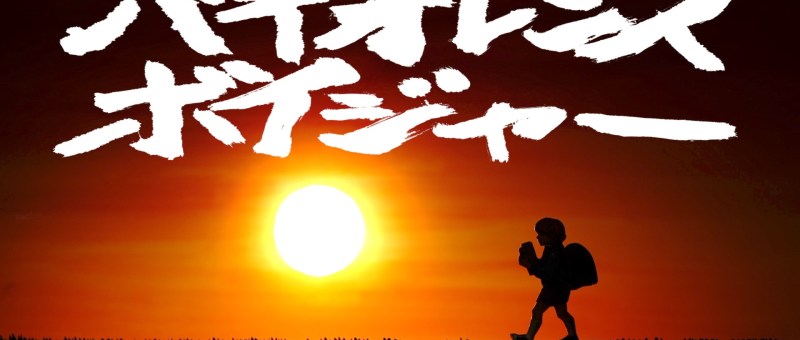
Violence Voyager (バイオレンス・ボイジャー, Ujicha, 2018) [Fantasia 2018]

violence voyager posterWeird stuff happens out in the mountains, stuff you wouldn’t even believe. Ujicha’s Burning Buddha Man followup Violence Voyager (バイオレンス・ボイジャー) is a pleasantly retro treat, set sometime in the more innocent past when the landscape still held hidden mysteries for small boys to find and anything goes so long as you’re home in time for tea. There are some mysteries, however, that it’s better not to solve and if something seems too good to be true, that’s usually because it is. Little Bobby (Aoi Yuki) is about to become a hero, but his journey will be a one way trip of unwelcome transformations, losses, and betrayals.

Bobby, an American boy with a blond bowl cut living in a little rural town with his distant dad and bedridden mum for otherwise unexplained reasons, has impressed his best friend Akkun (Shigeo Takahashi) with his high-tech pinball baseball computer console he made for the science fair, even if it has put the strange monster toys Akkun and his brother Yakkun entered with the intention of masking a lack of skill with pure strangeness to shame. Ostracised by the other kids, Bobby and Akkun long to cross the mountain and find their other friend, Takaaki (Daisuke Ono), who moved away to the next village. Akkun has heard tell of a secret mountain path which would take them there for free and it’s only *slightly* dangerous even if it does take time. Luckily it’s the summer holidays so time is something the boys have plenty of.

Setting off despite the warnings of Old Man Lucky Monkey (who actually lives with a chimpanzee as a “friend”), the boys are sidetracked when Bobby spots a fallen sign for something called “Violence Voyager” which sounds like too good an opportunity to miss. Ending up at an abandoned theme park, the boys are surprised to find the proprietor (Tomorowo Taguchi) still hanging around and overjoyed when he offers to let them in for free seeing as he rarely gets any business owing to the rapidly declining number of children in the area (alarm bells should be ringing right about now). Handed a “voyager suit” (an anorak and pair of wellies), the boys are shown an informational video explaining that the world has been invaded by aliens in the form of robot soldiers who shoot alkaline from their plant-like hands. Choosing a “weapon” (water pistol) each (Bobby a rifle, Akkun a tiny little dolphin), the boys set off but it’s not long before they start to suspect something isn’t quite right. Discovering another little girl lying injured, Bobby and Akkun plan an escape only to find their bullying classmates also facing the same dilemma.

It will come as no surprise that there really is something not quite right going at Violence Voyager. Like a combination of Westworld and Soylent Green, the park exists to strip the young of their innocence by exploiting it. A mad scientist desperately trying to save his only family is literally eating his young – sacrificing the souls of innocent children and “remaking” them in his own image to feed his ruined son. Meanwhile, Bobby’s dad fights equally hard to track down and rescue his own errant boy from an obviously bad situation.

Bobby emerges scarred and fundamentally “changed” mentally and physically but with his humanity fully intact, carrying a pretty bunch of flowers to take to his mum to cheer up her sickbed (and presumably lessen the shock of seeing him as he now is). An extreme coming of age tale, Violence Voyager runs from exposing the cynicism of businesses aimed at children to the desperation faced by a parent prepared to protect their offspring at all costs (including their remaining family).

Ujicha’s trademark “geki-animation” is a perfect fit for the bizarre tale at hand, filled with beautiful hand painted backgrounds and accompanied by the sonorous narration of comedian Hitoshi Matsumoto (Symbol, Big Man Japan). The retro design from Bobby’s bowl cut to the ‘70s musical score and noticeably old-fashioned composition (one shot even seems to reference the poster for Fukasaku’s Virus) allows the warmth of nostalgia to mix with its less positive elements all while indulging in a surreal B-movie adventure which starts with “aliens” and ends with the horror that men do. Whether a metaphor for the conformist meat grinder which strips children of their individuality to trap them in the straight jacket of the salaryman world, the ravages of grief, or just a B-movie body horror adventure, Violence Voyager is a surreal fever dream of bodily corruption but undercut with its own sense of fantastical whimsy and an oddly innocent heart for so dark a tale.


Violence Voyager was screened as part of Fantasia International Film Festival 2018.

Original trailer (English subtitles)

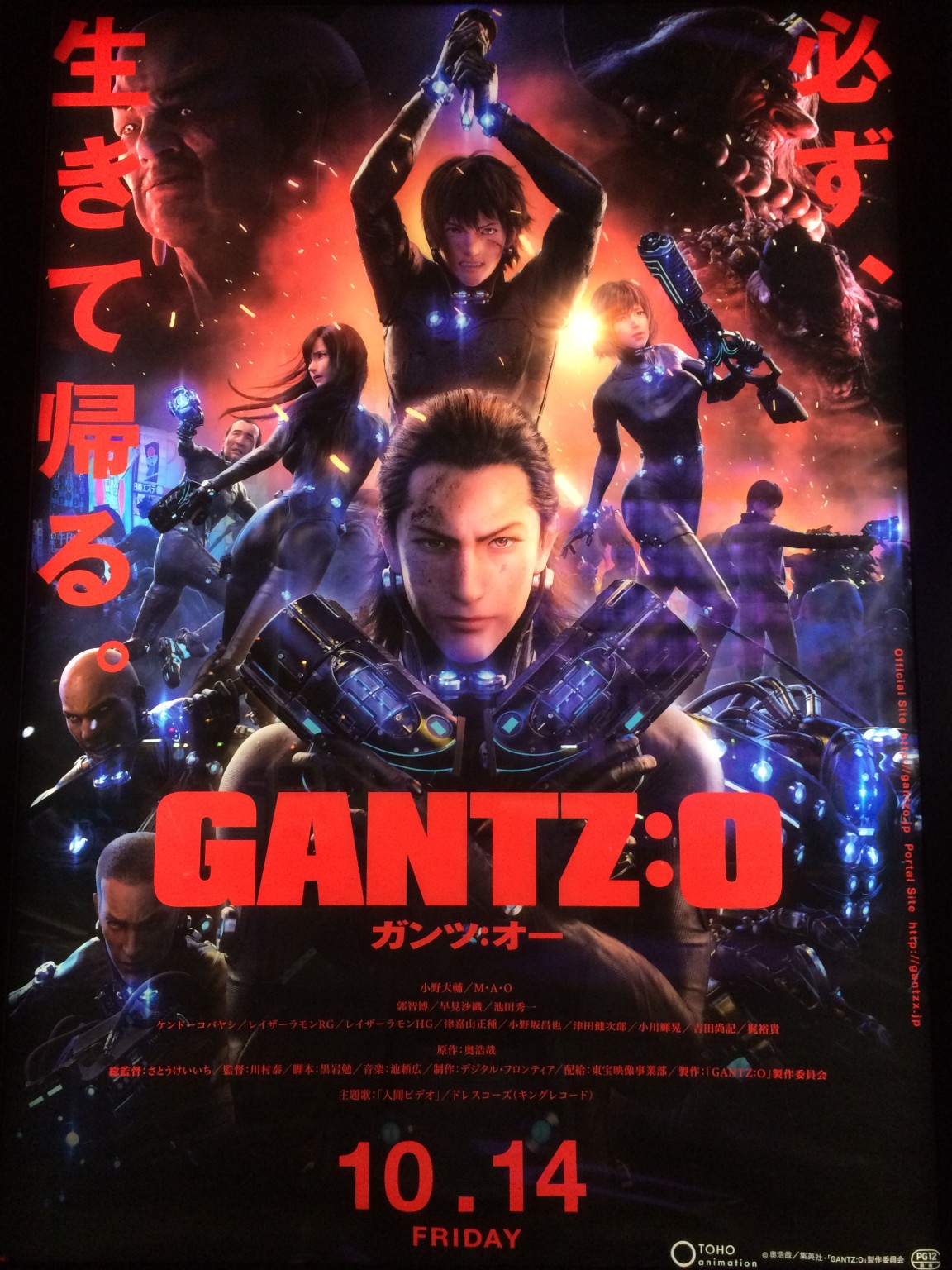
Gantz:O (ガンツ:オー, Yasushi Kawamura, 2016)

Gantz-oHiroya Oku’s long running manga series Gantz has already been adapted as a TV anime as well as two very successful live action films from Shinsuke Sato. Gantz:O (ガンツ:オー) is the first feature length animated treatment of the series and makes use of 3D CGI and motion capture for a hyperrealistic approach to alien killing action. “O” for Osaka rather than “0” for zero, the movie is inspired by the spin-off Osaka arc of the manga shifting the action south from the regular setting of central Tokyo.

Kicking off in Shibuya, the first scene features the demise of the franchise’s protagonist, Kei Kurono (Yuki Kaji), as he defeats one of the giant monsters terrorising the city and saves his friends but fails to save himself. A quick geographical cut takes us Osaka where there are reports of another disturbance, but the major threat turns out to be a depressingly commonplace one as a lone madman goes on a stabbing spree at a Tokyo train station.

17 year old high school student Masaru Kato (Daisuke Ono) gets himself mixed up in the incident when he ignores the crowds of people running in the opposite direction and comes to the aid of an injured old man. Sadly, Kato is repeatedly stabbed by the attacker and “dies” at the scene only to be resurrected in front of Gantz. Introduced to fellow players Suzuki (Shuuichi Ikeda) – an old man who “died” of a stroke, Reika (Saori Hayami) – an idol who was “killed” in a car crash, and the sardonic teenager Nishi (Tomohiro Kaku), Kato learns that he’s been given a second chance at life as a warrior in Gantz’s survival game in which he must fight off huge monsters within the time limit or die for real.

The entirety of Gantz:O revolves around this one climactic battle in the Osaka streets as Kato, Suzuki, Reika, and Nishi come into contact with the much more successful (but definitely less “nice”) Osaka detachment as backup in the fight against these fearsome monsters. As such, the main draw is furious action filled with bizarre scenes of carnage as the gang take down a collection of strange creatures often inspired by traditional folklore such as the huge winged tengu or shapeshifting priest-like boss. The visuals are extremely impressive displaying extreme fluidity of motion almost akin to live action photography.

Aesthetics are the key as the movie’s other elements are more or less inconsequential. As a bonus episode in the Gantz world, this is only to be expected and O makes no real attempt to do anything other than focus on the monster killing action. Thus character development is often shallow or non-existent, falling into genre clichés of cool heroes and depressed, brokenhearted women.

The question of self preservation vs altruism is central to the Gantz universe which begins from a position of nihilism and narcissistic self determination but gradually opens up to the importance of protecting one’s comrades, friends, family, and fellow human beings. Kato is the selfless hero the gang have been awaiting – his “death” results directly from his reckless attempt to help an injured person and his instinct is always to help those in need no matter the personal cost. His determination to save the lives of strangers is directly contrasted with his responsibility to the younger brother who is entirely dependent on him and would be lost should Kato lose his life. The film is ambivalent towards this dilemma as it constantly harks back to the people waiting for these secret warriors to come home, at once critical of them for risking their lives and acknowledging the fact that someone has to fight these monsters or everyone will die.

Despite the exposition heavy opening, Gantz:O does little to explain its world to the uninitiated and provides no logical explanations for its machinations leaving newcomers to the franchise with a host of unanswered questions but then all Gantz really wants to do is sell the message of altruism whilst destroying odd looking monsters in various bloody ways. Depressingly sexist, if edging away from the franchise’s nihilistic baseline, Gantz:O is an impressive visual spectacle but remains an essentially hollow, inconsequential addition to the Gantz canon.


Original trailer (no subtitles)

In This Corner of the World (この世界の片隅に, Sunao Katabuchi, 2016)

in this corner of the world J posterDepictions of wartime and the privation of the immediate post-war period in Japanese cinema run the gamut from kind hearted people helping each other through straitened times, to tales of amorality and despair as black-marketeers and unscrupulous crooks take advantage of the vulnerable and the desperate. In This Corner of the World (この世界の片隅に, Kono Sekai no Katasumi ni), adapted from the manga by Hiroshima native Fumiyo Kouno, is very much of the former variety as its dreamy, fantasy-prone heroine is dragged into a very real nightmare with the frontier drawing ever closer and the threat of death from the skies ever more present but manages to preserve something of herself even in such difficult times.

We first meet Suzu (Non) in December 1933 when, due to her brother’s indisposition, she’s sent to deliver the seaweed from the family business to the city. Observing pre-war Hiroshima with the painful tinge of memory, Suzu, her head in the clouds as always, gets herself completely lost and is eventually “rescued” by a strange man who puts her in a basket with another boy he’s “found”. Life goes on for Suzu, the tides of militarism rising in the rest of the country but seemingly not in this tiny rural village where she dreams away her days sketching fantasy stories to entertain her younger sister.

Despite a putative romance with a melancholy local boy, Tetsu (Daisuke Ono), Suzu is soon married off and travels to the harbour town of Kure to be with her new husband, Shusaku (the boy from the basket who carried a torch all those years, tracked her down and sought her hand in marriage on the basis of a single encounter). Always a dreamy girl and still only in her late teens, Suzu struggles with the business of being a wife and, though Shusaku’s family are nice people and welcoming to their new daughter-in-law, she constantly provokes the wrath of her widowed sister-in-law Keiko (Minori Omi) while striking up a friendship with her daughter Harumi (Natsuki Inaba).

The atmosphere in the cities may have been tense, but here in a traditional rural backwater, politics rarely rears its ugly head. Suzu and her family are just ordinary people living ordinary lives, yet they are literally on the fringes of the battlefield, gazing in wonder at the impressive array of giant battleships in the harbour including, at one point, the Yamato which becomes a kind of symbol of the nation’s hubris in its claims of invincibility. Shusaku, like his father, works as a clerk at the local naval offices which means he’s present (and as safe as anyone else), but this is otherwise a land of women alone, waiting for brothers, husbands and sons to come home or learning to accept that they never will.

Suzu’s troubles are normal ones for a woman of her age and time in learning to adjust to a new life she has not exactly chosen and which has meant cutting herself off almost entirely from everything she’s known. The severed connection with troubled childhood sweetheart Tetsu lingers but Suzu learns to make Kure her home, developing a deep love both for her husband (to whom she was fated, in an odd way, by their fairytale meeting) and for his family. A mildly conservative message is advanced as Suzu learns to become “happy” even in the midst of such anxiety while her sister-in-law Keiko’s attempt to forge her own future by becoming a ‘20s city flapper and marrying a mild mannered man for love has brought her nothing but heartbreak. Keiko pays dearly for her acts of individualism, suffering (the film seems to say) unnecessarily through allowing her sorrow to make her bitter, though hers is undoubtedly the most tragic of fates only offered respite by the growing community and interconnectedness of the little house in Kure.

Time moves on a pace as Suzu climbs ever closer to the climactic event she has no idea is coming, but has been on the viewer’s mind all along. The bombings intensify, the losses mount, and the future recedes but sooner or later it has to become not about what has gone or what could have been but what there is and what there will be. Suzu’s dream world colours her vision and ours as explosions in the sky become beautiful splashes of paint and raining fire bombs fireflies blinking out in the night sky. The more unbearable everything becomes the more her picture-book illustrations take over until one particular event becomes so painful, so difficult visualise that it is only possible to describe in abstract, black and white line drawings. The bomb is almost a peripheral event to Suzu, considering leaving her new home for the old one. A tremor, a flash, and a feeling of unidentifiable dread. Katabuchi’s aim not to show the direct horror of war (though there is plenty of that), but its effect on the lives of ordinary people just trying to survive in difficult circumstances not of their making. Filled with a sense of essential goodness, In This Corner of the World is a tribute to those who endured the unendurable and remained kind, determined to build a better world in which such horrors belong only to the distant past.


UK trailer

https://www.youtube.com/watch?v=TZ-B2B1Nm8Q&t=5s