Gowok: Javanese Kamasutra (Gowok: Kamasutra Jawa, Hanung Bramantyo, 2025)

There’s an essential contradiction at the centre of Hanung Bramantyo’s spicy romantic melodrama Gowok: Javanese Kamasutra (Gowok: Kamasutra Jawa) in that, on the one hand, the gowok is said to exist so that men learn how satisfy their wives’ sexual desires. Which is to say, the sexual desires of women are recognised and approved rather than denied or taboo while men are expected to live up to satisfying them as part of what it means to be a proper man. But at the same time, women are constrained by the patriarchal institution of marriage, have few rights of their own, and are largely unable to live independently while lacking status as anything other than a man’s wife. 

Indeed, the inserting of increasingly outdated notions of sex and class that stand in the way of romance and set the tragic events in motion rather than the black magic to which many attribute the looming crisis. Years before, Jaya’s mother had been in love with the soon-to-be king, but he couldn’t marry her because she wasn’t of sufficiently noble birth. She agreed to step aside and marry a mutual friend on the condition he would be given high office and her son would marry into royalty so that she would be a queen in all but name and their family would enter the royal bloodline.

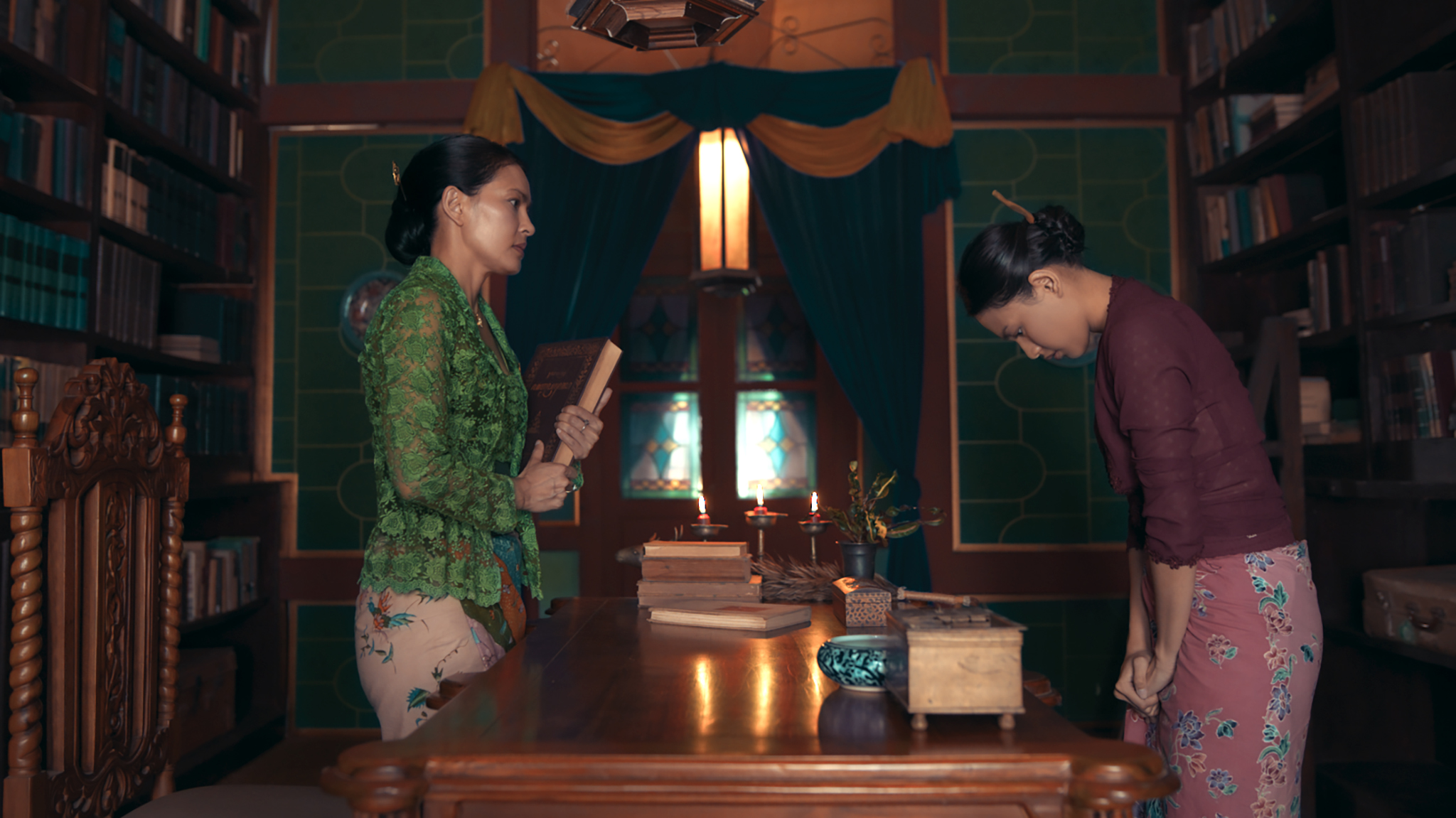
Now a university student, Jaya (Devano Danendra / Reza Rahadian) is sent to a gowok to make a real man out of him, though as he explains to his father, that’s not what a real man is. Jaya is a young man of the new Indonesia who believes in things like equality of the sexes and the breaking down of the old class system even if he maintains his privilege in other ways, including submitting himself to the gowok. Nevertheless, while he’s there, he falls in love with the adopted daughter of his gowok Santi (Lola Amaria), Ratri (Alika Jantinia / Raihaanun), and makes her a lot of promises about the future while introducing her to the women’s movement in 50s Indonesia that offers her the vision of a different future in which she might become an independent woman rather than being forced to become a gowok herself. To become a gowok necessarily means that she would not be able to marry. Most gowok adopt children to succeed them. Accidentally seeing a secret ritual, Santi fears that Ratri has fallen victim to a pure love spell that threatens spiritual disaster should the man break his promise which, as an older woman, she knows he almost certainly will. 

Then again, that turns out not quite to be the case and the lovers are in fact betrayed by those still clinging on to to the old class system. The destructive quality of their romance is played out against the background of the screws tightening across Indonesia as anti-communist fervour takes hold and suspicion falls on the women’s groups when military generals are abducted and murdered. Despite his progressive views, Jaya ends up married to a princess at his mother’s behest, exemplifying the ways in which women try to hold on to power by exerting matriarchal control over their sons. As for the princess, she is already pregnant by her communist boyfriend but prevented from marrying him and forced to marry Jaya instead though apparently coming fall in love with him after their marriage. Meanwhile, it turns out that there is an awkward connection between Jaya and Ratri that lends their fateful meeting a tragic quality even as his mother refuses to entertain the idea of Ratri marrying her son because her mother was a sex worker and she is not of their class.

In any case, though the gowok system may not actually be that different from other folk practices, there is something uncomfortable about it in that some of the “men” are very young and do not want to be there. Though Jaya, who is also sent there against his will, is in university and falls for Ratri who is around the same age, when his own son, Bargas, is sent to the gowok he is only around 14 and looks very childlike while ushered into “manhood” by a then 33-year-old Ratri. The system is at least potentially abusive and unethical while demonstrating how men are also ensnared by the patriarchal trap in that they too are being groomed for marriage whether they like it or not. It was in fact a man’s inability to remain faithful to the wife chosen for him that led to Ratri’s mother’s death and the activation of a black magic curse.

In any case, it turns out that human motivations can be far more damaging than any curse in the long years of anger, resentment, and misery born of misunderstandings and deliberately misdirected love. Ratri desperately tries to overcome her past and become an independent woman as a gowok but finds herself frustrated by the changing nature of society which promises so much freedom and opportunity in her youth only to immediately roll back on it while her own attempt at revenge backfires with tragic results. Poignant in its themes of tragic romance, the film quietly hints that this kind of oppression may not have really gone away even as Ratri seeks to reclaim her legacy in the 1980s-set coda by turning the gowok house into a school that educates women in a final attempt to finally free them from patriarchal control.


Gowok: Javanese Kamasutra screened as part of this year’s New York Asian Film Festival.

Trailer (English subtitles)

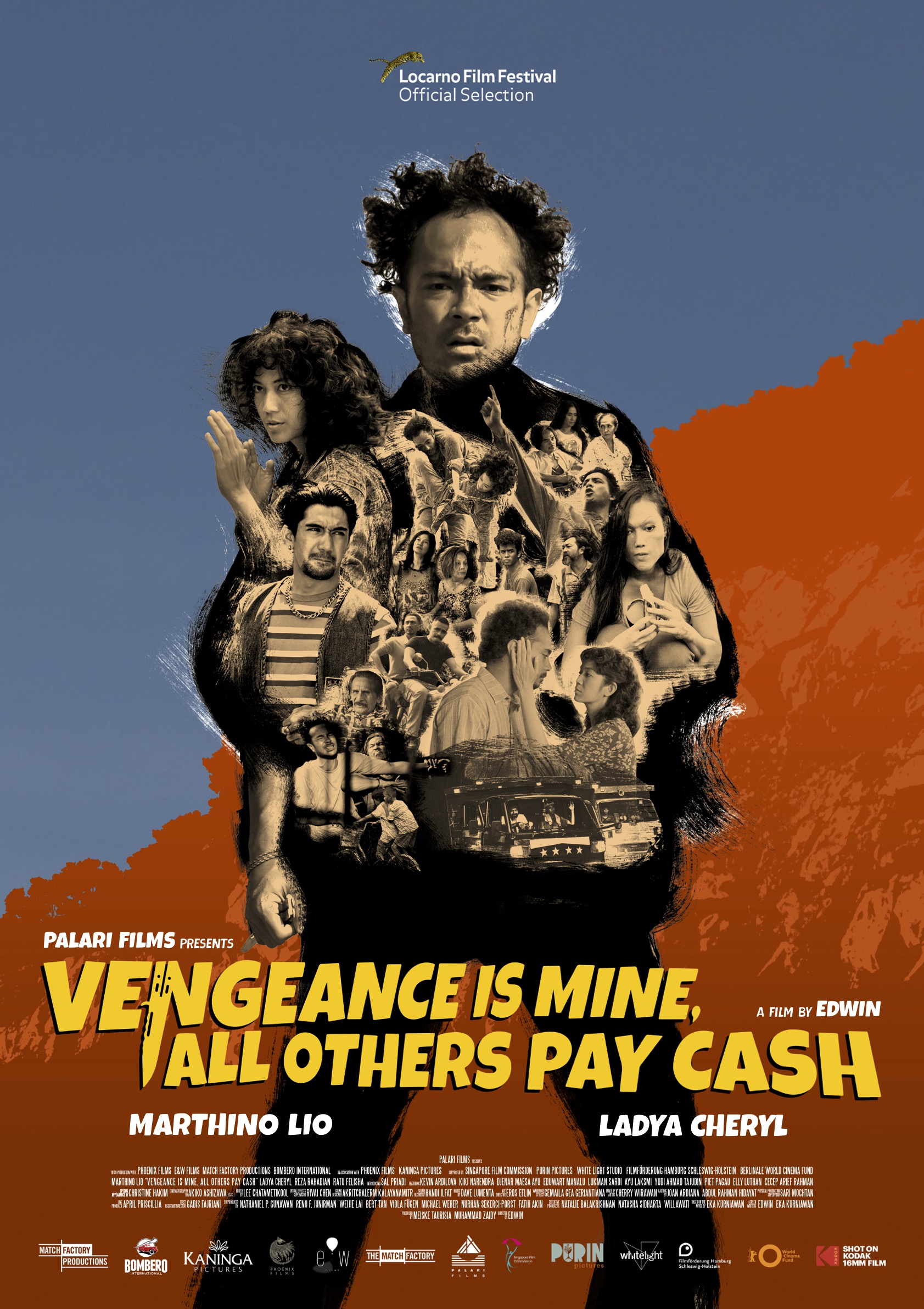
Vengeance Is Mine, All Others Pay Cash (Seperti Dendam, Rindu Harus Dibayar Tuntas, Edwin, 2021)

The innocent love of a pair of traumatised youngsters is crushed by the society in which they live in Edwin’s ‘80s-set pulp adventure, Vengeance is Mine, All Others Pay Cash (Seperti Dendam, Rindu Harus Dibayar Tuntas). An absurdist parable about the corrosive effects of toxic masculinity and its links to oppressive authoritarianism, Edwin’s outlandish drama sees a young man contend with literal and societal impotence through the medium of violence while falling in love with a woman equally in desire of revenge against her misuses at the hands of a misogynistic society. 

Rendered sexually impotent after childhood trauma, 20-something Ajo (Marthino Lio) gets his release through violence well known for always being up for a fight whether there’s money involved or not. Yet as we see he seems to enjoy being on the receiving end, almost giggling when he’s set upon by a small mob in a bar. During the course of one particular job with a social justice angle roughing up an overreaching local businessman who apparently pressed a man into debt in order to extract the payment from his wife, Ajo ends up running into Iteung (Ladya Cheryl), his target’s bodyguard and a lover of violence like himself. The pair fall in love, but Ajo is afraid to pursue a relationship because of his impotence eventually provoked into a rain-soaked confession only to realise that just like everyone else in town Iteung already knows and doesn’t care. She marries him anyway but is continually stalked by a resentful ex, Budi (Reza Rahadian), while Ajo is preoccupied with a job he unwisely took on to knock off a gangster rival of former general Uncle Gembul (Piet Pagau).

The pair are in a sense pursued by their pasts each of which stems back to an instance of sexual abuse, the young Ajo forced to participate in a rape after being kidnapped by a pair of corrupt soldiers and thereafter rendered impotent. In an ironic touch, the assault takes place on the day of an eclipse which president Suharto had issued advice not to look at owing to the possibility of damaging one’s sight though in essence Ajo gets in trouble for looking directly at something he should not have seen and is rendered impotent by corrupt state power. Years later, Iteung decides she wants revenge, that if she could track down and enact justice on these two former soldiers she might be able to lift Ajo’s curse and ironically enough restore his manhood so that they might have a full marriage. 

She meanwhile is also carrying her own trauma having been subject to male sexualised violence from a young age. Given Ajo’s condition, the pair consummate their relationship through pugilism, a fight scene standing in for sex but the disruptive presence of the brooding Budi continues to linger on the horizon Iteung coming to regret a bargain she made with him in the hope of tracking down the soldiers. Having quelled his lust for violence, discovering that Iteung has betrayed him sends Ajo into a murderous rage finally completing the job he had been afraid of doing in fear that it would pollute his otherwise blissful relationship with his new wife. In an ironic touch, Budi’s big business plan is selling a snake oil male virility tonic, his insecure yet superficially powerful vision of masculinity held up as an ideal while Ajo once again attempts to validate his manhood through violence. After a period of wandering and an encounter with a mysterious figure he begins to rediscover a sense of security in masculinity that is not linked with sexuality realising that all he wants is to be with Iteung and he no longer cares whether or not his impotence is ever cured. 

A retro homage to the action exploitation movies of the 1980s, Edwin’s absurdist world building is a direct attack on a macho culture that manifests itself in oppressive authoritarianism along with the concurrent misogyny that leaves women vulnerable to male violence. At heart a romance in which love ultimately triumphs over the corrosive effects of toxic masculinity and entrenched patriarchy, Edwin’s absurdist tale later takes a turn for the metaphysical in the form of the arrival of a ghostly avenger come to enact justice on those who presumed themselves above the law but nevertheless ends on a note of cosmic irony in which the wages of vengeance must indeed be paid in full.


Vengeance Is Mine, All Others Pay Cash screens in New York March 19 with lead actress Ladya Cheryl appearing in person as part of Museum of the Moving Image’s First Look 2022. Due to popular demand, a second screening without guest appearance has now been added on March 26.

International trailer (English subtitles)

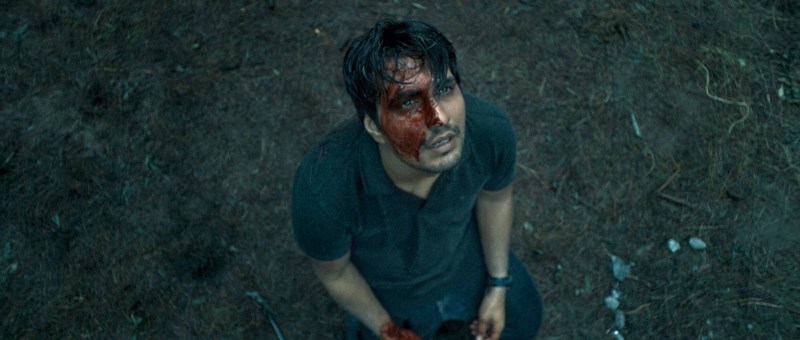
Death Knot (Tali mati, Cornelio Sunny, 2021)

Orphaned siblings attempt to process the dark legacy of the superstitious past in the debut feature directed by and starring actor Cornelio Sunny, Death Knot (Tali mati). Travelling from the comforting sophistication of the modern city back into the eerie darkness of the ancient forest, the pair find themselves confronted first by a filial dilemma and then a spiritual conundrum in their potential destiny which their possibly shamaness mother may have gone to great lengths in order to prevent. 

As the film opens, Hari (Cornelio Sunny) texts with his younger sister Eka (Widika Sidmore) who somewhat sexistly tells him not to stay single too long because he needs someone to cook for him. Falling asleep watching a program in which a woman remarks on the presence of jinns as manifestations of energy that can’t be seen by the naked eye, Hari has a strange dream in which he witnesses his mother hanging herself in the forest in the middle of the night uttering only the words “stay away”. As it turns out, Eka had exactly the same dream and a phone call from their estranged uncle who rather bluntly tells them that their mother is dead and as the villagers won’t have anything to do with her they need to come for the funeral, confirms their worst fears. Ignoring the warning in the dream, Hari, Eka, and her husband Adi (Morgan Oey) drive back to their home village but quickly find themselves out of their depth trying to figure out what’s going on. 

The first clue is the reaction from a previously friendly old woman who suddenly gets up and walks off after exclaiming that the body should have been burned not buried when Hari stops to ask for directions. The second clue is that only three people including their uncle turn up for the funeral. The third clue is that everyone keeps telling them to leave town right away while the fourth is that they can’t because of a mysterious storm that has apparently closed all the roads. Meanwhile, hostile uncle Rahmen immediately asks for what seems like a lot of money to cover his expenses for the clandestine funeral and then wastes no time staking his claim to their mother’s house. Though neither of the siblings want it, the request offends Hari who feels guilty that he never really got to know his mother and is wary of abandoning the last traces of her in the house she once owned. 

Described by Adi as creepy, the house does however have a dark legacy, the pair already aware that their father left and took them to the city because of their mother’s strange behaviour that saw her ostracised by the other villagers who suspected her of being a shamaness responsible for a strange phenomenon known as “The Harvest” in which spates of suicides take place across a specific month. Hari tries to rationalise it away, pointing out that it’s hard to live in rural poverty and putting a label on unexplained deaths is easier than admitting that people are taking their own lives because of economic precarity and an ongoing sense of despair, but with the increasing strangeness all around him he has to admit a degree of spiritual unease in this fiercely traditional world he is ill-equipped to understand. 

Rather than hauntings and jump scares, Cornelio Sunny concentrates on conjuring an atmosphere of supernatural dread in which anyone may suddenly become a grinning demon, performing strange ritualistic dance and odd movements only to suddenly disappear from view. An educated man from the city, Hari quickly becomes fed up with talk of ancestral deities, pacts with the devil, and black magic, only latterly accepting his role within an arcane system and understanding that his mother’s distance may have been her way of protecting him which has in the end backfired. Yet having destroyed the symbol of this spiritual oppression, Hari discovers that there may be no escape from its darkening legacy or the atavistic superstitions of the villagers, an ominous cloud always hanging over him even as he faces the final choice of whether to continue fighting or accept the inevitable. Proceeding with moody fatalism, the ironically titled Death Knot ensnares its confused hero in a tightening noose of spiritual dread and filial guilt before cutting him adrift a victim of his own sophistication. 


Death Knot streamed as part of this year’s hybrid edition Udine Far East Film Festival.

Original trailer (English subtitles)

Gundala (Joko Anwar, 2019)

“If we see injustice before our eyes and do nothing then we’re no longer humans” the idealistic father of a future superhero instructs his young son, trying to impart a sense of humanitarianism as a basic moral good. It’s a lesson the boy will find himself unlearning and resuming later, his innocence well and truly destroyed by an often cruel and cynical society only to be reawakened to the idea that it doesn’t need to stay that way. Among the most recognisable names of Indonesian cinema, Joko Anwar turns his hand to the creation of a local comic book cinematic universe, adapting the 1969 comic Gundala by Harya “Hasmi” Suraminata for the present day filtering contemporary Jakarta through classic Gotham. 

Operating as an origin story for the titular hero, Gundala opens with the young hero Sancaka (Muzakki Ramdhan) unable to prevent his father’s (Rio Dewanto) death due to his fear of electrical storms when he is first set up by a duplicitous factory boss and then assassinated while leading a protest for fair pay and conditions. Soon after, Sancaka loses his mother (Marissa Anita) too after she is forced to go to the city for work and never returns. Ending up a ragged street kid, he’s saved from an attack by a rival gang by an older boy (Faris Fadjar Munggaran) who teaches him how to protect himself physically and mentally by convincing him that the only way to survive on the street is keep his head down and walk on by even if it looks like others are in trouble. 20 years later the adult Sancaka (Abimana Aryasatya) is an aloof young man working as a security guard at a print house where his sympathetic mentor Agung (Pritt Timothy) begins to remind him of his father in his conviction that “living is no use if you stop caring and only think about yourself”, while he also finds himself defending the woman next-door, Wulan (Tara Basro), and her young brother Teddy (Bimasena Prisai Susilo), from hired thugs sent to intimidate them because of their involvement in a protest against the forced redevelopment of a local marketplace.  

Events seem echo around him. The major villain Pengkor (Bront Palarae) is also an orphan but on the opposing side as the son of a cruel plantation owner murdered by his not altogether ideologically pure workers whose desire for fair pay and conditions he had resolutely ignored. According to cynical politician Ridwan (Lukman Sardi), Pengkor became a union organiser of his own, leading an uprising at the abusive orphanage he was placed into by a cruel uncle hoping he’d die and free up the inheritance, thereafter becoming a kind of godfather to the fatherless with a thousands strong army of eternally grateful orphans he saved acting as sleeper agents for a coming revolution. 

Pengkor’s nefarious plan involves fostering a conspiracy surrounding contaminated rice said to make the unborn children of the women who eat it turn out “immoral”, a generation of psychopaths unable to tell right from wrong. Fairly unscientific, it has to be said, but playing directly into the central questions of the nature of “morality” in a “immoral” society. Can it really be “moral” for bosses to exploit their workers and get away with it, for politicians to cosy up to gangsters and remain complicit with corruption, and for a man like Pengkor to be the only hope for orphaned street kids otherwise abandoned and ignored by a wilfully indifferent society? Pengkor decries that hope is the opiate of the masses, but that’s exactly what Gundala eventually becomes for them in his “electric” ability to resist, eventually rediscovering his humanity as he designates himself as the embodiment of “the people” pushing back against the forces of oppression and seeming at least to win if only momentarily.  

Young Sancaka’s fear of lightning is, in essence, a fear of his power and his social responsibility something he is quite literally shocked into accepting. In a world of quite striking social inequality, he finds himself the lone defender of the oppressed whose very existence spurs others, including previously cynical politician Ridwan, into rediscovering their own humanity in the resurgent hope of a better future. As someone puts it, peace never lasts long but you keep fighting for it because every moment is precious. Not so much a battle of good versus evil as a battle for the meaning of good, Anwar’s Gundala recalibrates the anxieties of the late ‘60s for the modern era and creates an everyman hero not only to resist them but to foster a spirit of resistance and humanity in the face of heartless cynicism. 


Gundala streams in Poland until 6th December as part of the 14th Five Flavours Film Festival.

Original trailer (English subtitles)