Millennium Mambo (千禧曼波, Hou Hsiao-hsien, 2001)

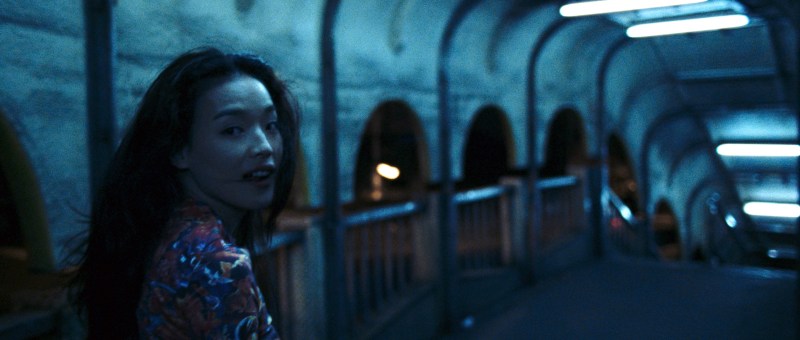
In the iconic opening sequence of Hou Hsiao-Hsien’s Millennium Mambo (千禧曼波, Qiānxī Mànbō), a young woman bounces enigmatically along a walkway, filled with joy and abandon and seemingly exultant in her freedom. Occasionally she glances back as if someone were actually filming her but then we start to wonder if this isn’t just her looking back at herself as she narrates her story in the third person, as if it happened to someone else because in a sense it did. “This happened 10 years ago,” she explains from the vantage point of 2011 looking back on the coming millennium and her own slow dance towards a new world. 

Then again, as she admits Vicky (Shu Qi) always seems to be drawn back into the orbit of Hao (Tuan Chun-hao), her no good, abusive boyfriend who is so controlling that he deliberately prevented her from taking her high school exams out of fear that she’d “move on”. Circling around Vicky’s memories, Hou often cuts to Hao in exactly the same position as he was before while Vicky has indeed moved on if not always in the direction she might have chosen such as the abrupt transition to her naked behind as a dancer at a nightclub where she is forced to work because Hao refuses to earn a living. When we first see her arrive at their apartment, Hao is sitting in the dark and we don’t even notice him until he gets up after Vicky enters the bathroom. Where her bedroom is colourful and cosy, bathed in soft light and demonstrating her ability to find small comforts in an otherwise harsh existence, Hao’s space is gloomy and ominous in its austerity. 

While Vicky tries to move into a more responsible adulthood, Hao extends Taipei clubland into their home frequently hanging out with friends while djing on the rig in his room. He takes drugs to keep his weight down to evade military service and gets into trouble with the law after pinching and pawning an expensive watch from his dad rather than trying to get job. He is the force which seems to keep Vicky trapped in a disappointing existence. By her own admission she finds herself returning to him as if she were in a kind a kind of trance, unable to escape though at times clearly despising him and perhaps herself too. Even Hao is fond of saying that they’re from different worlds, stuck on parallel orbits and otherwise incompatible. Even their apartment seems to be divided into night and day. 

Yet it’s also Taipei clubland that offers Vicky an escape route through the community she finds surrounding her amid the pulsing beats of millennial techno. A kindhearted gangster, Jack (Jack Kao), comes to her aid though he is later brought low by the recklessness of youth as his naive underlings bring their world crashing down around them. Jack takes her in and protects her with paternal affection, eventually inviting her to go on the run with him in Japan but immediately disappearing, just like the snowman she later describes Hao to have been in a moment imprinted on her memory. She carries Jack’s phone around with her unable to let go of him while recalling the scent of his abandoned jacket as she tries to make a decision in a snowy Tokyo just as she’d sworn to herself she’d leave Hao when she ran through her savings. 

Hou and cinematographer Mark Lee Ping-bing shoot all of this through the breeziness memory, following emotional logic rather than the literal as Vicki narrates to us events which are at odds with those occurring on screen and zig zags through the story of her youth before arriving at what seems to be a genuine moment of warmth amid heavy snow, perhaps finally “moving on” from the dissatisfying past to a future of her own choosing. Then again, her fleeting recollections amount to a constructed narrative, the story of the girl on the walkway who finally reaches the other side and disappears into the night either progressing into the new millennium or remaining trapped in a thousand year mambo of memory reliving the key moments of her life in a gentle oscillation, “as if under a spell or hypnotised” , unable to escape from the dangerous allure of nostalgia. 


Millennium Mambo is screening now at New York’s Metrograph and available to stream in the US via Metrograph at Home courtesy of Metrograph Pictures.

Trailer (English subtitles)

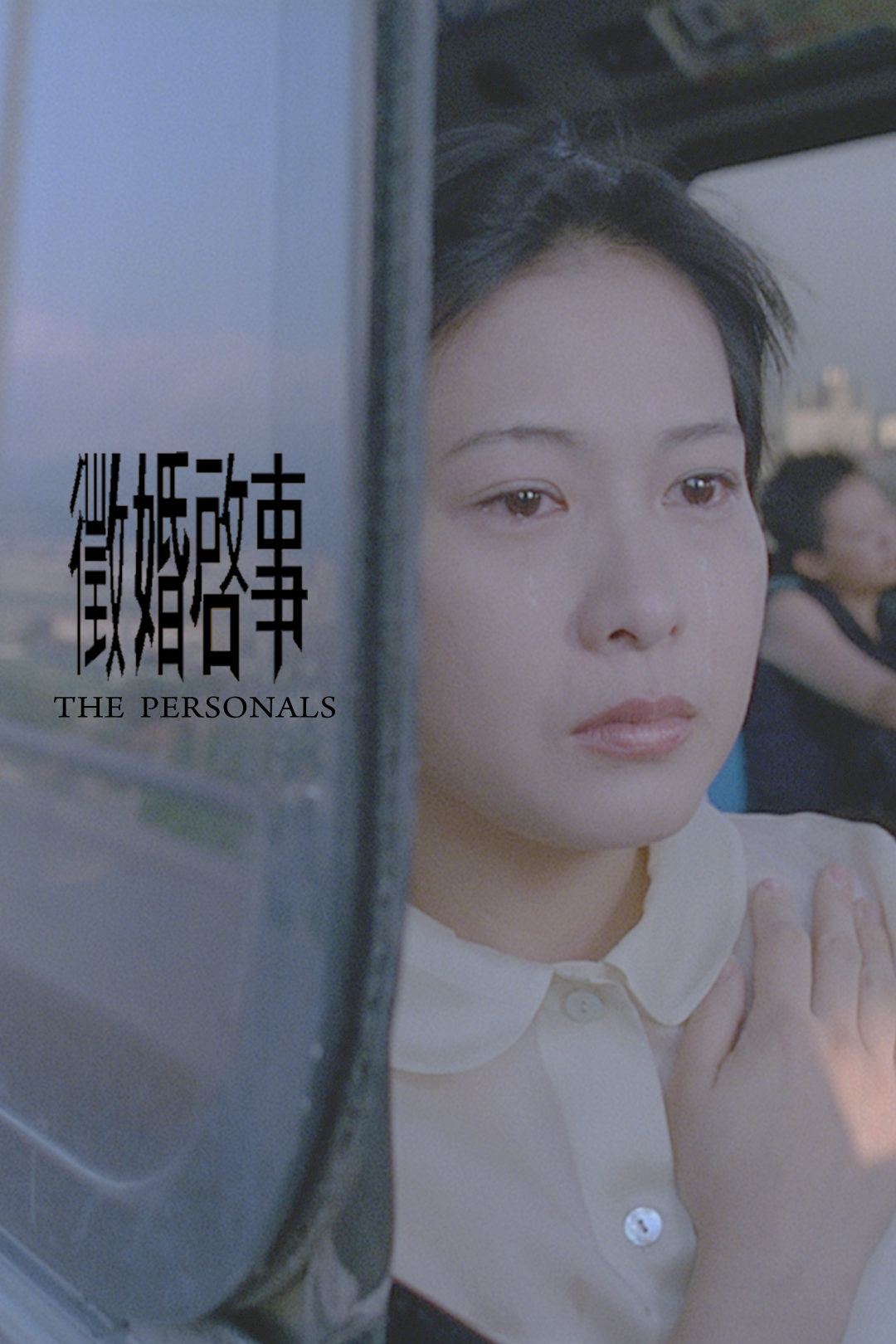
The Personals (徵婚啓事, Chen Kuo-fu, 1998)

Looking for love in all the wrong places, a Taipei career woman suddenly decides to give up her life and place a personal ad stating that she’s looking for a husband, “Who knows, maybe I’ll find happiness” she unconvincingly explains. Chen Kuo-fu’s sophisticated dramedy The Personals (徵婚啓事, Zhēnghūn Qǐ Shì) sends its heroine on a dating odyssey through the contemporary capital but is at heart the story of a woman learning to see herself while grieving a failed relationship and the married ex who won’t return her calls. 

Tu Chia-wen (Rene Liu Ruo-ying) was a successful eye doctor at a Taipei hospital, explaining to a patient that some people lose the ability to produce enough tears after the age of 30, but abruptly quits her job later claiming that she wanted sever connections with her past which is another reason why she’s decided to place an ad rather than asking friends to set her up with eligible bachelors. Implicitly, it also seems that Chia-wen feels her status as a doctor may be intimidating to some men in the still patriarchal society, if also a clue to her true identity which she has otherwise chosen to keep hidden going instead by the name of Miss “Wu” which just happens to be the name of her lover’s wife. 

Of course, it’s illogical to use a false identity if your end goal is finding a life partner, a factor which later feeds in to Chia-wen’s half-hearted conclusion that it isn’t the fault of the men she’s been meeting that they didn’t hit it off but her own in that she’s so far failed to fully “open up” to any of them. Despite newspaper personal ads not featuring photos, Chia-wen receives 100 messages in the three days after her details are posted from a varied cross section of applicants some more suitable than others. One gentleman who unconvincingly claims to be in his 30s reels off his CV as if he were introducing himself at a job interview while wearing a cheerful farmer-style straw hat. A factory worker chews betel nut and smokes tobacco at the same time while exposing an insecurity over his financial situation in complaining that modern women are too materialistic. One suitor is a woman who struggles to explain her gender and sexual identity with the terminology of the time causing Chia-Wen a degree of consternation. Another potential date is a shoe fetishist with a large suitcase intent on some kind of cinderella role-play closely followed by an executive who enthusiastically explains his only hobby outside of drinking is an encyclopaedic knowledge of S&M porn, while a son brings his father as a potential match because his mum’s “gone abroad” and in a heartbreaking moment a worried mother tries to negotiate on behalf of her son who appears to have learning difficulties and might not be sure what’s going on, hoping to find someone to look after him when she’s gone. 

It may be a biased sample, but it doesn’t speak well for the men of Taipei and that’s without even getting into the guy trying to recruit Chia-wen as a high class call girl, the obvious married man after no strings sex, or the salesman trying to peddle women’s self defence equipment with a case full of tasers and pepper spray. Chia-wen pours out her frustrations in daily calls to her ex’s answering machine, leaving long messages she knows he won’t reply to but somehow it makes her feel close to him. Gradually through her monologues we begin to piece together the trauma that she’s struggling to accommodate while a late and unexpected twist keys us in to the cosmic tragedy of her frustrated romance. “Choose what you can endure” she’s advised by a professor friend who confesses to her that he’s chosen to suppress his homosexuality out of a desire for a “normal” life as a husband and father hinting at the still conservative nature of the contemporary society. 

It’s not until she’s caught off guard by a potential match seeing through her ruse that Chia-wen begins to reconsider her experiment, eventually captivated by a sensitive young man who’s not long come out of prison but has an endearingly awkward smile that reminds her of her own. She meets each of the men in the same cafe where she had her first date with her former lover, taking on a slightly different character as she attempts to interview them about their lives, getting to know their hopes and desires often tinged with a note of loneliness or despair. They seldom seem very interested in her, but instantly propose marriage or at least some sort of serious courtship without even finding out about her hopes and aspirations in life. Chia-wen’s often comical encounters from the teenage boys trying their luck to the old men taking their last chance each expose something of contemporary gender dynamics as well as hinting at increasing urban loneliness and romantic desperation but in the end it’s herself Chia-wen must face in learning to let go of past trauma in order to give herself permission to move on in her ever evolving quest for love.


The Personals streams in the UK 25th to 31st October as part of this year’s Taiwan Film Festival Edinburgh.

Trailer (Traditional Chinese / English subtitles)