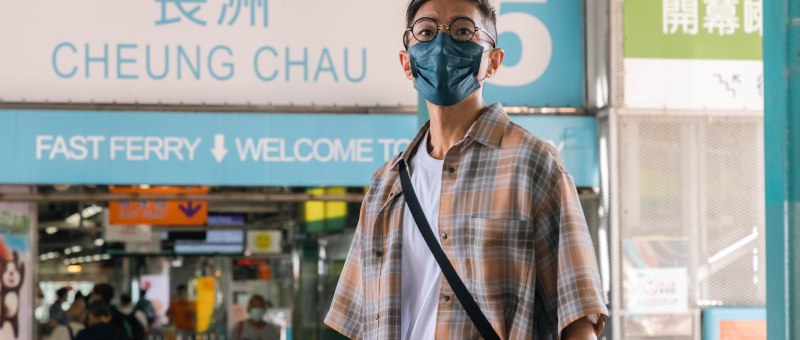
Everyphone Everywhere (全個世界都有電話, Amos Why, 2023)

Have we become too dependent on our phones, allowing them to divide rather than connect us? For those at the centre of Amos Why’s zeitgeisty comedy Everyphone Everywhere (全個世界都有電話), they do seem to have become a double-edged sword. Yet in the end, it’s a series of handsets that reconnect them with their youth if only to remind them of the disappointed hopes of a defeated middle-age given additional an weight by subtle hints of post-Handover despair. 

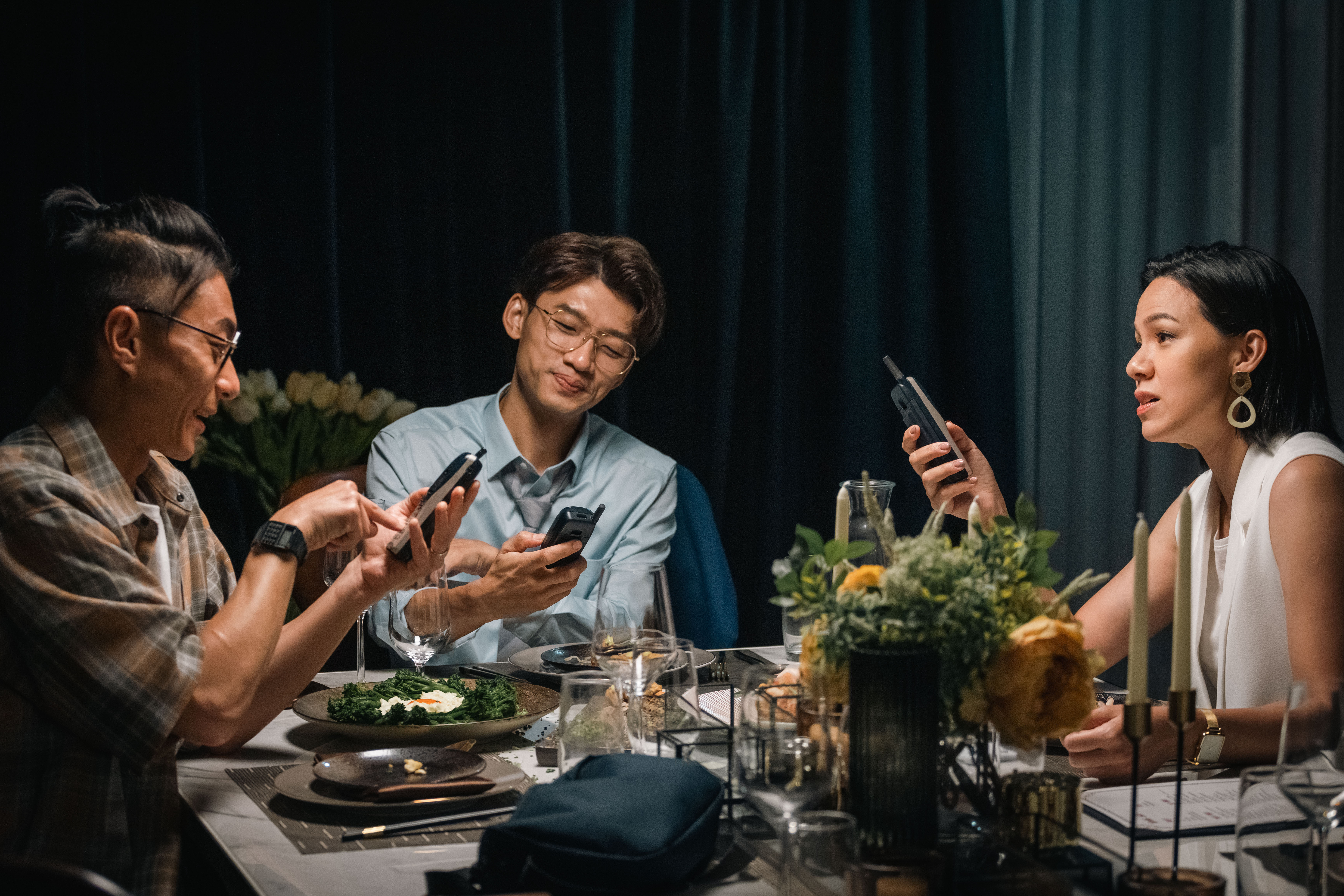
Asked why he’s decided to move to the UK, Raymond (Peter Chan Charm-Man) replies that everybody’s doing it even if he resented being sent away to study in Aberdeen, Scotland as a teenager in the wake of the Handover. The real reason is that he’s got himself involved in a lot of shady stuff and has just had his phone hacked so he fears blackmail or arrest. He’s organised a farewell dinner with old high school friends Chit (Endy Chow Kwok-Yin) and An (Rosa Maria Velasco), but nothing quite goes to plan in the curious ways the lives of three former friends remain entwined even if they’ve all been in some sense corrupted by the changes in their society. “All is well as long as we never change” reads a teenage message to a future self, but of course it’s a promise that can’t be kept even if in the end, “life must go on anyway.”

Still, the society itself is fairly corrupt given the prevalence of scams many of them connected to our phones. Raymond failed to get his hacked phone fixed and opted for a new number instead, but Ana in particular keeps getting weird calls from him she later realises must be an attempt to scam her out of money by someone posing as Raymond and explaining that he needs money desperately. But Ana is also the victim of another “scam” in the form of Chit’s new business strategy of getting a “monthly fee” from clients rather than be reliant on work for hire arrangements. Even the restaurant itself along with its “Japanese” chef seems to be fraudulent, while An remains preoccupied with her husband’s womanising and Raymond ironically with his series of bad decisions that culminate in tax fraud. Meanwhile Raymond’s daughter Yanki (Amy Tang Lai-Ying) is also indulging in a kind of scamming selling intimate pictures to nerdy guys via telegram and smartphone apps and ironically remarking that she doesn’t want to get scammed again when discussing ever increasing payment options with her hapless targets.

Yet as Chit discovers when he leaves his phone at home, everything seems inconvenient when you’re phoneless. In a running gag, he repeatedly tries to borrow someone’s landline but is refused leaving him wandering around the city looking for a “restaurant” in one of three very similarly named redeveloped blocks. His wife’s is the only number he remembers by heart, but she remains resentful of his meeting up with Ana, his first love, whom he previously described as a “gullible” auntie and is on some level “scamming” by convincing her to keep him on a monthly retainer. Raymond’s phone threatens to expose him, Ana uses hers to spy on her husband and stepson, and Chit’s in a sense incapacitates him, leaving him alone and disorientated in his own city no longer certain how to travel around it amid the rapidly changing landscape and seemingly identical redevelopment projects.

Life hasn’t turned out the way any of them thought it would, recalling their carefree days 25 years previously in pre-Handover Hong Kong. Banners advertise a “New Era”, but the trio are trapped in the past with which they are eventually reconnected thanks to the retro handsets that unlike the technology of today still work and contain a series of time capsule messages to their future selves. History in a sense repeats itself as Raymond prepares to leave, but each is able to come to terms with their unfinished business and begin making concrete decisions about their futures. Suddenly “can we meet on Saturday?” takes on a new sense of poignancy when everyone seems to be leaving but then again, perhaps our phones really do connect us even if they sometimes connect us to scammers or people we don’t really want to talk to. Subtly hinting a sense of disappointment which runs a little deeper than middle-age malaise, Why looks back to the carefree days of 1997 allying the broken dreams of youth with the “New Era” of today but nevertheless grants his heroes a sense of new sense of possibility even the face of their despair. 


Everyphone Everywhere screens July 20 as part of this year’s New York Asian Film Festival.

Original trailer (Traditional Chinese / English subtitles)

Images: © 2023 Dot 2 Dot Creation Limited. All Rights Reserved.
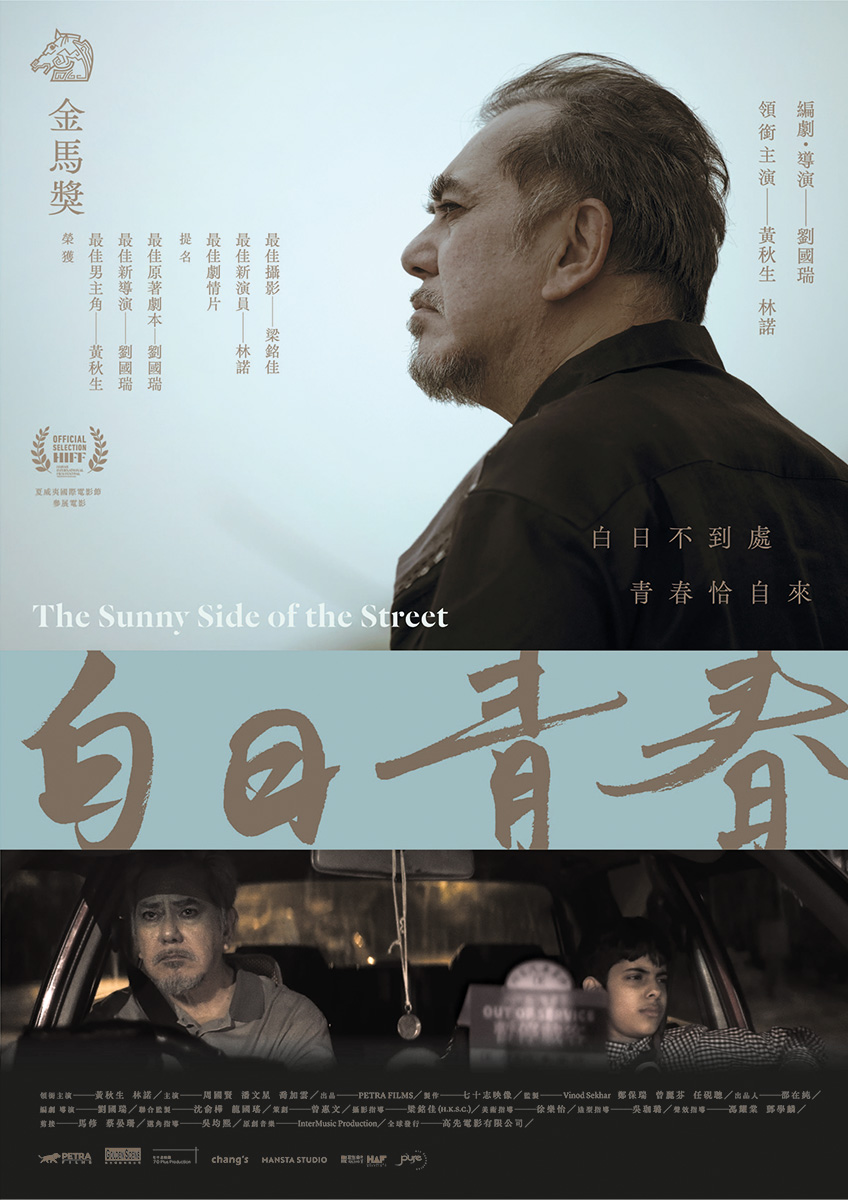
The Sunny Side of the Street (白日青春, Lau Kok-rui, 2022)

Dualities abound in the stories of two frustrated fathers and the sons who vow to be nothing like them in Malaysian director Lau Kok-rui’s paternal drama, The Sunny Side of the Street (白日青春). The fathers are in their way looking for a place in the sun but struggle to find it, while the sons want nothing but their affection and approval but remain resentful for their repeated failures. Each affected by the legacies of geographical displacement, they remain free floating if looking for safe harbour though perhaps in all the wrong places. 

The parallels between embittered taxi driver Yat (Anthony Wong Chau-sang) and former lawyer turned refugee Ahmed (Inderjeet Singh) are amply demonstrated by the opening sequence in which each is late for a wedding after Yat rams into the van Ahmed had borrowed from store owner Ali to transport a secondhand fridge. Yat arrives just in time to see his son, Hong (Endy Chow Kwok-yin), make the toast at his wedding but thank his father-in-law, a senior policeman at his precinct, while looking daggers at Yat whom he only invited a few days before out of a sense of obligation. Ahmed meanwhile was supposed to be a witness at a wedding between a Pakistani man and an Indonesian woman at the refugee camp not far from where Yat lives which the officiant is keen to remind them is binding in the eyes of Allah but not so much the government of Hong Kong. 

As a somewhat prejudicial radio show playing in Yat’s car explains, Hong Kong is a point of transit. If their claims are upheld, the refugees will not settle there but be moved on to other countries such as Canada where a family at the wedding are about to travel taking the best friend of Ahmed’s son Hassan (Sahal Zaman) with them. The radio show talks about “fake refugees” describing them as a drain on resources depriving local people of services they should otherwise be entitled to while it’s clear that many don’t seem to see the refugees as equals and think of them as lazy shirkers with criminal proclivities. Yat repeatedly uses a racial slur to refer to Ahmed and immediately tries to pin the accident on him assuming the policeman will also jump to the conclusion that it must be Ahmed’s fault for being a bad driver only the policeman doesn’t quite play along even when pulling Ahmed aside for an ID check. 

The irony is that Yat is also a refugee who swam to Hong Kong from the Mainland and is still carrying trauma from his flight in the same way many like Ahmed are yet cannot find it within himself to empathise with him, only to act with entitlement and absolve himself of blame through manipulating his connections with the police. He has quite clearly lost his moral compass as the repeated motif of him looking the one which led him to Hong Kong but now appears to be broken makes plain. Hong pointedly refuses to help his father and is clear they should go by the book, but his less rigorous friend is only too keen to help. In any case the petty vendetta between the two men, Ahmed sticking to his principles and refusing to lie to make the situation go away and Yat insisting on enforcing his privilege by forcing him to back down, escalates with tragic results eventually forcing Yat to wrestle with the consequences of his actions and not least the causes of his estrangement with his son. 

Hong tells him that he doesn’t want to be a man like him who is unable to protect his family, while Hassan snaps at Ahmed that his acts of petty thievery are better than being poor like his father. Yet while Hong has swung in the opposite direction, raising himself to be a man who is compassionate and dedicated to justice, Hassan is in danger of going off the rails not least because he has bad eyesight and is falling behind at school because even as something as simple as glasses for their son is not in the family’s reach. Ahmed’s dodgy friend Numen is forever trying to get him into crime, knowing that refugees are not permitted to work or even accept monetary gifts, but he refuses while Hassan begins to see a way of taking control of his situation though thievery and rebels against his father as he does so. 

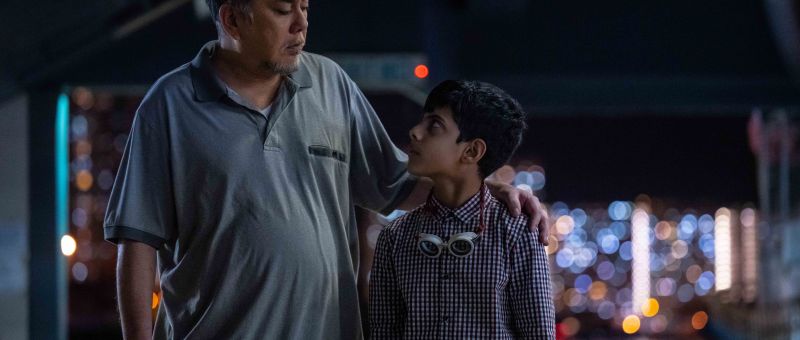
When Yat begins to take an interest in Hassan it’s mainly to assuage his guilt in knowing that he ruined Ahmed’s life and has left a boy without a father for whom he is now responsible. Yet it’s also in a way an attempt to repair the relationship he could not rebuild with his son while addressing the latent trauma from his own escape from Mainland China which he has otherwise buried through heavy drinking that finally resulted in a liver transplant from Hong that only seemed to deepen the sense of debt and obligation between them. Perhaps Hong Kong is a transitory place after all, each of them in some way displaced and not least from each other while continuing to hope for a better place in the future only to discover nothing more than loneliness and uncertainty if tempered by love and the shades of a frustrated hope.


The Sunny Side of the Street screens March 12/17 as part of this year’s Osaka Asian Film Festival.

Original trailer (Traditional Chinese / English subtitles)

Images: (C) Petra Films Pte Ltd

One Second Champion (一秒拳王, Chiu Sin-Hang, 2020)

“All things in their being are good for something” little Yan is told by a sympathetic TV presenter slightly unconvinced by his short-lived celebrity as the “One Second Wonder”. It may not sound like the most complimentary nickname, but in this case it’s intended in the kindest sense referring to the kid’s uncanny ability to see into the future if only for one second. As a child he’d told the TV audience that he wanted to grow up and find a way to use his superpower to contribute to society, but now a dejected middle-aged man the hero of Chiu Sin-Hang’s One Second Champion (一秒拳王) is something of a loser, imbued with a sense of defeat and not quite so much trading on past glory as using his “superpower” as a party trick to earn extra cash. 

As he tells us, Yan (Endy Chow Kwok-yin) was born during a storm, a power cut threatening his new life and leaving him apparently dead for one second to which he attributes the cause of his strange ability. All things considered, however, being able to see one second ahead is almost useless. What good is it to predict the winning lottery numbers or the winner of a horse race if you’ve no time to buy a ticket or place a bet? A nerdy sort of child unfairly thrust into the spotlight as the “One Second Wonder”, Yan has become a defeated middle-aged man working in the bar of an old friend while trying to pay off gambling debts accrued trying to raise the money for an operation for his son, Chi-leung (Hung Cheuk Lok), who is deaf. His total lack of self-esteem is rammed home when Chi-leung points out a classmate who’s been bullying him, often ripping out and damaging his hearing aid. Though Yan vows to talk to the school and the boy’s parents to sort it out, he quickly backs own even trying to force Chi-leung to apologise to the bully in front of his equally intimidating mum. 

The one arena where seeing one second ahead may in fact be valuable is in the middle of a fight which is what brings him to the attention of aspiring boxer Shun (Chiu Sin-hang). Faced with esteem issues of his own, Shun struggles in the ring partly due to his asthma and partly ongoing anxiety as a result of trauma having seen his dad behaving strangely after a fight. Aside from personal success, his desire is to resurrect his dad’s old gym, eventually teaming up with Yan after hearing of his strange ability and hoping his success might help attract more members. In this positive environment, Yan starts to regain a sense of confidence, getting a smart new haircut and paying more attention to personal grooming, while impressing his young son with his unexpected success not to mention reflecting that his “useless” ability might not be so useless after all. 

But then, after a traumatic incident he fears his special powers may be gone and is faced with another choice in whether to continue boxing as a “real” boxer or go back to the defeated life he used to live. Boxing shouldn’t be about gimmicks, according to a young pretty boy star (Chanon Santinatornkul) with an ironic, if sometimes cruel, devotion to the craft marketed like an idol by his ambitious manager, but Yan has to wonder if there’s more to him than the “One Second Wonder”. The conclusion that he comes to is that, as the TV presenter had said, everything’s good for something, one second can make a huge difference, and every choice you make counts. Win or lose, what matters is making the most of your time so why wait when you could start right away. A soulful tale of self-acceptance, the power of mutual solidarity, and the restorative qualities of physical discipline, Chiu Sin-Hang’s warmhearted drama is an ode to forging your own destiny, one second at a time, while remaining true to yourself. “Our superpower is never giving up” Yan tells his young son, no longer so afraid of the sound of his own heart beating, as they walk off into the sunset One Second Champions win or lose. 


One Second Champion streams worldwide (excl. China/Spain/Canada) until 2nd July as part of this year’s hybrid edition Udine Far East Film Festival.

Original trailer (English / Traditional Chinese subtitles)