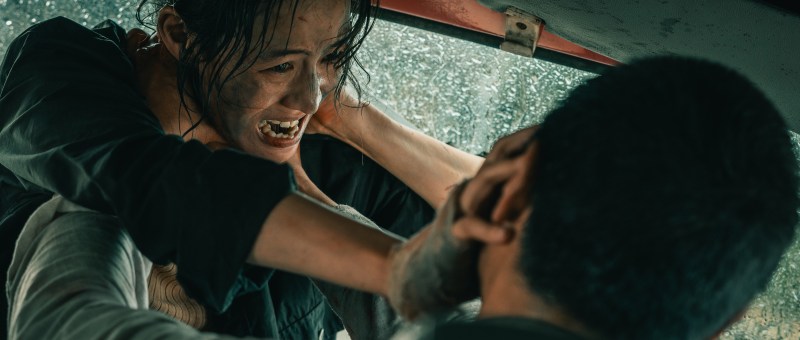
A Place Called Silence (默杀, Sam Quah Boon Lip, 2024)

Can the hammer of truth break the rock of silence? At the end of Sam Quah’s remake of his own 2022 film by the same name, A Place Called Silence (默杀, mò shā), you might ask if you really want to or if some secrets are best kept that way. Then again, Quah’s persistent focus on leaky roofs suggests the truth will out and that the slow drip of quietly collecting water will eventually erode even the strongest stone.

Though remade for the Mainland market, the film takes place in the fictional city of Doma which like many recent similarly themed films is ostensibly not located China but another area of South East Asia, the police uniforms and complex mix of languages and cultures strongly echoing those of the original Malaysian setting. This also extends to the increasingly Christianising imagery which leads back to a cult-like local charity that pedals a good book full of aphorisms landing somewhere between Confucius and Proverbs and are at best a superficial salve for the deeply rooted problems in what turns out to be a judgemental and classist society. 

At least, the reason no one challenges the increasingly extreme behaviour of school bully and queen bee Angie is because she’s the headmaster’s daughter. Angie has been relentlessly tormenting Tong largely because she has a disability and had until recently been taught in the special needs class. According to her mother, Han, Tong has been mute since birth and it’s in an attempt to get her a better education that she’s given up her job in accounting and taken a position as a cleaner at the school. Her mother’s profession is also another reason for Angie to bully Tong, though she also accuses Han of having seduced her father which does not appear to be true though his later admission to an “abuse of power” that gives Han leverage over him puts a different spin on the situation and does not cast him in a very good light. 

Neither does the state of disrepair at the school which has a persistently leaky roof that is at least according to handyman Zaifu structurally unsound and may cave in any minute. Some of the blame is placed on a recent tsunami which caused mass loss of life, and the school seems to be proud of itself for having taken in pupils from another institution that was swept away though they don’t appear to have been welcomed by everyone. When a pupil ends up dying because of Angie’s bullying, the headmaster delays calling for help in part it seems to evade a scandal while planning to simply bribe anyone who tries to look into the matter. 

In short, it’s not difficult to see why someone may feel they’d have to take the law into their hands to break the persistent silence that protects the wealthy and the powerful from the consequences of their actions. Though, truth be told, not everyone is very interested in the disappearance of the girls, Han is driven to distraction when she suspects that Tong has been abducted by a serial killer with a very particular motive who also seems to be aware of some secrets she herself had been keeping. Then again there are a lot of wilful silences, like that of Mrs Xu who later snaps that the whole building knew Han had suffered domestic violence yet apparently did nothing help her other than maintaining superficial politeness by avoiding bringing it up. 

Silence seems to be the only refuge for the bullied whether in school or the wider world for there’s little good in speaking up anyway. Tong tries to help a bullied friend, but her mother stops her, wary of their own need for silence and that Tong will simply become the next target which of course she does. Terrible things are done in the name of protection, but sometimes silence is necessary too and a means of atonement if not a weapon against life’s unfairness. An ambiguous mid-credits sequence somewhat muddies the waters in its implications though perhaps a concession to the censors demanding that crimes must be answered, but Quah otherwise depicts a hellish society of violence and powerlessness in which the only choices are silent complicity or murderous revenge.


A Place Called Silence is in UK cinemas now courtesy of CineAsia.

UK trailer (Simplified Chinese / English subtitles)

Hidden Blade (无名, Cheng Er, 2023)

In a moment of calm in Chang Er’s Hidden Blade (无名, Wúmíng), a man is served drunken shrimp and watches the poor creatures flail as they’re cooked alive in a bloody soup before placing them in his mouth still kicking, the red liquid dripping from his lips. The heroes are to some extent much the same, plunged into the dangerous waters of the Sino-Japanese war and drowning among its myriad confusions no longer even certain of their own identity let alone that of others. 

It’s at this that the Chinese title, Anonymous, hints for in this world of constant duplicity names are rarely exchanged or on occasion given only posthumously. That is aside from Mr. He (Tony Leung Chiu-wai) who introduces himself promptly after giving a secret knock to enter a hotel room marked with a Japanese character to meet a Mr. Liang who, it seems, intends to betray the Communist cause and instead serve the Wang Jingwei Regime which has sided with Japan in the puppet state of Manchuria, though we can in no way be sure if either of these men are telling the full truth or are who they claim to be. 

Chang replays this scene later with additional content as he will with several scenes throughout the film adding new context as he goes. Like Lou Ye’s Purple Buttlerfly, the fractured narrative hints at the chaos of an age in which nothing is quite as it seems and the truth is always obscured if at times irrelevant. Spanning the second Sino-Japanese war and its immediate aftermath, the film suggests that the motivations underpinning Japanese imperialism are anti-Communist and that Manchuria is a key asset for them as a bulwark against Soviet incursion. Collaborating with the Japanese, the Wang Jingwei Regime is the third point in a triangle lodged between Chiang Kai-shek’s Nationalists and the Communist Party with the implication that it essentially needs to drop out lowering the barriers for a confrontation between the two and the eventual victory of the Communists which occurs three years after the end of the film in 1949.

Technically the third part in the “China Victory Trilogy” which was conceived as “a gift to the Communist Party for its centenary” the film may make some bold claims as to the role of Communist spies in the 1930s but nevertheless neatly aligns the covert resistance movement with the Party’s eventual triumph if subversively ending on a note of loss and melancholy which leaves the survivors in lonely exile, ideologically victorious but emotionally ruined. Both Liang and the ambivalent Japanese soldier Watanabe (Hiroyuki Mori) talk of wanting a quiet life retiring to ancestral land as ordinary farmers freed from the murky world of politics but are each frustrated while He and Watanabe’s young goon Ye (Wang Yibo) wrestle with the romantic costs of their political choices. Yet the most dignified performance is reserved for an impossibly beautiful KMT assassin caught before she was able to take out a government minister while posing as his mistress “He used to write poems, now he writes execution orders,” Watanabe laments of the Minister (Da Peng) who later it seems pays a heavy price for his ruthless opportunism. At least his would-be-assassin remained true to her ideals and accepted her fate with dignity. Indeed, she may be the only one who is certain of herself and her identity even in her impeccable elegance which is a something of a mixed message given her political affiliation. 

In the end, it may be the self-denial that slowly erodes their souls while forced to conceal their true intentions even to those close to them. Then again, it’s impossible to know what’s for real and what’s for show. An intensely emotional exchange could in fact be intended for someone else’s ears or merely a cruel tragedy of misrepresentation. The real hidden blade is the self-repression living in an atmosphere of oppressive suspicion requires rather than the communist sleeper agents who in this version of the tale beat the Japanese into retreat. Featuring top notch production design and costuming, Chang’s oscillating venture through an abyss of cruelty and betrayal finds its heroes victorious but no so much anonymous as robbed of both name and country, lonely exiles of a war not quite won. 


Hidden Blade is available digitally in the US courtesy of Well Go USA.

US trailer (dialogue free)

No More Bets (孤注一掷, Shen Ao, 2023)

That the two biggest hits at the Chinese box office in summer 2023 both had a strong anti-gambling message perhaps hints at a contemporary anxiety, though No More Bets (孤注一掷, gūzhùyīzhì) is clearly the more direct of the two even if it also shares with Lost in the Stars its echoing of a theme in contemporary mainstream cinema that Chinese citizens are safe nowhere other than China. Then again, that particular message maybe somewhat disingenuous seeing as the villains here are all themselves Chinese if operating abroad to try and evade the law. 

This ambitious programmer Pan (Lay Zhang) learns to his cost when he abruptly quits his job after being passed over for a promotion in favour of someone with an influential father and accepts a too good to be true offer from what he’s been led to believe is a gaming company in Singapore. Soon enough, however, he realises their brief stopover is actually their destination and he’s been trafficked to another South East Asian nation where he is forced to participate in online gambling scams. Pan is however a righteous young man and immediately takes a stand, explicitly telling his captors he won’t do their bidding though they viciously beat him. Eventually he teams up with the slightly less conflicted model Anna (Gina Jin Chen) who vaguely understood the job when she agreed to it but not that they’d confiscate her passport and she’d be unable to leave. 

Like Pan, Anna accepted the job while frustrated by the vagaries of her industry after being unfairly let go by her agency after her photo was used on a flyer advertising sex work without her (or their) consent. Like those who play the games, she was suckered in by the promise of easy money that could be earned quickly and didn’t really think about the implications of what she was doing. That the film positions the victim, Tian (Darren Wang), as an incredibly wealthy young man who had access to vast generational wealth avoids the implication that some are drawn into scams for the same reasons that Pan and Anna were in they feel a sense of impossibility in their lives because of societal unfairness and economic hopeless but nevertheless paints his gradual descent into madness and addiction as a personal failing born of his insatiable greed rather than a misfortune that might befall anyone with a smartphone. Even so, if a highly educated young man can be tricked by such an obvious scam it suggests that it really can happen to anyone. 

At least, the film seems to say that in any case it’s bad to gamble but you should definitely think twice about promises that sound too good to be true, especially if they involve offers of work abroad. A series of talking heads interviews (with blurred faces) from victims of trafficking at the film’s conclusion all advise viewers not to travel to other countries to work, while several remark on how relieved they felt to see Chinese police when they were eventually rescued. Uniformed police also give a press conference during the film insisting that they are doubling down on combatting fraud and other kinds of cybercrimes while Inspector Zhao (Yong Mei), whose speech bookends the film, struggles to get anything done because the crimes are taking place overseas and therefore outside of her jurisdiction. Then again, the entire operation is run by Chinese businessmen who try to engender a sense of loyalty and rebellion among the men whom they’ve essentially enslaved by making them think that they’re merely rebelling against an unfair society by taking the money of the “greedy” people who play their games and redistributing it to their own, downtrodden families. 

Pan is trying to do the right thing, but often does it in the wrong way actively putting others in danger while trying to find a way to blow the whistle on the whole operation in the hope of being rescued while even Inspector Zhao at times seems dismissive, failing to take the claims of Tian’s girlfriend that he’s being swindled out of his entire family fortune by online scammers seriously until it’s too late. Even so, Shen crafts an often tense tale of escape as Pan does his best to send out coded messages under the noses of his kidnappers while unwillingly participating in the fraud hoping that eventually someone will figure out what’s going on and put a stop the cruel cycle of misery once and for all. 


No More Bets opens in UK cinemas 8th September courtesy of CineAsia.

UK trailer (English subtitles)