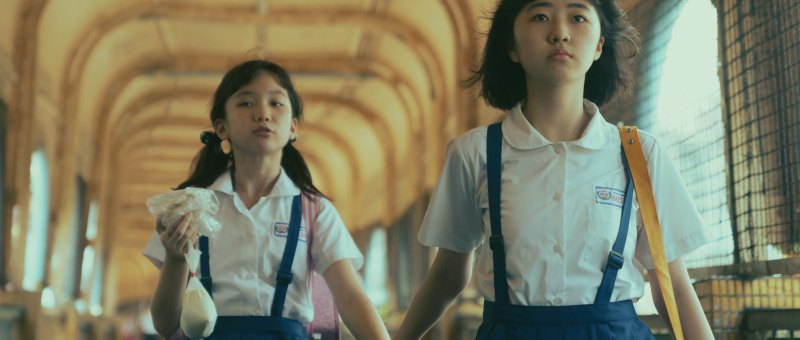
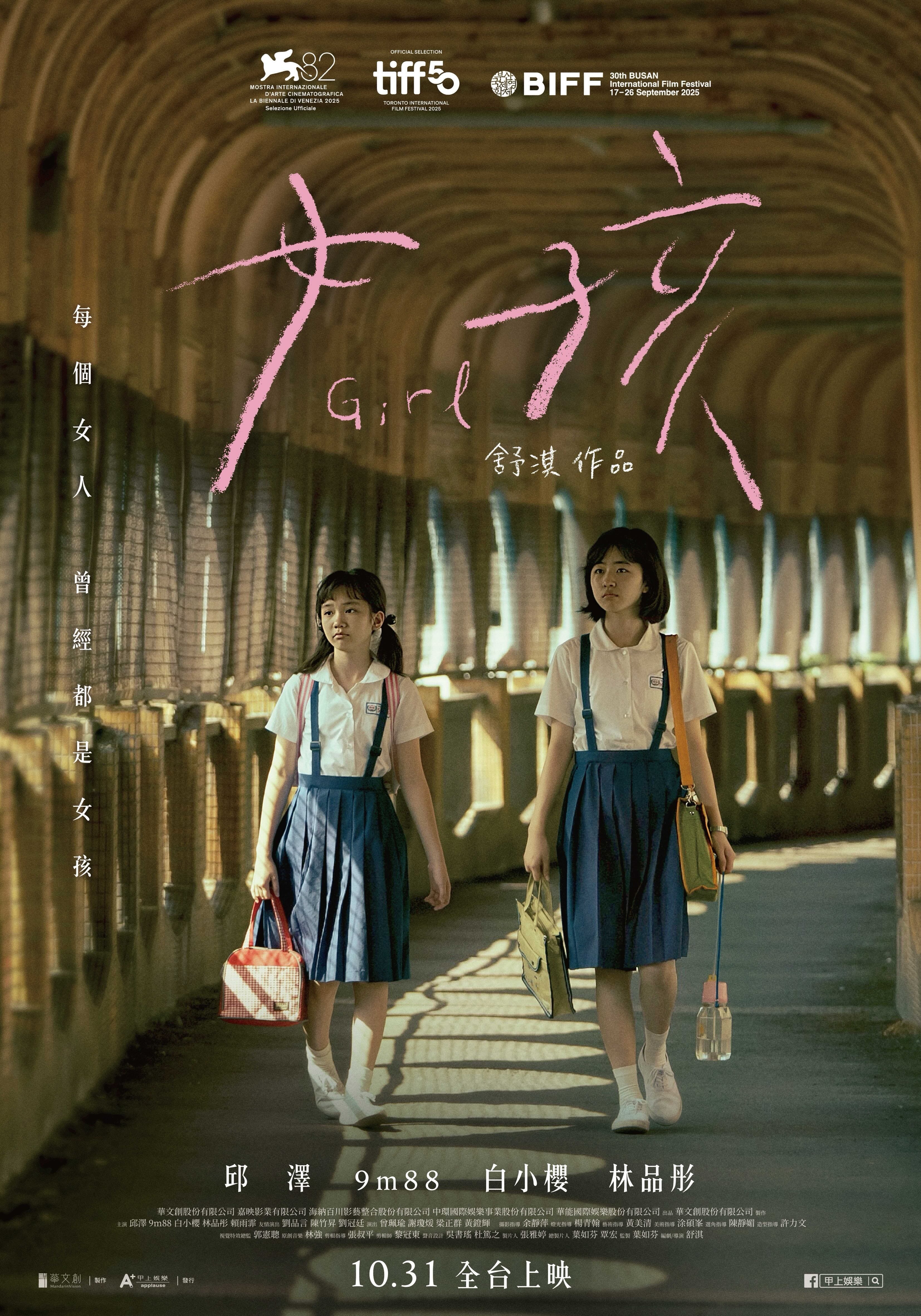
Taiwan may be emerging from martial law, but the cycles of patriarchal violence and oppression prove much harder to escape in Shu Qi’s touching directorial debut and portrait of a disrupted childhood, Girl (女孩, Nǚhái). Inspired by her own memories and set in the late ’80s, the film is unflinching in its depiction of mundane, domestic horror, but equally even-handed in extending understanding even to the most flawed of its protagonists who are themselves locked into a cycle of violence and self-loathing.
Hsiao-lee (Bai Xiao-Ying) doesn’t quite understand how her sister can be so cheerful even the other children at school make fun of her. Hsiao-lee is often criticised for looking “sullen,” and even her new friend Li-li (Lin Pin-Tung) jokes that on the rare occasion she smiles, she still looks “bitter”. But Hsiao-lee has plenty of reasons to be sorrowful and has perhaps already internalised the idea that there is no escape from her dismal circumstances. Finding a hole in the wall behind the school quite literally shows her another world, one that she later passes into in the company of Li-li who convinces her to ditch her classes and hang out with her at a sleazy video booth that is not really an age-appropriate environment for the two young girls.
Li-li is Taiwanese-American and has recently moved to the island following her parents’ divorce. The fact that Li-li’s parents’ marriage has ended, even if she wistfully wonders if her father will suddenly jet in to repair the family, shows Hsiao-lee that the prison that is her family home has a door that could be unlocked. It’s clear that Hsaio-lee is terrified of her father (Roy Chiu) who is a violent drunk and may also be sexually abusing her. She zips herself up in a tent at night and cowers in terror as his hand presses down on the canvas, though he doesn’t like closed doors and flies into rages when he encounters them, which explains the large dent next to the handle to the door of her room. Hsiao-lee’s mother, Chuan (9m88), seems to take most of her frustrations out on her even if she tries to intervene and distract her father from further harming her.
Hsiao-lee doesn’t understand why her mother seems to resent her while doting on her sister, though we soon come to wonder if she blames her for condemning her to this kind of life. Shots of Chuan’s adolescence in rural Taiwan hint at a still more patriarchal world in which her father told her there was no need to study and if she had free time to hang out with friends she should spend it helping her grandmother instead. It’s implied that Chuan may have been assaulted while finally embracing the simple freedom of spending time with other people her age, while her father disowned her on her pregnancy declaring himself ashamed and telling her to leave and never return. Even now, she earns a meagre living as a hairdresser’s assistant and is groped by the male customers which the salon otherwise has little option other than to court. Her boss fusses over the air conditioning whenever they come in, and though Chuan may have taken a liking to Mr Chen, he is already married and only ever a symbol of the life that has eluded her.
Chuan’s boss also tells her of a woman in Taipei who left an abusive husband and is now living happily with someone who treats her better, but Chuan continues to stick with Chiang possibly as an act of self-harm in her deep-seated self-loathing. Chiang doesn’t always seem to have been that way, but he’s otherwise someone who can’t fit into the contemporary society and is only employed thanks to a very understanding friend of his late father. Having gone too far and realised that Chuan may leave him if he continues to beat and rape her, he tries to reform, but it doesn’t last long and he’s soon back to drunkenly riding his scooter through town in the middle of the night. He too may feel hard done by, but it can’t excuse his behaviour nor the authoritarian terror of his home in which he takes out the frustrations of his fractured manhood on Chuan and Hsiao-lee.
Chuan is imprisoned within the house and can find no escape from it, even when Hsiao-lee directly asks her to divorce him. Hsaio-lee might, however, be able to get out but only be accepting exile from her family and leaving her mother and sister behind at her father’s mercy. Given the omnipresence of male failure, there’s something quite heartening about the female solidarity that arises between Hsiao-lee and Li-li even if their circumstances are quite different from each other. Li-li is mired in the collapse of her family and longs for its repair with her father’s return while resentful of the unfairness of being exiled to an unfamiliar country where she’s looked after by her grandmother whom she can’t understand, presumably because she speaks Taiwanese rather than the Mandarin her mother made her keep up in America, while Hsiao-lee is trapped and looking for a way to free herself from her father. On a trip to the local shop, she ominously eyes up the rat poison while Li-li buys some sweets.
But even as Taiwan emerges from the authoritarian superstructure of the martial law era, patriarchal violence refuses to die and it’s only through an act of maternal sacrifice, framed as rejection and a continuation of that same cycle of violence now enacted by her mother, that Hsaio-lee finds a more literal kind of escape. Only once her father is gone does light return to the house and the possibility of healing the disrupted relationship with her mother become a reality. Beautifully written and elegantly directed, the film has a very genuine sense of place with its busy alleyways and bustling streets. The kids at school might cheerfully sing that there’s no place like home, but for Hsiao-lee home might be the scariest place of all and the one it’s the most difficult to escape.
Girl screened as part of this year’s LEAFF.


 Windows on Worlds