Chang’an (长安三万里, Xie Junwei & Zou Jing, 2023)

It’s a strange thought, in a way, that poetry could save a nation. In reality, it didn’t quite. The An Lushan rebellion significantly weakened the Tang dynasty and contributed to its rapid decline. Nevertheless, Tang was an era in which art, culture, and freedom of thought all flourished. Animated feature Chang’an (长安三万里, Cháng’ān Sānwànlǐ), named for the imperial capital of that time, attempts dramatise the era through the lives of its poets and the eyes of Gao Shi (Yang Tianxiang) reflecting on his youthful and often distant friendship with the legendary Li Bai (Ling Zhenhe) whose poems are still recited by the school children of today.

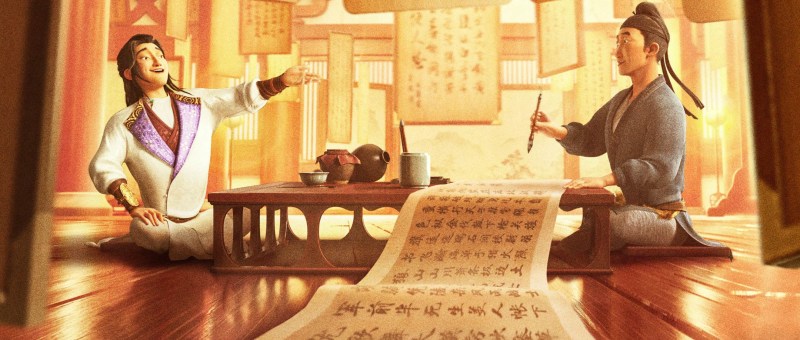
As the film opens, Gao Shi is an old man and embattled general staring down inevitable defeat at the hands of the invading Tubos emboldened by the weakening of borders following the failed An Lushan rebellion. But that’s not the reason he’s being visited by an imperial inspector who is far more interested in his relationship with Li Bai and the political importance it may have gained. Through this framing sequence, Geo Shi narrates the previous 40 years of history as he and Li Bai each age and take different paths in life while maintaining a distant if deeply felt friendship.

To that extent, Guo Shi is the earnest and practical son of a once noble house attempting to resurrect his family legacy, while Li Bai is a free spirited libertine attempting to overcome his lowly birth as the son of a wealthy merchant to gain government office through his skill as a poet. Then again, as future great poet Du Fu (Liu Jiaoyu / Sun Lulu) remarks, in this age poetry is something anyone can do and distinguishing oneself through it is no mean feat. It is however the only option for a man like Li Bai and the film in part seems to be an advocation for meritocracy in which those of ability would be free to prosper without needing to rely on social standing or personal connections. Despite the supposedly classless society of the modern day, this world may not yet have emerged. Another hopeful laments that she alone of her brothers inherited military skill yet as a woman there’s no door that is open to her to serve her country. 

Serving one’s country is the virtue that Gao Shi praises most highly and in effect his life’s purpose while Li Bai’s is more personal advancement and the perfection of his art. His poems are often melancholy and reflect on a sense of loneliness and longing for home, or else raucous celebrations of the art of drinking. Gao Shi does not approve of Li Bai’s party lifestyle and his debauchery later places a strain on their friendship. The film tacitly implies that this decadent behaviour is behind the decline of Tang, but also the reason that art and culture flourished amid a sense of destruction and despair. Having learned a few lessons in underhandedness from Li Bai, Geo Shi in effect restores order, albeit temporarily, through strategy and courage, while Li Bai first chooses isolation and then in its opposite after being pardoned for an apparently accidental and entirely thoughtless act of treason.

But what the film is keen to emphasise is the deep-seated friendship, or perhaps more, between the two men that makes the victory possible suggesting that a society needs both practicality and art to survive, not that Gao Shi was not a great poet himself if one well aware that Li Bai surpassed him in skill and keen support his success. Even so, as Gao Shi points out, a poet is not always an easy thing to be and in his old age those who once drank with Li Bai are either dead, one beaten to death at the age of 70, exiled or imprisoned. In a sense, both men achieve their aims if perhaps not in the way they intended. Gao restores his family name, and Li Bai finds a kind of immortality in his work that he otherwise failed to find spiritually in devoting himself to Taoism. The often beautifully rendered backgrounds capture a sense of a society on the brink of eclipse, such as the striking beauty of Gao Shi’s first entry to Yongzhou with its blossoming cherry trees lit by the warm light of lanterns under a full moon, only to turn to darkness on his return amid the twilight of the Tang dynasty. 


Dazzler Media presents Chang’an in UK and Irish cinemas from 28th February.

UK trailer (Mandarin with English subtitles)
I Am What I Am (雄狮少年, Sun Haipeng, 2021)

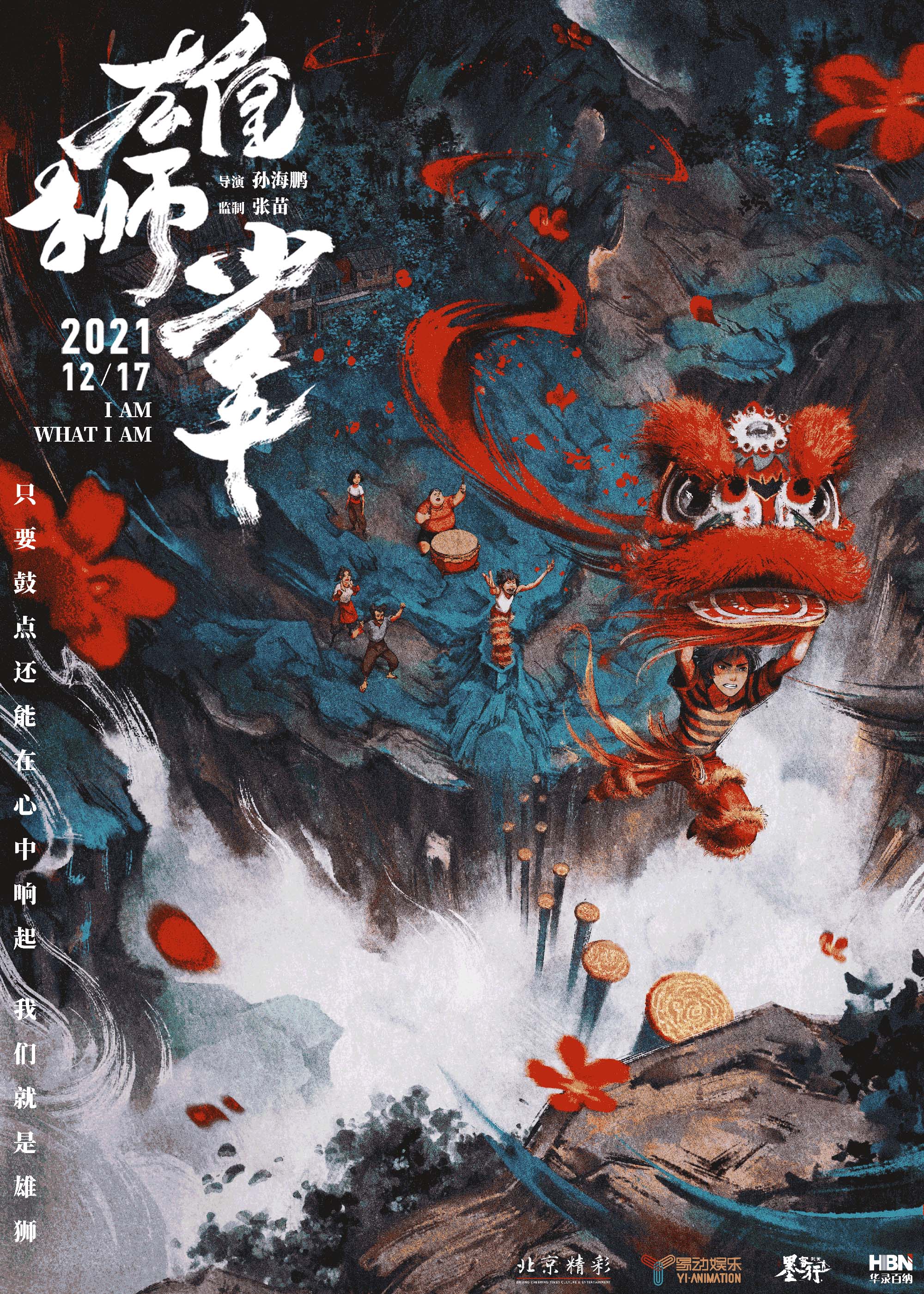
A diffident young man learns to unleash the lion inside while battling the fierce inequality of the modern China in Sun Haipeng’s heartfelt family animation, I Am What I Am (雄狮少年, xióngshī shàonián). With its beautifully animated opening and closing sequences inspired by classic ink painting and the enormously detailed, painterly backgrounds, the film is at once a celebration of tradition and advocation for seizing the moment, continuing to believe that miracles really are possible even for ordinary people no matter how hopeless it may seem. 

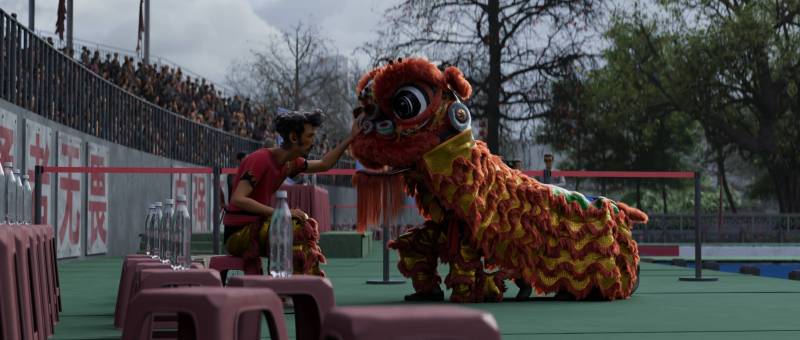
The hero, Gyun (Li Xin), is a left behind child cared for by his elderly grandfather and it seems regarded as a good for nothing by most of the local community. Relentlessly bullied by a well built neighbour who is also a talented lion dancer, Gyun finds it impossible to stand up for himself but is given fresh hope by a young woman who makes a dramatic entrance into the village’s lion dance competition and later gifts him her lion head telling him to listen to the roar in his heart. 

The young woman is presented as an almost spiritual figure embodying the lion dance itself, yet later reveals that her family were against her practicing the traditional art because she is female exposing the persistent sexism at the heart of the contemporary society. Gyun’s heart is indeed roaring, desperately missing his parents who were forced to travel to the city to find work while leaving him behind in the country hoping to earn enough for his college education. Part of the reason he wants to master the art of the lion dance is so that he can travel to the city where his parents can see him compete, while privately like his friends Kat and Doggie he may despair for his lack of options stuck in his small hometown. 

But even in small towns there are masters of art as the boys discover when directed to a small dried fish store in search of a once famous lion dancer. Perhaps the guy selling grain at the market is a master poet, or the local fisherman a talented calligrapher, genius often lies in unexpected places. Now 45, Qiang (Li Meng) is a henpecked husband who seems to have had the life-force knocked out of him after being forced to give up lion dancing in order to earn money to support his family, but as the film is keen to point out it’s never really too late to chase a dream. After agreeing to coach the boys, Qiang begins to reclaim his sense of confidence and possibility with even his wife reflecting that she’s sorry she made him give up a part of himself all those years ago. 

Then again, Gyun faces a series of setbacks not least when he’s forced to travel to the city himself in search of work to support his family taking his lion mask with him but only as an awkward burden reminding him of all he’s sacrificing. Taking every job that comes, he lives in a series of squalid dorms and gradually begins to lose the sense of hope the lion mask granted him under the crushing impossibility of a life of casual labour.  The final pole on the lion dance course is there, according to the judges, to remind contestants that there are miracles which cannot be achieved and that there will always be an unreachable peak that is simply beyond them. But as Gyun discovers sometimes miracles really do happen though only when it stops being a competition and becomes more of a collective liberation born of mutual support. 

In the end, Gyun can’t exactly overcome the vagaries of the contemporary society, still stuck in a crushing cycle of poverty marked by poor living conditions and exploitative employment, but he has at least learned to listen to himself roar while reconnecting with his family and forming new ones with friends and fellow lion dancers. While most Chinese animation has drawn inspiration from classic tales and legends, I Am What I Am roots itself firmly in the present day yet with its beautifully drawn backgrounds of verdant red forests lends itself a mythic quality while simultaneously insisting that even in the “real” world miracles can happen even for lowly village boys like Gyun when they take charge of their destiny not only standing up for themselves but for others too.


I Am What I Am screens in Chicago on Sept. 10 as the opening movie of Asian Pop-Up Cinema season 15.

Original trailer (English subtitles)