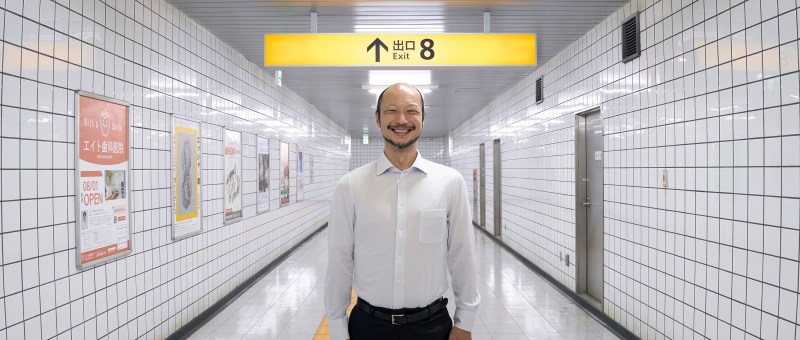
Shinjuku Station is notoriously difficult to escape. The endless labyrinthine corridors all look the same, lending the environment a degree of surreality that leaves you feeling anxious that actually you’re making no progress at all merely walking in circles and may do so until you die. It becomes a more literal hellscape for one “lost man” in Genki Kawamura’s elliptical adaptation of the popular video game in which the hero finds himself trapped in the same looping corridor where he is told he must turn back if he spots anything that isn’t as it should be and that he should do this eight times so that he can reach Exit 8 (8番出口, Hachiban Deguchi) and leave the station.
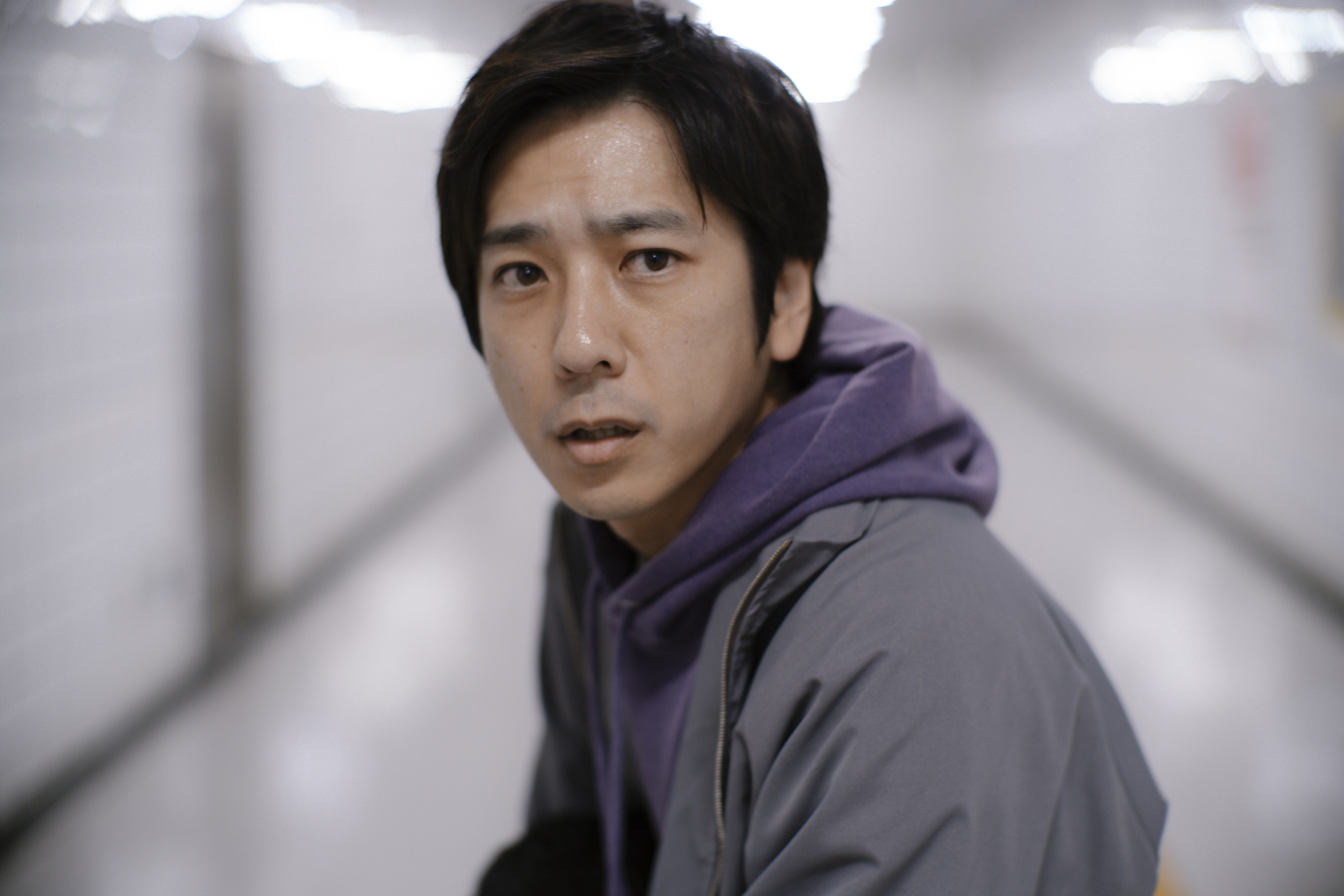
The figure 8 is an ellipsis in itself while simultaneously recalling the Noble Eightfold Path of Buddhism in which one must complete the eight steps to find Nirvana and escape the painful cycle of life and rebirth. It’s birth that most occupies the Lost Man (Kazunari Ninomiya) as, shortly before he enters the tunnel, he receives a call from the girlfriend (Nana Komatsu) he’s just broken up with telling him she’s pregnant. She says knows he always had an anxiety about becoming a father, but wants to know what he wants to do. Kawamura films this opening sequence in POV, at once recalling the film’s video game origins and placing us directly into this world in which we feel the Lost Man’s shock and disorientation as he stops suddenly and staggers while the world carries on around him.
The tunnel is then a manifestation of his mental destabilisation as he tries to process impending fatherhood and make a decision about whether or not he wants this child. This is to an extent reflected in his name in which he is both geographically and mentally “lost” while unable to reach a decision. Inside the tunnel, he’s told not to “overlook” anything that seems like an anomaly as if he were trying to remake the world and teach himself which is the right path to take. Though as his equally unnamed girlfriend says in a sequence that may be a fantasy, future echo, or fractured memory, no one can really know which path is right and life is a continual act of faith that we will not come to regret the decisions we have made or the ones we failed to make.
This is most obvious when the Lost Man encounters a little boy with a scratch on his face in the tunnel and immediately decides he’s an anomaly, only to discover he isn’t when the counter resets to zero meaning he made the wrong decision and has to start again. The boy seems to be another person trapped in the loop, though not previously on the same cycle as the Lost Man, but at the same time he comes to represent both the son the Lost Man may have and himself as a little boy. Likewise, the Walking Man (Yamato Kochi) that he encounters also seems to become the father that Lost Man fears becoming, and the one he never met. While the Walking Man eventually abandons the boy on discovering what could be Exit 8 to make his own escape, the Lost Man refuses to do so and begins to come to an accommodation with his own role as a potential father as well a responsible member of society.
In the opening sequence, he’d stood by and done nothing as an obnoxious salaryman laid into a mother holding her crying baby on the train, the only white-dressed figure on this funereal carriage filled with people dressed in back on their way to work. Another loopee asks the Walking Man if being trapped in this purgatorial hellscape is really any different than his life in which he repeats the same actions every day in the daily grind of the salaryman and it does seem as he is looking for an escape from the soul-destroying meaninglessness of the corporate life otherwise hinting at his own failed paternity and flight from domestic obligation. Meanwhile for the Lost Man, he fears he isn’t ready to become a father in part because he’s only a temp worker and hasn’t anchored himself safely enough within adulthood to be able to support a wife and child. Still, he resents himself for not having stood up for the woman and her baby in being cowed into submission by the paternal figure of the salaryman and the fear of putting his own head above the parapet by refusing to mind his own business like everyone else with their heads buried in their phones.
But then again, how could you ever really know that you’ve found the “real” Exit 8 and it’s not just another “anomaly” presented by the loop. Perhaps you never actually escaped this labyrinth, only ventured deeper inside it. Or perhaps, you escape the loop when it’s time for you to do so because your mind is clear and you know which path to take. There’s a minor irony in some the decor with the subway etiquette poster reading “are you alright?” while intending to ask the reader if they’re sure they’re behaving appropriately on public transport, but also hinting at the Lost Man’s failure to intervene and the Walking Man’s indifference to others. In any case, the tunnel has its hellishness and terror but it can also lead you where you’re supposed to go, if only you allow it.
Exit 8 screens 8/9th October as part of this year’s BFI London Film Festival.
Trailer (English subtitles)
 What would you give to live another day? What did you give to live this day? What did you take? Adapting the novel by Genki Kawamura, Akira Nagai takes a step back from the broad comedy of
  Windows on Worlds