
Honey Money Phony (“骗骗”喜欢你, Su Biao, 2024)

Can you really say a scammer who just takes people’s money without messing with their feelings is any better than one who just robs them? That’s a justification put forward by fraudster Ouyang (Sunny Sun) in Su Biao’s remake of Thai rom-com The Con-Heartist, but it’s a difficult one to swallow. After all, even if you just trick someone out of a small amount of cash,the psychological effects can be devastating though the pain may not be quite the same as getting your heart broken in a love scam.

Qinglang (Jin Chen) has indeed had her heart broken by the lothario Zijun (Wang Hao) whom she met at a tennis class she started going to after moving to the fictional city of Aoo Kang. Later it’s revealed that the cause of her move was getting fired from her company for reporting her boss for sexual harassment while she was also in a bit of debt from breaking a non-compete clause by getting another job, something which Zijun apparently sorted out for her. But not long after she took out a loan to give him money supposedly for his university tuition, Zijun ghosted her and she realised she’d been the victim of a romance scam. Now she’s on the hook for that too, working a series of part-time jobs in fast food restaurants and walking dogs as well as an unsuccessful gig as a vlogger in addition to her regular job in insurance. 

Experience is maybe why she suddenly thinks twice after being contacted by someone purporting to be from the vlogging site telling her she’s been suspended and needs to pay a fine. After getting Ouyang’s info from the bank she threatens to expose him but then makes a deal, if he helps her scam Zijun into giving back the money she gave him she won’t take this any further. Of course, there’s no guarantee Ouyang hasn’t just switched to a different con while Qinglang remains quite naive and despite herself trusting him. Then again, he’s the exact opposite of Zijun who took advantage of her despair and offered himself as a source of constant support. His aloofness and apparent honesty about what he is may in their way reassure her. 

There is something that might be comforting in Ouyan’s unflashiness. Though he drives a convertible, it’s not a particularly glamorous sort and has a busted taillight and in any case, he also lives in it. According to him, that’s so he can get away quickly if he needs to, but also suggests that it’s not really all about the money. Zijun, meanwhile, is greedy and materialistic, hopping from one wealthy woman to the next while hoping to join the social elite and live a high life of fast cars and wild parties. A justification for Ouyang’s scamming is given in a tragic backstory which may or may not be true suggesting that he was born out of wedlock and his mother died in childbirth. He was raised by his grandmother and uncle while his birth father entered his life at one point and tried to connect with him but it turned out it was all because his other son from a different relationship needed a bone marrow transplant. As soon as he found out Ouyang wasn’t a match, he disappeared from his life. 

The implication is that Ouyang scams as a kind of revenge because he doesn’t trust people and therefore is unable to live an ordinary, honest, life but through connecting with Qinglan and falling in love he develops the desire to live with more compassion and stability. Qinglang, meanwhile, gains confidence in herself and realises that her low self-esteem left her vulnerable to manipulation. Her friend, Xiaohui (Li Xueqin), who was also in massive debt and ended up posing as a blind person to carry out accident scams, also puts the skills she’s learned to good use to progress her acting career which might all be a very contradictory message even if there’s something satisfying about scamming a scammer and especially one as full of himself as Zijun. Released for Western New Year, the film has a zany wholesomeness despite its bleak subject matter and hints at a sense of despair in contemporary life in China but does indeed suggest that cheaters don’t necessarily need to prosper and you do have a degree of control over your life even if it’s just deciding to choose love and move on rather than wallow in a sense of futility. 


International trailer (English subtitles)

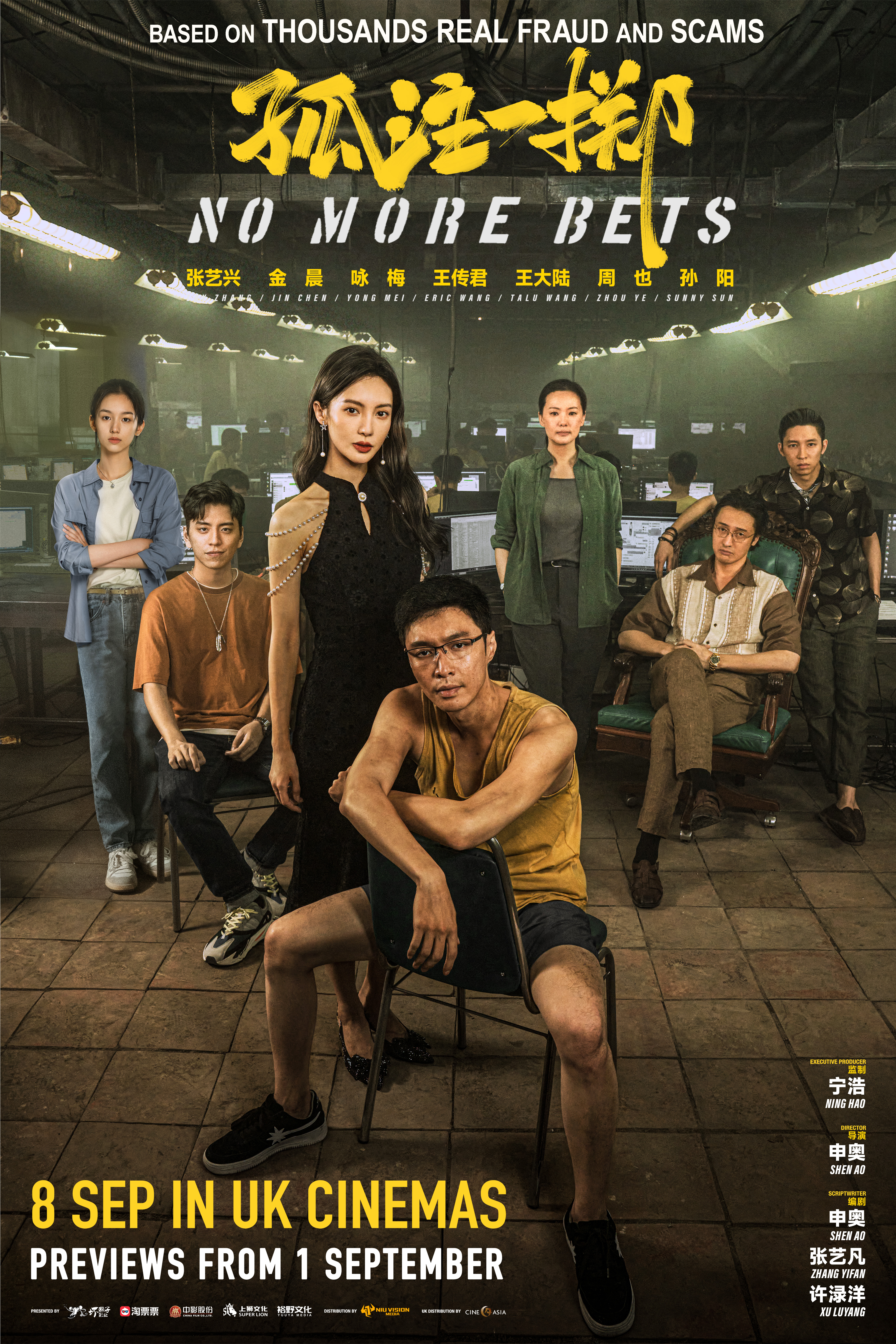
No More Bets (孤注一掷, Shen Ao, 2023)

That the two biggest hits at the Chinese box office in summer 2023 both had a strong anti-gambling message perhaps hints at a contemporary anxiety, though No More Bets (孤注一掷, gūzhùyīzhì) is clearly the more direct of the two even if it also shares with Lost in the Stars its echoing of a theme in contemporary mainstream cinema that Chinese citizens are safe nowhere other than China. Then again, that particular message maybe somewhat disingenuous seeing as the villains here are all themselves Chinese if operating abroad to try and evade the law. 

This ambitious programmer Pan (Lay Zhang) learns to his cost when he abruptly quits his job after being passed over for a promotion in favour of someone with an influential father and accepts a too good to be true offer from what he’s been led to believe is a gaming company in Singapore. Soon enough, however, he realises their brief stopover is actually their destination and he’s been trafficked to another South East Asian nation where he is forced to participate in online gambling scams. Pan is however a righteous young man and immediately takes a stand, explicitly telling his captors he won’t do their bidding though they viciously beat him. Eventually he teams up with the slightly less conflicted model Anna (Gina Jin Chen) who vaguely understood the job when she agreed to it but not that they’d confiscate her passport and she’d be unable to leave. 

Like Pan, Anna accepted the job while frustrated by the vagaries of her industry after being unfairly let go by her agency after her photo was used on a flyer advertising sex work without her (or their) consent. Like those who play the games, she was suckered in by the promise of easy money that could be earned quickly and didn’t really think about the implications of what she was doing. That the film positions the victim, Tian (Darren Wang), as an incredibly wealthy young man who had access to vast generational wealth avoids the implication that some are drawn into scams for the same reasons that Pan and Anna were in they feel a sense of impossibility in their lives because of societal unfairness and economic hopeless but nevertheless paints his gradual descent into madness and addiction as a personal failing born of his insatiable greed rather than a misfortune that might befall anyone with a smartphone. Even so, if a highly educated young man can be tricked by such an obvious scam it suggests that it really can happen to anyone. 

At least, the film seems to say that in any case it’s bad to gamble but you should definitely think twice about promises that sound too good to be true, especially if they involve offers of work abroad. A series of talking heads interviews (with blurred faces) from victims of trafficking at the film’s conclusion all advise viewers not to travel to other countries to work, while several remark on how relieved they felt to see Chinese police when they were eventually rescued. Uniformed police also give a press conference during the film insisting that they are doubling down on combatting fraud and other kinds of cybercrimes while Inspector Zhao (Yong Mei), whose speech bookends the film, struggles to get anything done because the crimes are taking place overseas and therefore outside of her jurisdiction. Then again, the entire operation is run by Chinese businessmen who try to engender a sense of loyalty and rebellion among the men whom they’ve essentially enslaved by making them think that they’re merely rebelling against an unfair society by taking the money of the “greedy” people who play their games and redistributing it to their own, downtrodden families. 

Pan is trying to do the right thing, but often does it in the wrong way actively putting others in danger while trying to find a way to blow the whistle on the whole operation in the hope of being rescued while even Inspector Zhao at times seems dismissive, failing to take the claims of Tian’s girlfriend that he’s being swindled out of his entire family fortune by online scammers seriously until it’s too late. Even so, Shen crafts an often tense tale of escape as Pan does his best to send out coded messages under the noses of his kidnappers while unwillingly participating in the fraud hoping that eventually someone will figure out what’s going on and put a stop the cruel cycle of misery once and for all. 


No More Bets opens in UK cinemas 8th September courtesy of CineAsia.

UK trailer (English subtitles)

Code of the Assassins (青面修罗, Daniel Lee Yan-Kong, 2022)

“Assassinate for peace” runs a series of characters along a wall in the secret den of a shady society known as Ghost Valley in Daniel Lee’s fantasy wuxia, Code of the Assassins (青面修罗, qīng miàn xiūluó). It may seem somewhat paradoxical, but the Ghost Valley philosophy is that they can one day help the world turn away from vengeance and hatred towards a more settled humanity by carrying out assassinations in “an age in which assassins are used to solve problems”. 

Yet everyone in Ghost Valley is out for revenge, not least the hero Junyuan (Feng Shaofeng) whose entire clan was wiped out after a mysterious man asked his dad to carve a copper treasure map. The map and its hidden riches continue to destabilise the political equilibrium in a series of neighbouring clans with ambitious retainer Prince Rui approaching Ghost Valley to get him the map and bump off his rival, head of the Imperial Guard Zhao (Hu Jun), in the process. Golden Mask, the mysterious leader of Ghost Valley tells Junyuan’s mentor Grim Ghost to keep him out of it, but Junyuan obviously doesn’t listen because learning the truth behind the map and his parents’ death is his life’s mission. 

That’s how he gets himself mixed up in intrigue, framed as a traitor to Ghost Valley and hunted by a series of enforcers while falling for enigmatic female assassin Shengsheng (Gina Jin Chen). Dualities seem to abound in the ironic juxtaposition of peace and assassination along with that of vengeance and righteousness in the ongoing battle against hate and darkness. Junyuan vows he will walk out of Ghost Valley once his vengeance has been achieved, but has to ask himself if his time there has changed him and if he can ever leave this shady world of mercenary violence. Golden Mask explains to him that you can’t change anything with a weapon but a plot can change an era, while Lady Hua, who has become a Buddhist, adds that assassinations don’t change anything either. 

Yet the plotters’ revolution fails in part because they have changed since they set their plot in motion and are no longer the right people for the right time. Junyuan grows suspicious of his masked society, certain that mask on or off he is the same Junyuan but now mistrustful of the effects the mask can have on others along with the power they confer. Power can make one hunger for more, contravening the laws of Ghost Valley to embrace greed in taking vengeance against a world that denies them what they want. Then again, hegemony may also in its way bring about “peace” at least for a time.

The eerie austerity of the snowbound Ghost Valley hideout echoes its emotional coldness in the sacrifices that have been made in the pursuit of plotting, romantic not least among them in the melancholy of Lady Hua filled with past regrets and a longing for lost love knowing that the long years of waiting have corrupted the innocent romance of her youth. Junyuan continues to grow closer to Shengsheng though suspicious of her dualistic qualities as top assassin and damsel in distress while himself unwilling to pursue romance in this continually uncertain world. 

Despite his claims to use no weapons, Golden Mask, like Junyuan who has a steampunk prosthetic arm, hides angel wings beneath his armour, while sometime enemy Black Judge has an umbrella that fires nails from its spokes. Lee conjures an anachronistic world of industrialised fantasy echoed in the factory-like design of Ghost Valley and the secret underground mailroom beneath the palace where the authoritarian lord has been secretly reading the private correspondence of his men including Zhao’s frequent letters to his wife which he then uses against him as a veiled threat. Lee introduces the Ghost Valley assassins with their own intro video showcasing their weaponry and techniques along with their mask and lends a touch of wizardry to impressive large scale action sequences with the quasi-magical quality of the equipment and its intricate metalworking. The video game aesthetic and heavy metal end credits also lend a cool if perhaps now retro sensibility injecting a punk spirit in direct contrast to the genre’s usual classicism as Junyuan commits the ultimate act of rebellion in maintaining his integrity in a world of masked intrigue.


Code of the Assassins is available to stream in the US via Hi-YAH! and released on Digital, blu-ray, and DVD courtesy of Well Go USA on March 28.

US release trailer (Mandarin with English subtitles)