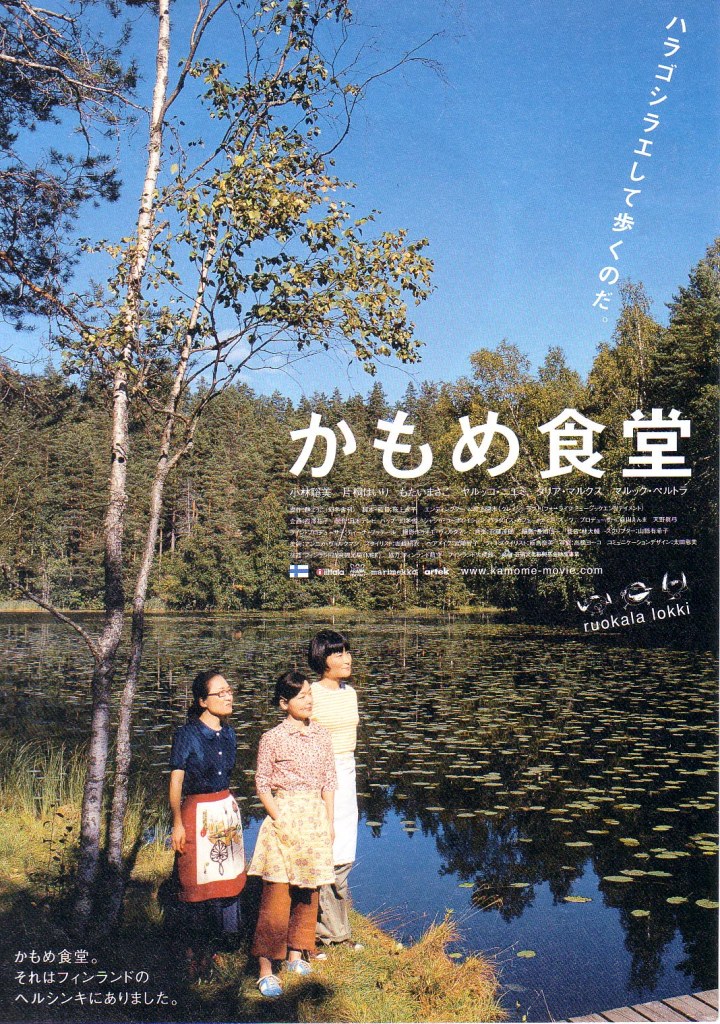
 Finland, Finland, Finland. That’s the country for me! Where better could there possibly be to open up a small Japanese cafe than in Helsinki? On second thoughts, don’t answer that but moving to Finland and opening her own diner all alone is exactly what the leading lady, Sachie, has done in this warm hearted comedy drama from Naoko Ogigami, Kamome Diner (かもめ食堂, Kamome Shokudou). As in most of her films, Ogigami has assembled an eclectic cast of eccentric characters who each find themselves turning up at Sachie’s restaurant largely by chance but this time there’s a little added cross cultural pollination too.
Sachie (Satomi Kobayashi) has learned fluent Finnish and put together a welcoming space serving coffee and sweet goods as well as full meals in a fairly central location though she’s yet to receive a single customer through her doors. Three middle aged women often stop outside and stare making some sort of derogatory comment before scuttling off when Sachie spots them. Then, one day a teenage boy comes in and unexpectedly tries out some of his Japanese. He turns out to be a bit of a Japanophile and asks Sachie to teach him all the words to the Gatachman theme tune though she can’t remember past the opening. The tune gets stuck in her head and starts to drive her so mad that when she spots another Japanese woman in a bookshop cafe she marches up to ask her if she can remember the whole thing and luckily she can. Sachie then offers to let the woman, Midori (Hairi Katagiri), stay at her place in return and the two become friends. Later another Japanese lady, Masako (Masako Motai), turns up after her luggage goes missing and together the three start to make a success of Sachie’s diner.
Why Sachie chose Finland remains a mystery, though she has taken the time to learn Finnish to a near native level and also seems to know quite a lot about the various local legends. She doesn’t seem particularly rushed though and is fairly content to wait around for the customers to come of their own accord rather than trying to chase them down herself. In fact she gives her very first customer, the Japanese pop culture enthusiast Tommi, free coffee for life which doesn’t seem like the best business decision.
Likewise, we learn how Midori came to choose Finland as a holiday destination but she seems a little sad and the fact that her stay is open ended perhaps hints at having run away from something though once again we aren’t told much about her backstory. Not that that matters very much, quite the contrary in fact. Masako proves the most eccentric of the three though we actually learn quite a bit about what brought her to Finland.
Other than Tommi who seems most interested in the stereotypical aspects of Japanese culture (to the slight consternation of Midori) with his T-shirts bearing non sensical slogans and illustrations of geisha, the restaurant does start to attract a few Finns albeit mostly ones who are in some sort of trouble. One man teaches Sachie how to make better coffee, a middle aged woman simply stares angrily at them from outside until she comes in one day and downs a few of the local spirit before collapsing, and then there are the other three gossips who turn out to be won over with something as simple as sweet smelling pastries.
Simply put, warmth, kindness and patience eventually break down all barriers. The Kamome Diner becomes a refuge for all the lonely misfits from home and abroad watched over by Sachie & co always ready to pour some delicious smelling coffee for the next needy customer through the door. Wonderfully low-key and filled with absurd yet oddly plausible situations, Kamome Diner blends the dual eccentricities of these two stereotypically “wacky” countries beautifully and just goes to prove there’s nowt so queer as folk wherever you land.
The Japanese region A blu-ray release of Kamome Diner includes English subtitles!
Short (unsubtitled) scene from near the beginning of the film:

 Windows on Worlds