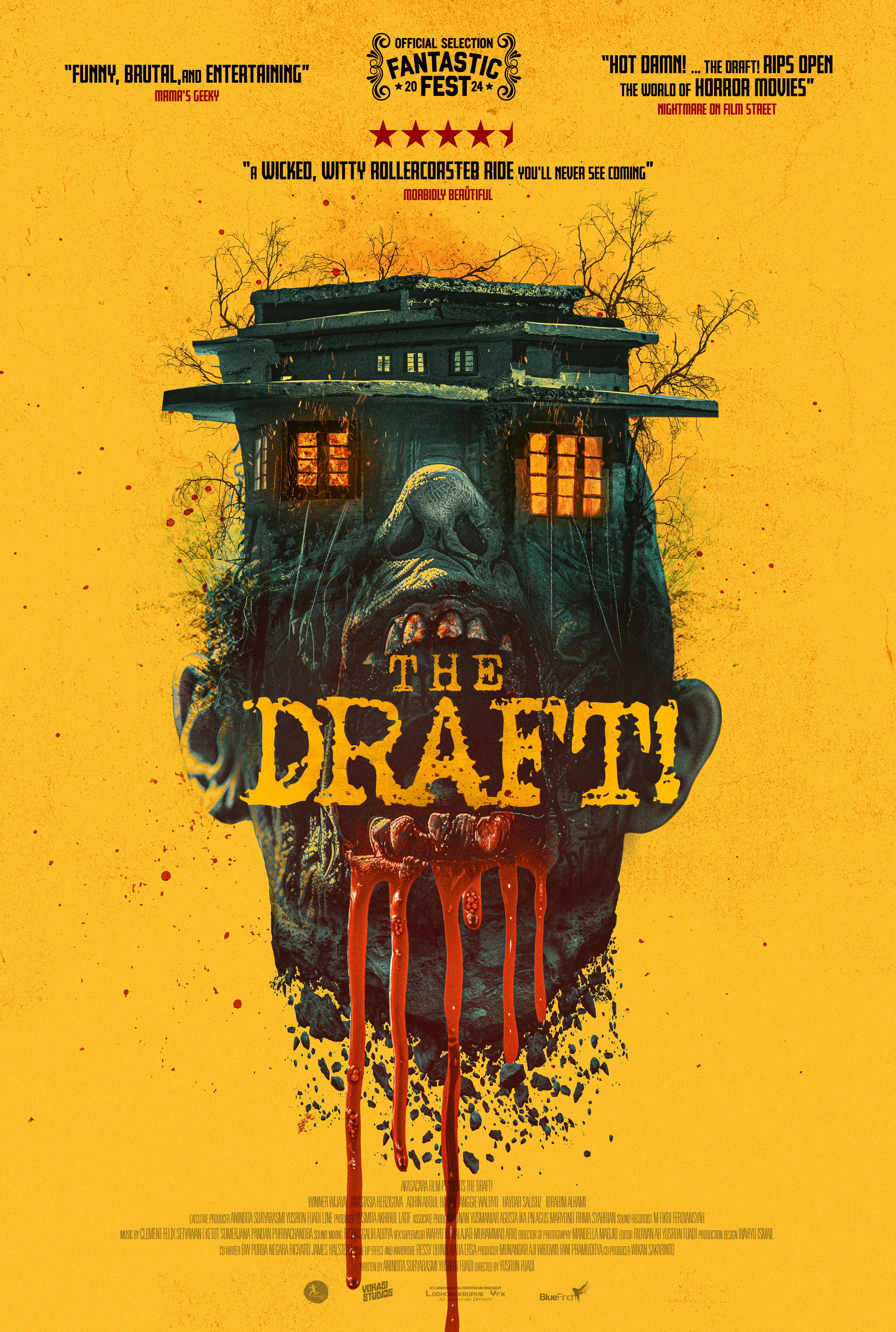
The Draft! (Setan Alas!, Yusron Fuadi, 2023)

It’s easy to feel as if you’re trapped on a certain path and that unseen forces are dictating your life, leaving you with little power to overcome your fate. But what if you were really imprisoned inside the as yet unfinished script for a terrible movie by a lazy, half-hearted writer who can’t think of anything more interesting than killing you in horrifying ways while being constantly hassled by an equally dull producer who threatens to replace him with Joko Anwar? 

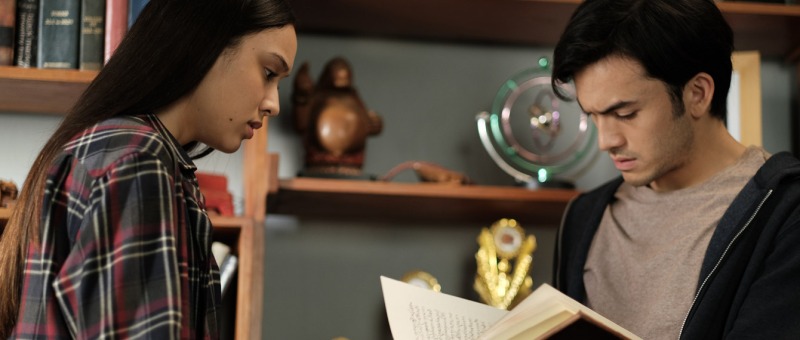
That is indeed the dilemma faced by those at the centre of Yusron Fuadi’s Indonesian meta horror, The Draft (Setan Alas!). The opening sequence follows them as they drive towards a remote country villa owned by rich girl Ani’s (Anggi Waluyo) recently divorced parents. As soon as they get there, they begin remarking on how it’s just like something out of an Indonesian horror movie complete with a Dutch cemetery not too far away and a creepy caretaker who seems to pop up out of nowhere. Predictably, the power’s gone out and the generator’s on the blink, so they’ll have to have atmospheric candles instead and obviously can’t get any phone signal to call for help. Ani’s also brought a photo of her apparently deceased younger sister, though none of that turns out to matter because the screenwriter’s about to forget about it. 

All of this heavy exposition is delivered in a very knowing manner, as if mocking the tropes of the Indonesian horror movie while simultaneously indulging in them until the gang suddenly figure out that they’re just characters in a half-written screenplay which is why they can’t really remember much of their pasts. As such, they’re desperately in search of “god”, or the writer, who alone has control over their fates and seems to have ill intentions for them while their only means of defence is to force him into a rewrite so they won’t die. After a while, they begin to work out how they can manipulate this world by influencing the writer’s thoughts when their joking speculation about might what happen next gives him ideas, so they can also write into their dialogue that there’s a massive stash of arms in the basement that will be very useful against the surprise zombie hordes. 

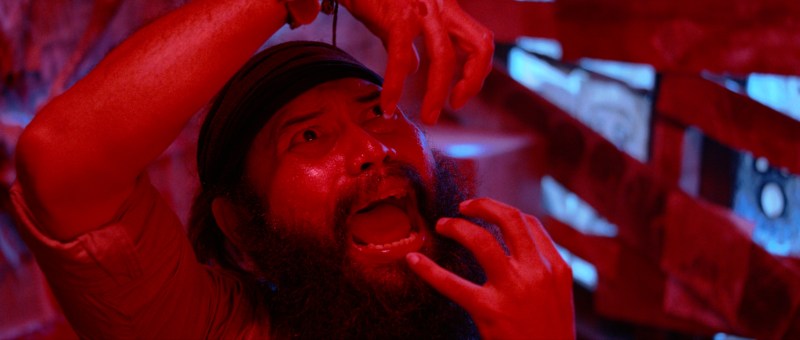
Meanwhile, in the real world, time passes for the writer who burns his motorbike and argues with his producer while constantly rewriting the screenplay to suit his preferences. The gang joke that there can’t be that many zombies coming because CGI’s too expensive, and no one would give a film with dialogue this bad a budget big enough to pay for thousands of extras. The writer is damned if he does and damned if he doesn’t. He either writes the film the producer wants with its generic plot and stereotypical characters or he doesn’t get to make a film at all.

The characters too are protesting being a part of this project and fighting for a movie along with a better life in which they have more light and shade, actual backstories and personalities both they and the audience can invest in. But increasingly, their author leaves them hanging as the real interferes with his screenwriting dreams and years go by with no more “revisions” leaving this film a perpetually unfinished draft that he may pick up again some day more out of idleness that ambition. The dream world of the movie seems to be forever receding like the cliff edge that prevents the characters from leaving, the abandoned drafts burning away as stripping layers from their reality. 

Trapped in this eternal state of limbo, they do at least realise they have an advantage and time to train, to write their own stories in the absence of their not quite so omniscient god. They might, after all, enjoy a life of “worldly pleasures without any consequences or commitment” while they wait as if this place too could be a kind of heaven free of any possible constraint save the inability to leave or to feel time passing and finally be allowed some kind of forward motion and growth. This project might be paused, indefinitely, and destined to live forever in the draw as an unfinished draft, but there might still be time to bring themselves into being while their inattentive creator perhaps does the same.


The Draft! is on UK and Ireland digital platforms 27 October.

Trailer (English subtitles)
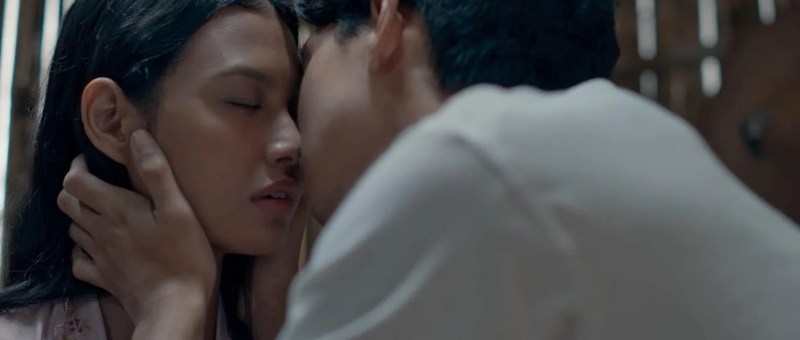
Gowok: Javanese Kamasutra (Gowok: Kamasutra Jawa, Hanung Bramantyo, 2025)

There’s an essential contradiction at the centre of Hanung Bramantyo’s spicy romantic melodrama Gowok: Javanese Kamasutra (Gowok: Kamasutra Jawa) in that, on the one hand, the gowok is said to exist so that men learn how satisfy their wives’ sexual desires. Which is to say, the sexual desires of women are recognised and approved rather than denied or taboo while men are expected to live up to satisfying them as part of what it means to be a proper man. But at the same time, women are constrained by the patriarchal institution of marriage, have few rights of their own, and are largely unable to live independently while lacking status as anything other than a man’s wife. 

Indeed, the inserting of increasingly outdated notions of sex and class that stand in the way of romance and set the tragic events in motion rather than the black magic to which many attribute the looming crisis. Years before, Jaya’s mother had been in love with the soon-to-be king, but he couldn’t marry her because she wasn’t of sufficiently noble birth. She agreed to step aside and marry a mutual friend on the condition he would be given high office and her son would marry into royalty so that she would be a queen in all but name and their family would enter the royal bloodline.

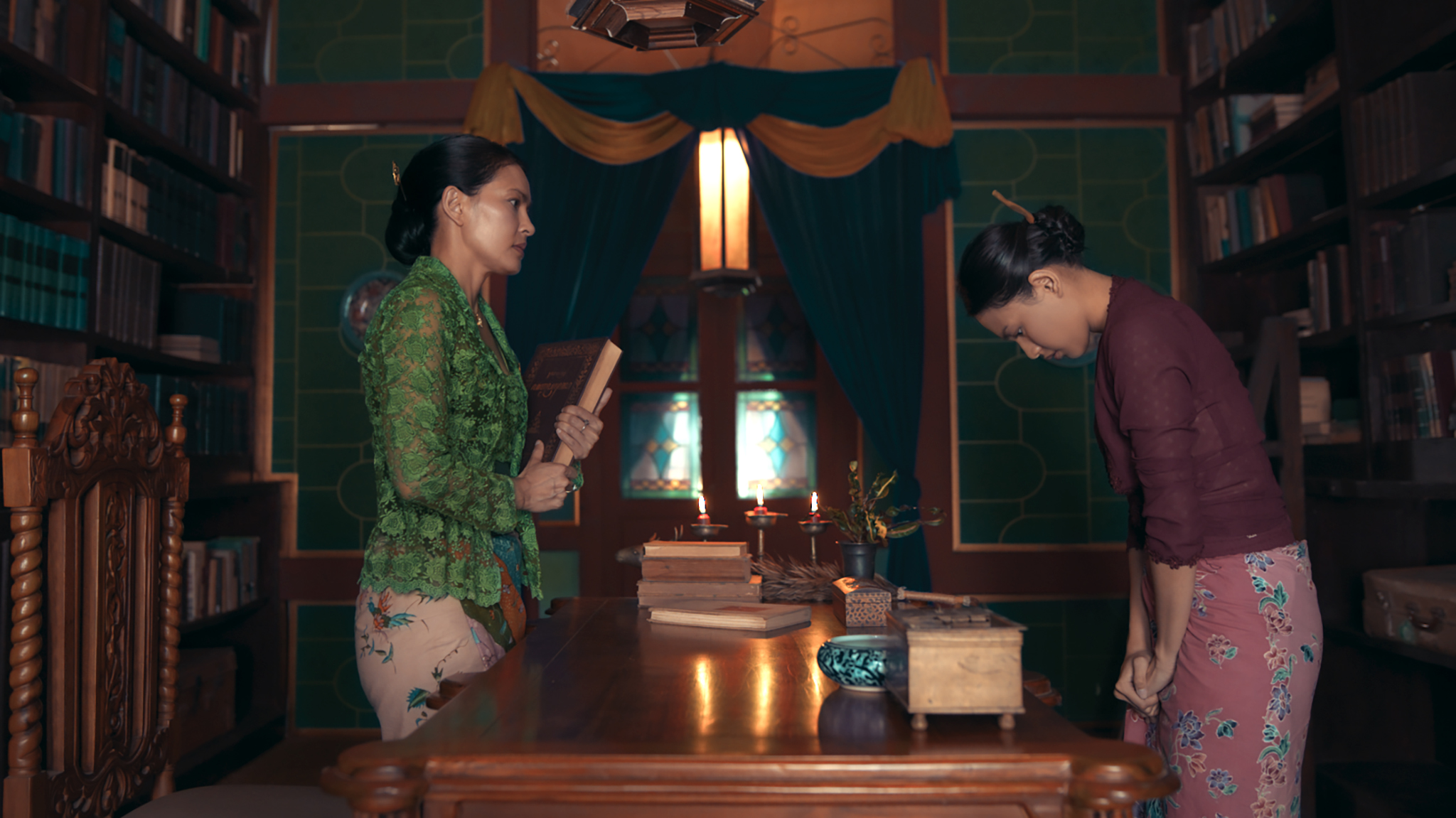
Now a university student, Jaya (Devano Danendra / Reza Rahadian) is sent to a gowok to make a real man out of him, though as he explains to his father, that’s not what a real man is. Jaya is a young man of the new Indonesia who believes in things like equality of the sexes and the breaking down of the old class system even if he maintains his privilege in other ways, including submitting himself to the gowok. Nevertheless, while he’s there, he falls in love with the adopted daughter of his gowok Santi (Lola Amaria), Ratri (Alika Jantinia / Raihaanun), and makes her a lot of promises about the future while introducing her to the women’s movement in 50s Indonesia that offers her the vision of a different future in which she might become an independent woman rather than being forced to become a gowok herself. To become a gowok necessarily means that she would not be able to marry. Most gowok adopt children to succeed them. Accidentally seeing a secret ritual, Santi fears that Ratri has fallen victim to a pure love spell that threatens spiritual disaster should the man break his promise which, as an older woman, she knows he almost certainly will. 

Then again, that turns out not quite to be the case and the lovers are in fact betrayed by those still clinging on to to the old class system. The destructive quality of their romance is played out against the background of the screws tightening across Indonesia as anti-communist fervour takes hold and suspicion falls on the women’s groups when military generals are abducted and murdered. Despite his progressive views, Jaya ends up married to a princess at his mother’s behest, exemplifying the ways in which women try to hold on to power by exerting matriarchal control over their sons. As for the princess, she is already pregnant by her communist boyfriend but prevented from marrying him and forced to marry Jaya instead though apparently coming fall in love with him after their marriage. Meanwhile, it turns out that there is an awkward connection between Jaya and Ratri that lends their fateful meeting a tragic quality even as his mother refuses to entertain the idea of Ratri marrying her son because her mother was a sex worker and she is not of their class.

In any case, though the gowok system may not actually be that different from other folk practices, there is something uncomfortable about it in that some of the “men” are very young and do not want to be there. Though Jaya, who is also sent there against his will, is in university and falls for Ratri who is around the same age, when his own son, Bargas, is sent to the gowok he is only around 14 and looks very childlike while ushered into “manhood” by a then 33-year-old Ratri. The system is at least potentially abusive and unethical while demonstrating how men are also ensnared by the patriarchal trap in that they too are being groomed for marriage whether they like it or not. It was in fact a man’s inability to remain faithful to the wife chosen for him that led to Ratri’s mother’s death and the activation of a black magic curse.

In any case, it turns out that human motivations can be far more damaging than any curse in the long years of anger, resentment, and misery born of misunderstandings and deliberately misdirected love. Ratri desperately tries to overcome her past and become an independent woman as a gowok but finds herself frustrated by the changing nature of society which promises so much freedom and opportunity in her youth only to immediately roll back on it while her own attempt at revenge backfires with tragic results. Poignant in its themes of tragic romance, the film quietly hints that this kind of oppression may not have really gone away even as Ratri seeks to reclaim her legacy in the 1980s-set coda by turning the gowok house into a school that educates women in a final attempt to finally free them from patriarchal control.


Gowok: Javanese Kamasutra screened as part of this year’s New York Asian Film Festival.

Trailer (English subtitles)

Legend of Gatotkaca (Satria Dewa: Gatotkaca, Hanung Bramantyo, 2022)

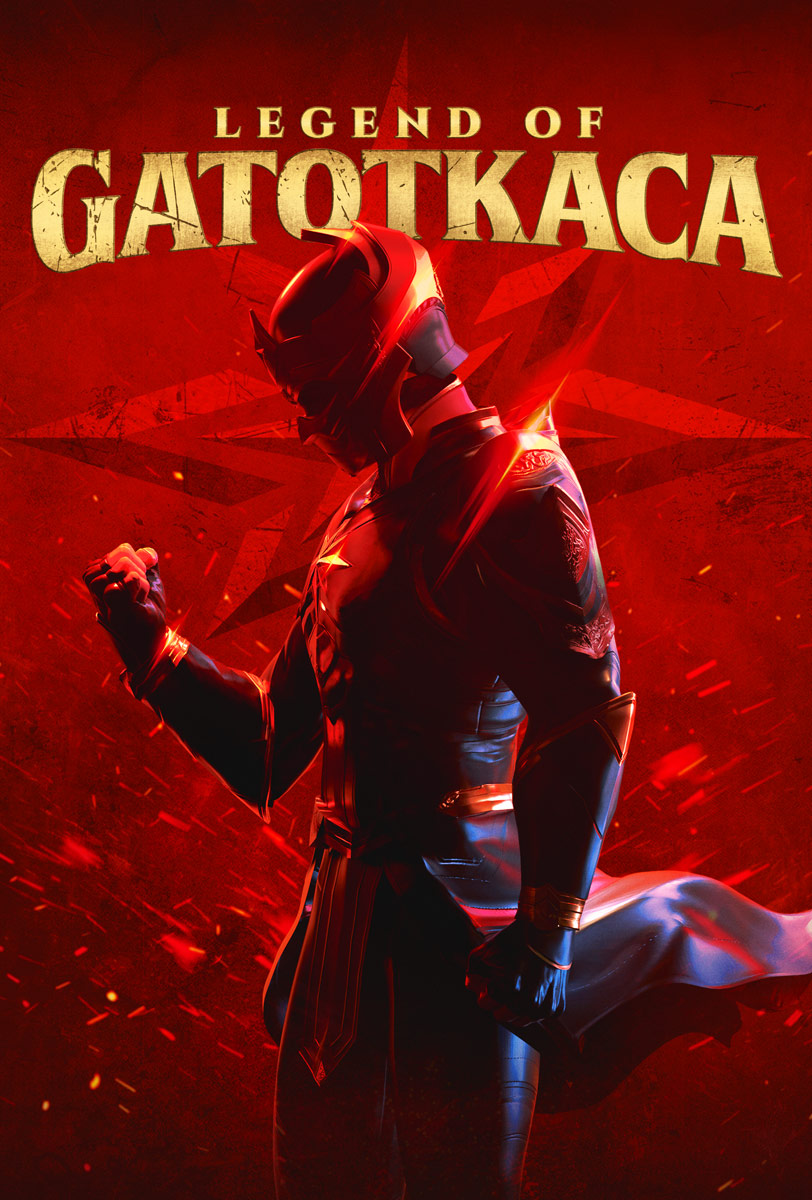
Indonesia has quietly been building its very own superhero cinematic universes over the past few years with Joko Anwar’s Gundala almost certainly the best known internationally. The Legend of Gatotkaca (Satria Dewa: Gatotkaca) is similarly intended to be the first in a new franchise, Satria Dewa, which draws influence from Indian mythology and is set in a dualistic world centuries after a battle between good and evil was ended by the gods to stop evil winning. 

Essentially an origin story for the titular hero Gatotkaca, the film follows down on his luck photographer Yuda (Rizky Nazar) who had to drop out of university because he is poor and also responsible for taking care of his mother who is suffering with memory loss and mental illness following an incident 15 years previously in which the pair were attacked by a mysterious figure in black who could shoot lasers from his fingers. Yuda assumes his memories from back then must have been a dream and that his mother’s mental distress has more to do with his father, Pande (Cecep Arif Rahman), abandoning the family. Nevertheless, he is soon dragged into intrigue when his best friend Erlangga (Jerome Kurnia) is murdered in the same way his mother was attacked during his university graduation ceremony. Determined to figure out the truth, Yuda and professor’s daughter Agni (Yasmin Napper) find their way to a secret organisation Erlangga had been a part of which aims to save the world from destructive forces carrying the Kaurava gene. 

In the film’s dualistic world view, there was once a civil war between those carrying the Pandava gene which encourages good, humanistic qualities and the Kaurava whose impulses are dark and destructive. But then as Professor Arya (Edward Akbar) who studies such things points out, Pandava can also be destructive while Kaurava are capable of using their “destructive” qualities for good. Even so, most of the bad things that have happened in the world particularly in the last 15 years since a mysterious meteorite fell to earth, can be attributed to the rising Kaurava influence from political corruption to illegal logging and even the COVID-19 pandemic. Someone is bumping off Pandava in an effort to release evil Kaurava general Aswatama (Fedi Nuril) from his imprisonment within a giant gemstone which explains the “mysterious” deaths of talented people like Olympic sportmsmen and a doctor who discovered a COVID-19 vaccine. 

Of course, Yuda turns out to be a chosen one and must pursue his destiny as the defender of the Pandava before assuming his rightful role as Gatotkaca. Only by confronting his immediate family history can he make himself whole and gain the strength to defeat Aswatama, saving the world from chaos. Meanwhile he has to contend with a romantic subplot in which Agni is aggressively courted by the odious and entitled Nathan (Axel Matthew Thomas) and his father who have at least strong Kaurava energy aside from being embodiments of oppressive elitism looking down on Yuda simply because he is poor. The underground cell Yuda eventually comes into contact with are also in their way a resistance to this same elitism, though unusually well equipped in their incredibly expensive-looking lair filled with the latest technology and looked after by a kindly Indian granny who is herself a Karauna but uses her powers, and at one point a good old-fashioned shot gun, for good.

It’s this duality to which the film eventually returns as Yuda declares they must be the light in the darkness and the darkness in the light as they secretly wage a war against an ancient evil apparently already well established in the contemporary social order. This being the first instalment in what seems to be cued up as a burgeoning franchise, there is undoubtedly a lot to take in from the talk of heirlooms and amulets to holy water and ancient weapons though the film does boast some excellent production design even if the centralisation of genetics as an indicator of good and evil is equally uncomfortable. Nevertheless, it’s a promising start to the cycle with a series of exciting action set pieces showcasing the art of silat along with some impressive CGI in the Star Wars-esque laser warfare even if it’s clear Gatotkaca’s toughest battles are yet to come.


Legend of Gatotkaca streams in the US via Hi-YAH! from 17th February and will be released on Digital, blu-ray, and DVD on March 21 courtesy of Well Go USA.

International trailer (English subtitles)