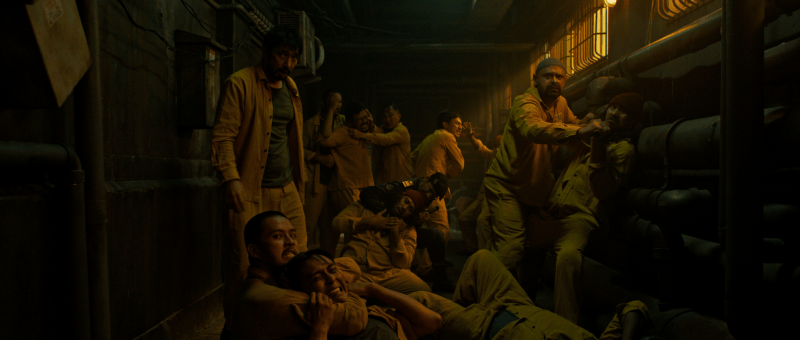

“This is Indonesia, not Norway,” the protagonists of Joko Anwar’s horror comedy Ghost in the Cell keep reminding each other as a means of explaining their dismal circumstances. The prison they’re confined within isn’t so different from the wider society, and even while inside they’re subject to the same hypocrisies, hierarchies, injustices and inequalities as they were outside. Ghosts, however, cannot be bound by prison walls and will seek bloody vengeance down to the last angry man.
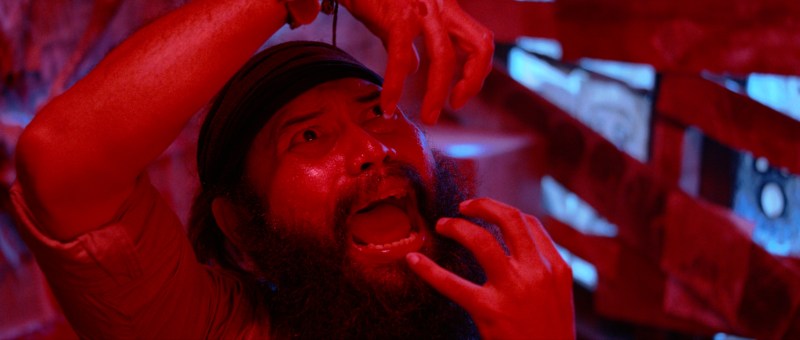
Indeed, one of the ghost’s characteristics is that it seems to feed on negative energy, targeting the angriest man it can find to sustain itself. It generally manifests as a kind of doppelgänger in which the victim is essentially confronted by themselves, their own rage and frustration turned back on them. To that extent, the message seems to be that in the end your anger will consume you if you don’t do something to mitigate it, forcing the men to take advantage of the tools they’ve been given to calm themselves such as prayer and dancing. Every so often during a fight, one of the men will call out that their friend’s aura is turning red which places them at risk of being targeted by the ghost, so they should immediately bust out some dance moves to improve their mood.
But at the same time, their anger can be a powerful weapon if turned in the right direction as de facto leader of the prisoners Anggoro (Abimana Aryasatya) later says. Many of them are in here because of some kind political manipulation. He was cheated out of his house by land sharks who wanted to build a luxury resort, so he tried to rob them but got caught and ended up in prison. One of the other men is a university professor who tried to expose corruption in his institution but was framed for theft and incarcerated. “It’s easier to survive in this country if people think you’re dumb,” he later reflects on reassuming his intellectual persona during the mini revolution provoked by the arrival of the ghost.
Dimas (Endy Arfian) ought to understand this better than anyone after being framed for the brutal murder and dismemberment of his boss. He’d just finished an article on the illegal clearing of a protected forest to build a nickel mine with investment from people in the government. His editor did not, however, want the hassle of publishing it especially as the paper is on its last legs. He objects to Dimas’ focus on the series of mysterious deaths that have taken place there, something he describes as better suited to a trashy clickbait outlet whereas their last remaining readership has stuck around for their rigorous reporting. The implication being that rigorous reporting is not sustainable in Indonesia, though another prisoner suggests that Indonesians care more about celebrities than their own lives and journalists have simply followed the money to give them what they want with a constant flow of salacious stories to distract them from the bigger issues such as the inherent corruption in their society.
This corruption exists within the prison too as one wing is dedicated to hosting corrupt politicians who live in luxurious cells with fridges and air conditioning. They can even leave whenever they want and treat prison like some kind of retreat where they can deflect press interest while basically carrying on doing the same things while inside. The irony is that both the prison warden and the corrupt politician behind the nickel mine were both once former activists who wanted Indonesia to be a better place. The warden joined a political party because he thought he could change it from inside before coming to the conclusion that nothing was going to change, and if you can’t beat them, join them. “In Indonesia it’s the survival of the fittest,” he explains, “they call it corruption, I call it reward for the smarts.”
In a way, perhaps that’s the real ghost in the cell, the imprisoned spectre of their youthful idealism. “We just need to save ourselves,” the warden tells his underling, an argument immediately countered by Anggoro who points out that they could all continue to prioritise their own survival, but the ghost will come for them in the end unless they work together to try to stop it. The message seems to be that they could save Indonesia too, if only they stopped allowing themselves to be distracted and remained united. Reminiscent of Silence of the Lambs, the ghost likes to create gruesome and ironic tableaux of its victims while itself perhaps distracted, sating its lust for vengeance while searching for the real source of injustice, but only finally finding it when the people work together for a common cause.
Ghost in the Cell is on digital platforms 26 October 2026 from Blue Finch Film Releasing.
Trailer