Ms. Apocalypse (세기말의 사랑, Lim Sun-ae, 2023)

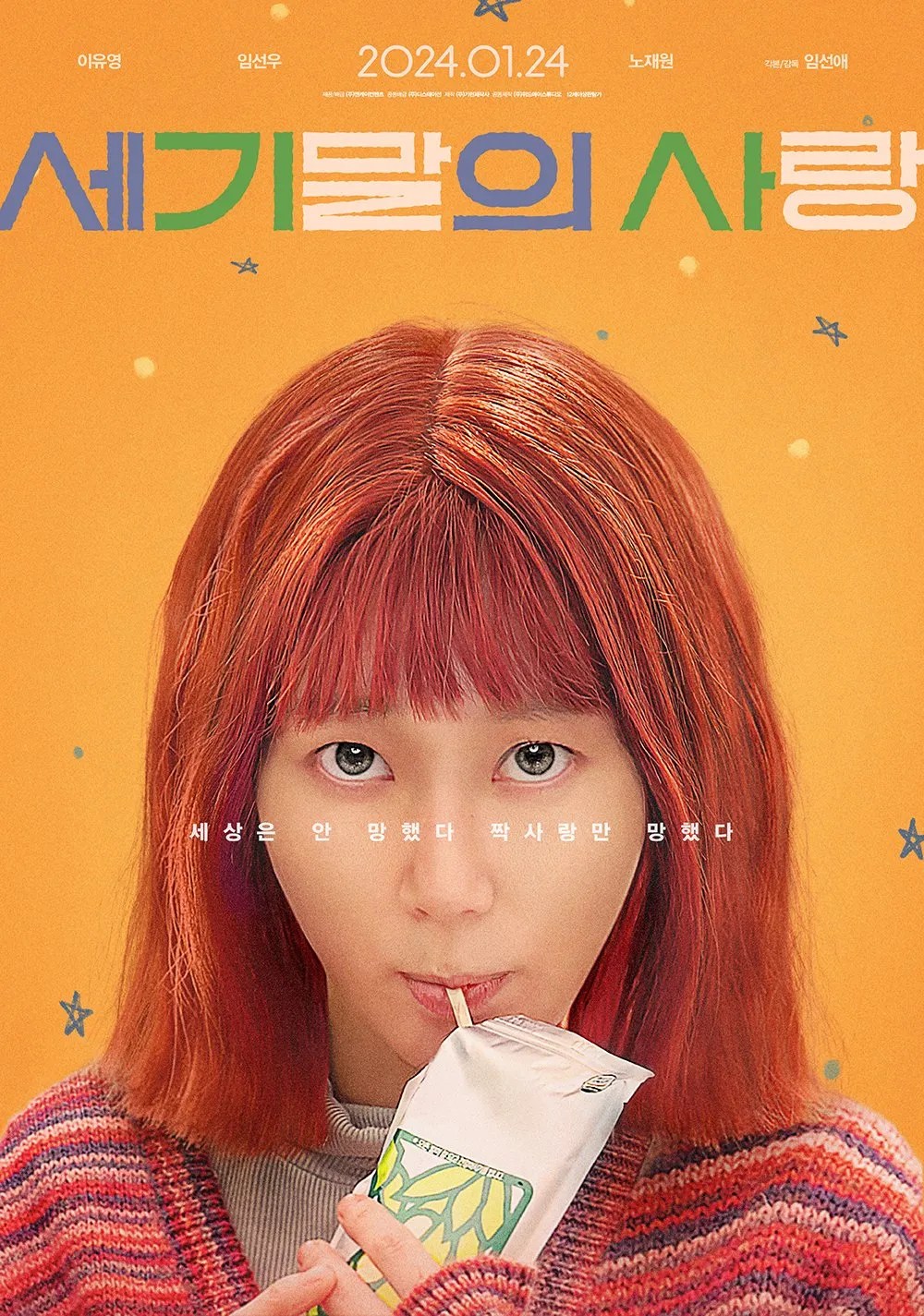
It’s funny to look back now at how worried we were about the millennium bug and the birth of a new century, but it’s true enough that the anxiety and desperation were enough to make people act in strange and incomprehensible ways. The first part of Ms Apocalypse (세기말의 사랑, Sekimalui Sarang) is filmed in black and white hinting at the dull incompleteness of the heroine’s life even as she finds herself overcome with dread and begging the man on whom she’s developed a crush to run away with her so she won’t die here, at her aunt’s funeral, where her obnoxious cousin wants her to pour drinks for his boorish friends. 

Young-mi (Lee Yoo-Young) is a mousy, shy woman who keeps herself to herself. At the factory where she works as a bookkeeper, they’ve nicknamed her “Ms Apocalypse”, because her face is “chaotic”, while the men make fun of how unattractive they find her behind her back. The only one of them that’s nice to her is Do-young (Roh Jae-Won), a driver who started five months ago. Young-mi has developed a crush on him, but is too shy to do anything about it and ends up rebuffing most of his overtures such as the precious gift of extra sausages from the canteen. But Young-mi has also discovered that Do-young has been embezzling the cash he’s supposed to be collecting for deliveries. She obviously doesn’t want him to get in any trouble, so she’s been making up the shortfall out of her own pocket by taking on sewing on the side. Unfortunately, when a remorseful Do-young turns himself in, Young-mi ends up going to prison too for failing to report his crimes.

It’s on her release that colour returns to the film, as if Young-mi as had been spiritually and emotionally set free to start a new life in the new century. Yet the only person who comes to meet her is Do-young’s spiky wife Yu-jin (Lim Sun-Woo). Yuj-in is living with a degenerative illness that has left her paralysed from the neck down though she maintains sensation in the rest of her body. Though they are opposites, the two women share a strange affinity and have more in common than they might care to admit. While Young-mi’s life had largely been in service of her aunt to set her cousin Kyu-tae (Heo Joon-Seok) free, Yu-jin has a complicated relationship with her niece, Mi-ri (Jang Sung-Yoon), who has currently run away from home and is imprisoned by her condition in the same way Young-mi is trapped by shyness. While Young-mi is all too aware of the way that others see her as “weird” and unattractive, Yu-jin is a beauty who radiates elegance and imperiousness. She has what her friend Jun (Moon Dong-Hyeok) describes as a nasty personality but is basically a reasonable person who knows full well how dependent she is on the kindness of strangers. 

Young-mi is a kind person, but there’s a question mark over whether she stays with Yu-jin because she wants her money back and has nowhere else to go after discovering Kyu-tae has sold her aunt’s house, or has come to genuinely care about her. It seems at first that they’ve both been betrayed by Do-young, though it’s not as simple as it seems and it may be a misguided gesture of kindness that’s landed them all in this very messy situation. They are nevertheless united in their outsider status as women at the mercy of a patriarchal society. Just as Young-mi is mocked for her appearance, the carers hired to look after Yu-jin make crass and inappropriate comments about her body while even her closest friend, Jun, has exploited her disability to get a discount on his car as well as swapping some of her favourite designer shoes for fakes, though Yu-jin knows she can’t say anything or risk Jun abandoning her. Though Young-mi was the one looking after her aunt who had dementia and a drinking problem, she was always at the mercy of Kyu-tae as her closest male relative and unfortunately he chose to betray her.

Kyu-tae’s not quite ex-wife blames the Asian Financial Crisis, but it seems Kyu-tae was always a selfish and unpleasant person emboldened his position in the patriarchal society and the meekness of Young-mi who he knew would not be able to stand up for herself. But it’s a new century now, and Young-mi’s world is certainly more colourful, if perhaps no easier. She’s learned to fight her corner, but also to make space in it for others in warming to the complicated Yu-jin whose loneliness and vulnerability all come out as meanness though she is a kind soul too and like Young-mi looking for ways to begin moving forward. Now they’ve got over their millennium bug, they’re ready to join the new century and embrace whatever it is that it has to offer them.


Trailer (no subtitles)

The Childe (귀공자, Park Hoon-jung, 2023) [Fantasia 2023]

“Isn’t money great? Everything is solvable with it” according to a lawyer working for an ailing chaebol CEO, but for the man he’s talking to money is at the root of all his problems because he doesn’t have any and is therefore powerless not least to save his equally ailing mother who needs an expensive operation to survive. The latest action drama from Park Hoon-jung, The Childe (귀공자, Gwigongja) implies an apparent focus switch in that the korean title, Nobleman, is also that of its absurdly cheerful assassin. “Childe” in its medieval spelling may simply be an attempt to lend a eerie mythical quality similar to the way the word “witch” is used in Park’s previous films, but in its original meaning also hints at the ostensible protagonist’s liminal status as a “nobleman” who has not yet come of age. 

That’s in part because Marco (Kang Tae-joo) has no idea of his parentage, only that his father was Korean and returned home alone leaving him and his mother behind in the Philippines. Referred to by a derogatory term for children fathered by Korean men as a result of sex tourism, Marco is an embittered young man filled with resentment and little hope for the future whose literal fatherlessness is an allusion to his cultural orphanhood. His mother sent him to Korean schools and raised him only to speak English and Korean, either feeling some affection for his absent father or more practically deciding he might have a better life as a Korean even if in the end neither culture fully accepts him. He would never have attempted to look for his father were it not for his mother’s illness hoping in some way to make him accept responsibility for his actions and the family he abandoned. 

In essence, Park uses the ailing chaebol patriarch’s familial irresponsibility as a wider metaphor for corporatising colonialism and exploitation while emphasising the corrupting influence of chaebol culture in which money really can solve pretty much everything even, it’s implied, imminent death. Picked up by a slick lawyer, Marco is told his father is looking for him too because, ironically enough, he is also ill and near death so simply wants to see the son he abandoned. Chairman Han will fly him to Korea and also cover his mother’s medical bills if he agrees to come but once he arrives Marco realises he’s in a very precarious position caught in the middle of a succession battle between his two half-siblings who each see him only as a pawn and ultimately want him dead. A mysterious assassin billed as The Nobleman (Kim Seon-ho) but introducing himself only as a “friend”, possibly the last you’ll ever make, is hot on his tail though his motivations remain unclear. 

As in some of his other films, Park hints at a mysterious shadow world filled with conspiracy and dominated by chaebol interests though in this case the figure of the corrupted patriarch takes on a poignant sensibility in which he too has become little more than a pawn. It appears he may disapprove of his children’s actions and actually has a genuine interest in meeting the son he abandoned who is like the hero of a fairytale the most just, deprived of his birthright by the greedy machinations of others. The abiding mystery may be why the chairman is kept alive though it seems that oldest son Yi-sa (Kim Kang-woo) is otherwise unable to maintain control of the corporate empire without recourse to his father’s identity for he has little power of his own. 

That might go some way to explaining the absurdity of his sociopathic violence, wandering around in a bathrobe carrying a shot gun and executing newspaper editors who’ve tried to expose their dodgy dealings in the midst of a vast estate bordered by forests. Even the school girl half-sister roams around with a pistol taking pot shots at Marco and The Nobleman but interestingly not at Yi-sa or the Chairman which hints at an odd kind of familial solidarity even in this incredibly dysfunctional and corrupt environment along with a wilful determination to deprive Marco of what may be his birthright. As with his previous films, Park loads up on gore delivered with more than a little absurdity in a series of high impact action scenes, but finally returns again to an unconventional friendship and unexpected brotherhood between the powerless and dispossessed in a sense at least reclaiming something that was theirs by right with the only means at their disposal. 


The Childe screened as part of this year’s Fantasia International Film Festival and is released in the US courtesy of Well Go USA.

International trailer (English subtitles)

Dream (드림, Lee Byeong-heon, 2023)

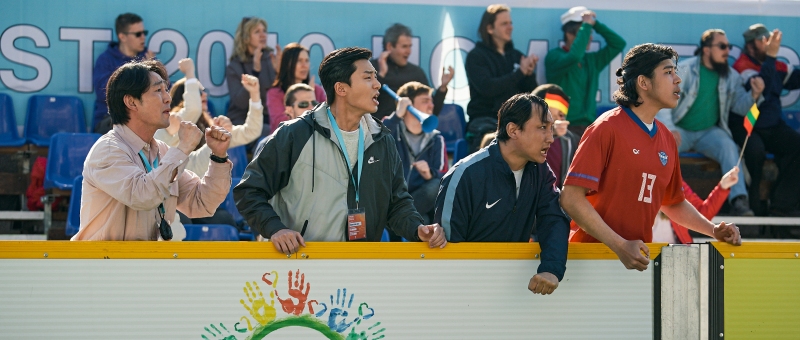
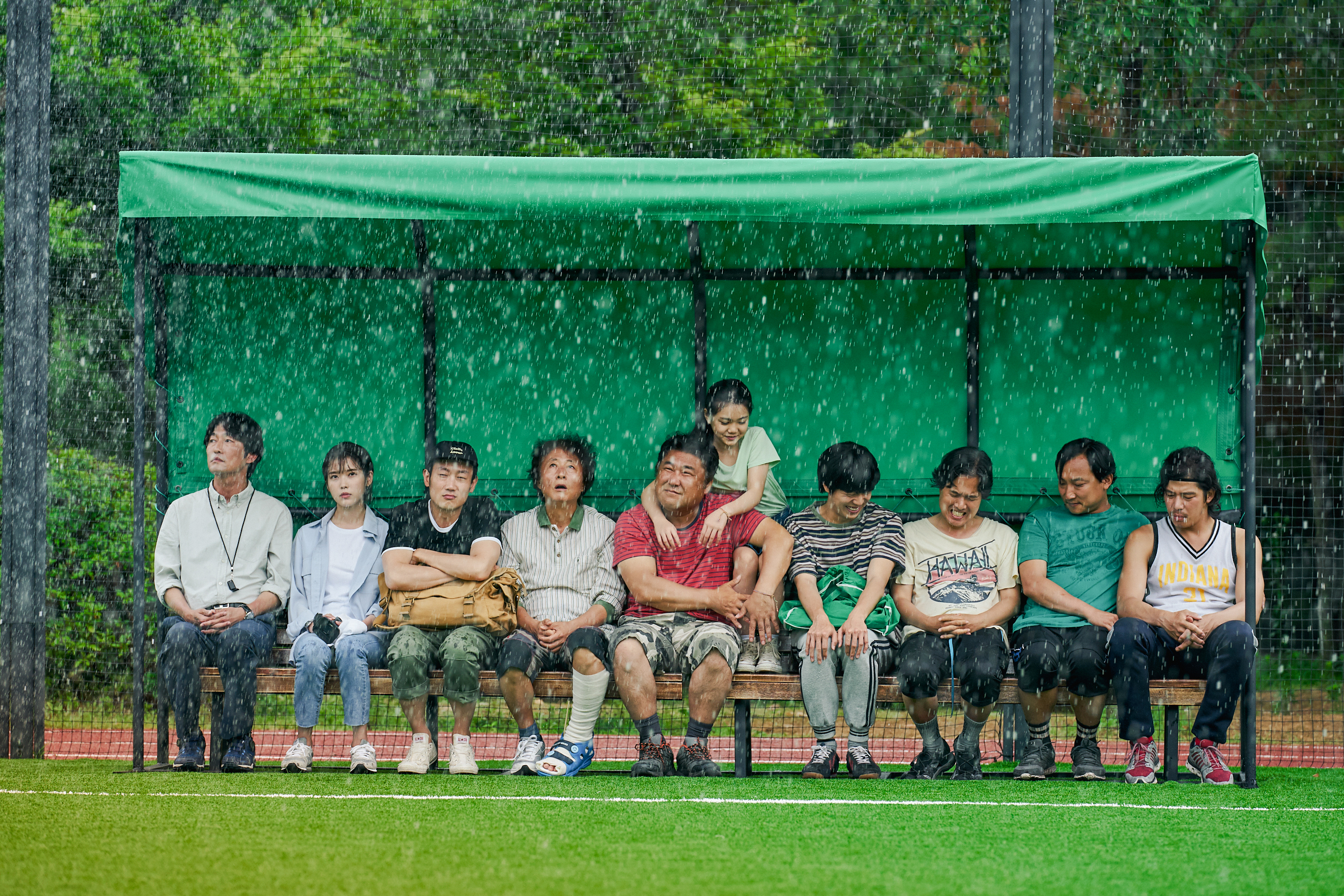
A disgraced football player gets a shot at redemption after agreeing to coach a team hoping to take part in the Homeless Olympics in Lee Byeong-heon’s sporting drama, Dream (드림). The Homeless Olympics was founded in order to advocate for the end of homelessness while combatting discrimination and stigma and takes place annually with teams of homeless people from all over the world taking part. Set in 2010 and inspired by the first Korean delegation to participate, the film is essentially an underdog sports drama in which the act of scoring a single goal is the same as an overall victory.

It is also, meanwhile, heavily critical of celebrity and sensationalist media each of which have a habit of latching onto popular causes in order to further their own careers. Hong-dae (Park Seo-jun) was a popular footballer insecure in his talents, but gained notoriety after poking an obnoxious reporter in the eyes when he repeatedly brought up the topic of his mother who happens to be a fugitive from justice. Deciding to retire from the game, Hong-dae is picked up by a talent agency who want to make him a star and is convinced to become the coach of the homeless football team in order to improve his personal brand while documentarian So-min (Lee Ji-eun) hopes to do something much the same by producing a semi-scripted reality show following the team’s fortunes.

Accordingly, So-min instructs Hong-dae to let her “cast” the key players on the basis of their touching backstories rather than their sporting ability. She comes up with a selection of people who have each for various reasons ended up on the streets but are looking for a way to turn their lives around and repair fractured relationships with family members. One man turned to booze and women while riding high but found himself out of luck when the Asian Financial Crisis ruined his business, while another claims that he’s not really homeless just lying low for a while, and a third was scammed by a friend and saddened by the impending exit of his ex-wife and daughter who will shortly be moving to Australia with her new husband. The film strays into more interesting territory in exploring the story of 44-year-old Beom-su (Jung Seung-gil) who ended up on the streets after a workplace accident left him with a chronic illness he did not have the money to treat, but otherwise falls into the same trap as So-min’s documentary in taking a fairly superficial view of homelessness. By the end of the film many of the players have thankfully moved into stable accommodation but do so largely without explanation aside from having apparently managed to save up for a deposit. 

Positioning their battle for sporting success as a means of reclaiming their self-esteem might also uncomfortably suggest that the reason they’re on the streets is a matter of mental attitude while ignoring other systemic issues that led them there or prevented them from moving on (assuming that they wish to do so). Aligning their struggles with Hong-dae’s and to a lesser extent So-min’s might do something similar while they too are also battling cynicism and self-esteem issues, Hong-dae continuing to blame his mother for his problems complaining that he was born to be second place because she never put him first. As Hong-dae later points out, So-min is also to an extent exploiting the homeless in trying to create an inspirational narrative for her TV show before she like everyone else realises there are other ways to win besides the literal. 

The final message is more one of never giving up as the team finally travel to the Olympics and find themselves out of their depth before deciding to give it everything they have even if it’s very unlikely they will win. There had indeed been discrimination in Korea, a sponsor pulling out describing the homeless as “smelly and disgusting” and expressing a degree of squeamishness about involving them with their brand, but at the Olympics they become the most popular team despite their lack of skill purely because of their charismatic perseverance. One player’s late in the game announcement that he is gay but has now come to accept himself in the knowledge that the problem lies with the world that will not accept him also makes the case for a greater equality if perhaps clumsily conflating two different issues. Nevertheless, IU’s lively performance and the film’s warmhearted tone help to overcome any mild sense of discomfort in its otherwise genial tale of never giving up and regaining your self-esteem even if you feel as if the world has already abandoned you. 


Dream screens July 17 as part of this year’s New York Asian Film Festival.

International trailer (English subtitles)

Images: © 2023 PLUS M ENTERTAINMENT & OCTOBER CINEMA INC. ALL RIGHTS RESERVED.

What a Man Wants (바람 바람 바람, Lee Byeong-heon, 2018)

What a man Wants posterMarriage, eh? Bit of a rollercoaster. Lee Byeong-heon’s sex farce What a Man Wants (바람 바람 바람, Baram Baram Baram) takes two ordinary couples and exposes the various hypocrisies which underpin their existences as they battle boredom and excitement in turn before finally figuring out exactly which relationship(s) they would ideally like to be in full time. The sexual politics are distinctly old fashioned, as is the male fantasy wish fulfilment at the film’s centre, but Lee chooses wryness over cynicism in asking if a little infidelity here and there might actually strengthen an otherwise shaky connection.

Seok-guen (Lee Sung-min) used to design rollercoasters all over the world, but now he drives a taxi on Jeju and gets his kicks “picking up” fares. That’s not to say he doesn’t love his wife, the patient Dam-deok (Jang Young-Nam), but he enjoys the thrill of the chase and favours instant gratification over the patient pleasures of married life. Seok-guen is often aided and abetted in his assignations by his straight laced brother-in-law, Bong-soo (Shin Ha-kyun), who is married to Seuk-guen’s forthright sister, Mi-young (Song Ji-hyo). Bong-soo doesn’t really approve of Seok-guen’s carrying on and doesn’t see the appeal of extra-marital affairs, but realises he has little choice other than to help Seok-guen out or risk his family life imploding. The couples live next-door to one another and are extremely close.

The trouble starts when Seok-guen tries to pick up the alluring Jenny (Lee El) at a pool bar. Bong-soo, not normally smitten, is seemingly hit by a lightening bolt and finds himself suddenly fantasising about another woman. Seok-guen had long been urging Bong-soo to have an affair (which is odd seeing as Bong-soo is married to his little sister), but he probably hadn’t envisaged him stealing Jenny out from under him. Flattered when Jenny starts paying him attention, Bong-soo succumbs only to make a rookie mistake of going home with her panties in his jacket pocket. Bong-soo takes revenge for years of being an alibi and blames the whole thing on Seok-guen who is mock thrown out by Dam-deok though she only really means to teach him a lesson rather than get rid of him for good.

The problem with Jenny is she’s not really real. She’s an embodiment of a male fantasy that might as well have been conjured up by the otherwise dull Bong-soo. With her sexy outfits, self consciously cute way of speaking, and frankly unbelievable interest in a boring failed restaurateur you really have to wonder if she’s not some kind of spy or a master criminal lining up a mark (except that neither Seok-guen or Bong-soo have any money). Sadly, no. She’s just the archetypal sexpot ripped straight from a ‘70s farce with little more to her character than sauciness with a side order of harlotry, despite the valiant efforts of actress Lee El who attempts to imbue her later emotional scenes with depth and sincerity to make up for her underwritten role. Jenny repeatedly claims to know what men “want” and then gives it to them, like some sort of temptress from a folktale, never allowed to express what it is she might “want” but only ever hanging around to be “won” by one of the two guys.

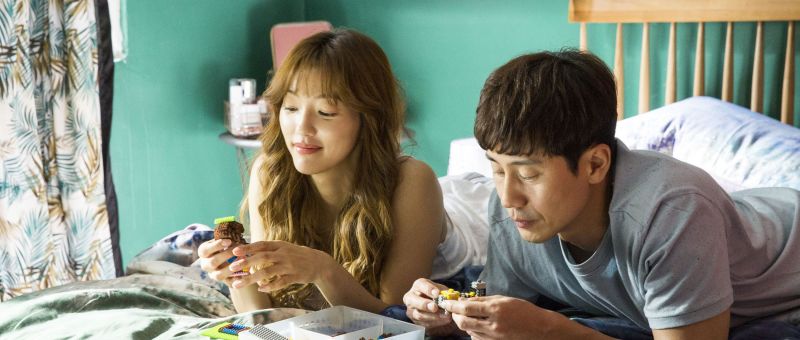
Bong-soo and Seok-guen undergo a role reversal when an unexpected tragedy forces Seok-gun to reassess his philandering ways while Bong-soo becomes a practiced adulterer. The marriage of Mi-young and Bong-soo is already on shaky ground – their sex life is all but dead and they’ve been having trouble conceiving. Mi-young is addicted to social media while Bong-soo spends his spare time building LEGO models, and in addition to being marital partners they also co-own an “Italian” restaurant which Bong-soo has long wanted to turn into a Chinese one (he trained as a Chinese chef) but Mi-young continually ignores his dream despite the fact that the restaurant is permanently empty and about to go bankrupt. Partly mid-life crisis, Bong-soo’s affair is motivated by a need to reassert his “manhood” while Jenny flatters him, strokes his ego, and does all the “wifely” things the “bossy” Mi-young refuses to do.

Yet just as Seok-guen said they would, Bong-soo’s fortunes improve thanks his to philandering – he becomes a better chef, the business takes off, and Mi-young (paradoxically) seems to develop more faith him as well as additional respect for his increasing “manliness”. Both men, through their interactions with the almost non-existent Jenny, are then forced to consider what, or who, it is they really want though Lee’s message seems to be that there are “secrets” in every marriage and perhaps it’s better not to ask too many questions if you want to maintain a happy married life. Cynical, though gleefully so, What a Man Wants is a salty affair but one which ultimately places its faith in “love” to find its way home despite the messiness of the journey.


What a Man Wants was screened as part of the New York Asian Film Festival 2018.

International trailer (English subtitles)

One Way Trip (글로리데이, Choi Jeong-yeol, 2016)

one-way-trip-poster

Young men just trying to do the right thing often end up losing out in the long run – so it is for the four best friends at the centre of Choi Jeong-yeol’s One Way Trip (글로리데이, AKA Glory Day). Caught right on the liminal divide between adolescence and adulthood, each of the four has a different path set before him, not entirely of their own choosing. De facto leader Young-bi (Ji Soo) seems the most directionless of the four but as the only one with a driving license he’s found an old banger of a van and got the guys together for one last road trip before Sang-woo (Suho) enlists in the military. Joined by city councilman’s son Ji-gong (Ryoo Joon-Yeol) and Doo-man (Kim Hee-Chan), a reluctant baseball player, the boys take off for the last real trip of their adolescent lives.

Things do not go to plan as the opening sequence features the guys furiously running away from the police, more worried about their parents finding out than any more serious consequences, but tragedy strikes when Sang-woo is knocked over in a hit and run accident. With Sang-woo unconscious in the hospital, the remaining three guys find themselves locked up on assault charges which later graduate to murder. How did their peaceful trip turn out like this?

Told largely through flashbacks explaining both the events of that night and the guys’ lives, One Way Trip examines the effect of a traumatic incident on each of the boys as they find their friendship coming under increasing pressure. Hanging around near the harbour, the guys spot a couple having a domestic dispute in a nearby car before the man drags the woman outside and proceeds to accuse her of having an affair whilst becoming increasingly violent. Headstrong Young-bi decides to intervene but goes too far in picking a fight with the guy while the woman gets herself to safety. When the violent husband falls into a nearby boat, the guys get scared and run off but the battered wife has already called the police who wind up chasing them through the town.

Panicking in the police station, distraught Young-bi gets himself into even more trouble sending their case straight up to the detectives. Though originally sympathetic, the police change their tune when it turns out that the woman involved is a high profile TV news reader. In an attempt to protect her reputation, she refuses to back the boys’ story and implicates them in the murder of her husband. The police, not overly interested in the finer details of the case, want a speedy resolution – a desire which is only echoed from further up where head office is getting pressure from the media.

These are all nice, ordinary kids who’ve never been in any kind of trouble before but suddenly they’re being encouraged to turn on each other and engineer the best possible outcome for themselves as individuals. Ji-gong’s mother (Moon Hee-kyung) is a prim woman most worried about what the neighbours will think, not to mention the impact on her husband’s political career. Doo-man’s father (Yoo Ha-bok) is even more panicked than his son and immediately starts making every conceivable kind of fuss at the police station, including attempted bribery. Young-bi, by contrast, has no one to speak for him as the only responsible adult is his older brother (Kim Dong-wan) – his father is already in jail. To the other parents, the answer is obvious, blame it on the no good delinquent their “nice” kid has been lead astray by and forget about the whole thing.

Though these boys are almost men, they have very little control over their own lives which continue to be dictated by parental expectation. Ji-gong’s overbearing mother locks him in the house to try and force him to study while Doo-man’s father ignores his pleas that he can’t stand playing baseball and is sick of the other players’ resentment because they know he’s only on the team because his father put him there. Young-bi has no firm parental input but his feelings about his family circumstances are what lead him to try and help a woman in peril, as well as the reason he loses his temper so quickly. Sang-woo, the most blameless among the boys, has only his grandmother whom he wanted to spare a life of hardship by serving in the military followed by a solid government guaranteed job afterwards.

Fear and external pressures start to work their magic on the three previously innocent guys who thought they were doing something good but have ended up paying the price. Heartbreak and betrayal are the order of the day as money, power, and influence will always win out over justice, goodness and friendship. Injustice is the force that governs the world, Young-bi thought he was doing the right thing by coming to the aid of a woman under attack only for everyone else to tell him he should have just minded his own business and not gotten involved. Bookended scenes of the four guys together having fun on the beach only reinforce the stark contrast between their youthful innocence, naively believing in friendship and the essential goodness of helping others, and their post-trip awakening to the self-centred indifference of the adult world.


Reviewed at the 2016 London Korean Film Festival.

International trailer:

Twenty (스물, Lee Byeong-heon, 2015)

Twenty Movie PosterReview of Lee Byeong-heon’s Twenty (스물, Seumool) up at UK Anime Network. I really felt so old watching this film.


The age at which you become “an adult” varies according to your culture but in Korea, as in Japan, at 20 you become fully grown up with all the rights and responsibilities that carries. The three guys at the centre of the Korean film Twenty are just walking through this magic doorway which marks the end of their childhoods and the beginning of their adult lives. The road has forked for them and they have to decide which path to take. However, they’ll have to take their minds off the opposite sex long enough to make a decision.

To state the obvious, Twenty is aimed at a very specific audience and is likely to please a certain group of people very well whilst leaving others a little lost and bemused. It stars a collection of popular and very good looking younger Korean actors and actresses and is largely about what it’s like to be on the cusp of adulthood in contemporary Korea. What it’s not is a hard hitting drama. The target audience for this movie is people who are in their teens or early twenties, so they know what it is to be young, now. They just want to laugh along or sympathise with others in a similar position.

We meet the three guys, Chi-ho (popular rich kid), Dong-woo (put upon poor boy), and Gyung-Jae (doing OK middle class guy) towards the end of their high school years. The boys became friends after falling for the same girl who eventually picked Chi-ho but being boys they had a fist fight about it and are now bonded for their rest of their lives. In many ways they’re quite different, Chi-ho is rich, good looking and only interested in girls whereas Dong-woo comes from quite an impoverished background which means he’ll find it difficult to pursue his studies past high school because he needs to be supporting his mother and siblings. Gyung-Jae is almost the protagonist and is a typical middle class boy who’ll go to college and probably do alright for himself. He’s also a typical “nice guy” with a selection of fairly ordinary romantic issues (bar one interesting aspect which is raised but never followed up on) but being pretty level headed he’ll almost certainly get over it.

At twenty they have the whole of their lives ahead of them – or they kind of do given the fairly restrictive nature of Korean society. Chi-ho just thinks about sex. His parents are rich so he just lives in a perpetual adolescence where he hasn’t applied for university but hasn’t decided on a job either. He watches lots of movies and mopes but honestly he’s just a bit lost and afraid to admit it. Dong-woo wants to be a manga artist and decides to repeat the last year of high school whilst continuing to work all the other hours to support his family all the while feeling guilty about trying to pursue his dream rather than accepting the offer of a steady office job at his uncle’s company. Gyung-Jae actually has it pretty easy as his problems are just the normal sort of romantic growing pains everybody goes through and realising that makes them a little easier for him.

The film is not really a serious examination of the problems young people face. Even the eventual looming of military service is treated in quite a matter of fact way. Twenty is more of a celebration of being young and that it’s OK to be a bit lost and stupid when you’ve just left school. It gets surprisingly crude given that it’s aimed at a comparatively conservative Korean audience but generally gets away with it thanks to its cheeky tone. Undoubtedly hilarious in places (the “fist fight” finale in a Chinese restaurant being a late highlight) Twenty is a film that will play best to those around the same age as its protagonists in real terms and truthfully doesn’t offer so much for those who are already little older but it is nevertheless very funny and likely to entertain Korean idol fans of any age.


Reviewed at the London Korean Film Festival 2015.