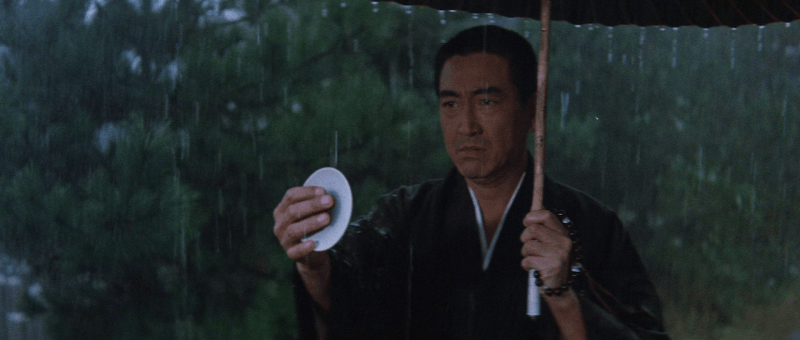
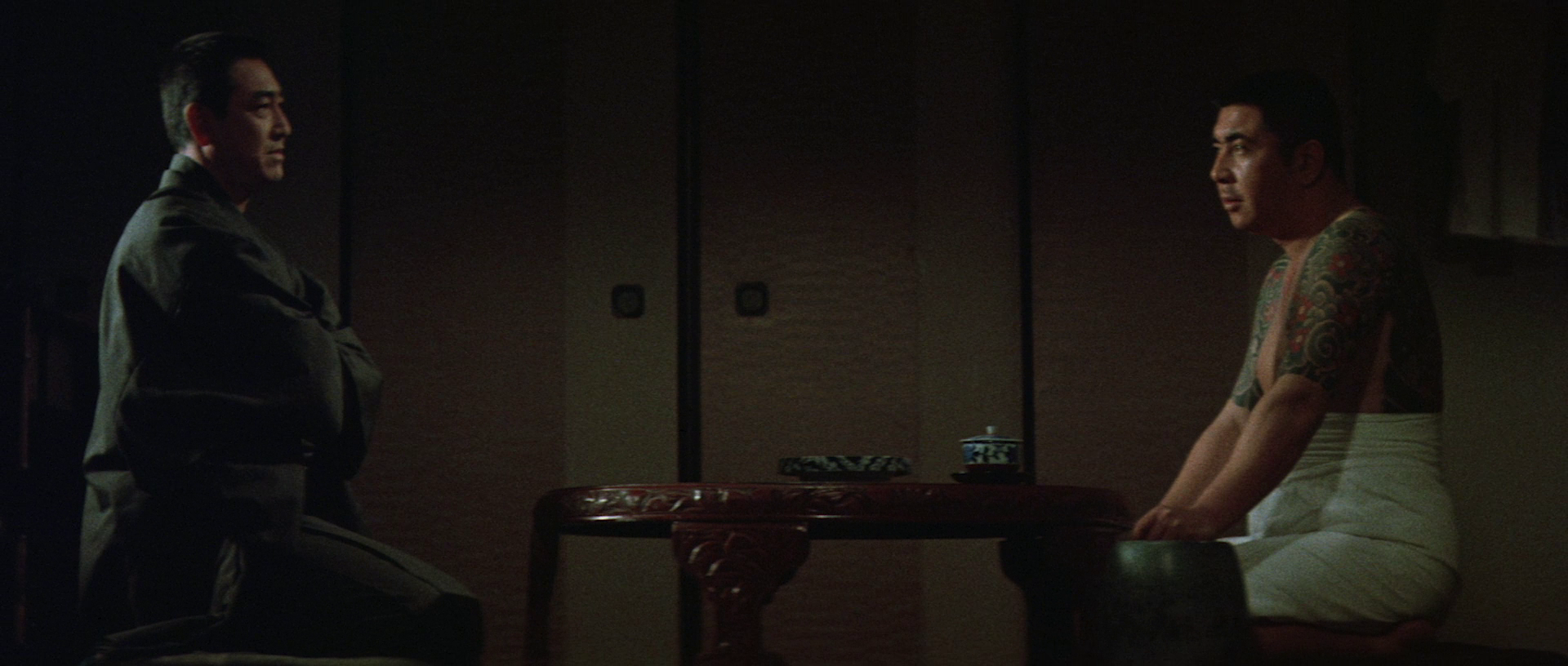
A Shakespearean tragedy of blood and honour, Kosaku Yamashita’s Big Time Gambling Boss (博奕打ち 総長賭博, Bakuchiuci: Socho Tobaku) discovers only fatalism and futility in the nobility of the yakuza code. The tragedy is that at any moment anyone could make a free choice to walk away, to abandon these arbitrary notions that convince them they must kill their friends and let their enemies go free, but they don’t because spiritually they cannot. Abandoning the yakuza code would in its own way a kind of death and mentally unsurvivable.
There is however a greater tragedy in play. The film opens in the spring of 1934 with a villain remarking that it’s absurd to restrict oneself to one’s home terrified while a sword and the Japanese flag appear behind him. The catalyst for all this drama is Japan’s imperialist expansion. Yakuza fixer Senba (Nobuo Kaneko) and the shady Kawashima have hatched a plan to get all the yakuza clans to unite in a “patriotic” mission to traffic drugs to the frontlines looting as they go. Noble boss of the Tenryu Awakawa refuses, reminding them he’s just a simple gambling man and has no desire to get involved with politics before collapsing with a stroke. With Awakara alive but bedridden and no longer able to communicate effectively, the Tenryu decide to nominate a successor. The ideal candidate, Nakai (Koji Tsuruta), declines the offer on the grounds that he is a transplant from another gang in Osaka and thinks it would be inappropriate for an outsider to lead the clan. He proposes that his sworn brother, Matsuda (Tomisaburo Wakayama), should be appointed, though he is currently surviving a prison sentence so a caretaker should serve in his stead until his release. Most think this sensible though the proposed caretaker, Ishido (Hiroshi Nawa), also declines given the rules of seniority despite the fact that he is Awakawa’s son-in-law and so dynastic succession would also seem permissible.
It’s during all of this finagling that Senba begins manipulating events to his advantage, gently manoeuvring the other lieutenants towards accepting Ishido as the new boss while he has no idea he’s being used as a pawn in Senba’s nefarious nationalist plotting. When Matsuda is released early, the entire situation kicks into overdrive in his outrage that the codes of rank have not been respected and that a man who is his inferior now sits at the head of the clan in a place he think’s rightfully Nakai’s but in light of his honourable refusal no one’s but his own. Even Matsuda later recognises his hot-headed recklessness in directly challenging Ishido over his decision to accept, insisting that the proper thing to do in his position would have been to persuade Nakai to take the job. Meanwhile, his own righthand man who’d been slumming it as a mere labourer in his absence, is dragged into intrigue in foolishly defending his honour by recklessly attacking Ishido’s men incorrectly believing they had provoked another gang’s attack on Matsuda little knowing it was all part of Senba’s plot.
Nationalist trappings aside, Senba’s villainy is obvious from the moment he tells Nakai he thinks Matsuda was foolish for going to prison on the clan’s behalf and that he should have just found a scapegoat and put the blame on them, signalling himself a member of the new amoral yakuza who does not believe in giri and has no ninjo. Nakai rather is the opposite, as his old boss confirms in praising him for his correct decision to turn down the succession as it would not be right for him to accept as one who did not originate in their gang. Matsuda meanwhile pays too much attention to the letter of the code and not its spirit, obsessed with Ishido’s transgression and unable to let the matter drop to live a quiet life even as Nakai tries to convince him that the decision has been ratified by the lieutenants and the boss and so he must obey it. In a poignant moment, Nakai brings out the cup they used to seal their friendship and tells him that he will choose the clan, breaking the cup if Matsuda does not agree to accept a minimal degree of humiliation in returning with the intention of lying low and subtly reminding him that if he does not Matsuda will be placing a heavy burden on him that he may be forced to inflict lethal violence on his best friend and in fact brother-in-law. Realising the gravity of the situation, Matsuda immediately backs down, but events are now in motion that neither of them are capable of stopping.
Of course, they could walk away but they don’t. Nakai offers the opportunity to Matsuda’s remorseful foot soldier Oto, telling him to leave the clan and take the woman he loves far away to live a peaceful life but of course he can’t because of his debt of loyalty to Matsuda. They are all trapped by the code which they follow and the villains ignore, laughing at them all the way. Then again, that’s what men like Nakai are for, born to set things right even if it comes at great personal cost. Even he finally snarls that he’s merely a murderer, rejecting any sense of honour in his actions while throwing a sword at the symbol of the system which has defined his life and submitting himself to the automatic operation of law of the state as a kind of martyr for system in which he may no longer believe.
Trailer (English subtitles)
 Windows on Worlds