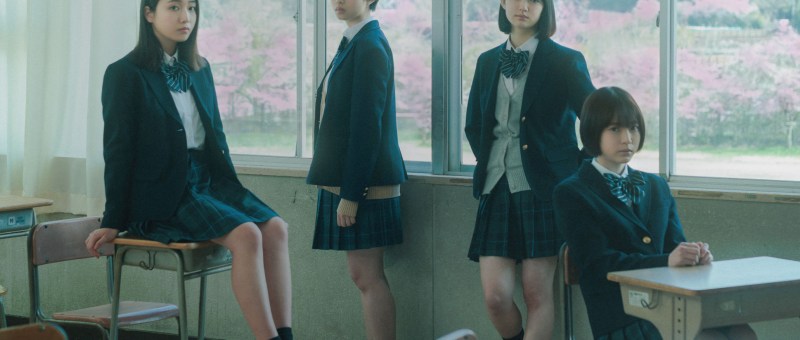

The end of high school takes on an additional poignancy for a collection of teens who realise they will be the last class to graduate before their school is demolished in Shun Nakagawa’s touching coming-of-age drama, Sayonara, Girls (少女は卒業しない, Shojo wa Sotsugyo Shinai). Adapted from a series of short stories by Ryo Asai, the film’s Japanese title is the more cryptic “girls don’t graduate” hinting at the ghost of adolescence that endures long after a literal graduation ceremony even as the teens find themselves attempting to move on into the “new world” of adulthood which necessarily means leaving youth behind.
Set mainly over the graduation day itself and the day before, the film focusses on four girls who aren’t particularly connected to each other but are each experiencing differing kinds of adolescent anxiety as they approach the end of high school. Kyoko (Rina Komiyama) is perhaps the most typical in that her dilemma relates to the physical distance that will be placed between herself and her past when she leaves her provincial hometown to study in Tokyo. However, it isn’t the thought of leaving a familiar place for an unknown city that bothers her nor uncertainty in her choices, only that her relationship with her high school boyfriend Terada (Takuma Usa) seems as if it will end on a sour note because of the emotional distance between them as they prepare to take different paths in life. She envisages her future in Tokyo working as a psychologist while he plans to stay local and get a job as a primary school teacher.
There doesn’t seem to be any suggestion that Kyoko would give up her ambitions to stay behind for Terada, and she herself fails to realise that he resents her for choosing Tokyo over him all of which has clouded their final days together despite the inevitability that they will have to end their relationship because the futures they each want for themselves do not align. There is also a slight dividing line between the kids who will not be going on to university at all but plan to look for work, those who plan to attend a local college and remain in their hometown, and those who have won prestigious university places to study in the capital. This is also of course the “graduation ceremony” for the school building itself, which has left Kyoko feeling wistful in realising that she will never be able to revisit this place that in a sense represents her youth. She would rather the building remain and be repurposed while Terada reminds that her romanticism is all very well but as he’ll be staying in the town for the rest of his life he’d rather it be replaced with something more practical like a shopping mall which is really the nexus of the problems in their relationships.
But on the other hand, for the socially awkward Shiori (Tomo Nakai) the last three years have been nothing but torture, the school building, excluding the library, an unending hell. Yet her regret is that she has been unable to overcome her shyness and with graduation approaching fears that she will never be able to talk to people properly. With the help of her kindly librarian (Kisetsu Fujiwara) even she begins to forge new connections and realise she’s not quite so alone as she thought. Music club president Yuki (Rina Ono), meanwhile, is focussed on making someone else come out of their shell while dealing with discord as other members object to the results of free vote which has elected thrash metal lip synchers Heaven’s Door as the headline act for the graduation concert with the band members, except for one, refusing to play assuming that people only voted for them as a joke.
Charged with giving the farewell speech at the graduation ceremony Manami (Yuumi Kawai) struggles with a more a literal kind of loss and the stolen futures of those who won’t ever be graduating high school but will be left behind in a kind of eternal youth. As part of her speech she reflects on the “new worlds” each of them will be stepping into and also on the series of encounters and farewells that will occur throughout their lives, but is also well aware of the poignant sense of guilt that comes with moving forward in a way that others never can. As the school will be demolished, in a way so will their youth but only in a less symbolic sense than it is for everyone who must make the difficult transition to adulthood with all the concurrent anxieties that may bring. In a sense the girls do not “graduate” so much as evolve, taking the ghosts of their younger selves with them as they go and leaving behind only a vague shade of their youth that will inevitably fade in time.
Sayonara, Girls screened as part of this year’s Nippon Connection.
International trailer (English subtitles)





 Windows on Worlds