Party 7 (Katsuhito Ishii, 2000)

“This shit’s for real.” according to the front desk guy at Hotel New Mexico, an out of the way spot just perfect for those looking to lay low for a little while. Like a lot of Katsuhito Ishii’s work, Party 7 is essentially a series of self-contained vignettes which eventually collide following a series of bizarre coincidences revolving around some money stolen from the mob, a two-way mirror in a regular hotel room, and the receptionist’s tendency to almost literally shoot the shit. 

Following a brief prologue, Ishii opens with striking animated sequence which introduces each of the main players with an arcade game aesthetic and explains that Miki (Masatoshi Nagase) has stolen money from the mob and is currently on the run which is why he’s turned up at the infinitely weird Hotel New Mexico. The running gag is that Miki thinks he’s holed up somewhere no one will find him, but sure enough a series of “friends” soon turn up in part thanks to a loose-lipped travel agent. The fact that people can find it so easily dampens the impression of the Hotel New Mexico as some kind of interstitial space. It’s not so much existing in a weird parallel world as a bit run down and staffed by a series of eccentrics. It does however have a “peep room” hidden behind a two-way mirror where “Captain Banana” (Yoshio Harada) is attempting to pass his knowledge on to the young Okita (Tadanobu Asano), the son of a recently deceased friend who has been repeatedly arrested for voyeurism. 

Captain Banana’s insistence on his surreal superhero suit is in a way ironic, if perhaps hinting at the super empowerment of accepting one’s authentic self. “It’s your soul,” he tells Okita, “it’s screaming ‘I want to peep’.’” Meanwhile, Miki gets into an argument with his ex-girlfriend Kana (Akemi Kobayashi) who has turned up in the hope of reclaiming money that he owes her. Kana too seems to be less than rigorous with the truth if perhaps emotionally authentic. She’s now now engaged to a nerdy guy having somewhat misrepresented herself as the innocent girl next-door type. Her refusal to let her fiancé into her apartment perhaps hints at a more literal barrier to intimacy or at least that she is intent on preventing him from seeing her true self. What she doesn’t know is that her fiancé hasn’t been completely honest either, in part because he thinks she’s out of his league and is insecure in their romance. 

Miki too maybe somewhat insecure, having run off with the gang’s money after hearing them bad mouth his associate Sonoda (Keisuke Horibe) who has now been charged with killing him and getting the money back. But Sonoda too has reasons to doubt the boss’ affection for him after Miki and the others point out that gifts he thought were so valuable are really just cheap knock offs that suggest the boss thinks very little of him at all. Okita’s psychiatrist tells him that there are “no rules in making friends”, and maybe in a strange way that’s what everyone is trying to do. Kana wanted the money to overcome her anxiety about having no friends or family to invite to the wedding, while all Sonoda wanted was the boss’ approval and though Miki had deliberately gone somewhere he thought no one would find him nevertheless attracts a series of followers. 

Even the receptionists seem to be desperate for human contact with their strange stories of poo falling from the sky and bizarre approach to hospitality. “The point is whether you believe it or not,” one tells the other after spinning what sounds like a yarn but then again might not be. Ishii’s zany world has its own surreal logic culminating in a piece of cosmic irony and defined by coincidence as the otherwise unrelated stories begin to come together and slowly find their way to Hotel New Mexico but seems to suggest the point is in the serendipity of the meeting and its concurrent authenticity even if a literal shot in the arm is a less than ideal way of brokering a friendship.


Party 7 is released in the UK on blu-ray on 17th July as part of Third Window Films’ Katsuhito Ishii Collection.

Original trailer (English subtitles)

Funky Forest: The First Contact (ナイスの森 The First Contact, Katsuhito Ishii & Hajime Ishimine & Shunichiro Miki, 2005)

“Is that normal?” someone asks watching a previously mild-mannered doctor having a right old go at a tiny man baby currently attached to a high school girl’s armpit after being pulled free of its aquatic carapace, “don’t be rude” his companion shushes him. Katsuhito Ishii, Hajime Ishimine, and Shunichiro Miki’s Funky Forest: The First Contact (ナイスの森 The First Contact, Nice Mori: The First Contact) became the best known example of the short-lived trend in surreal comedy which came to dominate a certain kind of Japanese cinema from the late ’90s to early 2000s while perhaps surviving into the present day in a more arthouse friendly form in the deadpan absurdist cinema of filmmakers such as Akira Ikeda (Ambitious Places, The Blue Danube) or Isamu Hirabayashi (Shell and Joint).  

Even so, Funky Forest is wilfully anarchic skipping between a series of interconnected skits that eventually coalesce as something like a unique universe loosely revolving around three “unpopular with women” brothers and a “delusional” high school teacher in a non-relationship with a former student who thinks he’s seen a UFO and is engaged in a battle to save the aliens from the planet Piko-Riko. Two and a half hours long, which is admittedly pushing it for a non-linear sketch comedy, the film is split into two parts, Side A and Side B, joined by a short intermission after which the surrealism intensifies, the design of the title cards changes, and the action shifts in focus from a quiet onsen to an ordinary high school where the teacher and the two adult brothers each work. 

The action begins however with a pair of manzai comedians seemingly performing on some kind of space ship and to an audience consisting of identical military personnel each like the comedians dressed in white and silver while the show is broadcast to a man sitting in a tiny pod-like dream ship. The “Mole Brothers” recur throughout, their set routinely dividing one skit from another while one, Kazushi, also turns up on his own in a couple of other sketches as part of the great connected universe, and though their act being kind of a dud is part of the joke their variety-style humour is an otherwise key indicator of the kind of comedy which is being employed and subverted even as the action becomes ever more surreal. As it happens, each of the major plot strands seems to lead us towards a dance sequence such as that which closes the first half in Takefumi’s (Ryo Kase) strange fever dream which culminates in a Mandarin-language group routine and the first appearance of the weird, shrimp-like creatures which dominate Side B. 

Side B is indeed somewhat through the looking glass as we find the high school kids literally playing these alien creatures like musical instruments some of which need to be plugged in to the human body in one way or another such as the strangely cute rat/shrimplike beings which attach directly to the tongue. Sitting right in front of the high school class which is taught by lovelorn brother Katsuichi (Susumu Terajima) is none other than the film director and Neon Genesis Evangelion creator Hideaki Anno who later turns up again to discuss contemporary anime with guitar bother Masaru (Tadanobu Asano) in one of his many part-time jobs, though the class also includes the young primary school student who featured in the first skit in which she lamented having so much homework and escaped to the dreamscape in order to fight giant orbs with her mind. 

In an odd way perhaps that’s what our three directors are doing too, away on flights of fancy which make little literal sense but seem to have their own internal logic even though the directorial force the film presents is an adorable little scottie dog whose thoughts are translated by someone wearing a giant papier-mâché head. “Thinking is too scary, so I’ll forget about it”, someone explains which may be good advice in deciding to just accept the crazy randomness and play along. Often interrupting the action by cutting to black to mimic old-fashioned channel hopping the directors also throw in a random 20s intermission in the middle of a scene, animation of various styles, and surreal body-horror-adjacent practical effects, before winding up at the funky forest itself, a weird dreamscape somewhere in Hokkaido ruled by a dream-hopping girlband.  “What a strange dream” one character exclaims though in the great scheme of things perhaps it’s easier to make sense of a dream than a defiantly surreal reality.  


Funky Forest: The First Contact is released on blu-ray in the UK on 21st March courtesy of Third Window Films alongside quasi-sequel Warped Forest in a set which includes a feature length commentary from all three directors and a series of deleted scenes.

Original trailer (English subtitles)

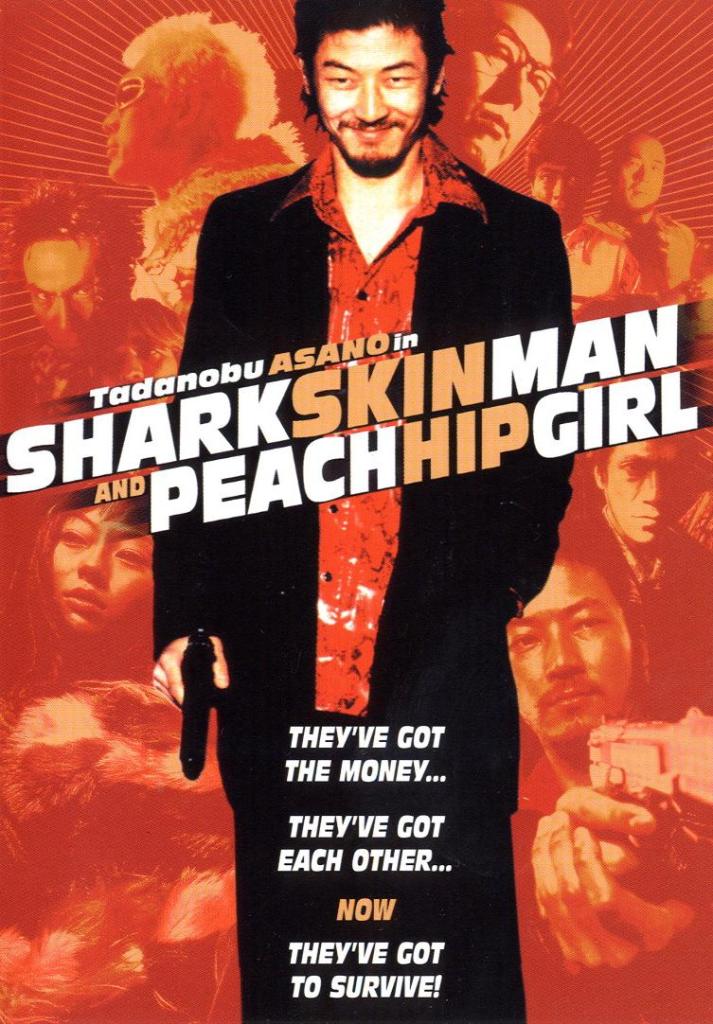
Shark Skin Man and Peach Hip Girl (鮫肌男と桃尻女, Katsuhito Ishii, 1999)

Shark_Skin_Man_And_Peach_Hip_Girl_(1998)If you’re going on the run you might as well do it in style. Wait, that’s terrible advice isn’t it? Perhaps there’s something to be said for planning a cunning double bluff by becoming so flamboyant that everyone starts ignoring you out of a mild sense of embarrassment but that’s quite a risk for someone whose original gamble has so obviously gone massively wrong. An adaptation of a manga, Katsuhito Ishii’s debut feature Sharkskin Man and Peach Hip Girl (鮫肌男と桃尻女,  Samehada Otoko to Momojiri Onna) follows a mysterious criminal trying to head off the gang he just stole a bunch of money from whilst also accompanying a strange young girl, also on the run but from her perverted, hotel owning “uncle” who has also sent an equally eccentric hitman after the absconding pair with instructions to bring her back.

Like Ishii’s subsequent efforts, Shark Skin Man and Peach Hip Girl is a riot of full on craziness from the get go, though he largely manages to avoid manga adaptation cliches. The gangster, Samehada (Tadanobu Asano), is pursued by an eccentric set of former gang members – the sanest amongst them being Sawada (Susumu Terajima), his former partner who wants to track him down first to prevent the bloody retribution his guys have in store for him. The gang’s boss (Ittoku Kishibe), lovingly caresses a harpoon, dresses in a gestapo style shiny black leather overcoat, wears one glove, and is on a quest to track down rare vintage posters of much loved Japanese comedian Kon Omura. One of his henchmen is a guy with bleach blond hair who dresses all in white and has an extremely sensitive sense of smell but an intense aversion to water.

The heat coming from the other side is equally strange as the leacherous uncle is apparently friends with Japan’s weirdest hitman, Yamada, who dresses in a retro style and has a unibrow and a high pitched voice. In fact, he’s basically Ken Omura himself, creeping about, being odd in a ridiculous cartoon character way. Unfortunately, Yamada has a weakness and just as he’s about to complete his mission he falls in love with his target! Apparently this is something that happens to him often though you’d think it would be quite a liability given his line of work. In this instance who could really blame him, but his new found romance means he won’t be able to pull the trigger  – and not only that, he can’t bring the girl back either because he doesn’t want to break the beautiful gangster’s heart! Ah, true love!

There is quite a lot going on. Too much, really. For all the craziness which ensues, it’s hard to build up an attachment to any of our strange little gangsters and their petty plots or bids for freedom. Things build to a whirlwind of chaos in the final stretch but when it’s all supposed to calm down for a little spiritual contemplation at the end, the effect begins to fall apart.

There are however a few quieter sections such as a surprisingly maudlin one in which yakuza sons of yakuza fathers lament their unhappy childhoods which saw them bullied and excluded by their law abiding peers. One even says that he thought the tattoos were something which just appeared on everyone when they grew up. Ishii employs some strange jump cuts, moving us ahead a little jerkily as the time passes slowly for this motley crew of veteran bad guys. He later employs a similar technique where he shifts some of his violence into the expressionist realm by cutting on the sound of landing punches.

As the title suggests, Shark Shin Man and Peach Hip Girl is the story of two crazy kids on the run, and the bizarre collection of people who end up chasing them. Ishii could never be accused of subtlety but the punk infused, anarchic and ironic tone are difficult to resist even if the end result is a necessarily slight one. An imperfect, though impressive debut, Shark Skin Man and Peach Hipped Girl is an interesting genre infused tale that uses absurd humour as a foil for the darkness and violence which underpins it.


Original trailer (no English subs – French subs available via settings menu)

Midway through this film someone starts singing a Japanese language cover of Donna Donna which was a surprise! Can’t find a clip so here’s Joan Baez’s version live in Japan in 1967!