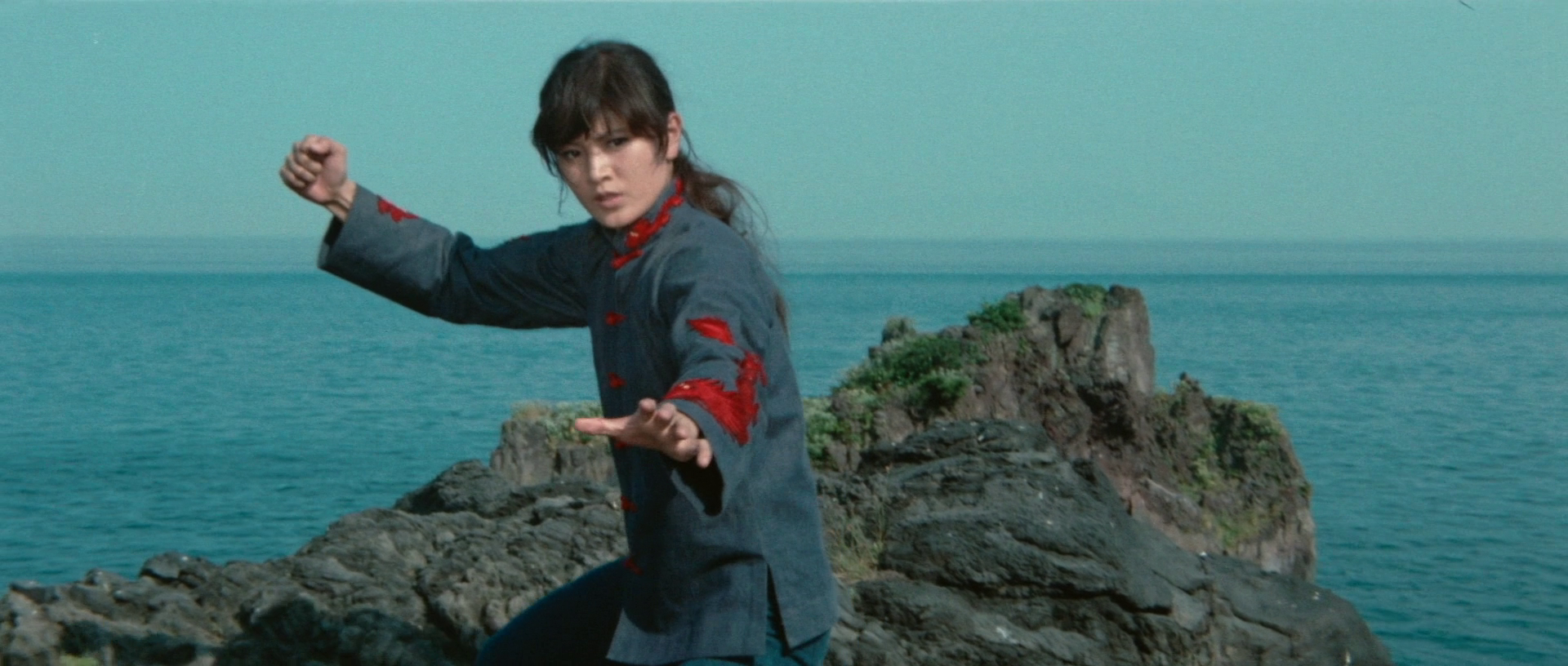
Sister Street Fighter (女必殺拳, Kazuhiko Yamaguchi, 1974)

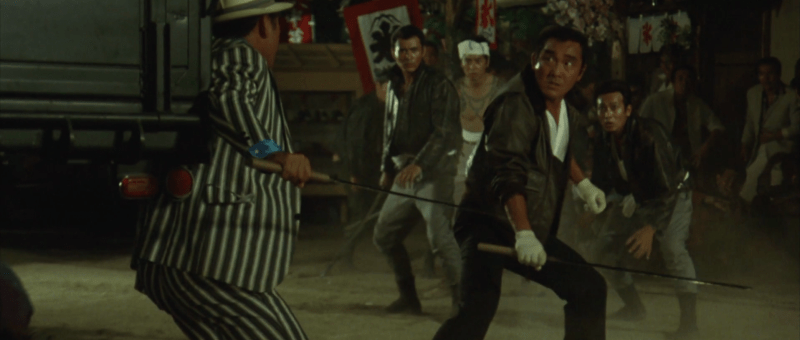
As the Japanese cinema industry continued to decline in the face of competition from television, there was perhaps paradoxically more space available for small-scale genre films. Shinichi Chiba had ushered in a new age of unarmed combat with his Bodyguard Kiba karate movies. The Street Fighter series followed hot on its heels and was enough of a hit for the studio to take notice. They suggested a new spin-off line that would feature a female action star with Chiba appearing in a supporting role and so Sister Street Fighter (女必殺拳, Onna hissatsu ken) was born.

Producers apparently first wanted Taiwanese-born Hong Kong actress Angela Mao who had starred with Bruce Lee in Enter the Dragon by which the film is clearly influenced. Angela Mao was, however, unavailable, which is what led them to take a chance on Chiba’s then 18-year-old protégé Etsuko Shihomi. Shihomi had joined his Japan Action Club out of high school to study stunts, martial arts, and gymnastics and had only limited acting experience but soon proved up to the challenge of carrying a movie as a female action lead. 

Koryu is the sister of a martial arts champion who has gone missing in Japan. She then finds out from his boss that he was actually an undercover narcotics agent trying to break a Japanese drug ring. As Koryu’s mother was Japanese and she still has family in Yokohama, the police inspector thinks she’d be a perfect fit to head out there, find out what’s happened to her brother Mansei (Hiroshi Miyauchi), and maybe take out the drug dealers too. 

In some ways, it’s an interesting subversion of the Sinophobia often found in Japanese films of this era that this time it’s a half-Chinese woman squaring off against Japanese drug dealers. Her brother was apparently so upset about not being able to stop the drugs flooding Japan that he decided to do something reckless that directly led to his disappearance. The Hong Kong police also have a second operative, a woman, working inside the gang but have lost contact with her. In contrast to Koryu, Fang Shing (Xie Xiu-rong) has been sent in as a classic honey trap to use her femininity as a weapon by becoming the boss’ mistress to get the lowdown on the gang. But as a consequence, Fang Shing has also become addicted to drugs which the boss uses as a means to control her. 

Koryu, by contrast, immediately stands up against male patriarchal control by beating up a bunch of guys that were trying to hassle her in a bar. Nevertheless, Mansei’s martial arts master says that her brother was hoping she’d get married and have a “normal life”, which does seem like quite a chauvinistic thing to say and especially to the martial arts-obsessed Koryu. Even so, he introduces her to another young woman, Emi, who got into Shorinji Kempo when Mansei saved her from being raped. These skills do after all give them the means to defend themselves against an often hostile and violent society along with granting them a greater independence than they might otherwise have.

Still, there are a selection of strange villains on show with death by blowgun and ex-priests along with the Amazon Seven team of Thai kickboxers and “Eva Parrish”, apparently the karate champion of the Southern Hemisphere. The action is quite obviously influenced by Hong Kong kung fu films and most particularly Enter the Dragon, though to a lesser extent Shaw Brothers in the warring schools subplot that sees the Shorinji Kempo love is power philosophy challenged by the gang’s very own martial artist, who feels he must wipe them out to overcome his humiliation in being defeated. Nevertheless, Koryu effortlessly takes out the bad guys as she battles her way towards saving her brother, whom the gang have started experimenting on in an effort to acquire more complex data about tolerance and safe levels for consumption of drugs. The bad guys have a full on lab in their basement where they’ve come up with an innovative solution to the smuggling issue by using wigs! It’s all quite surreal and cartoonish even when it starts getting grim, but rest assured Koryu is here to sort it all out, and sort it out she will.


Original trailer (English subtitles)

The Insatiable (現代ポルノ伝 先天性淫婦, Norifumi Suzuki, 1971)

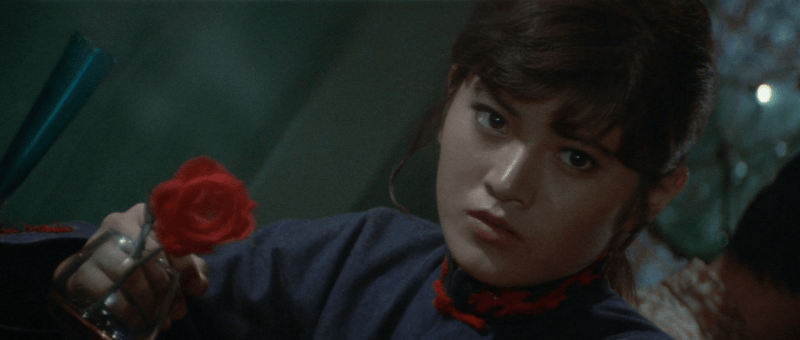
History repeats itself in Norifumi Suzuki’s erotic drama The Insatiable (現代ポルノ伝 先天性淫婦, Gendai Porno Den: Sentensei Inpu). The film’s Japanese title, Modern Porno Tale: Inherited Sex Mania, better hints at its true intentions in essentially repurposing a sense of class anxiety and moral conservatism as familiar from classic melodrama to fit Toei’s line of erotically charged movies but eventually offers little judgement of the heroine’s surrender to her fate (after gaining her revenge) in putting on her mother’s kimono to follow the path set down for her.

That was not, however, what Yuki’s (Reiko Ike) mother (Yoko Mihara) originally wanted. Hoping to save her from the life of a bar hostess with terrible taste in men, she sent her to a religious boarding school in Tokyo which has given her a toxic sense of shame in her sexuality. Sharing a bed with a classmate, she relates her fear and horror of sleeping with men which she assumes she is expected to do in time, though goes on to explore herself sexually with the other girl who feels much the same despite the warning from their lesson books that looking at another woman with desire is no different from adultery. 

Nevertheless, on returning to her mother’s home in Kyoto Yuki is later raped by her mother’s latest boyfriend who is for some reason a bowling enthusiast. His sensibility is emblematic of that of most men in the film who see Yuki merely as an object to be conquered. Following this violation, Yuki quits school and spends all her time in clubs in Shibuya unable to reconcile herself with her sexuality and living as good time girl if resenting herself when others see her as a sex worker. Sucked into the world of sleazy clubs, she becomes a kind of pass around for wealthy men while also cared for by a besotted yakuza who has been quite literally emasculated by his love for her, leaving Yuki unable to fully return his affections because he can no longer satisfy her sexually.

Eventually she meets handsome architect Yoichiro (Hiroshi Miyauchi) with whom she falls in a more wholesome love, but continues to believe that she cannot really be with him because of her sordid past. She then realises that not only does he have unfinished business with a French woman he met while studying abroad (Sandra Julien), but that his father, Matsumura (Tatsuo Endo), is the seedy loanshark who’s been trying to get his hands on her through middleman Akihito (Fumio Watanabe) who is connected with her mother’s new partner Tomoguchi, and also Yoichiro’s brother-in-law.

Akihito is really the villain of the piece, though mostly for his attempt to wage class warfare by taking over Matsumura’s business. His wife, Ayano (Miwako Onaya), has turned away from him knowing that her father brought him into the family for his ruthlessness while exclaiming that she hates self-made men. In much the same way that Yuki was attempting to escape her mother’s legacy, Akihito is also trying to overcome his impoverished background to catapult himself into the upper classes though Matsumura himself appears to have earned his wealth in dubious ways. In any case, he rejects Yoichiro’s decision to marry Yuki not only because he wants her himself but because he claims he wants to find a more appropriate wife for his son presumably as he found Ayano a husband who would benefit himself. 

In any case, Yuki is drugged and abused much like her mother turned into a plaything for men. Yuki resents her only momentarily for her role in her rape and sickening attempt to placate her boyfriend after having stood up for Yuki and confronted him about his betrayal. The two women later reconcile and find solidarity in their maternal relationship even if her mother can never escape the pattern of behaviour that keeps her dependent on bad men which is something Yuki may have overcome in the film’s closing moments as she in turn, wearing her mother’s kimono, opens a bar under her own name living as an independent woman. 

To get her revenge, she manipulated the men around her by using her sexuality against them only to be backed into a corner by Akihito’s chilling claim that she was now his slave. Her salvation at the hands of another man who damns himself in her defence and the defence of their love as something pure despite having cruelly rejected Yuki as a “whore” perhaps undercuts the message but also in the film’s eyes redeems her from her wandering life as an insatiable sex addict now free of her sense of shame and the lingering trauma of her rape. In this patriarchal and classist society, all men are animals driven only by destructive influences, while Yuki is even able to bond with Yoichiro’s French former lover with whom she also shares a sexual encounter. Suzuki films with characteristically romantic imagery and a wry sense of humour but nevertheless allows his heroine to find her way out of a world of beasts while refusing to shame her even as she embraces her mother’s legacy. 


*Norifumi Suzuki’s name is actually “Noribumi” but he has become known as “Norifumi” to English-speaking audiences.

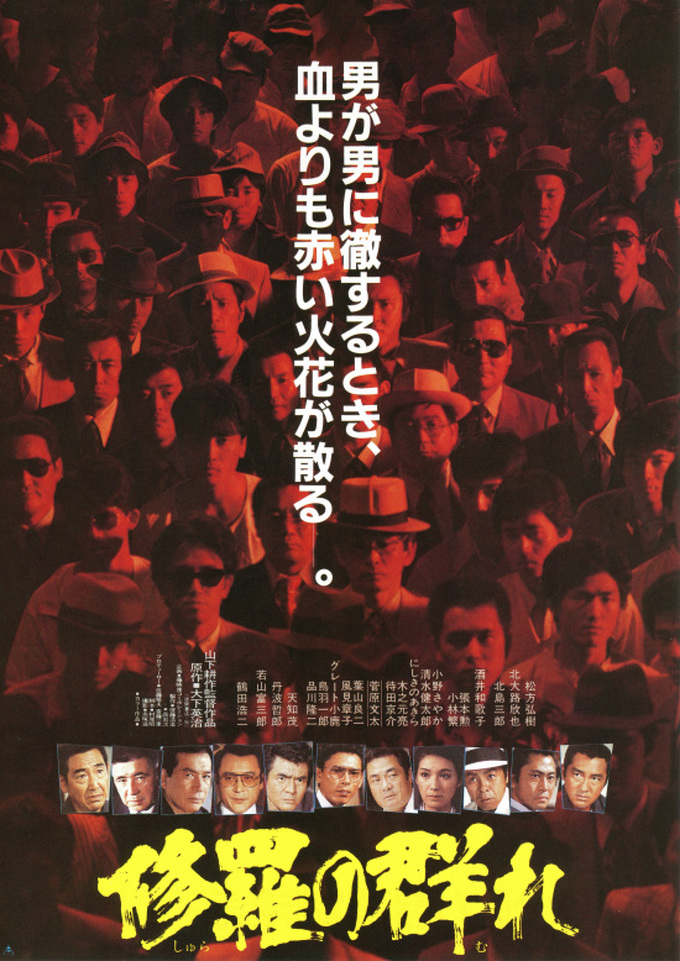
The Story of a Man Among Men (修羅の群れ, Kosaku Yamashita, 1984)

The ninkyo eiga, chivalrous tales of noble gangsters standing up for the little guy with decency and honour, had been Toei’s mainstay throughout the 1960s but a decade later the image of righteous yakuza had been well and truly imploded by the advent of the jitsuroku or “true account” movie which drew inspiration from real life tales of post-war gangsterdom using voiceover narration and onscreen text for added authenticity as it proved once and for all that there was no “honour and humanity” to be found in the gangster life only nihilism and futility. Still, the ninkyo, like many of its heroes, proved hard to kill as 1984’s Story of a Man Among Men (修羅の群れ, Shura no Mure) perhaps proves. A throwback to an earlier era with its infinitely noble hero and unexpectedly if not quite happy then defiantly positive ending, Kosaku Yamashita’s manly drama nevertheless adopts some of the trappings of the jitsuroku in its infrequent use of voiceover and emphasis on concrete historical events. 

The hero, Ryuji Inahara (Hiroki Matsukata), is like many heroes of post-war gangsterdom an orphan though his story begins in the mid-1930s as he’s recruited by a friendly yakuza at a karate dojo. As his teacher explains, Ryuji has already been offered a job with the police but given the chance to join the other side instead immediately agrees, explaining that his life’s ambition has been to gain revenge against the force that ruined his father and destroyed his family, gambling. He chooses to do this, however, not by destroying gambling dens everywhere but by becoming a gambler himself determined to be a winner which is, it seems, a textbook example of having learned the wrong lesson. Still, his noble gangster cool stands him in good stead in the yakuza world where he quickly earns the loyalty of other men, rapidly advancing up the ranks to head his own gang by the crime heyday of the mid-1950s. 

As the title implies, this is a story of a man, a very manly man, among other men. The gangster world is intensely homosocial and founded on ideas of brotherhood and loyalty. Thus, Ryuji finds a surrogate father figure in fellow gangster Yokoyama (Koji Tsuruta) who constantly gives him advice on what it is to be a proper man. “Don’t be a fool, don’t be too smart, and most of all don’t be half-hearted” he advises, later adding “you can’t be a man if you’re dirty about money”, and “taking action isn’t the only way to be a man. It takes a man to have patience.” (this last one as Ryuji hotheadedly discharges himself from hospital to get revenge on a punk who got the jump on him outside a shrine). To be a man, Ryuji intervenes when he sees some less than honourable young toughs hassling an old couple running a dango stand at the beach and the young woman from the caramel stall next-door, throwing his entire wallet on their counter to make up for the damage in what will become something of a repeated motif. His manliness earns him the eternal devotion of the young woman, Yukiko (Wakako Sakai), who eventually becomes his devoted wife against the will of her concerned mother who is nevertheless brought round on realising the love she has for him because of his intense nobility. 

Indeed, Ryuji lives in a noble world. He’s a gambler by trade but only because he hates gambling and is trying to best it. He doesn’t participate in the seedier sides of the yakuza life such as drugs or prostitution and is also in contrast to jitsuroku norms a humanist who defiantly stands up against racism and xenophobia, taking another gambler to task for using a racial slur against a Korean opponent while opting to befriend the “foreign” gangs of Atami when eventually put in charge of the lucrative area rather than divide and conquer. This is apparently a lesson he learned from his flawed but goodhearted father who hid a Korean man and his daughter from the pogroms after the 1923 earthquake because “we’re all the same human beings”. Spared the war because of an injury to his trigger finger, Ryuji kicks off against an entitled son of a gang boss for acting like a slavedriver while working at a quarry but earns only the respect of his superiors further enhancing his underworld ties because of his reputation as a standup guy willing to stand up to oppression. 

Such an intense sense of uncomplicated righteousness had perhaps been unseen since the ninkyo eiga days, and Ryuji’s rise and rise does in that sense seem improbable as his goodness only aids his success earning him the respect of over 1000 foot soldiers even as he finds himself in the awkward position of having to exile one of his most trusted associates for getting too big for his boots and disrespecting the yakuza code. His children also suffer for their connection to the gangster underworld, but are reassured that their father is a good man if with the subtle implication that he has damned them as his father did him. Shot with occasional expressionist flourishes such as crashing waves or a midnight sky, A Story of a Man among Men is not free from manly sadness and indeed ends on the sense of a baton passing from one era to another but does so with an unexpected sense of moral victory for its righteous hero who vows to bring his manly ideas with him into a new age of gangsterdom. 


Original trailer (no subtitles)

The War in Space (惑星大戦争, Jun Fukuda, 1977)

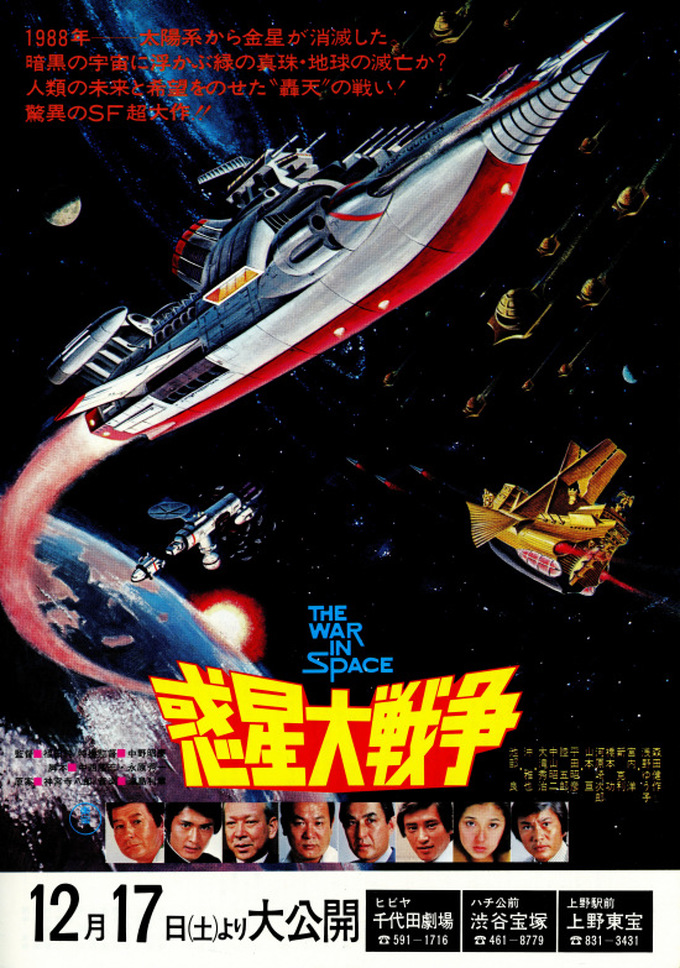
War in Space posterThe tokusatsu movie had been Toho’s signature line since the mid-‘50s, but 25 years later it was more or less played out. The late ‘70s saw the studio diversifying into other types of populist cinema while trying to find new directions in a rapidly changing industry. 1977’s The War in Space (惑星大戦争, Wakusei Daisenso), technically a “sequel” to Ishiro Honda’s Gorath from 1962, very much exemplifies the decline while trying to meld a fairly standard Star Trek-esque tale of interplanetary conflict with Star Wars-inspired fantasy.

In the distant future of 1988, the United Nations Space Force in Japan has been having trouble contacting the space station because of continued electromagnetic interference. Miyoshi (Kensaku Morita), a former team member making an unexpected return from America, tells them that they’d been having the same problem over there and not only that, there had been a worrying increase in UFO sightings across the nation. Making brief contact with the space station confirms their fears when the pilot suddenly starts screaming about a giant Roman spaceship approaching at speed before contact is lost once again. It seems that the Earth is now under attack from an extraterrestrial invasion, and the electromagnetic interference appears to be coming from Venus.

Miyoshi reconnects with his mentor, Takigawa (Ryo Ikebe), and tries to persuade him to resume an old research project to develop a high powered spaceship known as Gohten, but he remains reluctant. Part of the reason for his lack of enthusiasm is that Miyoshi had been his best student and Takigawa still bears him some resentment for his abrupt decision to leave for America rather than staying to contribute to Japan’s future while his feelings are further complicated by the fact that Miyoshi had been in a serious romantic relationship with his daughter, Jun (Yuko Asano), whose heart was broken when he left. A Space Force employee, Jun is now engaged to fellow officer Muroi (Masaya Oki) who is glad to see his old friend Miyoshi return, but also a little anxious.

With the Earth facing imminent destruction, however, there’s little time to worry about past heartache. Takigawa finds himself forced into restarting the Gohten project when he realises that the “Venusians” can pose as regular humans by possessing their bodies. As usual, everything rests on the team pulling together to finish the mammoth project in a record three days before the aliens obliterate their base just like they’re doing to most of the Earth’s major cities. Eventually, the team realise that the aliens aren’t from Venus at all, but from another major solar system and led by a man calling himself “Commander Hell” (Goro Mutsumi) who, for some reason, is dressed like a Roman emperor. Like the Romans, their aim is colonisation. They’ve worn out their home planet and are looking to move, but want somewhere kind of the same so they’ve set their heart on one three away from the sun, like the Earth. 

Aside from the classical trappings, War in Space was apparently rushed out to cash in on the success of Star Wars and even includes a scene which seems to anticipate Leia’s capture by Jabba the Hut in Return of the Jedi when Jun is kidnapped and forced into hotpants while chained to a Chewie-esque furry minotaur carrying a giant axe, which might be mixing their classical metaphors somewhat as Jun and Miyoshi, arriving to rescue her, attempt to escape from Commander Hell’s ship. Takigawa and co. make their way to Venus to try and take out Commander Hell’s base, but are faced with a terrible choice. The reason Takigawa didn’t want to finish the Gohten project is that the ship is armed with a terrifyingly powerful, universe destroying bomb which he worries it was irresponsible of him to invent. Hypocritically, he now knows he’ll have to use it but is hoping that in doing so it will be destroyed along with everything else except perhaps the Earth.

Unlike in Star Wars, it’s the good guys who blow up a planet to save their own though at least no one seemed to be living there, only Commander Hell’s evil minions. Bowing out with a slightly more bombastic evocation of the original tokusatsu messages about the dangers of irresponsible science, War in Space is a fairly generic exercise in genre but has its moments in its bodysnatching spy aliens, groovy ‘70s production design, and charmingly earnest sincerity.


Original trailer (no subtitles)

Yakuza Law (やくざ刑罰史 私刑!, Teruo Ishii, 1969)

yakuza law posterOne of the things that (supposedly) separates the “yakuza” from regular thugs is that they have a “code”. That code means many and various things, but in their grand mission to justify their existence it often means that they stand up for the little guy, all too often oppressed by the powers that be. Of course, a lot of people might feel themselves to be oppressed by yakuza thugs who like to throw their weight around and generally cause trouble for small business holders, but that’s beside the point. Teruo Ishii’s Yakuza Law (やくざ刑罰史 私刑!, Yakuza Keibatsushi: Lynch!) goes one step further and asks if the yakuza are themselves “oppressed” by their own code, or at least the various ways it is used and subverted by all who subscribe to it.

Set in three distinct time periods, Yakuza Law is also fairly unique in that the vast majority of those on the receiving end of its violence are male. The yakuza is an extremely homosocial world after all. Each of the three tales presented is preceded by a title card featuring the particular “laws” the unhappy gangsters are about to break and what kind of punishment they might expect for doing so.

The first and earliest, set in the Edo era, is a typical giri/ninjo tale that places the ideal of the yakuza code against the need to preserve a personal vision of justice. The “rules” here are that a yakuza does not steal and he does not fool around with married women. Our hero, Tsune (Bunta Sugawara), takes the heat for a nervous underling, Shinkichi (Hiroshi Miyauchi), who crumbled in the heat of battle, but incurs the wrath of his boss while a devious footsoldier, Viper (Renji Ishibashi), hides in the bushes and then stabs a corpse numerous times to make it look as if he’s done good service. Viper, not content with his ill-gotten gains, sets up Tsune and his superior Tomozo (Ryutaro Otomo) by implicating them in a gambling scam while Tsune falls for the boss’ girl Oren (Yoshiko Fujita) who is also desperately trying to protect the feckless Shinkichi.

The problem with all of this, it would seem, is not so much that the yakuza “law” has been broken but that’s it’s being misused in all quarters and is clearly in conflict with basic humanity. The boss uses the code to manipulate his underlings and keep a firm grip on his power, while Viper bends it to his own nefarious ways and a third underling, Shohei (Shhinichiro Hayashi), rests on the sidelines playing a little each way but remaining loyal to his brothers even as the axe falls on his head. The punishments meted out are suitably gruesome, escalating from finger cutting to eye gauging and ear removal in a senseless and counterproductive lust for violence which does eventually blow back on the boss who pushes his authority too far over too small a cause.

In tale two, however, which takes place in 20th century pre-war Japan, the “crime” is causing trouble and the punishment exile, but again the problem is not the code but the men who subvert it. Thus, hotheaded foot soldier Ogata (Minoru Oki) sets the cat amongst the pigeons by starting a gang war on his own and is sent to prison for three years during which time his gang prospers because of the movement he started. Even so, they aren’t keen to have him back when he gets out and immediately exile him from their territory. He sticks around waiting for his girl, Sayo (Masumi Tachibana), but she gets picked up by the evil boss who wants her for himself and delays her departure so that Ogata can be captured. Believing he’s dead, she hooks up with another goodhearted yakuza, Amamiya (Toyozo Yamamoto), who saves her from the bad guys only to have a romantic crisis when Ogata suddenly resurfaces. Amamiya and Ogata are, however, both “good” yakuza which means they both really love Sayo and want the best for her, each respecting the other for the old love and the new as they team up to kick the corrupt yakuza out of town and make sure she’s permanently safe whoever it is she eventually ends up with.

By the third tale we’ve reached the contemporary era, but we’re no longer in a traditional “yakuza” world so much as one seemingly ripped from a spy spoof in which the cardinal rule is that if you undermine the organisation you will be eliminated. More thugs than yakuza, this kind have no code and will stoop to the lowest kind of cruelty solely for money. Debonair, 007-esque international hitman Hirose (Teruo Yoshida) accepts a job from shady gangster Shimazu (Takashi Fujiki) to assassinate his boss, only Shimazu offs him first and then frames Hirose (which he finds very irritating). Hirose spends the rest of the picture teaching him a lesson while Shimazu tries to eliminate his competition in increasingly inhuman ways (including having someone crushed into a cube while trapped inside a luxury car).

Bar the third episode which isn’t really even about “yakuza”, what Ishii seems to be saying is that the yakuza are also oppressed because they are forced to live with fragmented integrity, torn between giri and ninjo in their adherence to an arcane set of values which are often overly enforced at the cost of true “justice”. To be fair, that is the idea behind every other yakuza film, but Ishii does is add a more cynical edge in suggesting the issue isn’t the code and conflicting value systems but individualised corruption (which is itself perhaps a kind of “ninjo”) in those who deliberately misuse the “noble” idea of the code for their own ends – something which has intensified since the Edo era though is apparently not a result of post-Meiji internationalism. All of that aside, despite the brutality of the title, Yakuza Law is fairly tame outing for Ishii which tempers its lust for blood with cartoonish irony as its deluded heroes battle themselves in service of a code which has never and will never truly serve them.


Available on blu-ray from Arrow Video in a set which also includes a new audio commentary by Jasper Sharp and a vintage interview with Teruo Ishii, as well as a booklet featuring new writing by Tom Mes.

Original trailer (no subtitles)