Bonds of Love (愛のきずな, Takashi Tsuboshima, 1969)

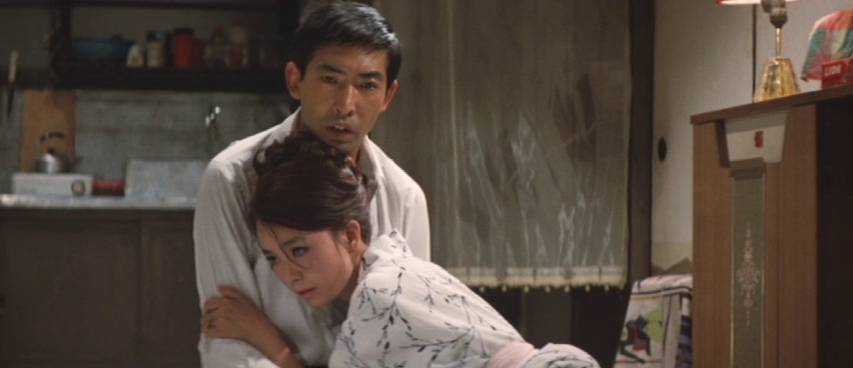
On a rainy night, a salaryman trapped in a loveless marriage and unsatisfying career chances on a beautiful woman dressed in kimono waiting by the side of the road. He decides to double back and offer her a lift, which she ill-advisedly accepts, but as it turns out he is actually the one in danger. Adapted from the Seicho Matsumoto short story Tazutazushi, The Bonds of Love (愛のきずな, Ai no Kizuna) has underlying misogyny that paints the woman at its centre as a sort of elemental spirit who bewitches men and leads them to their doom even while the hero himself is selfish and insecure, mired in an inferiority complex and incapacitated by wounded male pride.

The fact that Ryohei (Makoto Fujita) is already married comes as a bit of a shock, abruptly revealed as it is by the nameplate on the suburban home he returns to after a date with Yukiko (singer Mari Sono) having told her that he lives alone at the company dorm. It seems obvious that he’s dissatisfied with his domestic life and fed up with his overly materialist wife Sanae (Chisako Hara) whose constant gripes only seem to needle at his sense of inadequacy. Today, she’s misplaced an expensive ring he’d used his annual bonus to buy her and when he notices it simply sitting next to the sink, she remarks that it’s not all that nice anyway. Ryohei at least feels that she resents him for not being more successful and having the financial power to buy her the frivolous gifts and status symbols she clearly desires. The power dynamic is in any case unbalanced because Sanae is the daughter of his boss which means she in effect has total control over his career. One word to her father, and he’s toast, but at the same time she can only help him so far with his advancement despite nagging him constantly about his future prospects. Meanwhile, the other men at the office make fun of him. They describe Ryohei as an idiot who’s only in his position by virtue of being the boss’ son-in-law. 

This of course further needles at his wounded male pride, but dating Yukiko, who adores him completely, on the side restores his sense of masculinity. After he claims to have been staying out late playing mahjong, Sanae cautions him that one of his colleagues is being transferred because of his gambling and womanising habits. At his leaving do, Miyata (Sachio Sakai) lays into Ryohei and says he’s the one who taught him how to pick up women and pretend to be single as if this is the way they overcome their sense of impotence while under the company’s thumb. Ryohei appears not to like him, perhaps because he reflects the qualities in himself he is least proud of. The news of his transfer therefore spooks Ryohei knowing that the same fate may befall him if his affair with Yukiko is exposed. 

But when Sanae does eventually suspect he’s cheating on her and complains to her mother, the boss rings Ryohei and basically tells him not to worry about it because a man’s not a man if he doesn’t play around. The conflict that Ryohei has is essentially one of conflicting masculinities, the one in which he is effectively emasculated but defines his status through a hierarchical relationship with other men within the corporate structure, and the other in which he defines it through romantic conquest which also represents a kind of freedom. But being a fairly conventional man, in the end Ryohei cannot bear to have his salaryman persona ripped away from him and will do whatever it takes to maintain his relationship with his wife and by proxy his boss to preserve his career.

Realising Yukiko poses a threat to that, he decides the only solution is to kill her but it’s also true that he’s confronted by a much more robust vision of masculinity in the form of her estranged husband Kenji (Makoto Sato) who went to prison after stabbing another man in a jealous rage. It’s clear that Ryohei is afraid of Kenji and definitely doesn’t want to end up getting stabbed. His “love” for Yukiko does not stand up to that kind of scrutiny and it’s her assertion that she’s going to tell Kenji all about their affair and ask for a divorce that shifts him into crisis mode. After all, he’s in flight from domesticity. Leaving Sanae, and with it destroying his career might not solve his problems even if what he eventually chooses is just that, to be free of the burden of the salaryman dream and move to a small town to open a shop with a woman who is in thrall to him and therefore continually submissive and loving in contrast to Sanae who only ever makes him feel small.

Yet, we can’t actually be sure how much of what happens later is actually real or just Ryohei imagining things because of his guilty conscience and continuing sense of inadequacy. Essentially, he gets a second chance to make better choices and finally gains the courage to abandon his salaryman persona only to be immediately confronted by both his transgressions and violent masculinity. Tsuboshima crafts an atmosphere of malevolence and noirish dread coupled with a spiritual sense of retribution born of the constant rains and gothic thunderstorm that heralds the final confrontation in which Yukiko is herself a harbinger of death leading weak willed men towards their doom to which they go all too willingly. 

Sun Above, Death Below (狙撃, Hiromichi Horikawa, 1968)

“Fighting is the only way I have to live my life” according to a hitman battling existential ennui in Hiromichi Horikawa’s Toho action B-movie, Sun Above, Death Below (狙撃, Sogeki). A starrier affair than the studio’s other forays into moody crime, Horikawa’s psychedelic exploration of a killer drawn to death nevertheless situates itself very much in the world of 1968 in which the hero’s attempt to escape his sense of emptiness through killing is directly linked to an increasing economic prosperity and its concurrent costs in the nation’s current geopolitical positioning. 

As if to signal this sense of societal anxiety, the first target Matsushita (Yuzo Kayama) knocks off is sitting in the back row of the last carriage on the Shinkansen out of Tokyo. His next job, however, will apparently be more complicated. A criminal gang want him to take out “five or six” targets at a specific location in order to intercept a fortune in gold smuggled by, as later becomes clear, an international Chinese gangster, though the men at the waterside greet each other in Arabic. The hit does not go entirely to plan but Matsushita is later able to bring the situation under control allowing the gang to get their hands on the gold. The smugglers, meanwhile, are obviously unhappy with this turn of events and send in their best hitman (Masayuki Mori), who permanently travels with a blonde companion, to take back what’s theirs. 

Matsushita is a killer for hire so he doesn’t really care very much about the gold and is even annoyed when the gang try to pay him with it, correctly surmising they didn’t really expect him to succeed so haven’t bothered bringing any cash. As he explains to love interest Shoko (Ruriko Asaoka), he doesn’t really care about anything. He simply shoots at the best target, man, with his favourite gun. He kills to feel alive, explaining that the intense concentration in which he becomes one with the gun as if it were an extension of his own body allows him to overcome his sense of existential dread which is why he’s so ice cool all the time. 

A fashion model obsessed with rare butterflies and the paradise to be found New Guinea Shoko dreams of a time in which they can become one under the sun, envisioning a future in which Matsushita has become friends with all the creatures of the forest. Yet as Matsushita tells an old friend, Fukazawa (Shin Kishida), running a secondhand gun shop near a US army base as a front for his revolutionary activities, he has no dream or ideal and knows nothing other than killing. Whereas as his friend is apparently working for some kind of never quite explained but seemingly left-wing/anarchist cause, Matsushita simply lives out his days of emptiness on some level knowing he’ll probably never make it to Shoko’s New Guinean utopia. 

Fukazawa nevertheless hints at the political instability all around them, firstly agreeing to pawn a gun for a pair of Americans after beer money, and then by handing Matsushita an AK47 apparently smuggled back from Vietnam via the American base. Matsushita’s sense of ennui is born of this growing unease with empty capitalistic consumerism and a concurrent sense of powerless in Japan’s ongoing complicity with American foreign policy in Asia. Displaying a sense of Sinophobia familiar from many similar films of this era, the big boss turns out to be Chinese while many that surround him are also from outside of Japan even if Matsushita’s rival is just a slightly older, crueller version of himself. 

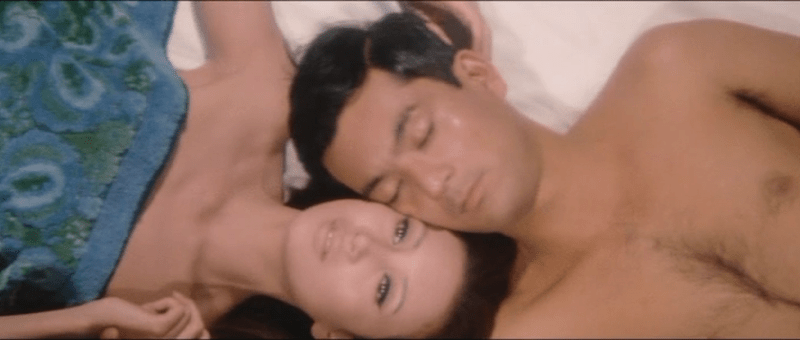
One of Toho’s more serious crime dramas, Horikawa often veers into experimental territory with his psychedelic butterfly imagery Matsushita apparently having some kind of vision while experiencing carnal ecstasy that equates climax with literal gunshot, while his usage of stock footage featuring the New Guinean indigenous community along with an out of place blackface tribal dance performed in a hotel room clearly display some outdated attitudes otherwise unacceptable and potentially offensive in the present day. Nevertheless, Sun Above, Death Below largely lives up to its hardboiled title, the Japanese “Sniping” perhaps also hinting at the various ways Matsushita eventually strays into the crosshairs of his own inevitable destiny. 


Original trailer (no subtitles)

Too Young to Die (死ぬにはまだ早い, Kiyoshi Nishimura, 1969)

Perhaps more or less forgotten for reasons we’ll come to later, Kiyoshi Nishimura was for a time a successful director associated with Toho’s line of noirish B-movie action dramas. When the Japanese cinema industry entered its decline in the 1970s, Nishimura shifted into similarly themed TV drama and was well respected for his ability to turn in on time and on budget. None of that mattered however when he was engulfed in scandal in 1987 after being caught operating spy cams in the female only area of a public bathhouse bringing his career to an abrupt end. Directing a few more projects under the name Yusai Ito, he sadly took his own life a few years later in 1993 at the age of 61. 

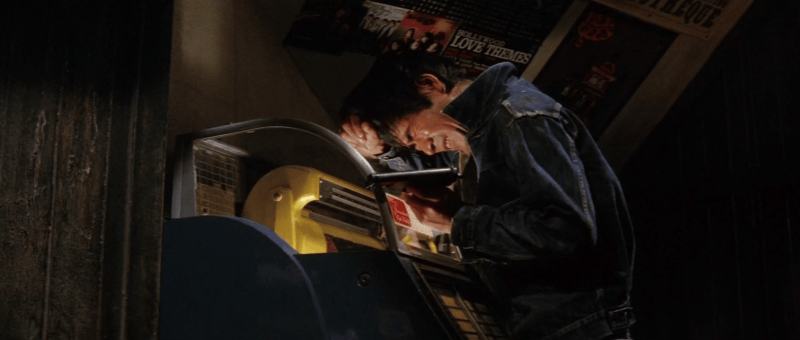
Nishimura’s 1969 debut Too Young to Die (死ぬにはまだ早い, Shinu ni wa Mada Hayai), however, is a masterclass in high tension filmed with shaky handheld set largely in a single location and imbued with a singular irony replete as it is with cosmic coincidences as a collection of customers at a roadside bar are taken hostage by a crazed criminal with a gun intent on finding the lover of the girlfriend he claims to have murdered for her infidelity. The heroes, however, are ennui-filled couple Matsuoka (Koji Takahashi) and Yumiko (Mako Midori) who are in fact not married, or at least not to each other, but carrying on an extra-marital affair which may be on the cusp of fizzling out. A former racing champ who claims he just got bored with the sport one day and now works for a company selling accessories for toy cars, Matsuoka is supposed to drive Yumiko home where she’s expecting a call from her controlling husband, away on a business trip, at 1am. These are all reasons they are unusually nervous about a police checkpoint searching for an armed fugitive, deciding to stop off at a roadside bar for a stiff drink and something to eat. Only, shortly after their arrival a young man (Toshio Kurosawa) in denim enters giving each of the other men intense side eye before shooting a policeman who comes in to make enquiries about the fugitive. 

The unnamed young tough takes the entire bar hostage intent on finding his lover’s lover, overcome with a sense of cosmic irony when Matsuoka calmly points out he may have arrived too early and the man he’s looking for had not yet arrived when he put the place in lockdown. Before the gunman’s arrival, Nishimura introduces us to each of the other customers via the handy device of two teenage girls apparently stranded and asking around for a lift back to the city. A middle-aged doctor (Chuzaburo Wakamiya), apparently a regular, eventually offers to take them but is dissuaded by the barman (Kazuya Oguri) who reminds him he’s been drinking too heavily to take passengers, while a taxi driver (Shigeki Ishida) who seems to be feeling unwell flat out refuses. The other customers are a suspicious looking man in a trenchcoat (Daigo Kusano) sitting in the corner piling matchsticks, and a newlywed couple who we later learn saved up for their wedding for three years, the wife (Nami Tamura) already going through her accounts book irritated by her friends’ decision to graffiti their car and wondering how much it’ll cost to get it cleaned up while the husband (Tatsuyoshi Ehara) disappoints her by wanting to rush home because he’s planning to return to work the next morning ahead of schedule. 

The relationships of the two couples are often directly contrasted, Matsuoka and Yumiko unsure of their connection as adulterous lovers while the newly married couple also seem be under strain even before the traumatic events about to take place. Apparently brokenhearted, the gunman collapses over the jukebox playing a series of melancholy songs about lost love, Matsuoka later darkly musing that perhaps he was only able to kill his lover because he loved her so much. Unlike the other customers, Matsuoka appears entirely unperturbed by their predicament calmly talking to the gunman and even ringing the police to ask them to temporarily stand back so they can evacuate a hostage in need of medical treatment. The gunman sends Matsuoka and the newlywed husband to take the injured party out, taking Yumiko hostage as security while she fears Matsuoka does not value her enough to return though both men do in fact come back rather than abandon their respective women. The newlywed husband, however, later fails a test of manhood when the enraged gunman goes off on a misogynistic rant and tries to force the doctor to rape the newlywed wife to prove that all women are faithless “whores”, the husband reduced to a gibbering wreck cowering in the corner unable to protect his new wife or challenge the gunman’s authority as Matsuoka later does when he orders Yumiko to remove her clothes in front of the other hostages. 

Though Yumiko had feared the affair was on its way out, ironically describing Matsuoka as not so different from her husband while lamenting that their connection seemed to have dwindled, the traumatic experience seems to reinforce the reality of their love as something more than a casual extra-marital fling even as Matsuoka forgives her for not trusting him because their relationship is not founded on the same idea of “commitment” as the married couple. The question for the other customers is how much the lives of others they’ve only just met really mean to them, the two teenage girls deciding to attempt escape while the gunman takes Yumiko hostage to use the bathroom, the doctor edging round the sides as Matsuoka tries to stop them to protect her while the newlyweds similarly waltz towards the door. All the while the TV crackles with an inane variety show complete with its cheerful advertisements while the police apparently have the place surrounded ironically convincing the gunman he has no way out and therefore nothing to lose. A tense meditation on interpersonal relationships, Too Young to Die is not without its share of ironies in strange number of coincidences and misapprehensions as the siege eventually draws to an unexpected close sending our conflicted lovers back into the night if perhaps a little more alive for their brush with death.