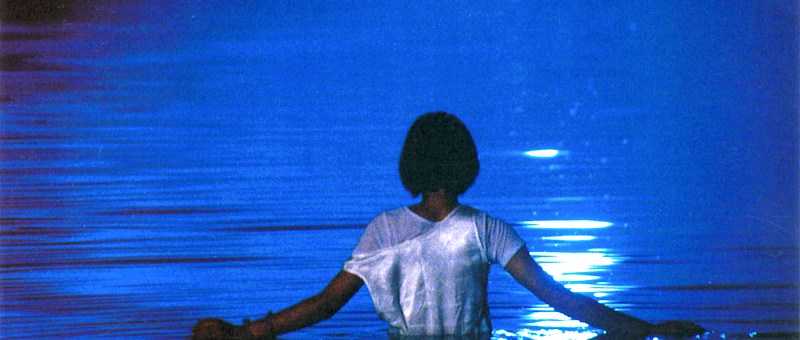
August in the Water (水の中の八月, Sogo Ishii, 1995)

How does the world, or perhaps the cosmos, attempt to communicate with us? As Douglas Adams once did, August in the Water (水の中の八月, Mizu no naka no Hachigatsu) suggests it maybe through the dolphins who here at least seem to be quasi-mystical beings existing in what is really the lifeblood of humanity. In the film’s opening scenes, we’re told that the hero, Mao (Shinsuke Aoki) whose name means “true fish” and his friend Ukiya (Masaaki Takarai) have taken part-time jobs at a marine part to learn how to communicate with dolphins, but it’s the heroine Izumi, whose name means “spring” who eventually claims to have learned to do so. 

At least, her final words are that the dolphins have taught her “the perfect balance” which has allowed her to open the floodgates both literal and metaphorical to return water to an arid land. We’re repeatedly told that there’s been a lengthy drought and a water shortage leading to rationing and locked pipes though the marine park remains open and the local festival goes ahead  hinting at the ways in which we do and don’t value our natural resources. Izumi’s science teacher tells the kids that humans don’t contribute to the Earth and waste the resources that it gives us which might help to explain the gradual ossification of the planet including a mysterious condition known as the Stone Disease which causes people to collapse in the street as their organs harden. 

Izumi’s sister Yo later remarks that she thinks humanity came from a distant planet long ago and yearns to go home but to do so we must become stone because water is a substance that exists only here on Earth. Turning to stone is however seen as quite a bad thing and also echoes a millennial distrust in increasing technology with TV pundits positing that if human brains were replaced with computer chips we wouldn’t need to worry about water shortages anymore. In Yo’s dream, after people’s brains have become computer chips they become connected to the universe and can transport their minds to the moon enabling them to communicate with anyone anywhere at any time. 

But then despite the potential for communication that computers were only just beginning to offer in the mid-90s, Izumi warns her sister to stay away from them as they leave you vulnerable to the Stone Disease. The boys’ ultramodern friend, Miki (Reiko Matsuo), is a computer addict and it’s she who eventually manages to unlock parts of the mystery but paradoxically as if she were some kind of seer correctly predicting that an accident will befall Izumi on 23rd August and discovering a prophecy that in the year humanity neglects the water god two meteorites will fall in close proximity and drought will follow. Only a ritual conducted by the chosen one under a full moon will be able to cure it. Two child-like old men also warn that nothing’s been the same since they moved the old shinto shrine over which there have also been sightings of UFOs.

After the diving accident in which Izumi plunges meteor-like into the pool, she herself feels as if she’s been split in two almost like the world itself which is divided between these ancient beliefs and modern advancements that have perhaps blocked the flow that once allowed us to communicate with each other and with the universe. A psychiatrist suggests that Izumi may be suffering with sudden onset schizophrenia as a result of her accident and that all of her talk about secret messages from dolphins and mysterious aliens who want to turn the world to stone is nothing but confused delusion though in the film’s closing scenes she herself takes on a supernatural quality as a kind of etherial saviour figure who realises that she may have been dead ever since the accident and is now something different, different and distant as her sister puts it, charged with the mission of rejuvenating a human spirit long since dulled by mechanisation.

In contrast to Ishii’s earlier films which brimmed with punkish energy, August in the Water unfolds at a leisurely pace with eerie yet nostalgic mood music and a new age sensibility speaking to millennial youth with a sense of turn of the century anxiety and human remorse that perhaps we’ve already poisoned our futures. Nevertheless, despite his youthful heartbreak, what Izumi bequeaths to Mao and humanity itself is seemingly the ability to live in the abundant fullness of existence until that existence is done and we return once again to water and the comforting embrace of the Earth.


August in the Water screened as part of this year’s JAPAN CUTS.
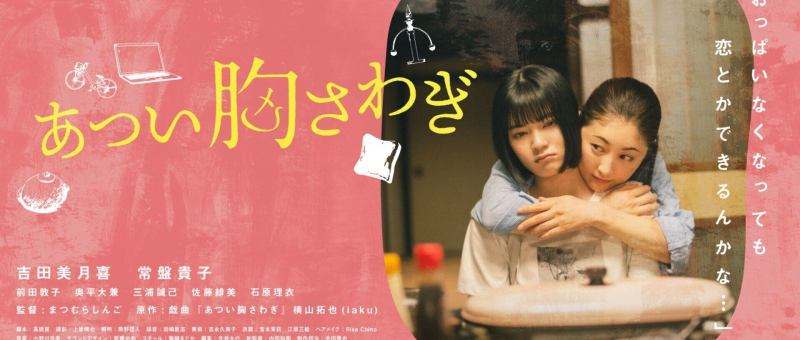
The Lump in My Heart (あつい胸さわぎ, Shingo Matsumura, 2022)

A young woman with a growing desire for independence is thrown into turmoil by a totally unexpected diagnosis of cancer in Shingo Matsumura’s gentle coming-of-age tale and maternal drama, The Lump in My Heart (あつい胸さわぎ, Atsui Munasawagi). Perhaps because of her youth, the heroine finds herself struggling not with a fear of pain or death but of being unsexed while preoccupied with what it might mean for the rest of her life if she were to lose her breasts at such an early age.

It seems that Chinatsu (Mizuki Yoshida) has had a particular hangup about her chest size since the onset of puberty when her mother, Akiko (Tokiko Tokiwa), first refused to buy her a bra, making her wait a year longer than the other girls and leaving her with a sense of embarrassment that might be out of keeping with her age. One of the things that most bothered her about the doctors visits is that she was treated by a middle-aged man who was then the first person ever to touch her breasts which is something she’s unhappy about while also feeling insecure that she’s never had a proper boyfriend and might never get one if it turns out she needs a mastectomy. As it turns out, she’s carrying a torch for childhood friend Ko (Daiken Okudaira), an aspiring actor, but is too shy to say anything especially with this threat to her sense of femininity hanging over her. Of course, it doesn’t help that the doctors are asking her to make advance decisions about things an 18-year-old wouldn’t usually consider such as if and when she might want children because her feelings about her fertility might affect her treatment options. 

Then again, it’s also true that she remains trapped in adolescence resentful when her mother tells her not to worry she’ll make all the decisions but also perhaps relieved. A little sick of their co-dependency she’d been thinking of moving out though it seems difficult to believe she’d be able to afford rent with just her part-time job while studying full-time at university. But when her mother shows a little interest in an incredibly awkward man at work it sends her in the other direction, now feeling resentful and rejected while fearing the loss of their familial intimacy given it had just been the two of them for so long after her father’s death when she was four.

Motoharu (Masaki Miura) accidentally demonstrates the entrenched sexism of the world around them when he makes a misogynistic joke as an attempt at an icebreaker when introduced as the boss at the factory where Akiko works. It later comes to light that he left his last job due to an accusation of sexual assault, and though it turns out to have been a misunderstanding highlights a lack of awareness in the working environment that feeds in to Chinatsu’s ongoing preoccupation with her femininity and the elusiveness of romance. Her homework assignment over the summer holidays is to write a story about her first love, a topic which might be seen as bordering on inappropriate, perhaps discriminatory against those who do not feel romantic desire not to mention that Chinatsu is only 18 so it is only natural that she is still in the process of figuring things out and cannot be expected to have much of a perspective on what is to her still a fairly recent (in fact ongoing) event. 

Meanwhile, her mother and Motoharu are each feeling a pang of regret that they always let things pass them by like the arrival of the circus, destined to be in town for a limited time only so it’s best to catch it while you can. Unfortunately that’s easier said than done especially when not everyone’s on the same page. The lump in Chinatsu’s heart is her yearning for romantic love, though she still lacks the courage to be honest with her feelings even if it’s helped her repair her relationship with her mother. An unexpected piece of compassionate advice also helps her begin to re-imagine her femininity in accepting that the loss of her breasts might not mean that she’s destined to be alone forever nor undeserving of romantic love symbolically dissolving the lump in her heart in allowing her to move forward with her life no matter what the future might hold.


The Lump in My Heart screened as part of this year’s Japan Foundation Touring Film Programme.

Original trailer (English subtitles

Labyrinth of Dreams (ユメノ銀河, Sogo Ishii, 1997)

“If both held their courses they would collide in nine seconds, and catastrophe would be inevitable” according to the voiceover which opens Sogo Ishii’s ethereal psychodrama Labyrinth of Dreams (ユメノ銀河, Yume no Ginga) though his words might as easily apply to the protagonist and her opposing number as a bus and a train locked as they are into a fateful cycle of love and death. Ishii had made his name in the ‘80s for a series of frenetic punk films such as Burst City and The Crazy Family yet adapted from the novel by Kyusaku Yumeno, Labyrinth of Dreams adopts the language of golden age cinema to tell a punk story as a young woman searching for freedom, independence, and a more exciting life finds herself drawn towards death in her inexorable desire. 

Set sometime in the 1930s, the film opens with a taste of the gothic on a stormy night all mists and confusion as a bus heads towards and then unwisely across a level crossing in front of an oncoming train. “Double suicide or accident?” a newspaper headline asks, as we’ll discover on more than one occasion as this is not an isolated incident either bizarre cosmic coincidence or the work of a mysterious serial killer. The heroine, Tomoko (Rena Komine), had always wanted to become a bus conductress, explaining that they looked so “heroic” in their uniforms but has discovered the reality to be not quite so satisfying. “The female bus conductor only looks good on the surface. We must obey the driver’s orders, put up with all displeasure and work like a slave” she writes in a letter to a friend, Chieko (Kotomi Kyono), telling her in no uncertain terms that she must never become a bus conductress. 

To a young woman from the country in the 1930s, such a job must have seemed exciting promising a way out of stultifying small-town life and a path to an independent urban future. It’s this sense of self-possession that Tomoko seems to have been seeking hoping that wearing a uniform even that of a bus conductress would grant her a level of authority she does not really have realising that she is a mere subordinate to the male bus driver and quite literally has no real control over the direction of her life. When she receives a letter from a friend who had also become a bus conductress only to die in a tragic accident explaining that she thinks her fiancé is a bus-based bluebeard rumoured to have seduced and murdered his previous conductresses Tomoko smells not danger but excitement in realising the new handsome driver with a flashy Tokyo haircut who’s just transferred to their station is none other than her friend’s possibly sociopathic former boyfriend. 

Fully embracing a sense of the gothic, neither we nor Tomoko can ever be sure if Niitaka (Tadanobu Asano) is a coldblooded killer or merely the projection of a fantasy created by Tomoko’s repressed desires and yearning for a more exciting life. Having encountered him once before sleeping on the railway tracks as a train approached, he becomes to her something like an angel of death and though she believes him to be dangerous she cannot help falling in love with him anyway. Ishii constantly flashes back to deathly images, a pair of shoes abandoned on the rocks or a bunch of drooping lilies while a literal funeral procession eventually boards the bus just before the climactic moments on which Tomoko is in effect staking her life as she and Niitaka each refuse to deviate from their course, a set of railway points and a trapped butterfly added to the film’s rich symbolic imagery. 

A policeman at the film’s conclusion makes a point of asking Chieko if Tomoko is known to be a habitual liar having found no evidence that Niitaka deliberately caused the deaths of his previous conductresses even if it seems unlikely that he is simply the victim of unhappy coincidence. “My life was miserable and lonely,” Tomoko writes, “but remember me as the one who wrestled her fate at the end”, staking her life on a “fatal romance” and in a sense overcoming existential dread by staring it down, a deathly desire leading finally to new life. Beautifully lensed in a golden age black and white with occasional onscreen text in the ornate font of the silent movies, Ishii’s ethereal drama freewheels between dreams and reality amid gothic mists and expressionist thunderstorms as it reels towards an inevitable collision. “They haven’t a clue about the truth” Tomoko sighs, perhaps all too aware.