New Female Prisoner Scorpion: Special Cellblock X (新・女囚さそり 特殊房X, Yutaka Kohira, 1977)

After Meiko Kaji declined to appear in further Female Prisoner Scorpion movies, Toei attempted to reboot the franchise under the “New Female Prisoner Scorpion” banner much as they did with some of their other franchises such as New Battles without Honour and Humanity. This second, and in fact final, instalment Special Cellblock X (新・女囚さそり 特殊房X, Shin Joshu Sasori: Tokushu-bo X) is not a sequel to New Female Prisoner Scorpion but itself another reboot that like its predecessor takes place amid a backdrop of paranoia and political corruption. 

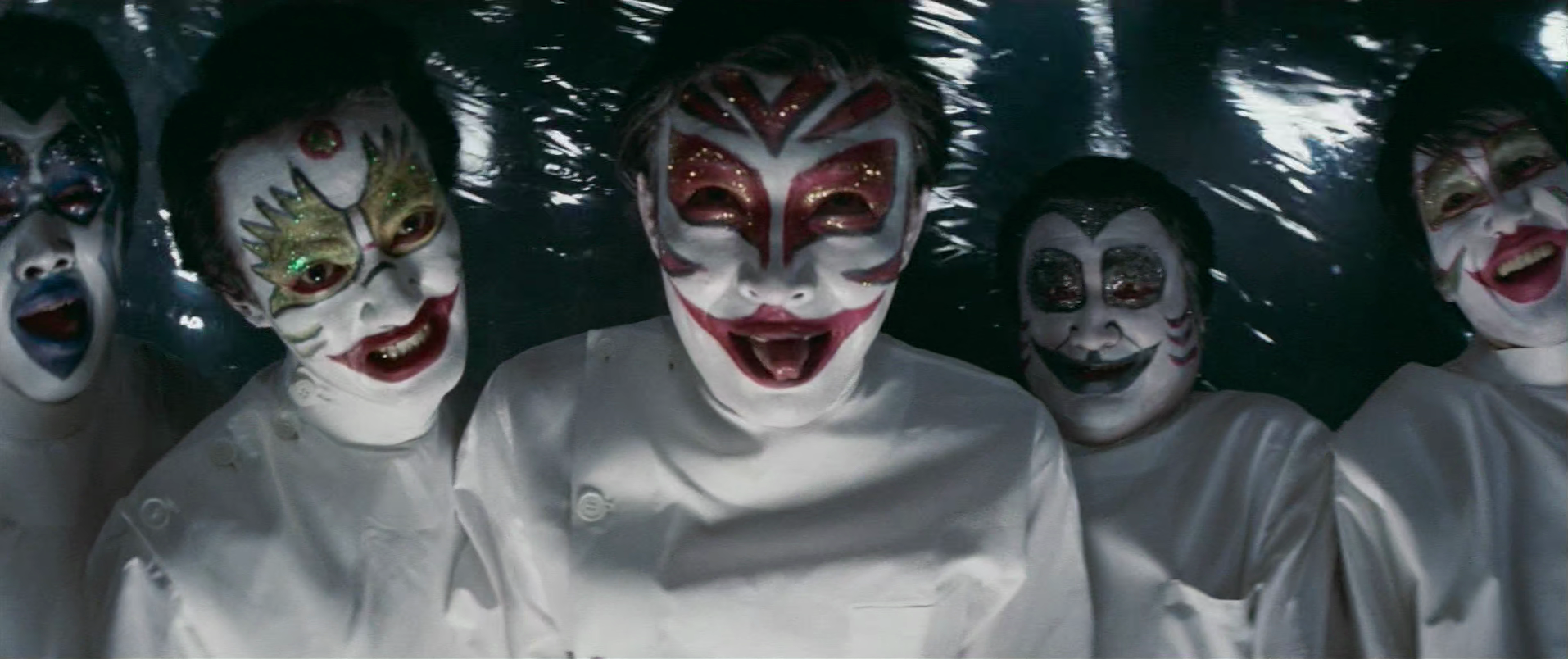
Arriving back at the prison after a failed escape attempt, this Nami (Yoko Natsuki) has an all new backstory as an idealistic nurse whose doctor boyfriend was given shock therapy that destroyed his mind and left him in a vegetative state after threatening to blow the whistle on his hospital’s decision to let the man at the centre of a growing political scandal quietly pass away. These facts are first communicated to us through a surreal fever dream Nami has presumably caused by an infected wound on her leg. She first dreams herself frolicking cheerfully with the doctor before frightening figures of darkness pull him back into an abyss while terrifying clowns leer over and then rape her. She’s only saved from her life-threatening medical condition by the intervention of Kiyomi (Kaori Ono), a fellow prisoner who feels indebted to her because of a blood transfusion she received three years earlier before everything in Nami’s life went wrong. 

But otherwise Nami enjoys little respite in the prison as the other inmates take out their frustrations on her in regards to the reprisals enacted on them following her escape attempt. Like most other prisons in the franchise, this one employs a tactic of divide and rule encouraging the prisons to turn on Nami rather than the guards for their treatment of them. But things are changing in the prison. Chief guard Kajiki (Takeo Chii) had ruled supreme, but the warden has different ideas and objects to Kajiki’s tactic of appeasement by allowing things like cigarettes and chocolate to circulate in the prison to keep the inmates happy. He brings in a super tough security enforcer from the face male Abashiri prison which means Kajiki’s career is definitely on the decline and leaving him increasingly siding with the prisoners over the cruel treatment they’re exposed to by the warden who is too busy courting the justice minister in the hope of a government position to consider things like prison regulations or the welfare of the prisoners. 

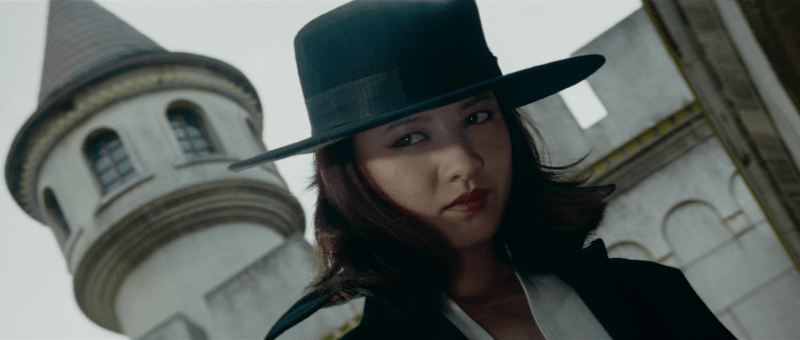
Of course, it’s also the justice minister against whom Nami wants revenge. This Sasori is even more silent than most, glaring angrily at those around her but saying little other than stopping to advise Kiyomi not to get involved with her because it won’t end well in a prediction that turns to be accurate. When she eventually assumes her Sasori persona, it’s a little different from that of her predecessors as she dresses all in white (perhaps apt for a former nurse) with a long black over coat. Her black hat has a wide, stiff brim and a feather tucked in the side. She kills with a scalpel, as if she were literally excising the corruption in society and is prepared to play a little bit dirty. The justice minister had asked the warden to kill her and pass it off as an illness. She threatens to blackmail him though it’s obvious she’s not after money and executes the warden when he delivers the pay off on a cheerful fairground ride. 

Though it may lack the striking cinematography found in Ito’s trilogy, the film nevertheless skews surreal with its strange fever dream that turns out not to be so far from the reality as you’d assume along with weird gags like Nami and Kojiki stealing the clothes of a young couple after escaping together who happened to be dressed in identical outfits. Nami teaming up with a former guard is also something of a surprise and though she fights with him and rejects his romantic advances, she seems to have genuine pity when he gives up his life to save her. In any case, they each have something in common as those who now resist the system as Kajiki became a victim of a more authoritarian regime that doesn’t like his lax approach to rule keeping and Nami pursues her desire for justice in an unjust society at all costs. Dropping a bloody scalpel behind her, she disappears into the night, justice done, but presumably onto some other kind of vengeance against a corrupt authority that equally will stop at nothing to hang on to its power.

Criminal Woman: Killing Melody (前科おんな殺し節, Atsushi Mihori, 1973)

“Five women like us could take on the whole world!” a woman exclaims after a very successful mission of revenge in which they didn’t have to do very much at all except play on male pride and yakuza honour. Criminal Woman: Killing Melody (前科おんな殺し節, Zenka onna: Koroshi-bushi) stars the two main players of Toei’s pinky violence line, Reiko Ike and Miki Sugimoto, and plays with their star rivalry by casting them as a pair of women eventually divided by the conflicting loyalties presented by the heroine’s desire for revenge. 

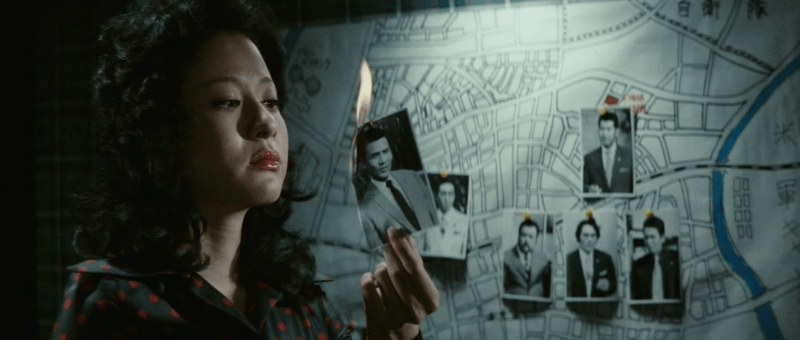
Ike stars as Maki, an intense young woman first seen hiding behind a door in the classic club scene that opens the film. Eventually she darts inside and slashes some yakuza with a knife, but her assassination attempt is very unsuccessful landing her in prison for a number of years where she largely spends her time glaring at the bars and plotting her revenge. Nevertheless, it’s the solidarity she finds with her cellmates that eventually allows her to carry out her plan. On her arrival, she first clashes with cell boss Masayo (Miki Sugimoto), a former yakuza moll inside for slashing some guys with a razor after they caught her cheating at hanafuda, but eventually wins her respect after a prison test of strength in which each woman is armed with a glass shard and grips a rope between their teeth until the loser gives in and lets go. Maki is not a skilled fighter and easily wounded by Masayo but refuses to surrender, getting right back up again every time Masayo knocks her down until Masayo finally concedes defeat.

The early prison fight is repeated at the end of the film only without the rope and with real knives, drugs replacing the white chalk that clouded around them as they fought in the prison yard. This time they are more evenly matched. Maki is no good with a knife, but more than able to hold her own and the fight is more about settling a score than it is about revenge so neither really wants to harm the other anyway. Though they found themselves temporarily on opposing sides, inevitably it turns out that Masayo is the woman of the yakuza Maki is trying to bring down, the sense of solidarity between them as women eventually wins out and though Masayo is unable to betray Oba (Ryoji Hayama) she cannot betray Maki either and ends up helping in her in quest for revenge if in a round about way.

It’s this sense of solidarity that brings the other cell mates back to the prison when Maki is released already having decided to help her get her revenge on the yakuza who forced her father to traffic drugs and then had him killed. Maki first refuses their help, as she had the opportunity of getting legal justice by telling the police everything that had happened including her own gang rape at the hands of the same yakuza, because it’s important that she’s the one who takes down Oba but later accepts their gesture and forms a tightly knit gang of her own fronted out of former sex worker Kaoru’s (Yumiko Katayama) bar. To fund the mission, Maki goes on a two week sex work spree mostly bedding American servicemen with whom she later makes a deal to buy a large number of guns and grenades she eventually sells to hotheaded yakuza son Tetsu (Takeo Chii) who is already resentful towards Oba for having stolen his father’s turf.

All Maki has to do to is light the touch paper on a simmering gang war between old school yakuza and the amoral corporatising Oba. She antagonises him by expertly offing one of his guys in a rain drenched assassination scene and getting one of the other girls to strongly hint it was Tetsu’s doing, then pretending to come to Tetsu’s rescue with the guns only to further provoke Oba. The girls even joke they’re doing a public service by cleaning up the town in taking out the corrupt politician who was propping up Oba for his own financial gain. It’s all expertly planned by Maki who appears in a series of quite stunning power suits and sporting giant hair, battling yakuza with killer style and an expert understanding of the way their brains work. But the reason the plan succeeds is the shared sense of solidarity between the women, Masayo included, as they strike back together against an oppressive and patriarchal society.


Female Prisoner Scorpion: Jailhouse 41 (女囚さそり第41雑居房, Shunya Ito, 1972)

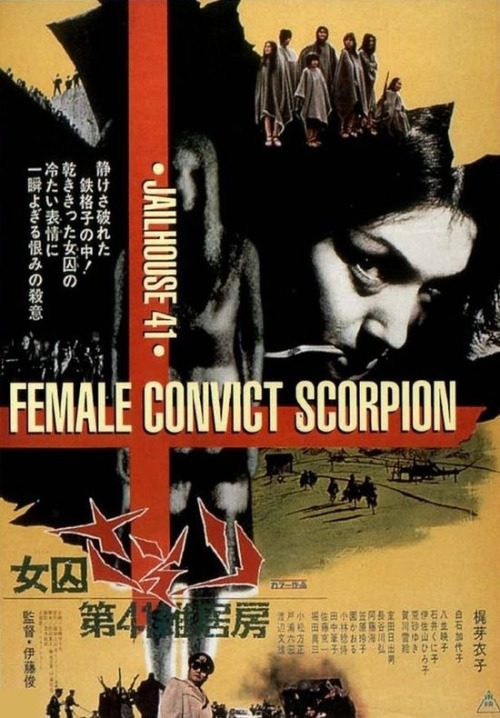
scorpion-2Female Prisoner Scorpion: Jailhouse 41 (女囚さそり第41雑居房, Joshu Sasori – Dai 41 Zakkyobo) picks up around a year after the end of Female Prisoner #701: Scorpion and finds Matsu (Meiko Kaji) tied up in a dingy prison basement, apparently left bound and in solitary confinement for the entire interval. Once again directed by Shunya Ito, the second instalment in the Female Prisoner Scorpion series is another foray into the women in prison field but Ito resolutely refuses to give in to the exploitative genre norms, overlaying his tale of individualistic rebellion with an arthouse sensibility that has a much wider scope than its ordinary vengeance driven narrative may suggest.

Matsu may have been lying bound and gagged in a dingy underground hole for the best part of a year but today is a special day and sadistic prison warden Goda (Fumio Watanabe) is going to let her out to be shown off in front of a visiting inspector who’s paying a final visit before Goda is promoted to a top job in Tokyo. When Matsu makes a lunge for Goda, the inspector is so afraid that he wets himself, sending the other woman into a frenzy and resulting in a riot. Once again the entirety of the prison is punished, but this time Matsu is singled out for a public punishment gang rape by Goda’s goons. This kind of humiliation is too much for her fellow prisoners who instantly turn on her, but their violence provides an opportunity for escape and before long Matsu is on the run, again.

At the end of the first film, Matsu had accomplished her first round of vengeance – against the man who orchestrated her downfall and the men who secured it, but ultimately she wound up a female prisoner once again. Though Goda may have had her hidden away because of her habitual escapism, Matsu had not given up as we see from her attempts to scrape the floor away with her spoon held tight in her mouth. Barely speaking, Matsu is an unstoppable column of pure rage but an elegant one, supported by her self contained restraint.

Her anger this time is directed towards Goda himself, especially after his despicable organised punishment rape that was designed both to break her own spirit once and for all and also to damage her in the eyes of her fellow inmates who are intended to see her defeated and destroyed. The guards are a stand in for society at large, using sexual dominance and social position to keep their women in line. The visiting prison inspector makes a point of telling Matsu that “they” don’t hate her personally – they’re there for her, to help her “recover” and become a functioning member of society. Which is ironic because Goda does hate her personally as he holds her responsible for the damage to his eye sustained in the previous film. His last act before moving on is one against Mastu – an attempt by the forces of authority to crush her individual rebellion and use their victory as a coercive tool to force others to conform.

In this way, Matsu’s position as a member of a subjugated class is less important than her status as an agitator but these are women who have each suffered at the hands of men. As an extremely theatrical sequence sung in the traditional form informs us, the women who escaped with Matsu committed their crimes out of love or jealousy. Poisoned rivals, dead lovers, even children murdered to get back at their philandering father in some Medea level psychotic rage which ruins the perpetrator even more than the intended victim.

Later while the women are enjoying their brief taste of freedom, one of them is brutally raped and murdered by a troupe of feral men who boast about the wartime atrocities they committed before descending on a lone woman like a pack of rabid dogs. The others take their revenge for their friend, but also for all the women who have met a similar fate inflicted by a male dominated society which sees them as something to be controlled and then made use of, little more that cattle hemmed in and milked until dry.

As in the first film Ito makes use of expressionist techniques and strange angles to give his film a more elevated feeling that might be expected but this time he adds in a surrealist, spiritual dimension as with the old woman who sings the stories of our heroines and then dies only to bury herself in leaves and disappear into the ether, like some forgotten deity of misused women. Likewise, when one of the prisoners is raped and murdered, the men throw her body into a nearby river like an empty beer can but the waterfall behind her suddenly runs with blood as an expression of the violence which pollutes the natural world. A bus suddenly splits in two, separating our subjugated women from the violent men who mentally sentence them, given free reign simply because of their sex. Ironically enough, our last glimpse of of Matsu takes place in the reflection of Goda’s glasses and then in his false eye when she is suddenly rejoined by her compatriots for a triumphant dance of freedom on a city rooftop.

Even stronger than in the original Female Prisoner #701 Scorpion, Jailhouse 41 further advances its ideology of free individuals battling the conformist authority of the state all filtered through the prism of the patriarchy. Matsu’s vengeance is personal, she keeps her distance from the other women who do not seem inclined to band together to oppose the forces which oppress them so much as seek a wary, temporary alliance of necessity, but seeing them all reassembled in spirit at the end brings a larger dimension to Matsu’s victory which now seems much less like solving a practical problem than a deliberate strike at a wall which was solely designed to keep a certain group of people in their place. The jail is broken, all that remains is to choose to escape its restraints.


Original trailer (English subtitles, NSFW/gore)