Tengu Priest (お坊主天狗, Yasushi Sasaki, 1962)

Disparate denizens of Edo are united in one thing in Yasushi Sasaki’s light hearted jidaigeki, Tengu Priest (お坊主天狗, Obozu tengu), revenge. Like many jidaigeki, what they really want is revenge against the evils of feudalism to which they have each fallen victim, but also acknowledge that they have found something better in being outside it in the solidarity that exists between them as outsiders free from the obligations of samurai society if also with loose ends waiting to be tied.

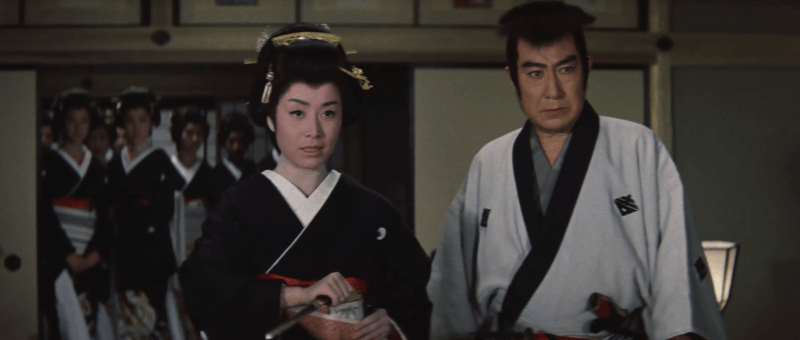
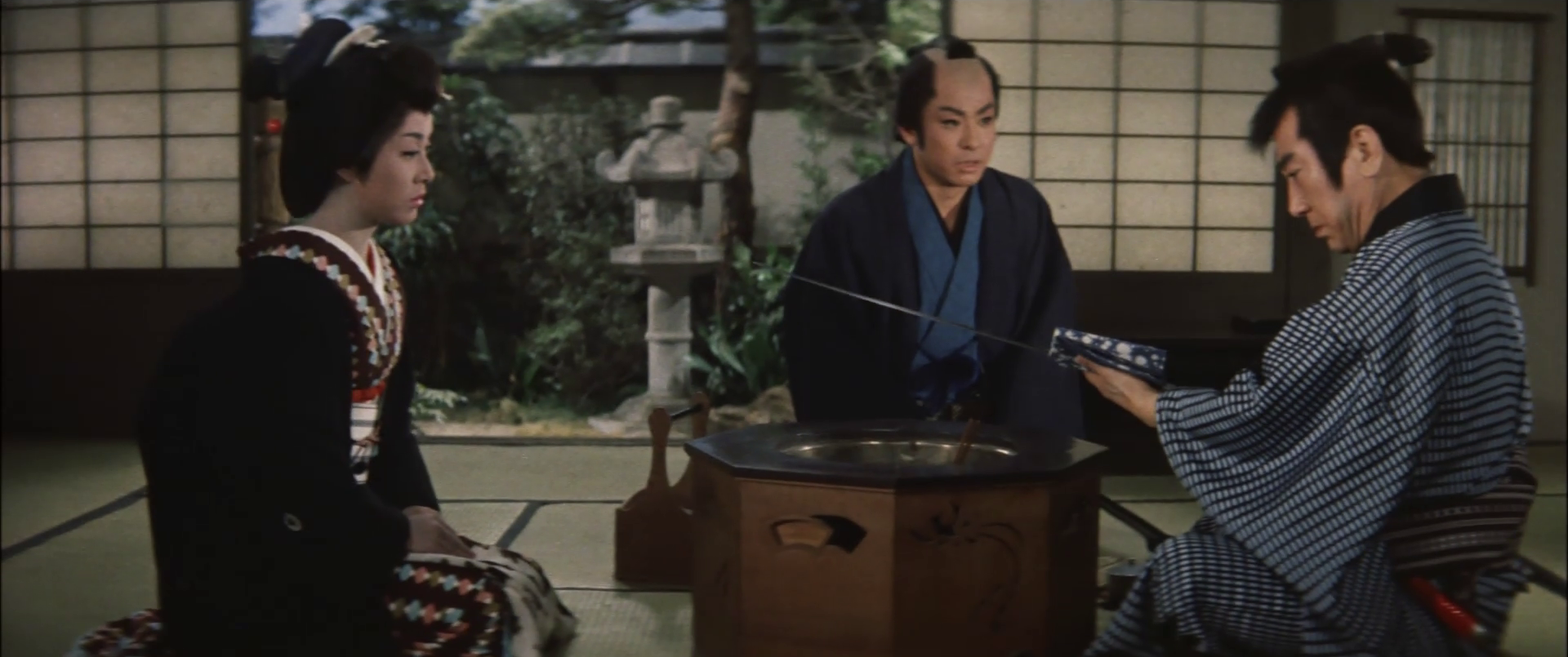
Once a hatamoto with a 1000 Koku stipend, Obo Kichiza (Chiezo Kataoka) is now a much feared figure keeping order in Edo. When some yakuza toughs are hassling the geisha Kozome (Hibari Misora) at the theatre, insisting that she serve them sake even as she reminds them she’s off the clock, one look from him stops them dead though Kichizo is also impressed with Kozome’s nerve. Like him, Kozome is also in Edo for revenge. Formerly a samurai’s daughter, she became a geisha to look for the man who killed her father in a stupid quarrel over a fencing duel. Kichiza, meanwhile, seeks revenge against the local lord, Honda Etsu (Masao Mishima), who killed his father in a fit of temper when he ordered him to commit seppuku for causing his son-in-law to fall off his horse but he refused. 

Loyal retainer Kinpei (Ryutaro Otomo) had begged for his forgiveness and insisted that he could get Etsu to reform but three years have passed and not only has he bribed his way to head office but his behaviour has declined still further. We see him cruelly cut down a maid seemingly for no reason, simply ordering his men to get rid of the body. Etsu has a reputation for random violence while drunk, but as he is the lord, there are no real consequences for him. His retainers cover up his crimes, and Kinpei’s sole attempt to talk some sense into him goes nowhere, meanwhile his chief adviser Shichinosuke (Sentaro Fushimi) is basically running the show telling others the lord is not in his right mind and cannot make decisions so he must make them for him.

They are all, including Etsu himself, victims of the feudal order in which the systems of power are necessarily corrupt. In his yakuza persona, Kichiza has struck up a friendship with another geisha, Kozuru (Naoko Kubo), who was actually a lady in waiting working as a maid at his estate. She has long been in love with him, but the class difference would have made any union impossible. Ironically, she remarks to Kozome that even in their present state they are still a Hatamoto and a lady in waiting so she dare not express her love for him. Only once his revenge is concluded and he’s fully abandoned his samurai status can Kichiza truly be free to embrace a relationship with Kozuru while conversely Kozome regains her life as a samurai’s daughter by avenging the death of her father.

Kozome asks for Kichiza’s help to track down the target of her revenge, but he also respects her wishes and understands that it’s something she must do herself as does eccentric sword sharpener Shinzaburo (Hashizo Okawa ) who actively stands back so she, another wronged woman, can stick the knife in. Hibari Misora’s role in the film is smaller than one might expect as her revenge subplot is secondary to Kichiza’s and she has relatively little screen time with only a brief musical sequence during a naginata dance though she does participate in the high octane final showdown in which all grievances are exorcised and a kind of order returned to the samurai realm even if it must be destroyed to so as Kinpei resolves to protect both the lives and livelihoods of their many retainers and the integrity of Kichiza, going so far as to congratulate Kozome on the successful completion of her revenge. 

Yet what made the whole thing possible was Kichiza’s own band of outlaw drifters whom he allowed to live in his home he later says just so that they would have a place to come and be together so that they might more easily reintegrate into mainstream society. He might have lost his domain and samurai status but has discovered something better in this accidental community. They may be in a sense almost like retainers to him, but if so they stay by choice rather than obligation and help out of a genuine sense of loyalty and affection. In essence, in taking his revenge, he frees himself from the oppressive nature of the samurai code and is able to live like an ordinary man lamenting that if only he and Kinpei had both been ronin they could have enjoyed their time together for longer. Lighthearted and cheerful despite its dark themes, the film is nevertheless a condemnation of the hypocrisies and abuses of a feudal society in which freedom is to be found only among those who live outside it.
Lady Sen and Hideyori (千姫と秀頼, Masahiro Makino, 1962)

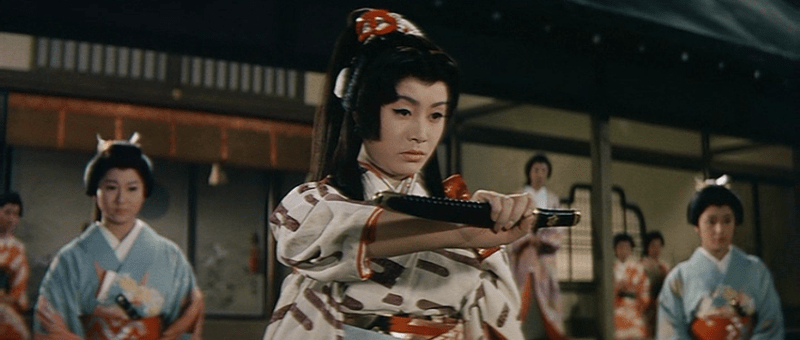
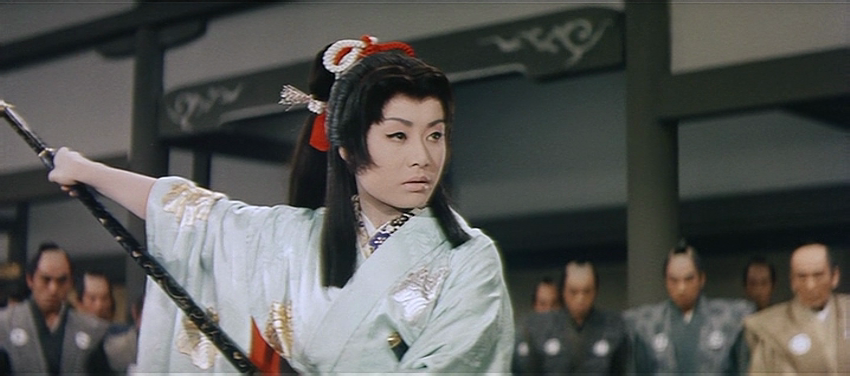
Son of cinema pioneer Shozo Makino, Masahiro Makino is most closely associated with the jidaigeki though he also had a reputation for highly entertaining, innovatively choreographed musicals some of which starred post-war marquee singing star Hibari Misora. The somewhat misleadingly titled Lady Sen and Hideyori (千姫と秀頼, Sen-hime to Hideyori), however, is pure historical melodrama playing fast and loose with the accepted narrative and acting as a star vehicle for Misora to showcase her acting talent in a rare dramatic role in which she neither sings nor engages in the feisty swordplay for which her otherwise generally lighthearted work at Toei was usually known. 

Lady Sen (Hibari Misora) is herself a well-known historical figure though Hideyori (Kinnosuke Nakamura) will not feature in the film beyond his presumed demise (his body was never found leading to various rumours that he had actually survived and gone into hiding) during the siege of Osaka in 1615. Born the granddaughter of Tokugawa Ieyasu (Eijiro Tono) who would later defeat the Toyotomi to bring Japan’s Warring States era to an end, Sen was sent to the Toyotomi as Hideyori’s future wife at seven years old (he was only four years older than she was and 21 at the presumed date of his death) and therefore perhaps far more Toyotomi that Tokugawa. In contrast to other portrayals of Sen’s life which centre on her understandable identity conflict and lack of agency in the fiercely patriarchal feudal society, Misora’s Lady Sen is clear in her loyalty to her husband whom she dearly loved and feels her father and grandfather who were directly responsible for his death are her natural enemies.  

Old Ieyasu and his son meanwhile do at least appear to care about Sen’s welfare, loudly crying out for a retainer to save her during their assault on the castle offering unrealistic rewards to any who manage a rescue. Unfortunately, however, having retrieved his granddaughter Ieyasu immediately marries her off to someone else demonstrating just how little control Sen has over her own destiny and how ridiculous it might be that she should have any loyalty to the family of her birth. His decision backfires on two levels, the first being that Dewa (Tetsunosuke Tsukigata), a lowly retainer responsible for Sen’s rescue from the falling castle, has taken a liking to her himself and fully expected to become her husband as a reward. While originally annoyed and hurt to think that perhaps she has rejected him because of the prominent facial scarring sustained while he was rescuing her, Dewa finally realises he just wants her to be happy only to be offended on realising that they’ve rerouted her bridal procession past his home which he takes as a personal slight. Nevertheless, in contrast with real life (Sen’s marriage to Honda Tadatoki was apparently amicable and produced two children though only one survived to adulthood) Sen’s relationship with her new husband is not a success, in part because she resents being used as a dynastic tool and in part because she remains loyal to Hideyori. In consequence, she makes full use of her only tool of resistance in refusing to consummate the marriage with the result that her new husband, Heihachi (Kantaro Suga), slowly drinks himself to death. 

Her other act of rebellion is however darker, striking down an old man who made the mistake of telling her with pride how he informed on retreating Toyotomi soldiers after the siege. Determining to become an “evil woman” she deliberately blackens the Tokugawa name by killing random commoners, chastened when confronted by a grieving widow but banking on the fact her relatives will not move against her and will therefore gradually lose public sympathy for failing to enforce the law against one of their own. The spell is only broken by the arrival of a former Toyotomi retainer (played by Misora’s frequent co-star in her contemporary films Ken Takakura) who reminds her of her loyalty to her husband’s legacy and prompts her retreat into religious life as a Buddhist nun mirroring the real Lady Sen who entered a convent after her second husband died of tuberculosis. Like most of Misora’s film’s Lady Sen ends with a softening, a rebuke to her transgressive femininity which in this case has admittedly turned worryingly dark her murder spree apparently a form of resistance to the entrenched patriarchy of the world around her and most particularly to her continued misuse at the hands of her father and grandfather. Despite the absence of large-scale musical numbers, Makino makes space for a fair few dance sequences along with festival parades and well-populated battle scenes but makes sure to place Misora centre stage as if countering the continual marginalisation of Lady Sen and all the women of feudal Japan. 


Clip (English subtitles)

Feisty Edo Girl Nakanori-san (ひばり民謡の旅シリーズ べらんめえ中乗りさん, Masamitsu Igayama, 1961)

Nakanori-san posterThe voice of the post-war era, Hibari Misora also had a long and phenomenally popular run as a tentpole movie star which began at the very beginning of her career and eventually totalled 166 films. Working mostly (though not exclusively) at Toei, she starred in a series of contemporary and period comedies all of which afforded her at least a small opportunity to showcase her musical talents. Directed by Masamitsu Igayama, Feisty Edo Girl Nakanori-san (ひばり民謡の旅シリーズ べらんめえ中乗りさん, Hibari Minyo no Tabi: Beranme Nakanori-san, AKA Travelsongs: Sharp-Tongued Acquaintance) once again stars Hibari Misora as a strong-willed, independent post-war woman who stands up to corruption and looks after the little guy while falling in love with regular co-star Ken Takakura. 

Nobuko (Hibari Misora) is the daughter of a formerly successful lumber merchant whose business is being threatened by an unscrupulous competitor. With her father ill in bed, Nobuko has taken over the family firm but is dismayed to find that a contract she assumed signed has been reneged on by a corrupt underling at a construction company who has been bribed by the thuggish Tajikyo (Takashi Kanda). Unlike Nobuko’s father Sado (Isao Yamagata), Tajikyo is unafraid to embrace the new, completely amoral business landscape of the post-war world and will do whatever it takes to become top dog in the small lumber-centric world of Kibo.

Tajikyo has teamed up with the similarly minded, though nowhere near as unscrupulous, Oka (Yoshi Kato) whose son Kenichi (Ken Takakura) has recently returned from America. Kenichi, having come back to Japan with with clear ideas about the importance of fair practice in business, is not happy with his father’s capitulation to Tajikyo’s bullying. Of course, it also helps that he had a charming meet cute with the spiky Nobuko and became instantly smitten so he is unlikely to be in favour of anything which damages her father’s business even if they are technically competitors.

As in the majority of her films, Misora plays the “feisty” girl of the title, a no nonsense sort of woman thoroughly fed up with the misogynistic micro aggressions she often encounters when trying to participate fully in the running of her family business. Though her father seems happy enough, even if casually reminding her that aspects of the job are more difficult for women – particularly the ones which involve literal heavy lifting and being alone with a large number of men in the middle of a forest, he too remarks on her seeming masculinity in joking that her mother made a mistake in giving birth to her as a girl. Likewise, Tajikyo’s ridiculous plan to have Nobuko marry his idiot son is laughed off not only because Tajikyo is their enemy, but because most people seem to think that Nobuko’s feistiness makes her unsuitable for marriage – something she later puts to Kenichi as their courtship begins to become more serious. Kenichi, of course, is attracted to her precisely because of these qualities even if she eventually stops to wonder if she might need to become more “feminine” in order to become his wife.

To this extent, Feisty Edo Girl is the story of its heroine’s gradual softening as she finally writes home to her father that she is happy to have been born a girl while fantasising about weddings and dreaming of Kenichi’s handsome face. Meanwhile, she also attracts the attentions of an improbable motorcycle champion who just happens to also be the son of a logging family and therefore also able to help in the grand finale even if he never becomes a credible love rival despite Nobuko’s frequent admiration for his fiery, rebellious character which more than matches her own.

Nevertheless, the central concern (aside from the romance) is a preoccupation with corruption in the wartime generation. Where Nobuko’s father Sado is “old fashioned” in that he wants to do business legitimately while keeping local traditions alive, the Tajikyos of the world are content to wield his scruples against him, destroying his business through underhanded methods running from staff poaching to bribery and violence. Kenichi’s father has gone along with Tajikoyo’s plans out of greed and weakness, irritated by his son’s moral purity on one level but also mildly horrified by what he might have gotten himself into by not standing up to Tajikyo in the beginning.

As expected, Nobuko and Kenichi eventually triumph through nothing more than a fierce determination to treat others with respect. Working together cheerfully achieves results, while the corrupt forces of Tajikyo eventually find themselves blocked by those who either cannot be bought or find the strength to refuse to be. Nobuko’s big job is finding prime lumber to be used to build a traditional pagoda in America as part of a cultural celebration. She wants to do her best not only because she takes pride in her work but because she knows this project will represent Japan overseas. Tajikyo, however, would cut corners, believing that the Americans wouldn’t notice even if he sent them rotten logs riddled with woodworm as long as the paperwork tallies. Filled with music and song, Nakanori-san is an action packed outing for Misora in which she once again succeeds in setting the world to rights while falling in love with a likeminded soul as they prepare to sail off into kinder post-war future.


Some of Hibari’s songs from the film (no subtitles):

https://www.youtube.com/watch?v=gCeE4lCTpW4