My Favorite Season (最想念的季節, Chen Kun-Hou, 1985)

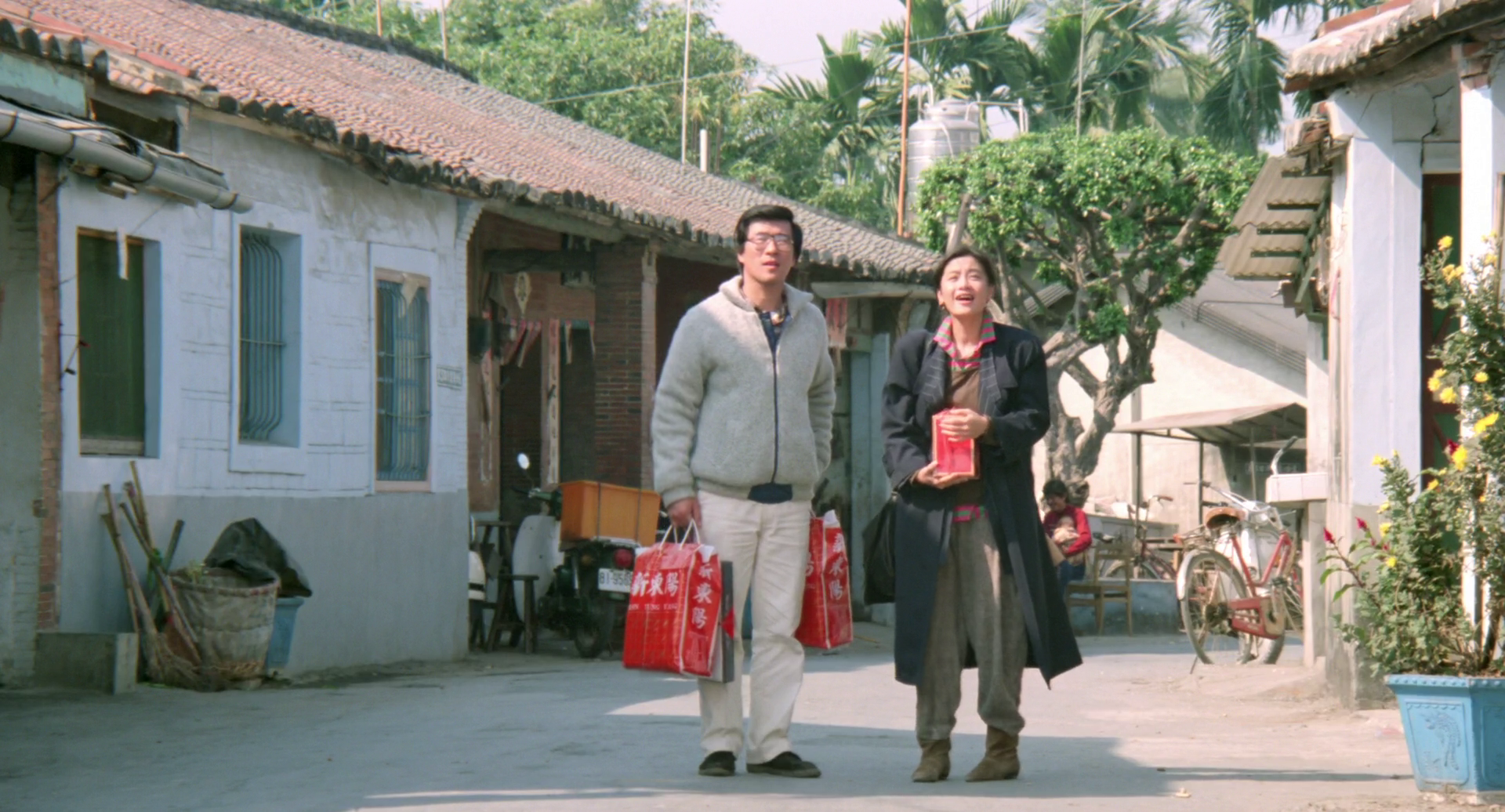
After becoming pregnant by her married lover, an otherwise independent young woman decides she must find a husband so that her baby will be legitimised but plans to divorce him a year later in Chen Kun-Hou’s charming Taipei-set rom-com, My Favourite Season (最想念的季節, zuì xiǎngniàn de jìjié). These contradictions perhaps express those at the centre of a changing society as the heroine temporarily shackles herself to a weak-willed man but finds herself both bonding with him and resentful of his attempts to control her, while the relationship itself continually straddles an awkward line.

Pao-liang (Jonathan Lee Chung-shan) is a somewhat nerdy guy who runs a print shop and has become a guardian to his niece because his sister and her husband are struggling artists. Incredibly superstitious, he insists he won’t get married before the age of 30 because it would be bad luck, but is roped into Hsiang-mei’s (Sylvia Chang Ai-chia) scheme by a friend who turned her down. Pao-liang tries to turn her down too, but is also struck by her beauty, his own improbable luck, and a possibly genuine emotional connection the pair may share even though they are in other ways opposites. 

Hsiang-mei works as a journalist for a fashion magazine and has more sophisticated tastes as well as a looser connection to money than the penny-pinching Pao-liang who, as the saying goes, knows the cost of everything but the value of nothing. He doesn’t like it when Hsiang-mei spends her own money on things she wants and insists on keeping a running tally of mutual expenses. When his sister asks him for a loan to tide her over, he immediately refuses despite having a large amount in his bank account, partly because he’s mean with money and partly because he’s essentially selfish. Hsiang-mei gives it to her instead, which annoys Pao-liang on several levels because he realises it’s made him look bad while he is now further indebted to Hsiang-mei. 

She, meanwhile, is from a small town and came to Taipei for a better life. The only girl in her family, Hsiao-mei strives for independence and ironically wanted a husband to secure it so she could have her baby and raise it on her own. As her brother says, “she does what she wants,” but seemingly hadn’t really thought through her plan assuming it would all go smoothly and she and Pao-liang could essentially hang out for a year and then bring the arrangement to an end. She picks Pao-liang partly because they do seem to get on, and possibly because she thought he’d be easy to manage, but is lucky in her choice of man that he presents little danger to her.

He is, however, petty and patriarchal in his mindset. He’s both attracted to Hsiang-mei and resentful of her strong will and independence while also small-minded and incapable of direct communication. It’s obvious that he wants this arrangement to continue, but often acts in ways that endanger it and lashes out at Hsiang-mei rather than explaining how he feels. When Hsiang-mei returns upset having met up with her married lover, Pao-liang shouts at her and accuses her of embarrassing him by sleeping with another man. He does something similar when she encounters unexpected tragedy, blaming and berating her in place of offering comfort even if his cruelty is motivated by frustrated affection. 

But Hsiang-mei is in some ways the same. She doesn’t really say what she wants either or acknowledge that she has grown fond of Pao-liang and his niece. She’s fiercely independent, but felt she still needed to have a husband to have a baby after having an affair with a man who was already married so was to her the ideal boyfriend because he wouldn’t tie her down. She buys a lamp for Pao-liang’s place because lamps make a place a home, but Pao-liang doesn’t want it or approve of the expense while simultaneously insisting on paying for half of it because it’s for a “communal” area. He’s still intent on keeping score and isn’t ready to accept that he and Hsiang-mei live in the house together so everything belongs to them “communally” as a couple. On a baseline level, he won’t cede his space to her nor acknowledge that she still has the upper-hand in this relationship even as the pair inevitably draw closer. Chen’s vision of 80s Taipei is warm and sophisticated as Pao-liang spends his time dancing with the old ladies in the park and loses his keys at opportune moments or drives his car into a ditch but even despite his pettiness and ineffectuality, can still find love and the courage to chase it if somewhat passive aggressively.


My Favorite Season screened as part of the BFI’s Myriad Voices: Reframing Taiwan New Cinema.

Trailer (Traditional Chinese / English subtitles)
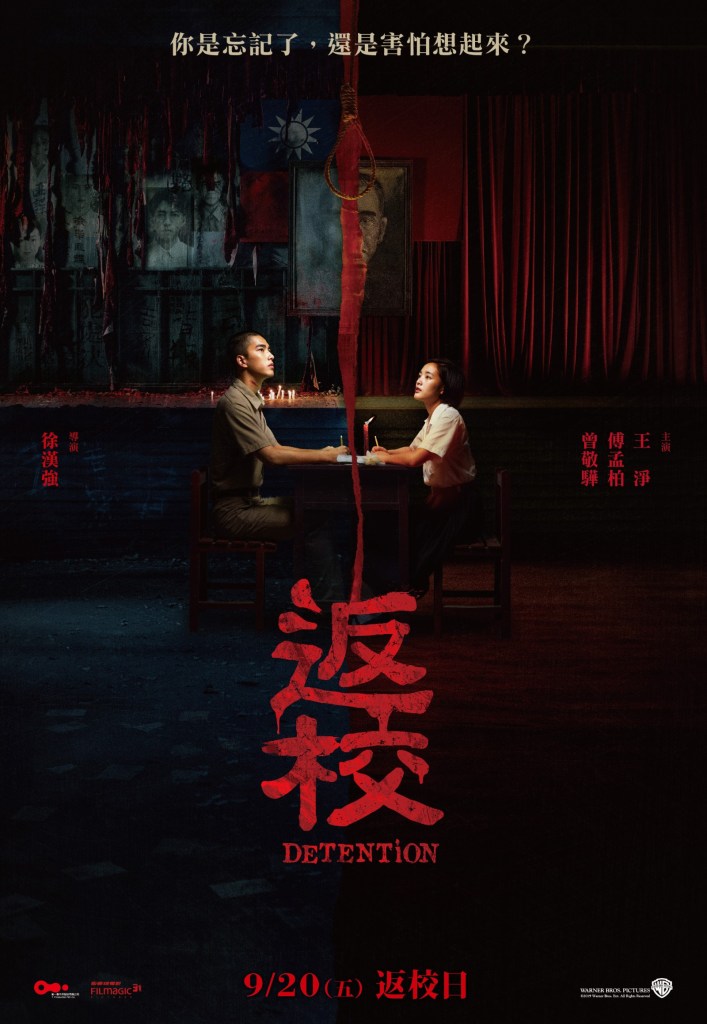
Detention (返校, John Hsu, 2019)

“Have you forgotten or are you scared of remembering?” a mysterious supernatural force seems to ask the heroine of John Hsu’s ironically named Detention (返校, Fǎn Xiào). In fact, the Chinese title means something close to “back to school”, hinting at its central message which uses the, it argues forgotten, tyranny of the “White Terror” to remind us that freedom is hard to win but harder still to keep. An unfortunately timely message given the assaults on democracy across the world but even more so given the recent protests in Hong Kong which have found support in Taiwan as it too looks back on its complicated history.

Based on a popular survival horror video game, Detention’s first hero is idealistic student Wei Zhong-ting (Tseng Ching-hua) who we quickly learn was picked up and tortured by the military police for reading books banned by the regime as part of an underground club run by two of his teachers – mild-mannered artist Zhang (Fu Meng-po) and stern musician Yin (Cecilia Choi Sze-wan). Set in 1962, the film finds itself at the height of the “White Terror”, a period of martial law which lasted for 38 years, during which any resistance real or perceived towards Chiang Kai-shek’s Kuomintang government was brutally suppressed with thousands tortured, imprisoned, or killed by the regime.

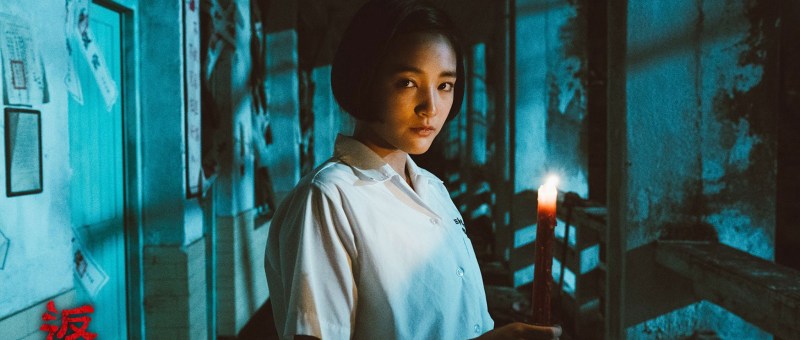
Wei finds himself in a lucid nightmare, trapped in his school building which has become derelict and seemingly abandoned while cut off by a raging flood. Gradually he starts to piece together memories of what must have happened, realising that his fellow club members seem to be absent and something must have happened with the military police. While in the school he runs into a fellow classmate, Fang Ray-shin (Gingle Wang Ching), though she doesn’t quite seem to remember him. Having apparently fallen asleep and woken up in this nightmare world, Fang seems even less clear about what’s going on than Wei but desperately wants to find their teacher, Zhang, with whom, we learn, she has fallen in love. 

Plagued by horrifying visions that maybe repressed memories or simple nightmares, the pair are chased by giant monsters dressed in KMT uniforms standing in for the terror of living under an authoritarian regime. Only, these particular nightmare soldiers are literally “faceless” in that their hollowed out skulls, which themselves sit on fetid, rotting corpses, are filled only by a mirror making plain that the faces of the “faceless” regime are our own. Fang and Wei become convinced that someone has betrayed them by giving one of the illicit books to arch militarist teacher Inspector Bai, but they can’t be sure who it was, finally doubting even themselves in their inability to remember the exact circumstances which brought them here. 

Flashing back to the “real” world, we discover that one sort of oppression cannot help but lead to others. Fang’s father is a respected soldier and supporter of the ruling regime, but he’s also abusive towards his wife, enforcing a rule of fear and violence even within his own home. Her mother has taken to religion in order resist him, regretting her marriage and furiously praying that he will soon be “gone for good”. “Gone for good” becomes a kind of mantra for others straining to free themselves from obstacles to their desires. Fang learns all the wrong lessons from her parents, allowing herself to be corrupted by their twin failures – her father’s in being a willing participant in the oppression of others, and her mother’s in subverting the world in which she lives in an attempt to free herself from violence. 

Yet, as Zhang later tells her, no one is really at fault because they are all victims of the oppressive rule of the KMT. The ruined schoolhouse becomes a kind of repository for the orphaned memories of a forgotten past. You can tear it down and build a fancy apartment complex over the top, but the ghost of authoritarianism is always lurking on the horizon, and capitalist success will not safeguard your freedom. Those left behind have to tell the story so  this never happens again because those who fail to learn from history are doomed to repeat it. Zhang imagined himself a narcissus, living in his own world without caring what other people thought and claiming that the solidarity of silent understanding is the best cure for loneliness, but he lived in times in which he had no freedom in which to live, sacrificing his own future to become the selfless roots of emancipation blooming only for those who will come later.


Detention screens in Amsterdam on March 5/7 as part of this year’s CinemAsia Film Festival. It will also screen in Chicago on March 26th as part of the 10th Season of Asian Pop-Up Cinema.

Original trailer (English subtitles)

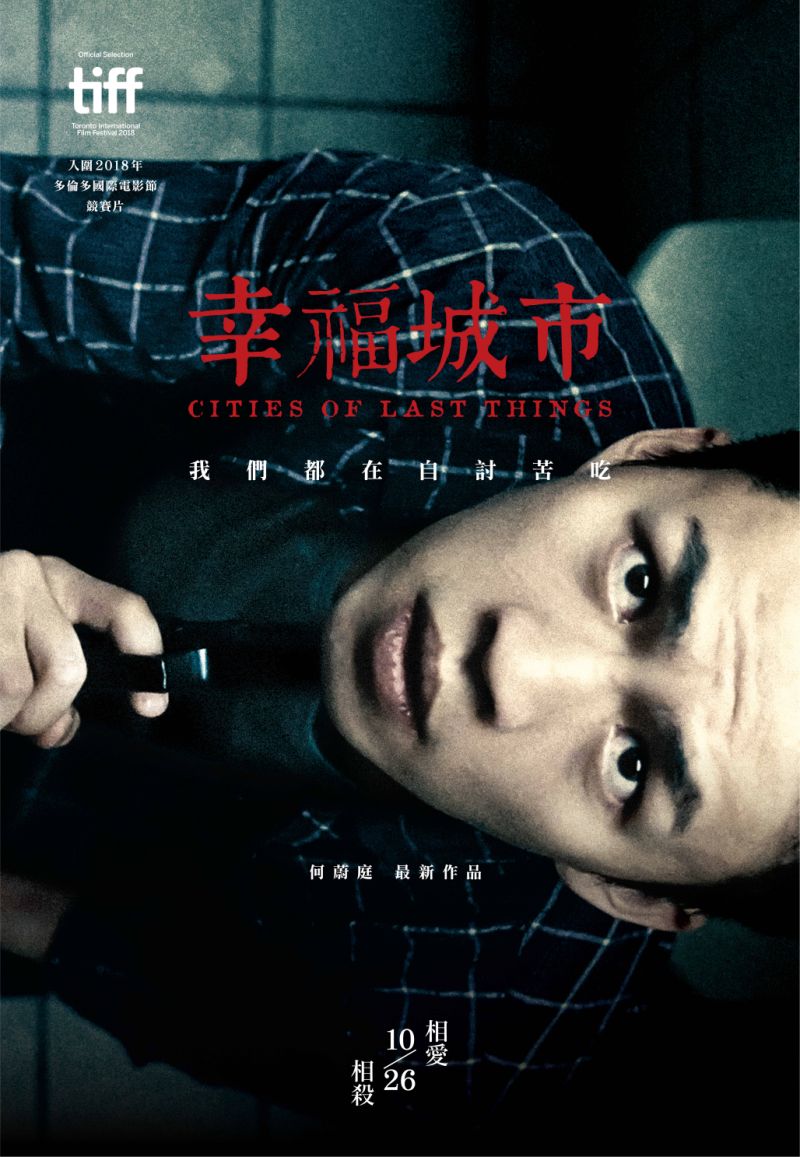
Cities of Last Things (幸福城市, Ho Wi Ding, 2018)

Cities of last things poster 1A sense of finality defines the appropriately titled Cities of Last Things (幸福城市, Xìngfú Chéngshì), even as it works itself backwards from the darkness towards the light. Still more ironic, the Chinese title hints at “Happiness City” (neatly subverting Hou Hsiao-hsien’s “City of Sadness”) but that, it seems, is somewhere its hero has never quite felt himself to be. Embittered by a series of abandonments, betrayals, and impossibilities, he grows resentful of the brave new world in which old age has marooned him. 

Ho opens with a bouncy, retro track advising that one should never be too generous with love only for a body to suddenly rain down from above. As we later discover, the body belongs to 60-something former policeman Dong-ling (Jack Kao) who has grown disillusioned with his futuristic, digital world, stubbornly smoking cigarettes and growing old gracefully while surrounded by vapers and ads for rejuvenating drugs. For reasons we don’t yet understand, he ventures into the red light district to buy a gun, punches his wife’s dance partner, and visits a hard-nosed sex worker who reminds him of a woman he loved and lost thirty years previously.

Love, guns, death and revenge become persistent themes for the older Dong-ling whose only bright spot seems to be a grownup daughter preparing to move abroad with her foreign boyfriend. Thirty years previously Dong-ling (Lee Hong-chi) too dreamed of running overseas. Consumed with rage on discovering his wife’s infidelity, he imagines himself killing her, her lover, and himself but settles only for a petty revenge against a colleague which exposes the entrenched police corruption he had refused to participate in, alienating his fellow officers. Bonding with a French kleptomaniac (Louise Grinberg) on the run from some kind of unresolved conflict with her father, he sees a way out only to have the door cruelly closed on him just as it was so many years before when he was just a teenager picked up for trying to steal a scooter.

In true film noir style, all women are perhaps one woman. Abruptly shifting tone in venturing into the recent past, we are introduced to Big Sister Wang (Ding Ning) – an embittered, disappointed femme fatale running out of road, hemmed in by the choices she has already made. She may already know there’s no way out for her, little needing the policeman’s warning that after her arrest everyone in gangland will assume she talked when they let her go, but she refuses to give in, repeatedly insisting on cigarettes and asserting her dominance while the unsympathetic policemen get on with their grim business.

Cornered, Ara, the shoplifting free spirit, decides to interrogate her interrogator, calling back to the later version of herself in asking why it is that prostitution is illegal. The policeman has no answer for her, save that he does not make the rules only follow them. Dong-ling too wanted to be a force of order, perhaps taking Big Sister Wang’s impassioned pleas to be a good person and not end up like her a little too much to heart. He follows the rules too closely for the comfort of his colleagues but finds himself dangerously exposed by an inability to regulate his feelings, a victim of toxic masculinity humiliated by his wife’s betrayal but unable to stand up to the corrupt superior who so casually closes down the only escape route he has been able to find.

The older Dong-ling is horrified by his daughter’s revelation that she lasered away a birthmark. How else can you recognise someone you lost long ago in the great wide world other than by a mark placed on them when they were born? His daughter rolls her eyes and reminds him that these days everyone is chipped, but there may be something in his rationale that everyone is marked at birth. Dong-ling is surrounded by handcuffs, self-driving vehicles, and locked doors. His fate is sealed, as we know, because we saw him fall, yet like Big Sister Wang he fought back only his resistance was violent and vengeful, abhorrent in its enraged pettiness. His is a tale of fatalistic resentment and of an existence consumed by a sense of hopeless abandonment, coloured only by a longing for lost love. Ho’s decision to end the film with its happiest moment, bright sunshine in place of rain soaked night, is ironic in the extreme but returns us to the grim serenity of the opening as the cheerful retro strains re-echo and Dong-ling catapults himself into a life of misery in the cities of last things where all hope is futile and all love loss. 


Screened as part of the 2019 London East Asia Film Festival, Cities of Last Things is also available to stream online via Netflix.

TIFF trailer (English subtitles)

Liu Wen-cheng – Don’t Be Too Generous About Love