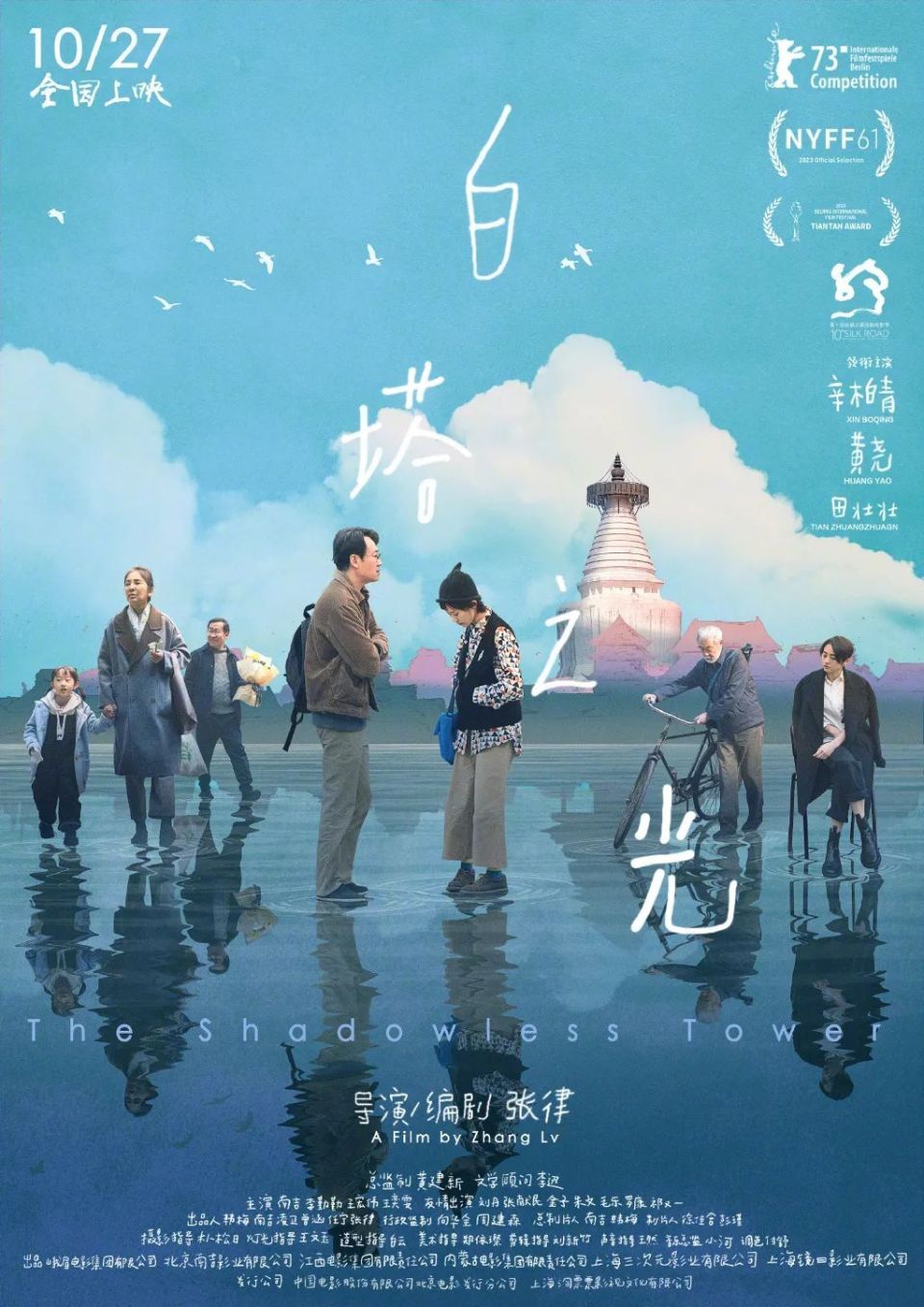
The Shadowless Tower (白塔之光, Zhang Lu, 2023)

A tale of middle-aged loneliness and regret, Zhang Lu’s Shadowless Tower (白塔之光, Bái Tǎ zhī Guāng) takes its name from a white pagoda in the centre of Beijing that is said to cast no shadow. Or at least, as the hero later suggests, its shadow may be far away in its old home town of Tibet. Most Zhang’s protagonists are somewhat displaced most particularly spiritually and existentially, cut adrift by corrupted paternity while uncertain how to progress towards the future. 

For Gu (Xin Baiqing), a former poet now a melancholy restaurant critic and divorcee with a small daughter, the problem is he’s beginning to feel more and more like the father he hasn’t seen since he was five when his mother kicked him out of the house after he was accused of groping a woman on a bus. In a meta-textual touch, Gu’s kite-flying father Yunlai is played by film director Tian Zhuangzhuang who once made a film called The Blue Kite that is also about failed fatherhood and was banned by the authorities on its release. In any case, Gu is only a part-time father to his little girl, Smiley (Wang Yiwen), who is living with his sister and her husband who has been secretly in touch with Yunlai and aware that he rides hundreds of miles by bicycle twice a year visit Beijing on the kids’ birthdays though he cannot meet them.

In many ways, it might seem to be the father, or at least the image of one, that is the shadowless tower that hangs over Gu’s life. He fantasies about interrogating him over the bus incident, wondering if what his mother did was right or if they unfairly rejected a good man because of a misunderstanding. His mother’s anger was apparently partly because Yunlai would not compromise and confess to the crime to get a lighter sentence, instead being sent to a labour camp which left her financially responsible for the children on her own. Gu’s sister Wenhai (Li Qinqin) reflects that if he had not been such a good father to begin with she could have forgiven him, but because he was his disgrace caused her to lose faith in the world. 

Gu seems not to have much faith in the world either, remarking that he separated from his wife owing to an excess of politeness, the same politeness that keeps him aloof from his surroundings and prevents him from making meaningful connections. Yet for all that, he embodies a kind of fatherhood, sitting down on the bed of his lodger and gently placing a hand on his back on hearing his crying through the wall. The young man later embraces him as a son to a father, while Gu finds himself dancing a melancholy waltz with Yunlai who is also an image of his future self. 

But even as a lifelong Beijinger, Gu remains rootless. Meeting up with old friends, all of whom might have been young in the late ‘80s, they drink and sing the song composed for the 2008 Olympics as if they were looking for a father in the city. Gu also reads from Bei Dao’s My Beijing which similarly rests on a sense of exile even while present. The only woman in the group laments that she never married and meditates on the ghost of lost love, while the only one of them who fled abroad eventually takes his own life in a foreign land.

Jolting him out of his inertia, Gu encounters free spirited photographer Wenhai (Huang Ya) who shares his sister’s name though she is also similarly displaced and struggling with a more literal orphanhood that leaves her caught between the North East and the Cantonese-speaking south where she was adopted. A gentle love story arises between them, Wenhai cutting through the wall of Gu’s politeness with refreshing frankness but also with troubles of her own and a worrying tendency to refer to him as her father which nevertheless has a kind of circularity to it. 

Crouching down by the pagoda, they can’t see their shadows either and wonder where they are. Then again, perhaps it’s not so much that tower casts no shadow, but the shadow it casts is so vast that covers everything below just as Gu’s searching for his father overshadows his life even as he is also searching for himself. Intensely moving, Zhang’s poetic drama waxes on middle-aged rootlessness but also the interconnectedness of all things, from kites to earthworms and the great dance of life in all its inescapable loneliness. 


The Shadowless Tower screened as part of this year’s London East Asia Film Festival.

Original trailer (Simplified Chinese / English subtitles)

The Crossing (过春天, Bai Xue, 2018)

The Crossing posterReally, when it comes right down to it, a border is not much more than an imaginary line drawn across a piece of paper intended to bring order to a formless world. People have fought and died over the positioning of such lines for centuries, but then when all is said and done the boundaries which matter most are the internal ones and everybody has their lines they will not cross. An internal war over the nature of that line is very much at the centre of Bai Xue’s melancholy coming of age drama The Crossing (过春天, Guò Chūntiānin which a young girl living a life on top of borders geographical, emotional, and legal, begins to discover herself only through transgression.

It’s Peipei’s (Huang Yao) 16th birthday, but the most important fact about that for her is that she is now of legal working age and can get a part-time job. Peipei’s parents split up some time ago and now she lives with her flighty mother (Ni Hongjie) in Shenzhen while attending a posh high school in Hong Kong where she doesn’t quite fit in considering her comparatively humble background. This is brought home to her by her insensitive best friend Jo (Carmen Soup) who wants the pair to go on holiday together to Japan at Christmas while full-well knowing that there is no way Peipei can get the money together in time. Desperate to go, Peipei has been selling cellphone cases at school and now has her part-time job but it’s all very slow going. When Jo convinces her to bunk off and party with a bunch of ne’er-do-wells she ends up getting herself involved in a cellphone smuggling operation thanks to Jo’s no good boyfriend Hao (Sunny Sun). 

Peipei’s problem is the time old one of falling in with the wrong crowd, but then we most often catch her alone and it’s a lonely figure she cuts through the busy streets of her bifurcated world. Young but tough and angry, Peipei thinks she knows what she’s doing but is caught on the difficult dividing line between adolescence and adulthood and her attempts to claim her independence are filled with determined naivety. Resentful of her mother’s seeming indifference and parade of useless boyfriends, she wants to grow up as soon as possible but it’s not so much the daring and adventure that draws her into the orbit of Sister Hua’s (Elena Kong may-yee) gang of thieves as the camaraderie. Peipei likes being part of a “family”, she likes the maternal attentions of the spiky Sister Hua, and she likes being valuable even if on some level she realises that her usefulness will fade and that her growing loyalty to the gang is largely one sided.

“The big fish eat the little fish. Never trust men” Sister Hua later advises her, and it is indeed good advice if offered a little too late. Peipei knows she’s a little a fish, which is perhaps why she sympathises so strongly with the miniature shark trapped in a tank at the palatial mansion owned by Jo’s absentee aunt. Nevertheless, she tries to swim free only to find herself sinking ever deeper into a murky underworld she is ill-equipped to understand. Her first anxious crossing with a handful of iPhones in her backpack is a fraught affair, but carrying it off without a hitch an oddly empowering experience. Even so, when Sister Hua considers swapping the phones for a gun Peipei hesitates. In essence it’s the same – perhaps it doesn’t really matter what the cargo is, and Sister Hua’s “love” is indeed dependent on a job well done, but the stakes here are sky high. It’s not such a fun game anymore, as Peipei realises spotting a badly wounded gang member hovering outside having apparently received punishment for some kind of transgression.

Meanwhile she finds herself in another kind of interstitial space altogether when caught between best friend Jo and bad boy Hao. Jo, spoilt and self-centred, assumes her family will send her abroad to study and is later shocked by the realisation that her sexist dad thinks she’s not worth it, expects her to marry young in Hong Kong, and intends to invest all the money in her brother instead. Jo didn’t care much for Hao before and even jokingly offered to bequeath him to Peipei when she left, but now all her dreams are crumbling and she suspects he’s losing interest it’s a different story. Playing with fire, Peipei finds herself drawn to Hao who becomes something between white knight and big brother figure in the confusing world of crime until his protective instincts begin to bubble into something else. The pair bicker flirtatiously but also shift into a shared space born of their mutual dissatisfaction and desire to gain access to the Hong Kong inhabited by the likes of Jo whose vast wealth has left her blind to her own privilege.

Peipei crosses lines with giddy excitement, but only through burning her bridges does she begin to discover her own identity caught as she is between Hong Kong and China, between rich and poor, between the going somewheres and not, and between innocence and experience as her exciting adventure in the world of crime eventually blows up in her face. A rather strange title card informing us that efforts to limit smuggling at the border have been redoubled (seemingly ripped right out of the Mainland censor’s notebook) finally gives way to something calmer and more meditative as Peipei awakens to a new understanding of herself and the world in which she lives, looking out instead of up and ahead rather than behind as she resolves to keep moving forward as if there were no more lines to be crossed.


Currently on limited release in UK cinemas.

International trailer (English subtitles)