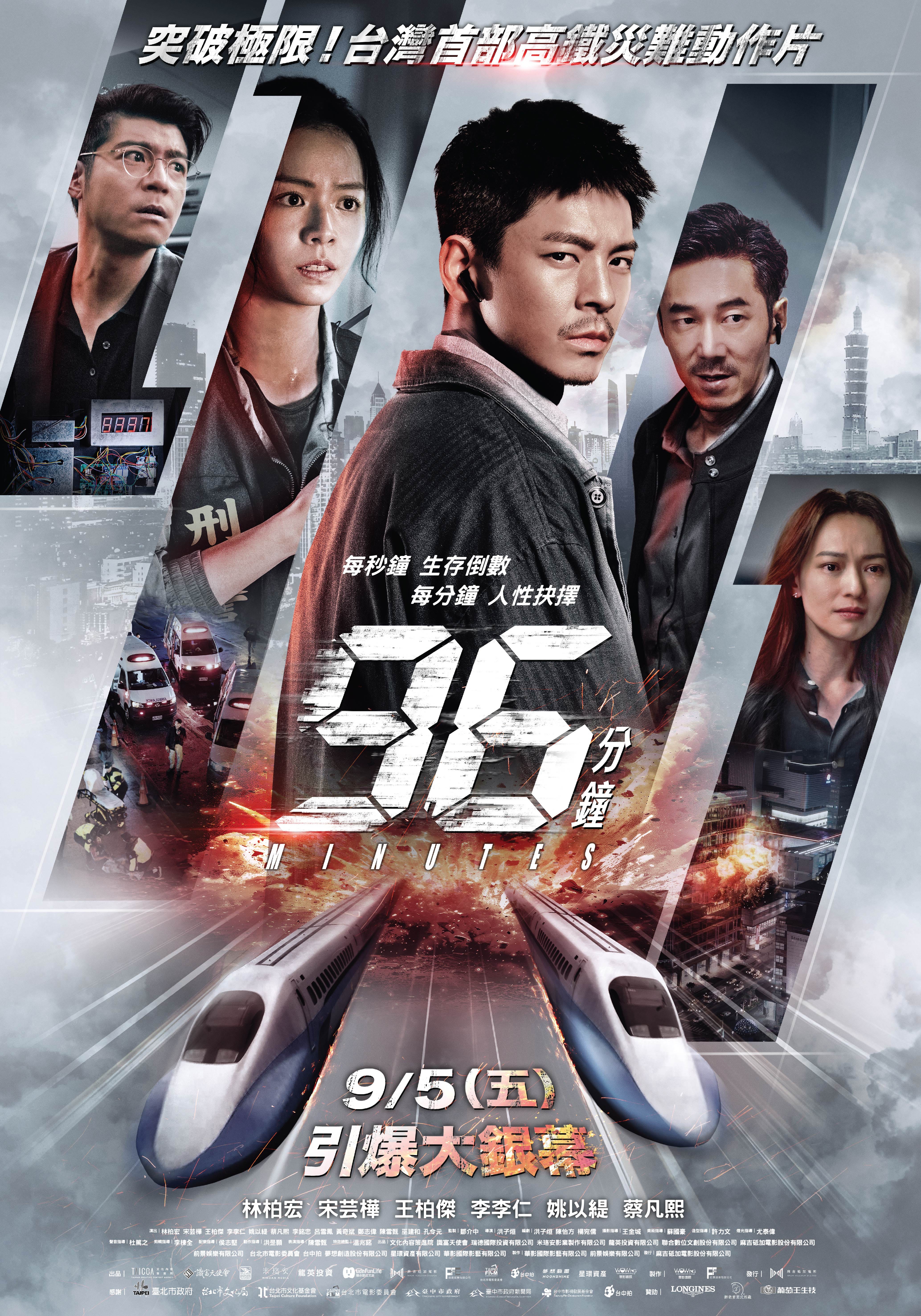
96 Minutes (96分鐘, Hung Tzu-Hsuan, 2025)

The needs of the many outweigh the needs of the few, as the famous goes. Prioritising saving lives where you can rather than risk spreading yourself too thin and not helping anyone as a result may be a sensible decision. But what if you or a loved are among those who’ve been deprioritised? Like many things, now it’s not just theory but here right in front of you and victims are real people not just anonymous numbers, it looks quite different.

At least, that’s how it is for A-Ren (Austin Lin), a brash bomb disposal expert. Though he disarmed a bomb in a cinema, another one went off across the road in a department store. The bomber had warned them that might happen, but A-Ren’s commanding officer Liu (Wang Bo-Chieh) convinced him they were probably bluffing. They were told there were two more bombs, one located in their command centre, and the other in the department store, and given a choice. Save the people in the department store by heroically blowing themselves up, or choose to save themselves even though this time they’re in the minority. 

Three years later, A-Ren has never forgiven himself, or Liu, for the bomb going off. He’s quit the police and though he’s married fellow officer Huang Xin (Vivian Sung), they never had a wedding and still haven’t been on honeymoon. His guilt is compounded by the fact that he’s been feted as a hero even though he knows he’s directly responsible for everyone who died in the department store. He gets a shot at redemption when the train he’s travelling on returning home after a memorial service for victims of the bombing receives a bomb threat, but at the same time he fears the eventual exposure of what really happened three years ago and is too ashamed to get his mind fully on the job.

On the other hand, it’s true that, ironically, no one on the train has been able to move on from the incident. All of them are mired in their grief and confusion, while looking for someone to blame. Needing to solve the case quickly, the police named a random victim with a criminal past as the bomber rather than admit they didn’t know who did it, making the police themselves a legitimate target for the resentment of the victims’ families given their cavalier attitude to life and death. Liu reminded A-Ren that the policemen in the command centre had families too, as if the people in the department store didn’t or that having a family made their lives weigh more, while Huang Xin was there too further influencing their decision and feeding into A-Ren’s guilt wondering if he was just selfish and made a choice to save her at the expense of the lives of a large number of people he didn’t know.

The bomber essentially gives him the same choice again, putting two bombs on two trains and leaving A-Ren with a binary choice of choosing to sacrifice one or the other to see if he will make the same hypocritical decision again in opting to save the minority because he is among them. Of course, they try a number of other high-risk strategies to disarm both bombs and/or evacuate passengers, but the bomber leaves them with little choice other than to accept the fact that one of the bombs has to go off. A-Ren and Liu can either blow themselves up figuratively by admitting that they chose to sacrifice the lives of the department store victims, or they can save themselves by blowing up the other train.

During a train derailment incident, Liu had cited his greater good philosophy in prioritising passengers who remained outside the tunnel rather than those trapped in the carriages inside, but he perhaps he was wrong to do so and should either have made more of an effort to help everyone or refrained from announcing his decision to let some of the victims die live on television. But then again, the victims’ families are also torn now they are directly involved with some leaning towards saving themselves rather the passengers on the other train whom they don’t after all even know. A-Ren, meanwhile, is in a race against time to restore his sense of integrity by disarming the bombs inside his mind to cure the lingering trauma of the department store bombing as the train rockets forward with only him between it and certain destruction.


96 Minutes screened as part of this year’s LEAFF.

Trailer (Traditional Chinese / English subtitles)

The Scoundrels (狂徒, Hung Tzu-hsuan, 2018)

The Scoundrels posterTaiwanese cinema has, of late, been most closely associated with whimsical romantic comedies and maudlin melodrama but a return to action could very much be on the cards if The Scoundrels (狂徒, Kuáng Tú) is anything to go by. A tensely plotted neo-noir, the debut feature from Hung Tzu-Hsuan takes its cues from classic Hong Kong heroic bloodshed and contemporary Korean crime thrillers as its conflicted hero battles himself in other forms, unwittingly taking the fall for the “Raincoat Robber” all while trying to reclaim his sense of self approval.

Ruining himself through a senseless act of self destructive violence, Ray (J.C. Lin Cheng-Hsi) lost his top basketball career along with the fame and fortune that went with it and now makes a living on the fringes of the crime world tagging luxury cars with GPS trackers so the thugs can pick them up later. His life takes an abrupt turn for the worse when he is about to tag the car belonging to the elusive “Raincoat Robber” (Chris Wu Kang-Ren) who takes him hostage at gunpoint and gets him to call an ambulance for the injured woman (Nikki Hsieh Hsin-Ying) lying in the back before abandoning her on the roadside and driving off.

Despite his obvious fear, Ray finds himself warming to the strangely jovial criminal who perhaps reinforces his sense of being wronged by the world with his dubious philosophies. Ben, as he calls himself, tells him that society is to blame and he’s better off embracing his darker nature but Ray remains unconvinced. Despite an awareness of his bad qualities – his self destructive need for violence and propensity to make unwise decisions, Ray prefers not to think of himself as actively criminal and resents being lumped in with the Raincoat Robber even if the TV stations sometimes paint him as a kindly Robin Hood figure who only shoots people in the knees  and makes a point of stealing from those who can afford to lose.

Even so there is something in what he says in that Ray struggles to emerge from the labels which have been placed on him throughout his life. He wants to change his fate, but is uncertain how to do it. If everyone calls him a crazed and violent man, perhaps it’s a label he can’t help but live up to and if you can’t beat your programming perhaps it’s easier to give in and simply become what everyone assumes you to be.

The police, as a case in point, quickly decide Ray is guilty because of his previous crimes and reputation as a man of violence. The veteran cop (Jack Kao) who arrested him before is convinced that Ray is their man not because the evidence says so but because he has it in for him and is convinced that no one is ever really reformed. Only one more earnest cop (Shih Ming-Shuai) bothers to examine the evidence and give credence to Ray’s pleas, but in any case Ray is unlikely to trust the authorities when the authorities have so little trust in him despite the encouragement of his loyal girlfriend (Nana Lee Chien-na) who seems to think he really might be guilty but looks as if she might stand by him anyway.

Ray wants to change his fate, but to do it he’ll have to face himself in the form of Ben only Ben is quite the adversary and in some ways even more like himself than he might have guessed if more ruthless and (almost) completely amoral. The awkward bromance between the two begins to simmer as they dance around each other never quite sure who is going to betray whom and when though Hung is careful to keep the tension high and the door open for a more genuine kind of camaraderie.

Set against the rain drenched streets of Taiwan at night, The Scoundrels fully inhabits its murky noirish world of tiny back alleys and underground gambling dens existing underneath the gleaming spires and shiny high tech hospitals. The action is thick and fast but always realistic with a good deal of humour which even sees the fight in a tea house tradition honoured in true heroic bloodshed fashion while Ray scraps for his life literally and metaphorically. A tightly plotted thriller with true noir flair, Hung’s debut is an impressively assured affair which makes the most of its meagre budget to prove that action cinema is well and truly alive and kicking in contemporary Taiwan.


The Scoundrels was screened as part of the 2019 Udine Far East Film Festival.

International trailer (English subtitles)