Hijack 1971 (하이재킹, Kim Sung-han, 2024)

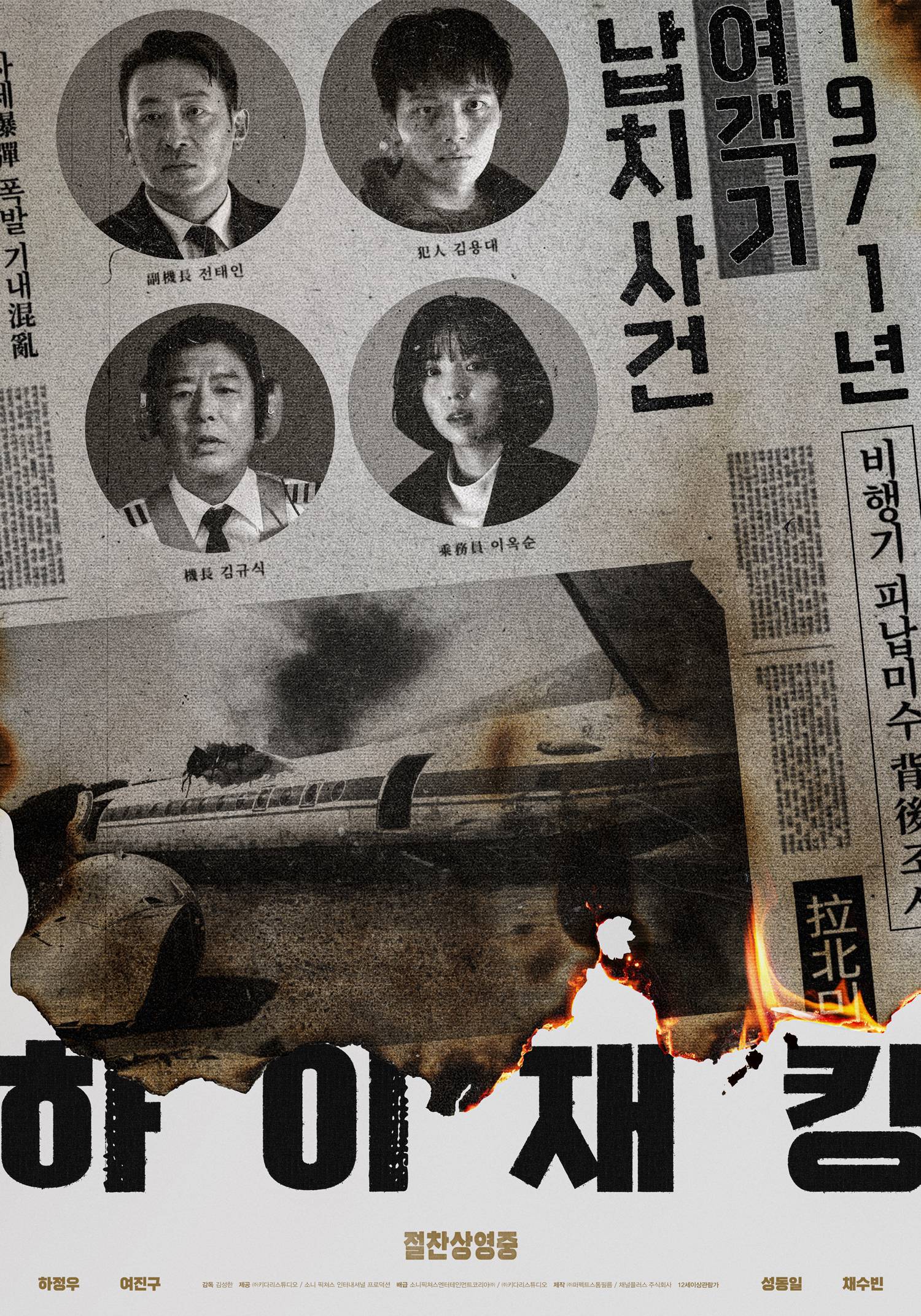
Newspaper-style Korean-language poster featuring a stock photo of a burning place and circular photos of the cast members in black and white.

When a passenger plane is hijacked and forced to fly to North Korea in 1969, the Korean Air Force pilot ordered to fire on it refuses. He recognises the pilot and realises there is something wrong. If there is a hijacker on board, he fears that that he may kill the pilot and crash the plane, killing everyone on board, and while his commanders remind him that the plane should be able to land on just one engine, he knows that if he hits the fuselage instead, the plane could blow up. Even if they land in North Korea, isn’t it better everyone survives?

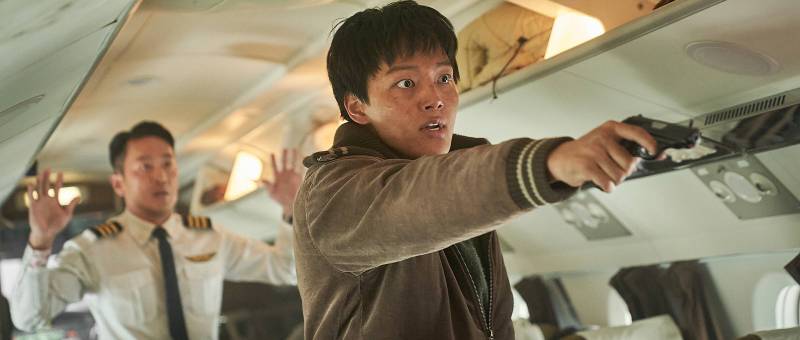
Not according to some in Kim Sung-han’s Hijack, 1971 (하이재킹, Hijacking), inspired by a real life incident. Tae-in (Ha Jung-woo) is summarily dismissed from the air force for his insubordination while otherwise ostracised as the man who allowed the plane to reach North Korea. As he predicted, most of the passengers are returned home shortly afterwards, but 11 never see the South again including his friend the pilot, Min-su (Choi Kwang-il). Meanwhile, Min-su’s wife (Kim Sun-young) continues to face harassment for supposedly being a communist sympathiser. Now working for a commercial airliner, Tae-in also faces discrimination from his new colleagues who, ironically, don’t trust him to properly protect passengers. All their assumptions are tested, however, when a young man sneaks a bomb on board and threatens them to fly to the North apparently inspired by the previous case in which the hijacker was given a hero’s welcome for successfully kidnapping so many useful people.

What’s immediately obvious is how easy it still was to get a bomb on a plane. Yong-dae (Yeo Jin-goo) simply packs them into some tin cans and wraps them up like a picnic. When boarding opens, the passengers literally sprint past each other to get the best seats because they weren’t yet reserved, and when we see a passenger start smoking, we assume the stewardess will tell him not to yet she simply points out the ash tray in the arm of the seat and asks him not to drop ash on the floor or woman sitting next to him. One woman also delays the flight because she’s brought a live chicken with her to make a soup for her daughter whom she’s travelling to see because she’s ill. Tae-in scores an early win and the goodwill of (most of) the passengers by defusing the chicken situation and allowing the woman to keep it on the condition she has it on her lap for the duration of the flight. 

Letting the old lady keep the chicken signals Tae-in’s consideration for his passengers’ welfare and happiness, while the air marshal becomes so preoccupied with this minor breach of the rules that he fails to notice the suspicious behaviour of the hijacker. The presence of the air marshal, a precaution taken after the previous incident, also proves counterproductive when he’s injured when the first bomb goes off, allowing Yong-dae to steal his gun. Granted, this is a fairly minor flight from a provincial airport to Seoul so maybe no one really thought there was much need for advanced security, but they really are woefully underprepared for this kind of incident, especially after the pilot is seriously injured and can’t see well enough to fly alone, meaning Tae-in also cannot do very much to respond to the hijacker’s threats. 

But what we come to realise is that it’s really society that’s been hijacked by the extreme prejudice directed towards “communists” and the North. The passengers from the first plane were returned, but spent time in interrogation to make sure they hadn’t been turned. A newlywed passenger also remarks that a fisherman friend of his was abducted and the police haven’t stopped hassling him about being a spy ever since he got back. Yeong-do’s motive is that he faced constant and unwarranted harassment, including being scalded with boiling water as a child, because his older brother defected to North Korea. His mother later died when he was carted off to prison for being a supposed sympathiser, while other passengers on the plane are similarly worried that their families will starve if they end up in North Korea or are detained when they return. 

A minor subplot, meanwhile, explores the prejudice faced by an older woman travelling to Seoul with her son, who has become a prosecutor. She is deaf and unable to speak, but her son tells her to stop signing because it’s embarrassing him after noticing disapproving looks from another woman in hanbok across the aisle. The old lady had also taken her shoes off after getting on the plane as if she were entering someone else’s home signalling both her politeness and lack of familiarity with modern customs. Her son had repeated the stewardess’ instructions to put them back on, but addresses her like stranger when telling her not to sign. In a way, this casual prejudice is the same and directed at someone simply for being different. Even so, there’s something quite tragic about her son being ordered to tear up the prosecutor ID card she was so proud of. Eventually she swallows it herself to make sure no trace of it remains, telling her son not to worry she will always protect him even in North Korea though he has not done very much to protect her here.

Tae-in later does something similar when he encourages Yong-dae that they should all go on living to ensure no one else endures the mistreatment he has and we don’t end up with any more incidents like this. Though his behaviour is increasingly deranged, it becomes easy to sympathise with Yong-dae for enduring so much suffering for something that was really nothing to do with him while we’re constantly reminded that if the plane lands in North Korea everyone on the plane and all their relatives will also suffer the same fate. At least facing this disaster together eventually forces the passengers to set aside their petty prejudices and pitch in to save the plane so they can get home to their families even if it’ll take them a bit longer to get to Seoul. Though the outcome is already known to the home audience, Kim Sung-han keeps the tension high and defines heroism largely as compassion and selflessness in Tae-in’s continued efforts to ensure the safety of his passengers rather than playing politics or allowing himself to be swayed by those who think landing in North Korea is a fate worse than death.


International trailer (English subtitles)

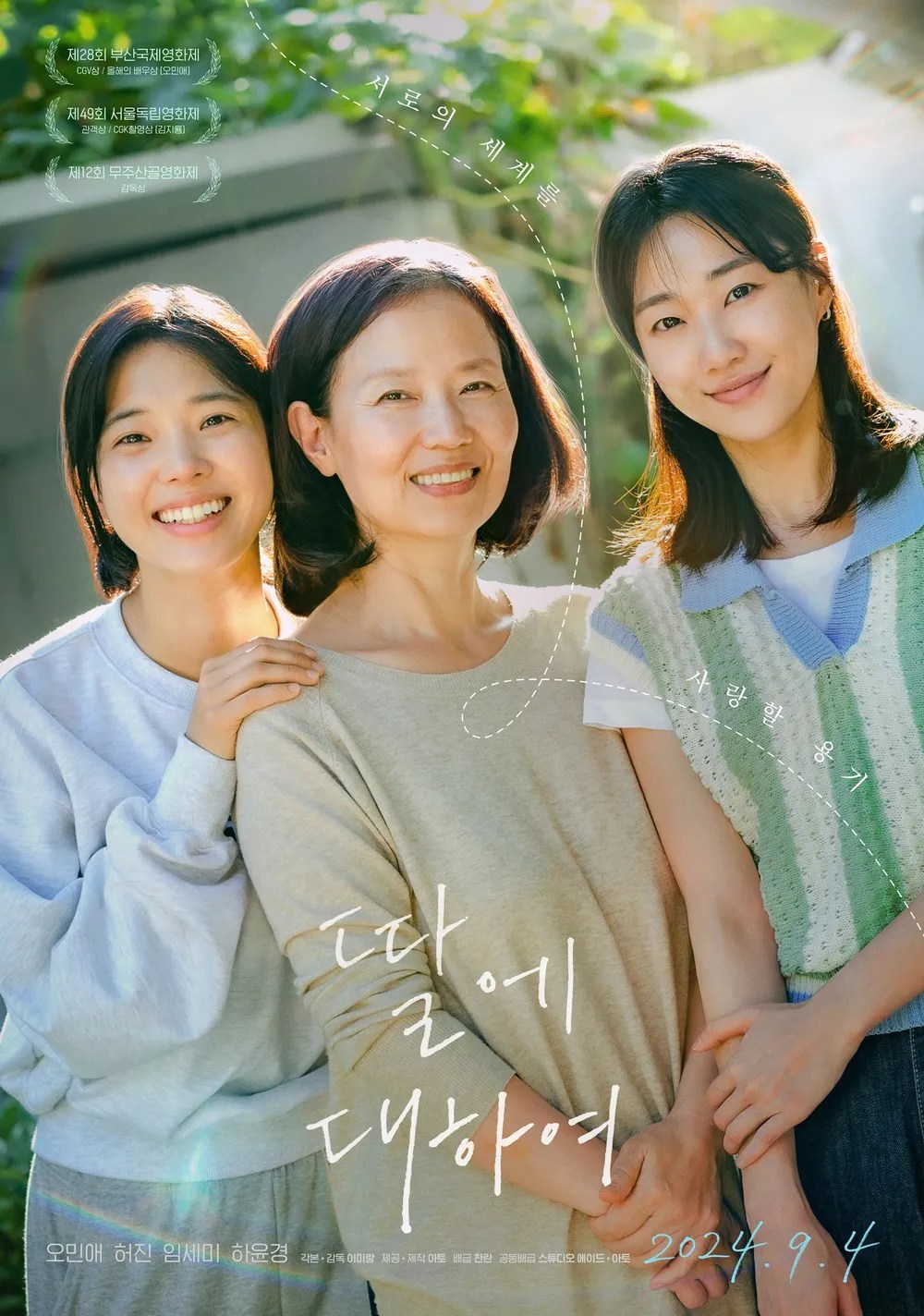
Concerning My Daughter (딸에 대하여, Lee Mi-rang, 2023)

The unnamed mother (Oh Min-ae) at the centre of Lee Mi-rang’s Concerning My Daughter (딸에 대하여) has only one wish, that her daughter will find a nice man to marry and have a few grandchildren. But Green (Im Se-mi) is gay and has been in a relationship with her partner Rain (Ha Yoon-kyung) for the last seven years though her mother doesn’t seem to accept that what they have together is “real” believing it to be some kind of delusion that’s holding Green back from her happy maternal future. 

When she suggests Green move back in with her after her attempt to secure a loan to help her out with the rising cost of housing is denied, it doesn’t seem to have occurred to her that Rain would be coming too while it perhaps seemed so natural to Green that it didn’t occur to spell it out. Green can at times be obtuse and insensitive, unfair both to her mother and to Rain who bears the unpleasant atmosphere with grace and tries her best to get along with her new mother-in-law who is openly hostile towards her and makes no secret of the fact she would prefer her to leave. Of course, some of these issues may be the same were it a heterosexual relationship as the mother-in-law struggles to accept the presence of the new spouse in the family home and the changing dynamics that involves, but Green’s mother’s resentment is so acute precisely because her daughter’s partner is a woman. She cannot understand the nature of their relationship because it will produce no children and to her therefore seems pointless. 

While her attitude is in part determined by prejudice and a sense of embarrassment that her daughter is different, it’s the question of children which seems to be foremost in her mind. Another woman of a similar age at her job at a care home remarks on her maternal success having raised her daughter to become a professor, but she also says that only by leaving children and grandchildren behind you can die with honour. Green’s mother is the primary carer for an elderly lady, Mrs Lee (Heo Jin), who had no children of her own though sponsored several orphans none of whom appear to have remained in touch with her. Now ironically orphaned herself in her old age, Green’s mother is the only one who cares for her while the manager berates her for using too many resources and eventually degrades Mrs Lee’s access to care Green’s mother suspects precisely because she has no family and therefore no one to advocate for her. 

It’s this fate that she fears for her daughter, that without biological children she will become a kind of non-person whose existence is rendered meaningless. Of course, it’s also a fear that she has for herself and her tenderness towards Mrs Lee is also a salve for her own loneliness and increasing awareness of mortality. Green is her only child, and she may also fear that she will not want to look after her as she might traditionally be expected to because her life is so much more modern as exemplified by the bread and pasta the girls bring into her otherwise fairly traditional Korean-style home. On some level she is probably aware that if she continues to pressure Green to accept a traditional marriage they may end up becoming estranged and she will be in the same position as Mrs Lee, wilfully misused by a cost-cutting care industry because they know there’s no one to kick up a fuss about her standard of care.

Even so, it doesn’t seem to occur to her that Rain could care for her daughter into their old age. Resentfully asking her why they “have to” to live together, Rain patiently explains that in a society which rejects their existence, in which they are unable to marry or adopt children, togetherness is all that they have. Green is currently engaged in a battle with her institution which has fired her colleague on spurious grounds but really because of her sexuality with claims that some students are “uncomfortable” with her classes. The violence with which the women are attacked is emblematic of that they endure from their society while even colleagues interviewing her invalidate Green’s concerns because she too is “one of them,” in their prejudicial way of speaking. 

Green’s mother had also, rather oddly, said that her daughter wasn’t like that when Rain reluctantly explained her difficulties at work and again resents that she’s making waves rather than keeping her head down and getting on with her career. Her decision to jump in a car with boxes of biscuits intending to smooth things over with Green’s boss by apologising on her behalf bares out her old-fashioned attitudes, though she too is shocked by the violence directed at Green and her colleague. When her lodgers ask about Rain, she tells them she’s her daughter’s friend, while she avoids the question when her colleagues ask, still embarrassed that her daughter has not followed the conventional path as if it reflected badly on her parenting. 

Yet through her experiences with Mrs Lee and Rain’s constant, caring patience she perhaps comes to understand that her daughter won’t be alone when she’s old and that she too does not need to be so lonely now. There’s something a little a sad in the various ways Green’s mother is told that her attachment to Mrs Lee is somehow inappropriate as if taking an interest in the lives of those not related to us by blood were taboo even if it’s also sadly true that it’s also in Mrs Lee’s best interests to ask those questions to protect her from those who might not have her best interests at heart. What the film seems to say in the end is that we should all take better care of each other, something which Green’s mother too may come to realise in coming to a gradual, belated acceptance of her daughter-in-law if in part through recognising that they aren’t alone and that it’s a blessing that her daughter is loved and will be cared for until the end of her days.


Concerning My Daughter screened as part of this year’s London Korean Film Festival.

Trailer (English subtitles)

Money (돈, Park Noo-ri, 2019) [Fantasia 2019]

money poster 1“Could you ask him something for me,” the beleaguered yet victorious protagonist of Park Noo-ri’s Money (돈, Don) eventually asks, “what was he going to use the money for?”. Wealth is, quite literally it seems, a numbers game for the villainous Ticket (Yoo Ji-tae) whose favourite hobby is destabilising the global stock market just for kicks. As for Cho Il-hyun (Ryu Jun-yeol), well, he just wanted to get rich, but where does getting rich get you in the end? There’s only so much money you can spend and being rich can make you lonely in ways you might not expect.

Unlike most of his fellow brokers, Cho Il-hyun is an ordinary lad from the country. His parents own a small raspberry farm and he didn’t graduate from an elite university or benefit from good connections, yet somehow he’s here and determined to make a success of himself. In fact, his only selling point is that he’s committed the registration numbers of all the firms on the company books to memory, and his ongoing nervousness and inferiority complex is making it hard for him to pick up the job. A semi-serious rookie mistake lands the team in a hole and costs everyone their bonuses, which is when veteran broker Yoon (Kim Min-Jae) steps in to offer Il-hyun a way out through connecting him with a shady middle-man named “The Ticket” who can set him up with some killer deals to get him back on the board.

Il-hyun isn’t stupid and he knows this isn’t quite on the level, but he’s desperate to get into the elite financial world and willing to cheat to make it happen. As might be expected his new found “success” quickly goes to his head as he “invests” in swanky apartments and luxury accessories, while his sweet and humble teacher girlfriend eventually dumps him after he starts showering her with expensive gifts and acting like an entitled elitist. It’s not until some of his fellow brokers who also seem to have ties to Ticket start dying in mysterious circumstances that Il-hyun begins to wonder if he might be in over his head.

Unlike other similarly themed financial thrillers, it’s not the effects of stock market manipulation on ordinary people which eventually wake Il-hyun up from his ultra capitalist dream (those are are never even referenced save a brief reflective shot at the end), but cold hard self-interest as he finally realises he is just a patsy Ticket can easily stub out when he’s done with him. Yoon only hooked him up in the first place because he knew he’d be desperate to take the bait in order to avoid repeated workplace humiliation and probably being let go at the end of his probationary period. What he’s chasing isn’t just “money” but esteem and access to the elite high life that a poor boy from a raspberry farm might have assumed entirely out of his reach.

It’s difficult to escape the note of class-based resentment in Il-hyun’s sneering instruction to his mother that she should “stop living in poverty” when she has the audacity to try and offer him some homemade chicken soup from ancient Tupperware, and it’s largely a sense of inferiority which drives him when he eventually decides to take his revenge on the omnipotent Ticket. Yet there’s a strangely co-dependent bond between the two men which becomes increasingly difficult pin down as they wilfully dance around each other.

The world of high finance is, unfortunately, a very male and homosocial one in which business is often conducted in night-clubs and massage parlours surrounded by pretty women. There is only one female broker on Il-hyun’s team. The guys refer to her as “Barbie” and gossip about how exactly she might have got to her position while she also becomes a kind of trophy conquest for Il-hyun as he climbs the corporate ladder. Meanwhile, there is also an inescapably homoerotic component to Il-hyun’s business dealings which sees him flirt and then enjoy a holiday (b)romance with a Korean-American hedge fund manager (Daniel Henney) he meets at a bar in the Bahamas, and wilfully strip off in front of Ticket ostensibly to prove he isn’t wearing a wire while dogged financial crimes investigator Ji-cheol (Jo Woo-jin) stalks him with the fury of a jilted lover.

Obsessed with “winning” in one sense or another, Il-hyun does not so much redeem himself as simply emerge victorious (though possibly at great cost). Even his late in the game make up with Chaebol best friend Woo-sung (Kim Jae-young), who actually turns out to be thoroughly decent and principled (perhaps because unlike Il-hyun he was born with wealth, status, and a good name and so does not need to care about acquiring them), is mostly self-interest rather than born of genuine feeling. In answer to some of Il-hyun’s early qualms, Ticket tells him that in finance the border between legal and illegal is murky at best and it may in fact be “immoral” not to exploit it. What Il-hyun wanted wasn’t so much “money” but what it represents – freedom, the freedom from “labour” and from from the anxiety of poverty. Life is long and there are plenty of things to enjoy, he exclaims at the height of his superficial success, but the party can only last so long. What was the money for? Who knows. Really, it’s beside the point.


Money was screened as part of the 2019 Fantasia International Film Festival.

International trailer (English subtitles)