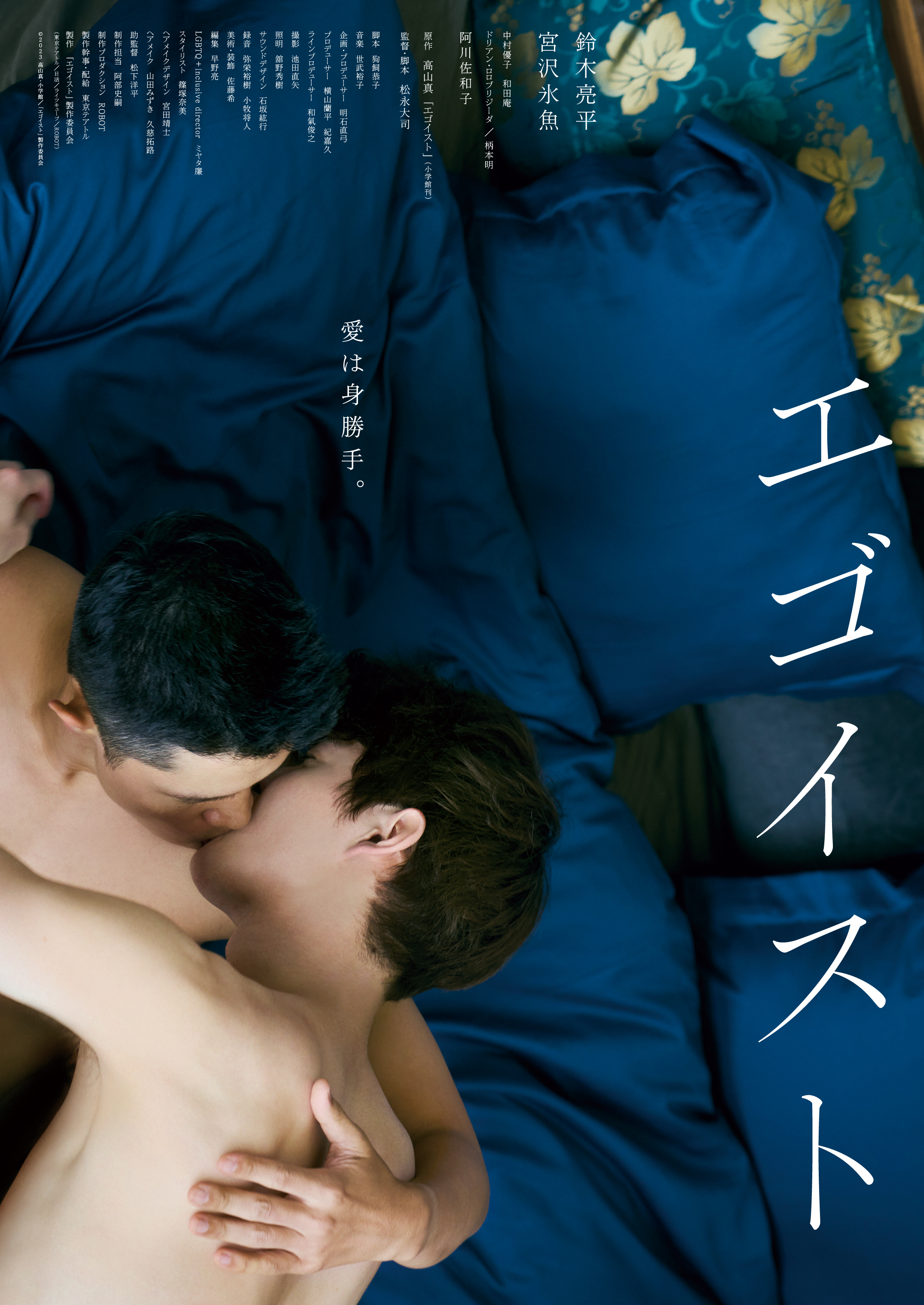
Egoist (エゴイスト, Daishi Matsunaga, 2022)

If love is unselfish, is it really love at all? Based on a semi-autobiographical novel by Makoto Takayama, Daishi Matsunaga’s deeply moving romantic drama Egoist (エゴイスト) asks if all love is in the end transactional and if to deny its “selfishness” is akin to denying love itself because it would mean denying a basic human need for connection and reciprocity. In the end, perhaps selfish is what we should be with love because we are always running out of time and if we aren’t careful it will slip away from us unnoticed.

An “extreme realist”, fashion editor Kosuke (Ryohei Suzuki) is already full of regrets and many of them linking back to the early death of his mother from illness when he was only 14. It’s clear that his financial wealth helps to fill an emotional void but also that he’s lonely and longs for a sense of family that’s long been absent from his life. He rarely visits the conservative hometown where he was bullied for being different, and seems to have a strained relationship with his widowed father (Akira Emoto) who doesn’t know that Kosuke is gay and continues to ask him about getting married and settling down. Early on in his courtship with Ryuta (Hio Miyazawa), a personal trainer he met through a friend, Kosuke remarks that he’s never met a lover’s mother before hinting at the landmarks of a relationship such as marriage that LGBTQ+ people often miss out on in a conservative culture in which such things cannot always be discussed openly.

Later, Ryuta’s mother Taeko (Sawako Agawa) tells Kosuke that knew from that first meeting that they were more than just friends and was happy that her son had someone he loved who loved him regardless if they were a man or a woman. But just when the relationship had seemed to be blossoming, Ryuta had abruptly tried to break up with Kosuke explaining that he had been involved in sex work since his early teens in order to support his mother who was unable to work due to illness. Now that he’s experienced real romantic love he finds sex work “painful” but has no other means of supporting himself and so gives up love for economic necessity. “I’ll buy you,” Kosuke unironically counters adding a note of literal transactionality to their relationship which is already fraught with disparity in the respective differences in their ages along with Kosuke’s wealth and Ryuta’s poverty. 

Kosuke later describes his gesture as “pure”, something he’d previously called Ryuta while also remarking that he found him too “polite” in bed and would rather he be a little more “selfish”. In a way it’s altruistic, he isn’t really trying to trap Ryuta into a compensated relationship only to help him while simultaneously ensuring that he stays in his life. His wealth fills a void, but it’s by giving pieces of it away that he feels that void decreasing. Kosuke first gives Ryuta gifts for his mother, knowing that it’s easier for him to accept them because doing so is unselfish when the gift is for someone else. Even so as he later acknowledges sometimes the gift is more for himself than the recipient, a means not of manipulation but of healing. Kosuke claims not to know what love is and largely mediates it through money along with additional acts of care, but as Taeko later tells him it doesn’t really matter if he doesn’t know because they felt his love anyway. 

Matsunaga frequently cuts backs to visual motifs such as door numbers, envelopes, and dropped coins to hint at the transactionality of love but eventually reflects that love is an act of exchange in which the desire to be loved is an essential component. Kosuke eventually asks his father how it was for him when his mother was dying and he recalls a conversation in which she said she wanted to leave him because she couldn’t bear to see him suffering for her, a request which could in itself be read as “selfish” even in its “selflessness” with his reply implying that it’s alright to be selfish in love because in way it might be its ultimate expression. Filming with handheld realism, Matsunaga captures the rhythms of contemporary gay life along with the easy giddiness of burgeoning romance and the poignancy of profound loss tempered only by a fleeting feeling of warmth and the jealous memory of a “selfish” love. 


Egoist screens in Frankfurt 9th June as part of this year’s Nippon Connection.

International trailer (English subtitles)

A Madder Red (茜色に焼かれる, Yuya Ishii, 2021)

©︎2021 "A Madder Red" Film Partners

A single mother and her son face the myriad injustices of the modern society with dignity and grace in Yuya Ishii’s quietly seething pandemic-era social drama, A Madder Red (茜色に焼かれる, Akaneiro ni Yakareru). The heroine is constantly asked why she isn’t angrier, those around her confused by her stoical attitude and tendency to simply sigh and say “let’s get through this” rather than railing against the persistent unfairness that defines her life but then she doesn’t have a lot of time for being angry nor would it particularly help her situation or bring about change. All she can do is persevere in the hope that it won’t always be this way, her run of bad luck will end, and she will eventually be permitted to rest. 

Ishii opens the film with a 3D model simulation of a traffic accident in which a cyclist is killed by an out of control car on a zebra crossing in an otherwise tranquil residential area. Ryoko’s (Machiko Ono) husband Yoichi (Joe Odagiri) is sent flying and ends up squished like a bug on the windscreen of a vehicle travelling in the other direction. The driver, an elderly man later revealed to have been living with Alzheimer’s, mistook the accelerator for the brake but as he had been a prominent local official the matter was swept under the carpet and he faced no consequences. What people can’t seem to understand is why Ryoko chose to attend the old man’s funeral when he eventually died. It seems attend was all she did, but the man’s son had security throw her out and his lawyer accuse her of “harassment” while expressing anger and resentment that her presence tarnished his father’s lavish ceremony when he had been such a good a man. Her presence perhaps annoys him because he knows on some level he’s in the wrong, while her strength and dignity shame him knowing that they should have just apologised. The lawyer implies she’s being unfair targeting the family who were not themselves responsible for the accident, except that in a sense they were because they failed to protect the old man by continuing to allow him to drive by himself. 

Ryoko refused the compensation money for this reason, that they tried to settle it with cash as if her husband’s life had no meaning. She lives in subsidised government housing, but doesn’t claim any benefits supporting herself after she was forced to close her cafe through a part-time job in a supermarket floristry department and after hours sex work. “Break a rule, break your life” she teaches her 13-year-old son Junpei (Iori Wada) yet constantly falls foul of rules written or otherwise while doing nothing wrong in the eyes of those who rant about benefit scroungers and routinely belittle those without means. She’s taken to task by her manager for taking home flowers that were due to be thrown out and for taking a phone call outside the store after clocking off, but when they fire her on a pretext to hire the daughter of a prominent client who can’t find a part-time job because of the pandemic, they refuse to honour the two month notice clause in her contract. Similarly when bullies from Junpei’s school set fire to some books left outside their apartment, they are the ones who have to move for violating the rule about causing a disturbance to the other residents. 

Given all of this no one can understand why Ryoko isn’t seething mad. She still pays for her father-in-law’s nursing home and even child support for a girl she’s never met fathered by Yoichi with another woman. Struggling herself, the child’s mother later turns to a sleazy friend of Yoichi’s, Ryu (Tateto Serizawa), to petition Ryoko to increase the child support but like her also worries that it “doesn’t seem right” to further burden a woman who is also struggling to raise a child alone just like herself while Ryu, as he had unsuccessfully with Ryoko, attempts to extort sexual favours in return for his assistance. Ryoko does these things when she doesn’t strictly have to and many people wouldn’t less out of pride or stubbornness than because it’s the right thing to do and if she can satisfy herself that she’s done right by others even if they’ve not done right by her then she maintains her dignity and their scorn can’t harm her. 

Even so, sick of being treated like a bug Ryoko’s rage eventually begins to boil over her subdued outfits giving way to a fiery red as her hopes of escape are once again dashed on realising a potential romantic suitor only ever viewed as a plaything. Everyone is always telling Ryoko’s that she’s “strange”, “weird”, “crazy”, in her passive resistance living by her own rules while constantly betrayed by those of others which they only enforce when it suits them. Ishii flags up all of her various expenses on the screen making it clear just how much it costs for Ryoko to be this poor while she seemingly grins and bears it. Then again as the film’s only title card tells us Ryoko is a good actress, and perhaps she has to be to get by in this indifferent society filled hidden suffering and an almost sadistic lust for self-preservation. “Mom, it’s all too much” Junpei sighs as he comes to an appreciation of his mother’s fortitude and her desire to simply “get through this” as they ride a mamachari towards a glowing technicolour sunset which ironically enough refuses to end trapping in them in this space of grief and unfairness but carrying with it a far off hope perhaps cruel in its elusiveness.


A Madder Red streamed as part of this year’s Nippon Connection.

International trailer (English subtitles)

Images: ©︎2021 “A Madder Red” Film Partners