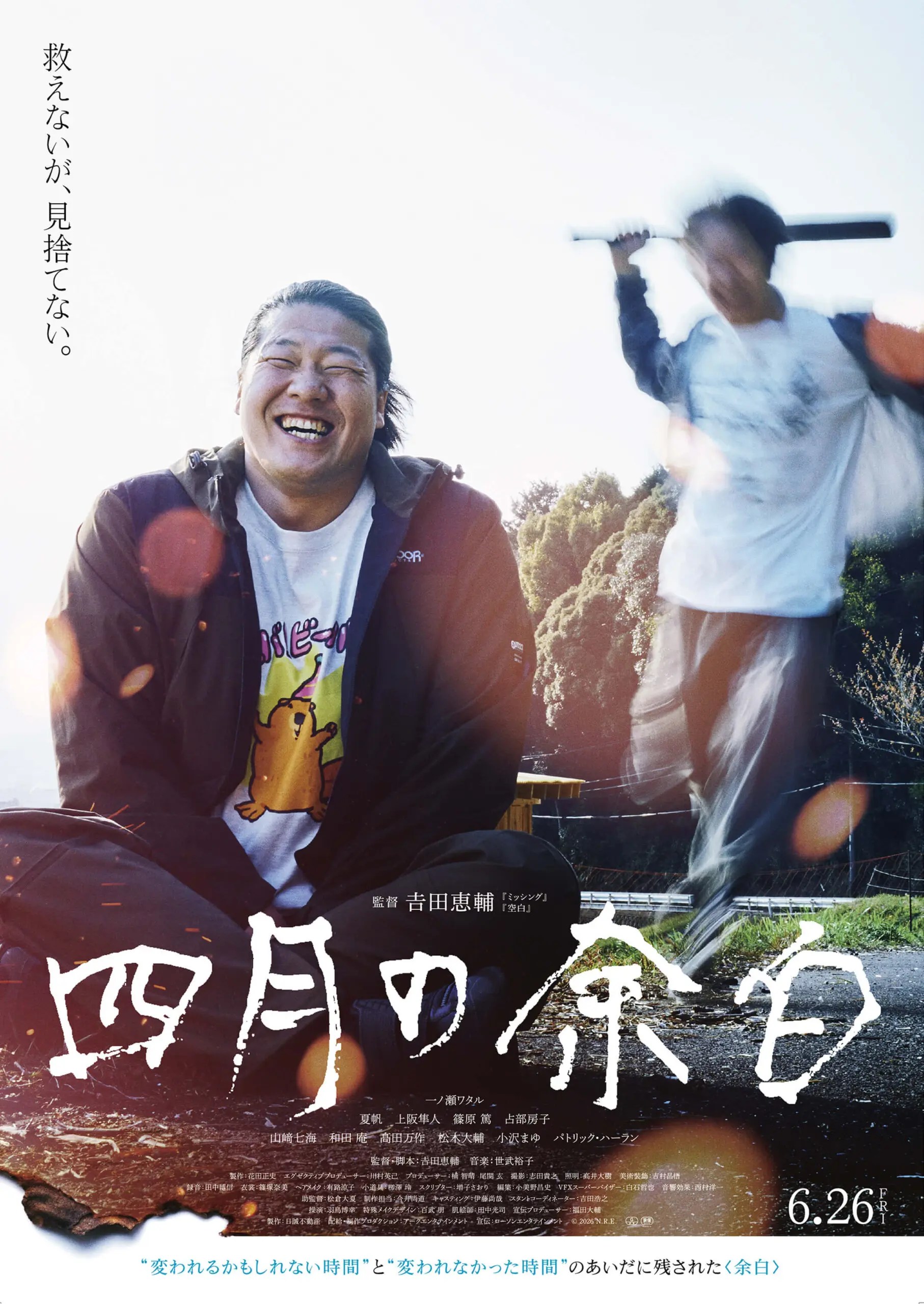
Unchained (四月の余白,  Keisuke Yoshida, 2026)

Can a person really change, or should we just accept that some people are born bad and can’t be accepted in mainstream society? This seems to be the question at the centre of Keisuke Yoshida’s empathetic drama Unchained (四月の余白, Shigatsu no Yohaku) which suggests, in a way, that violence is a vicious circle as society tends to write off those with behavioural issues pushing them deeper into their isolation and giving them little opportunity for reform or rehabilitation.

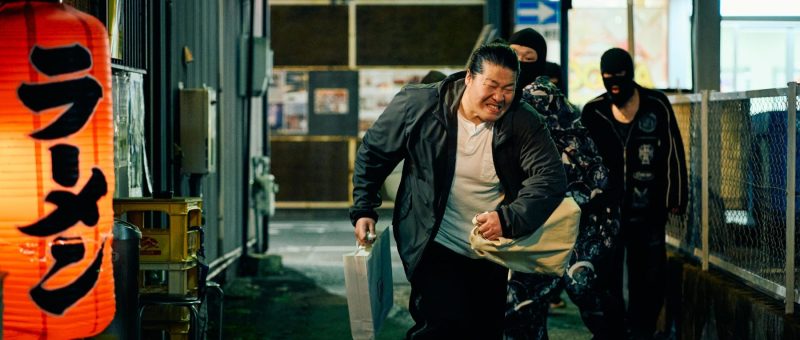
“Mister Nishi” (Wataru Ichinose), as he seems to be known, is a former delinquent who committed acts of heinous violence in his youth, spent time in prison, and experienced a personal tragedy that acted as a wake up call and gave him the opportunity to turn his life around. He now works at a kind of tough love bootcamp that attempts to guide wayward teens back towards the mainstream. His methods, however, are not universally approved and especially not by contemporary teachers. Though corporal punishment has long been outlawed in educational facilities, Nishi believes that sometimes there is no other way to reach these children and violence may be the only way to teach them that their actions have consequences. 

A teacher takes him to task and asks him if he isn’t just teaching them to be violent and in fact pushing them towards and anti-social behaviour. Nishi disagrees, but the film doesn’t really explore the alternative any further and more or less sides with Nishi. The children at the facility do seem to be doing better than they presumably were beforehand and do not appear to be unhappy there. It also seems that they are expected to do farm work, and it’s unclear if they’re being compensated for that, though this may be a slight cultural difference that is not raised in the film either by the documentary crew that comes to film the facility nor by a journalist who tries to take Nishi down by accusing him of fabricating details of his backstory which eventually leads to the facility closing down. 

Nishi may, however, have met his match in Kaito (Hayato Kohsaka), a violent young man exhibiting an extreme lack of empathy. Kaito’s teacher first seeks out Nishi because she’s at a loss of what else to do, while the boy’s mother appears to be a good woman who has tried everything she can and is now at the end of her tether. Kaito has become violent towards her too and apparently beat the family dog to death in a fit of rage for which he feels no remorse. The mother is beginning to feel suicidal and willing to try Nishi’s methods as a last-ditch effort to save her family. There is no clear reason why Kaito became this way. We get a hint of generational violence in that Kaito seems to resent his father who is disabled and in his view defeated by life. His father does seem to have become depressed because of his disability and it’s because of the depression and sense of worthlessness that he’s been unable to hold down a job and has taken to drink.

In a twist of fate, it turns out that it was Nishi who crushed his knee and left him permanently disabled. Kaito’s father therefore piles all of his resentment onto him without taking any responsibility for the choices he made himself after that. When Kaito ironically injures another boy in the same way, his father begins to realise his mistakes and cautions the other boy against becoming consumed by resentment or a sense of defeat. It’s this notion of “defeat” that becomes central to the interrogation of a cultural notion of toxic masculinity in which the reason some of these young men are thought to act out is that they don’t want to be seen as losers and harm others to prove their superiority. This is in part true of Kaito who declares himself happy to hurt other people as long as he himself does not get hurt. It’s not that he is incapable of understanding that others experience pain in the same way that he does, but that he simply does not really care. 

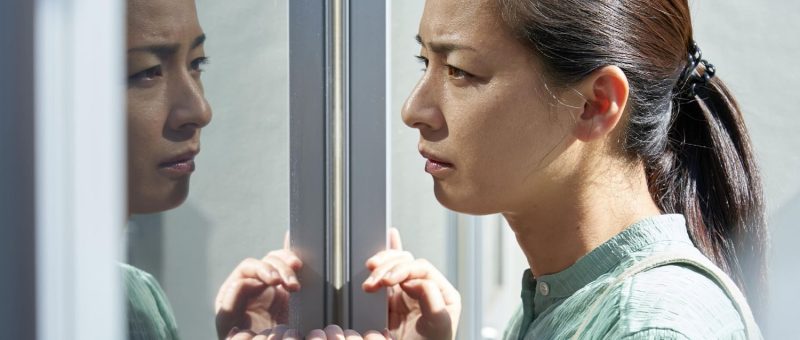
Some argue that Nishi doesn’t either and that, as he was a delinquent himself, he is incapable of fully sympathising with victims and only has empathy for those commit acts of violence. Nevertheless, that does give him a unique perspective that allows him to help some of these teens both by supporting them and being a positive role model as someone who has been able to reform and live a more mainstream, settled life. Then again, some seem dubious of the way he seems to change after the media takes interest which leaves him with less time for the children while chasing the spotlight. Ms. Kusano (Kaho), meanwhile, wonders if she did the right thing or perhaps just did what was easiest for her in abandoning Kaito into Nishi’s care. She chastises herself for having forgotten a model student who spoke to her at a reunion while uncertain if it’s right to devote so much of her time to kids like Kaito rather than supporting those he victimised such as student who withdrew from the school due to his bullying.

While a fellow teacher’s characterisation of Kaito as a”bad apple” who should be “discarded” before he causes any more trouble may seem callous, it’s also true that without his influence the other kids who’d been in his gang begin to straighten out and give more thought to their futures. Though he struggles at the facility, Kaito does seem to benefit in a way from a less stimulating environment and shows signs of change, if also of self-sabotage and an inability to walk away from his delinquent life for fear of being seen as a loser. It’s only after he’s cajoled into another act of violence and receiving kindness in return that he begins to see the error of his ways. The film seems to suggest, then, that person can change but that equally society has to let them, rather than try to tear them down as they did to Nishi in denying him his fresh start by reminding him that no apology is enough to change what he did in the past. While perhaps controversial in some of its implications, the film is at least empathetic and even handed, filmed in an unostentatious style that tries to sympathise both with the dealers and the receivers of violence in the conviction that there is no one who cannot change.


Unchainedscreened as part of this year’s Camera Japan.

Trailer (no subtitles)
All Greens (万事快調〈オール・グリーンズ〉, Takashi Koyama, 2025)

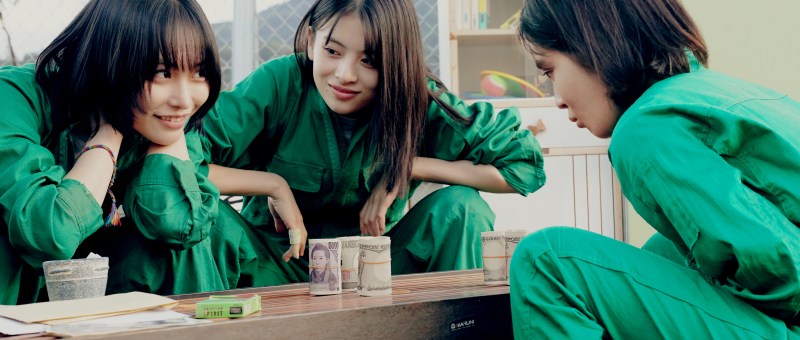
Consumed by rural ennui, three teenage girls set on a dramatic plan for escape in Takashi Koyama’s darkly comic youth drama, All Greens (万事快調〈オール・グリーンズ). The title turns out to be apt, not only in ironically referencing the drugs at the film’s centre, but also that the girls are all still fairly naive and just trying to figure out their place in the world. Whatever that may turn out to be, it’s clear that each of them is constrained by their circumstances from abusive fathers to absent parents and outdated patriarchal ideals.

The reduced horizons of their lives are evident in Hidemi’s (Sara Minami) description of the school as a place where everyone’s either given up on exams or is too poor to access better education. She and Mako (Mizuki Yoshida) seem to resent popular girl Milk (Natsuki Deguchi) and her seemingly perfect life, but are unaware that circumstances are similar to theirs or that she too is longing to escape this dead-end town. Hidemi is sick of her abusive father and submissive mother and finds release through rap music. Mako wants to be a manga artist, but is under pressure from her family who expect her to marry a man to take over their farm. And Milk has become a mother to her mother who appears to have had a mental breakdown following the death of her husband, a nuclear plant worker caught up in a radioactive incident. 

The attitude of Mako’s family may seem excessively old-fashioned, but seems to reflect the traditional culture of the village. When the teacher warns their class about a flasher, he tells the girls to travel in groups and avoid going home alone while ensuring their skirts are not too short as if that had anything to do with the likelihood of being flashed. The three girls are briefly united when they witness a woman and her small child being dumped in the middle of an intersection by an abusive spouse. They hear later that the woman snapped, killed her abusive husband and burnt his house down before drowning herself and her daughter in the river. Each of them fear ending up like this woman, as if the village itself were an abusive spouse from whom they can’t escape. Hidemi’s dreams of rap stardom are even disrupted when she’s offered a promising opportunity with a “beat master” who first tells her he’s quitting the business because he’s getting married and needs a more stable line of work, and then matter-of-factly says that the job is conditional on sleeping with him. He even tried to drug her drink, but Hidemi has a healthy level of suspicion regarding men who offer help, so she switched their drinks which is how she finds out he has a safe full of marijuana seeds.

The drugs offer a more literal kind of escape in the prospect of a small business the three girls could operate illicitly together without really thinking about the consequences beyond the hope of making enough money to leave town. Later they bring in two fellow students who need money because they are gay and want to move in together to escape their oppressive families, though Hidemi’s assertion that karma isn’t real may seem hubristic while playing into her sense of the world as a lawless place in which there are no real consequences for anything because she’s used to seeing bad guys get away with their crimes. In trying their luck in the big city, however, the girls find themselves out of their depth as their small-town gangster dreams implode in the face of the realities of urban crime. 

In the end, the only real answer may be to burn it all down, but the sense of solidarity between the girls has at least given them the courage to chase their dreams even if they may still prove elusive. As the fumes make their way through the school, it provokes a sense of liberation as the old codes of conformity begin to dissolve and people say what they really feel. It may be only temporary and perhaps lead nowhere at all, but for the moment at least the road ahead is wide open.


All Greens screened as part of this year’s Nippon Connection

Trailer (no subtitles)

Egoist (エゴイスト, Daishi Matsunaga, 2022)

If love is unselfish, is it really love at all? Based on a semi-autobiographical novel by Makoto Takayama, Daishi Matsunaga’s deeply moving romantic drama Egoist (エゴイスト) asks if all love is in the end transactional and if to deny its “selfishness” is akin to denying love itself because it would mean denying a basic human need for connection and reciprocity. In the end, perhaps selfish is what we should be with love because we are always running out of time and if we aren’t careful it will slip away from us unnoticed.

An “extreme realist”, fashion editor Kosuke (Ryohei Suzuki) is already full of regrets and many of them linking back to the early death of his mother from illness when he was only 14. It’s clear that his financial wealth helps to fill an emotional void but also that he’s lonely and longs for a sense of family that’s long been absent from his life. He rarely visits the conservative hometown where he was bullied for being different, and seems to have a strained relationship with his widowed father (Akira Emoto) who doesn’t know that Kosuke is gay and continues to ask him about getting married and settling down. Early on in his courtship with Ryuta (Hio Miyazawa), a personal trainer he met through a friend, Kosuke remarks that he’s never met a lover’s mother before hinting at the landmarks of a relationship such as marriage that LGBTQ+ people often miss out on in a conservative culture in which such things cannot always be discussed openly.

Later, Ryuta’s mother Taeko (Sawako Agawa) tells Kosuke that knew from that first meeting that they were more than just friends and was happy that her son had someone he loved who loved him regardless if they were a man or a woman. But just when the relationship had seemed to be blossoming, Ryuta had abruptly tried to break up with Kosuke explaining that he had been involved in sex work since his early teens in order to support his mother who was unable to work due to illness. Now that he’s experienced real romantic love he finds sex work “painful” but has no other means of supporting himself and so gives up love for economic necessity. “I’ll buy you,” Kosuke unironically counters adding a note of literal transactionality to their relationship which is already fraught with disparity in the respective differences in their ages along with Kosuke’s wealth and Ryuta’s poverty. 

Kosuke later describes his gesture as “pure”, something he’d previously called Ryuta while also remarking that he found him too “polite” in bed and would rather he be a little more “selfish”. In a way it’s altruistic, he isn’t really trying to trap Ryuta into a compensated relationship only to help him while simultaneously ensuring that he stays in his life. His wealth fills a void, but it’s by giving pieces of it away that he feels that void decreasing. Kosuke first gives Ryuta gifts for his mother, knowing that it’s easier for him to accept them because doing so is unselfish when the gift is for someone else. Even so as he later acknowledges sometimes the gift is more for himself than the recipient, a means not of manipulation but of healing. Kosuke claims not to know what love is and largely mediates it through money along with additional acts of care, but as Taeko later tells him it doesn’t really matter if he doesn’t know because they felt his love anyway. 

Matsunaga frequently cuts backs to visual motifs such as door numbers, envelopes, and dropped coins to hint at the transactionality of love but eventually reflects that love is an act of exchange in which the desire to be loved is an essential component. Kosuke eventually asks his father how it was for him when his mother was dying and he recalls a conversation in which she said she wanted to leave him because she couldn’t bear to see him suffering for her, a request which could in itself be read as “selfish” even in its “selflessness” with his reply implying that it’s alright to be selfish in love because in way it might be its ultimate expression. Filming with handheld realism, Matsunaga captures the rhythms of contemporary gay life along with the easy giddiness of burgeoning romance and the poignancy of profound loss tempered only by a fleeting feeling of warmth and the jealous memory of a “selfish” love. 


Egoist screens in Frankfurt 9th June as part of this year’s Nippon Connection.

International trailer (English subtitles)

A Madder Red (茜色に焼かれる, Yuya Ishii, 2021)

©︎2021 "A Madder Red" Film Partners

A single mother and her son face the myriad injustices of the modern society with dignity and grace in Yuya Ishii’s quietly seething pandemic-era social drama, A Madder Red (茜色に焼かれる, Akaneiro ni Yakareru). The heroine is constantly asked why she isn’t angrier, those around her confused by her stoical attitude and tendency to simply sigh and say “let’s get through this” rather than railing against the persistent unfairness that defines her life but then she doesn’t have a lot of time for being angry nor would it particularly help her situation or bring about change. All she can do is persevere in the hope that it won’t always be this way, her run of bad luck will end, and she will eventually be permitted to rest. 

Ishii opens the film with a 3D model simulation of a traffic accident in which a cyclist is killed by an out of control car on a zebra crossing in an otherwise tranquil residential area. Ryoko’s (Machiko Ono) husband Yoichi (Joe Odagiri) is sent flying and ends up squished like a bug on the windscreen of a vehicle travelling in the other direction. The driver, an elderly man later revealed to have been living with Alzheimer’s, mistook the accelerator for the brake but as he had been a prominent local official the matter was swept under the carpet and he faced no consequences. What people can’t seem to understand is why Ryoko chose to attend the old man’s funeral when he eventually died. It seems attend was all she did, but the man’s son had security throw her out and his lawyer accuse her of “harassment” while expressing anger and resentment that her presence tarnished his father’s lavish ceremony when he had been such a good a man. Her presence perhaps annoys him because he knows on some level he’s in the wrong, while her strength and dignity shame him knowing that they should have just apologised. The lawyer implies she’s being unfair targeting the family who were not themselves responsible for the accident, except that in a sense they were because they failed to protect the old man by continuing to allow him to drive by himself. 

Ryoko refused the compensation money for this reason, that they tried to settle it with cash as if her husband’s life had no meaning. She lives in subsidised government housing, but doesn’t claim any benefits supporting herself after she was forced to close her cafe through a part-time job in a supermarket floristry department and after hours sex work. “Break a rule, break your life” she teaches her 13-year-old son Junpei (Iori Wada) yet constantly falls foul of rules written or otherwise while doing nothing wrong in the eyes of those who rant about benefit scroungers and routinely belittle those without means. She’s taken to task by her manager for taking home flowers that were due to be thrown out and for taking a phone call outside the store after clocking off, but when they fire her on a pretext to hire the daughter of a prominent client who can’t find a part-time job because of the pandemic, they refuse to honour the two month notice clause in her contract. Similarly when bullies from Junpei’s school set fire to some books left outside their apartment, they are the ones who have to move for violating the rule about causing a disturbance to the other residents. 

Given all of this no one can understand why Ryoko isn’t seething mad. She still pays for her father-in-law’s nursing home and even child support for a girl she’s never met fathered by Yoichi with another woman. Struggling herself, the child’s mother later turns to a sleazy friend of Yoichi’s, Ryu (Tateto Serizawa), to petition Ryoko to increase the child support but like her also worries that it “doesn’t seem right” to further burden a woman who is also struggling to raise a child alone just like herself while Ryu, as he had unsuccessfully with Ryoko, attempts to extort sexual favours in return for his assistance. Ryoko does these things when she doesn’t strictly have to and many people wouldn’t less out of pride or stubbornness than because it’s the right thing to do and if she can satisfy herself that she’s done right by others even if they’ve not done right by her then she maintains her dignity and their scorn can’t harm her. 

Even so, sick of being treated like a bug Ryoko’s rage eventually begins to boil over her subdued outfits giving way to a fiery red as her hopes of escape are once again dashed on realising a potential romantic suitor only ever viewed as a plaything. Everyone is always telling Ryoko’s that she’s “strange”, “weird”, “crazy”, in her passive resistance living by her own rules while constantly betrayed by those of others which they only enforce when it suits them. Ishii flags up all of her various expenses on the screen making it clear just how much it costs for Ryoko to be this poor while she seemingly grins and bears it. Then again as the film’s only title card tells us Ryoko is a good actress, and perhaps she has to be to get by in this indifferent society filled hidden suffering and an almost sadistic lust for self-preservation. “Mom, it’s all too much” Junpei sighs as he comes to an appreciation of his mother’s fortitude and her desire to simply “get through this” as they ride a mamachari towards a glowing technicolour sunset which ironically enough refuses to end trapping in them in this space of grief and unfairness but carrying with it a far off hope perhaps cruel in its elusiveness.


A Madder Red streamed as part of this year’s Nippon Connection.

International trailer (English subtitles)

Images: ©︎2021 “A Madder Red” Film Partners