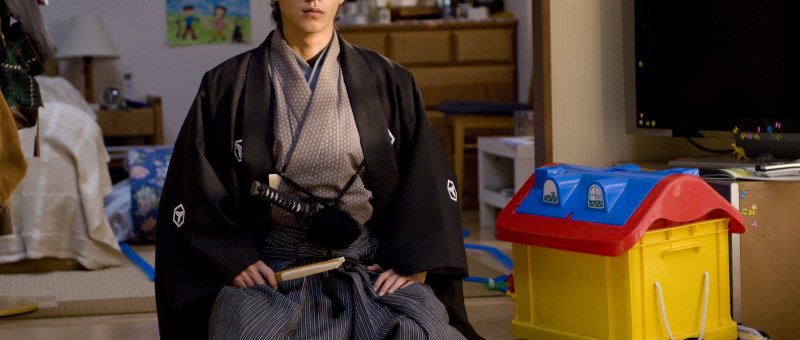
 Edo/Tokyo – what difference can a name make? A lot, it seems, but then perhaps not so much as you’d think. “Edo” was the seat of power in Japan from 1603 until it was renamed “Tokyo” during the Meiji Restoration, heralding a brand new era of modernity following more than 200 years of self-imposed isolation. Logically, there must have been people who went to sleep in Edo and woke up in Tokyo, but most of them didn’t nap for nearly 200 years. The hero of A Boy and his Samurai (ちょんまげぷりん, Chonmage Purin) didn’t exactly nap either, but he’s fetched up 200 years in the future, which, you have to admit, is very disorientating.
Divorced single mother Hiroko (Rie Tomosaka) is late getting her 6-year-old son Tomoya (Fuku Suzuki) out of the house and on his way to school so she’s less than interested when he suddenly stops in the street to stare at a severe man in samurai dress standing outside a supermarket. Assuming it’s some kind of advertising stunt, Hiroko drags her son away, but the man turns up again later wandering around their apartment block and seemingly very confused. Hiroko tries to help him, but he is extremely rude and intimidating, eventually demanding to be taken back to her apartment almost at sword point. Nevertheless, once everyone has figured out the man, who says his name is Kijima Yasube (Ryo Nishikido) and he’s a samurai retainer, is either quite mad or a time traveller, the trio being living together and trying to bridge their very different social values.
Those values have obviously changed a lot, but in many ways not enough. Hiroko has a regular job at an advertising agency but is disrespected by some of her colleagues because she can’t work overtime and has to leave early to make sure someone picks up Tomoya. We learn that the reason she divorced her husband two years ago is that while he pretended to be modern and progressive, he was unwilling to share his portion of the domestic burden and secretly wanted his wife to quit work and look after the house despite superficially encouraging her with her career. Hiroko figured it made no difference if he was around or not, so she left him and took Tomoya with her. Hiroko likes her job, but working also reinforces her individual identity (even if blending into the corporate) aside from that of wife and mother which has all too often been all that a woman is in a rigid and conformist society.
Indeed, when Yasube first arrives he adopts a superior tone and refers to Hiroko only as “woman”, viewing her as necessarily inferior by reason of sex while also reasserting himself as a samurai communicating with someone he assumes to be of the lower orders. Yasube is stunned to learn that Hiroko has a surname – a reminder that those of the lower orders did not (officially) have surnames until the Meiji Restoration. He now thinks she must be very noble, adopts a suitably humble tone, and resigns himself to accepting her hospitality in the absence of other options. He can’t get his head around her family situation or process the various motions towards sexual equality the modern world has produced. To him women manage the house and men protect it from outside. He finds Hiroko’s desire for independence strange and this new world uncivilised.
Nevertheless, he decides to give the Tokyo way a go by stepping briefly beyond himself – in return for room and board, he’ll effectively become Hiroko’s “wife”, managing all the domestic chores while she concentrates on her career. Yasube finds a strange affinity for domesticity, quickly getting to grips with white goods and taking recipe notes from cooking TV (to write them down with ink and a brush using classical Japanese script). Despite never tasting them before, he finds himself a natural baker providing sweet treats for all. However, Hiroko perhaps disappoints herself by accidentally slipping into the role of workaholic salaryman, suddenly embracing the art of overtime and leaving everything at home in the capable hands of Yasube without really considering his feelings even if he never seems to resent it.
Trouble brews when Yasube gets the opportunity to build a career of his own as a pastry chef. Hiroko, true to her word, is encouraging and obviously wants to give him the opportunity to fulfil himself, but the same situation recurs – Yasube becomes obsessed with his professional development leaving little Tomoya brokenhearted and missing his surrogate dad. The problem isn’t so much gender roles as a reluctance to fully commit by agreeing to share domestic responsibilities equally in recognition of equal commitment to a mutual endeavour. Then again, Yasube disappoints – his Edo ethics reassert themselves. he answers Hiroko’s pleas that he spend more time with Tomoya by suggesting she quit her job so he won’t be lonely while his wages can support them as a family. He thinks he’s saying something nice, confirming his loyalty to them as a father figure who will protect and provide, but it’s the wrong the thing to say and only goes to show that his “ancient” way of thinking is sadly not quite archaic enough.
Likewise, his old-fashioned parenting style of fatherly authority advanced with shouts and stares would likely not be approved by most today but it does uncomfortably seem to be accepted by the film, as if Tomoya needs male parental input rather than just benefiting from having a mum who’s less tired and stressed out for having someone to share her life with. He does, however, soften on exposure to Tokyo liberality, willingly embracing modern equalities in realising that there’s nothing wrong with a man supporting a woman and a child in ways other than the financial even if he eventually goes back on it when presented with the opportunity to reassert his male pride as a provider, declaring that domestic matters “no longer concern” him now that he has “other duties”. “Tokyo” still has a ways to go (where doesn’t?), but it’s moving in the right direction even if there are some who are content to be slow in catching up.
Original trailer compilation (no subtitles)
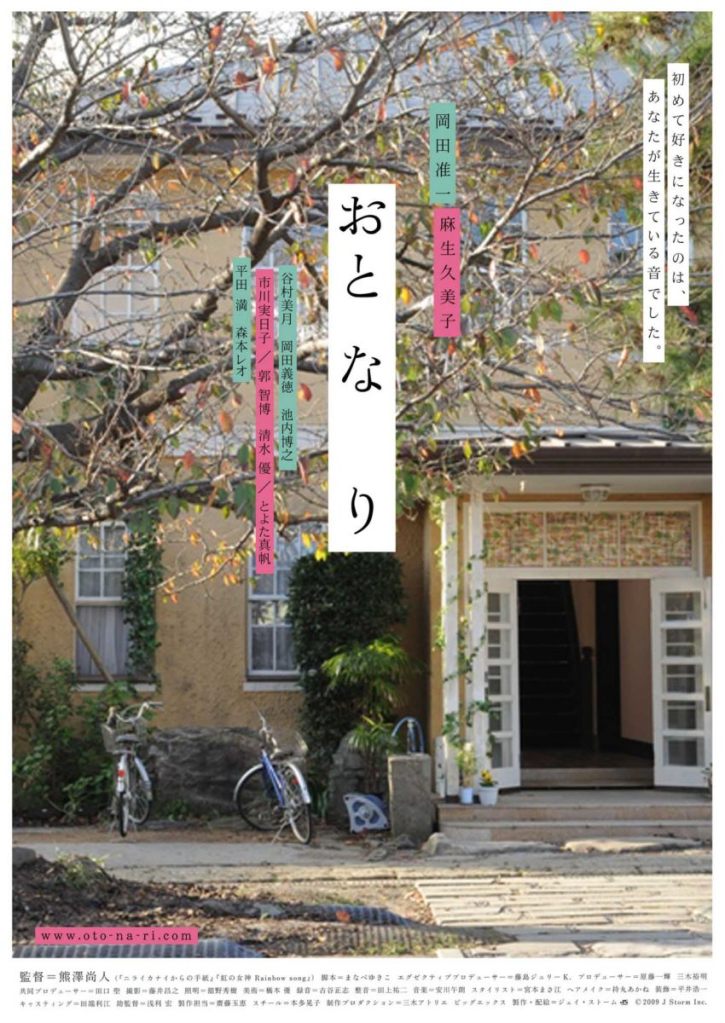 Sometimes when you live in the city it’s difficult to build meaningful connections with other people. You might find yourself a little lost, caught between the rat race and what it was that brought you to the city in the first place, but if you just close your eyes and listen, you can hear that you’re not alone. Romantic Prelude (おと・な・り, Oto-na-ri) is the story of two such people who build up a strange connection even though they’ve never really met.
 Windows on Worlds