
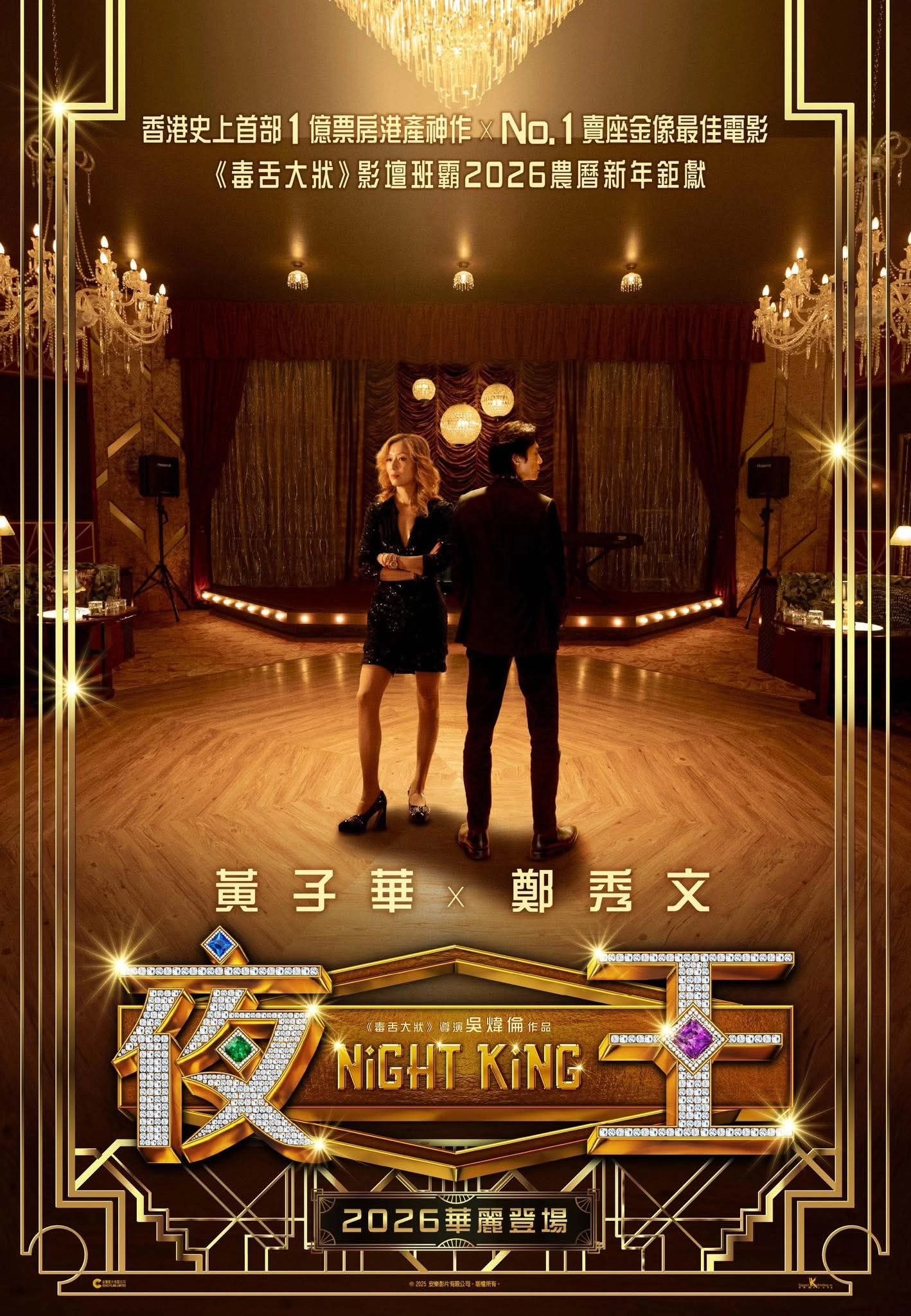
Night King (夜王, Jack Ng Wai-Lun, 2026)

Times are changing in the Hong Kong of Jack Ng Wai-Lun’s Lunar New Year comedy, Night King (夜王). Reuniting the team behind the megahit A Guilty Conscience, Ng paints the tiny enclave of old-fashioned hostess bars at its centre as the last bastion of a disappearing culture where a good-hearted manager holds out against the encroaching forces of capitalism in the form of his ex-wife, Madam V (Sammi Cheng), who is determined to buy the club and rule all of East Tsim Sha Tsui. 

Back in the economic boom of the 80s and 90s, Foon (Dayo Wong) ruled the roost as the famed “Night King” of the entertainment district, but these days clubs are closing reft, left, and centre, while his EJ is one of the only holdouts left alongside Madam V’s Muses. Madam V has poached several of Foon’s best girls which is why his bar is understaffed, but there’s no real denying that the place is on its way out because customer behaviour has changed. Madam V bristles when her boss’ nerdy son Prince Fung (Siuyea Lo) suggests young people don’t go to places like these any more and they’re better off turning it into a modern nightclub instead, but he does have a point. Most of the clientele are elderly men who might be rich but won’t be very coming for very much longer while there’s no one really there to take their place. The younger men who do come, like Fung, on occasion, are there because, as Foon says, hostess bars are naturally places where information circulates freely.

To that extent, Madam V represents an incursion of modern capitalism as she ruthlessly takes her red pen to the books and insists on getting rid of unpopular girls. Rather than the current system, she suggests switching to a pageant style in which the girls are brought in en masse with the customer taking his pick, which somehow seems even more sexist and sleazy than before. Madam V’s ambition seems to have been one reason for the marriage’s failure and it’s clear that she resents Foon for being a soft touch. As she says, he lends money to every girl that asks him and is actually quite supportive of them in a way that makes this business seem less exploitative than it might otherwise be. In any case, he’s determined to hang on to his long timers even if some of them have aged out of active hostessing while Madam V wants to bring in her army of soulless and identical ringers.

So the question is really, is it better to go down with the ship clinging to the past or join the capitalist revolution alongside men like Fung who no longer value Hong Kong and do most of their business abroad. Of course, there might be another way if Madam V and Foon can find their way back to working together, but the first problem is the petty princeling with a sexist chip on his shoulder because he can’t accept it that his sister is a better businesswoman and the likely heir to his father’s empire. His family seem to have written him off already, and sadly they may have been right. Giving himself a glam up, Fung shows up at the club like a playboy throwing his money around, but has secretly teamed up the widow of Foon’s late Triad godfather to screw over Madam V for the purposes revenge, while Mrs Wong simply wants rid of the club because she couldn’t stand her husband’s involvement in the seedier side of his business as a violent gangster. 

As in so many recent Hong Kong films, the idea seems to be that it’s better to let go of the past and take with you only what you can carry. Foon and Madam V eventually open a new club that’s fully their own rather than inherited or run on behalf of a backer. In essence, it’s still a hostess bar, but in a different part of town and more modern in sensibility, skewing young professional rather than elderly billionaire. Foon too is dressing in a more contemporary fashion, abandoning his colourful open-neck shirts with visible medallion and jeans for a smart suit jacket and turtle neck. Nevertheless, Ng seems to be looking back rather than forwards in his directorial style including typical elements of 80s and 90s cinema such as slow motion, freeze frames, and fade to black transitions perhaps to echo the ways in which Foon is stuck in the past. The eventual message though is one of solidarity and creating your own space outside of whatever external forces may be constraining it.


Trailer (Traditional Chinese / English subtitles)
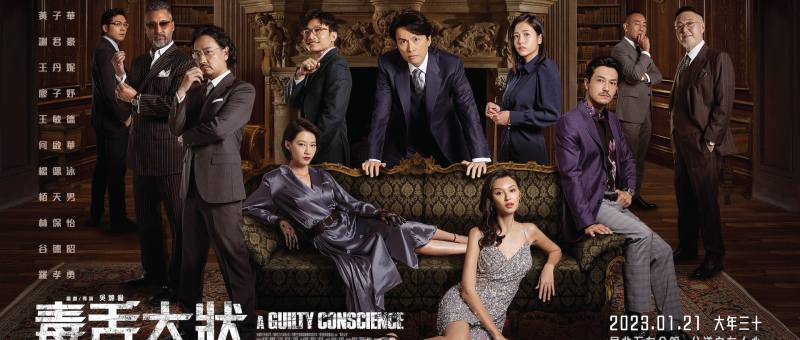
A Guilty Conscience (毒舌大狀, Jack Ng Wai-Lun, 2023)

“Something is wrong” a defence lawyer eventually asserts, witnessing a blatant attempt at perverting the course of justice right in front of her but otherwise unsure what to do about it when her opponents are so sure that they really are above the law. The directorial debut from screenwriter Jack Ng Wai-lun, A Guilty Conscience (毒舌大狀) is the latest in a series of films to put the judicial system on trial in pointing out that we are not in fact all equal before the law and the systems that are intended to protect us can often by subverted. 

Subverting the legal system was in a sense what the hero, fast-talking lawyer Adrian Lam (Dayo Wong Chi-Wah), had been trying to do. After years on the bench, his career as a magistrate is going nowhere and he doesn’t really bother to show up anymore which is why he’s abruptly demoted to a committee dealing with potentially obscene material. Cutting his losses, he decides to join the private sector working for a sleazy firm representing the rich and powerful. His first case is supposed to be a walk in the park, defending a woman, Jolene Tsang (Louise Wong Dan-Ni), accused of murdering her daughter. As usual, Lam assumes the case will be easy to win and doesn’t really bother putting the work in, especially once he finds out the mother was the mistress of a powerful man, Desmond Chung (Adam Pak Tin-Nam), and assumes sorting out the murder charge will help him get in with the elite. Only Lam badly miscalculates and owing to his own hubris sees his heartbroken client sentenced to 17 years in prison for a crime she almost certainly did not commit. 

It’s a huge wake up call for Lam who is suddenly snapped out of his cynicism and burdened by the guilty conscience of the title knowing that it’s his sloppiness that sent a bereaved young mother to serve out the rest of her youth in jail. Opening a small office of his own in a rundown part of town he resolves to serve a better kind of justice, but also determines to do what he can for Jolene in an effort to correct his mistake. He gets a chance when someone involved with the case dies and leaves a note explaining that they lied during the original trial, but as the wealthy Chung family is involved he finds himself frustrated at every turn. No one is brave enough to go against them, while their sleazy legal advisor Tung (Michael Wong Man-Tak) continues to manipulate the system to his own advantage. 

Lam may have to play a little dirty, appealing directly to the jury and wilfully breaking court procedure to make sure they hear evidence which is otherwise inadmissible, but does so in the interest of “truth” which according to Tung has no place in a court of law. Tung may well be correct, objective truth is largely irrelevant when rhetoric and legal argument hold sway. What’s morally wrong might not actually be against the law, while doing what’s right might also get you into trouble. That’s where the jury comes in, Lam answers, as a kind of check and balance using common sense to temper cold legality and decide what might best serve a kind of moral justice rather than simply answer if an offence has been committed under the law. 

But Tung calls the jury “laymen”, implying they are too stupid to understand legal complexities and are in fact a spanner in the works of justice. He objects to the introduction of “feelings” and preaches “fairness” while manipulating the system to his own advantage. Lam catches him out by needling at his elitism, pointing out that he may think he’s an elite now that he hobnobs with the rich and powerful but in their eyes he’ll never really be their equal in a world still ruled by old money. In a case Lam presided over in which a young man was accused of stealing a pair of ready meals from a convenience store where he’d previously been employed, he asks the defendant if he thought poverty was an excuse to do whatever he wanted, irritated by his attempt to manipulate his feelings by emotionally blackmailing him in claiming the meals were for his elderly parents and only taken because his boss had not paid his wages. Nevertheless, Lam had acted in the interests of “fairness” spotting that he was being asked to repay the full price in compensation when the meals he stole were actually heavily discounted and adjusting the amount accordingly. In effect Lam does something similar in defending Jolene, asking the rich if they think their power and status puts them above the law. The Chungs at least clearly think they do, doing their best to intimidate and frustrate the course of justice. 

“Everything is wrong” Lam adds during his closing speech, decrying the influence of wealth and power not only in the judicial system but in society at large. Tung thought he could manipulate the prosecutor (Tse Kwan-Ho) in knowing him to be a stickler for letter of the law, but even he knows that sometimes you might have to break the rules to do the right thing and to apply the law incorrectly would not be in the best interests of justice. With strong comedic undertones and warmhearted charm, Ng’s farcical courtroom drama discovers that the real culprits are privilege, elitism, corruption, and ambition but that justice can be served if only we apply a little common sense. 


A Guilty Conscience is in UK cinemas now courtesy of Magnum Films Global.

Original trailer (Cantonese with Traditional Chinese / English subtitles)