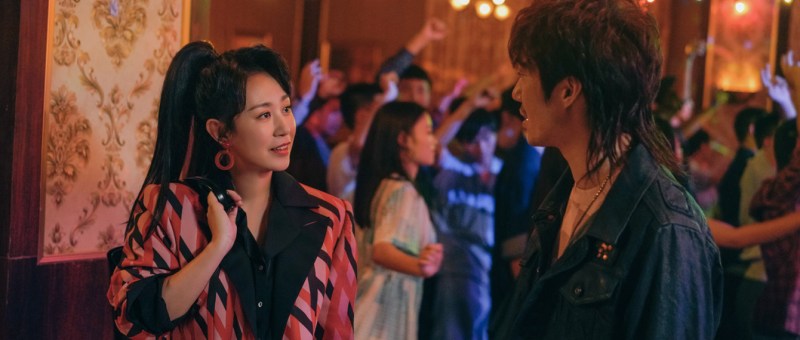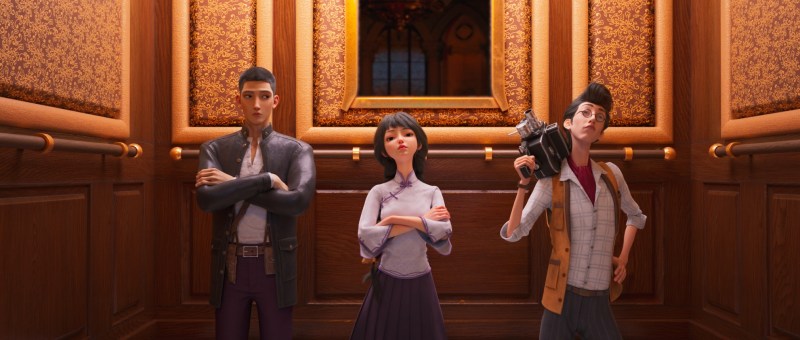
Deep in the Mountains (如意饭店, Li Yongyi, 2025)

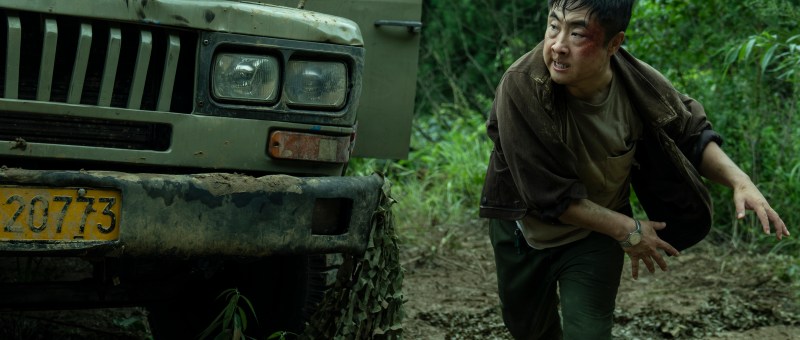
Such in the confusion in mid-90s China that the chaos has penetrated all the way to a remote village in Li Yongyi’s satirical farce Deep in the Mountains (如意饭店, rúyì fàndiàn). What begins as gritty Sino-noir soon turns into black comedy as the unfairly demoted policeman hero finds himself chasing a serial killer right into a traditional village community that seems to be home to some of the nation’s least astute people who are themselves caught between the old China and the New but also obsessed with their own status and petty vendettas.

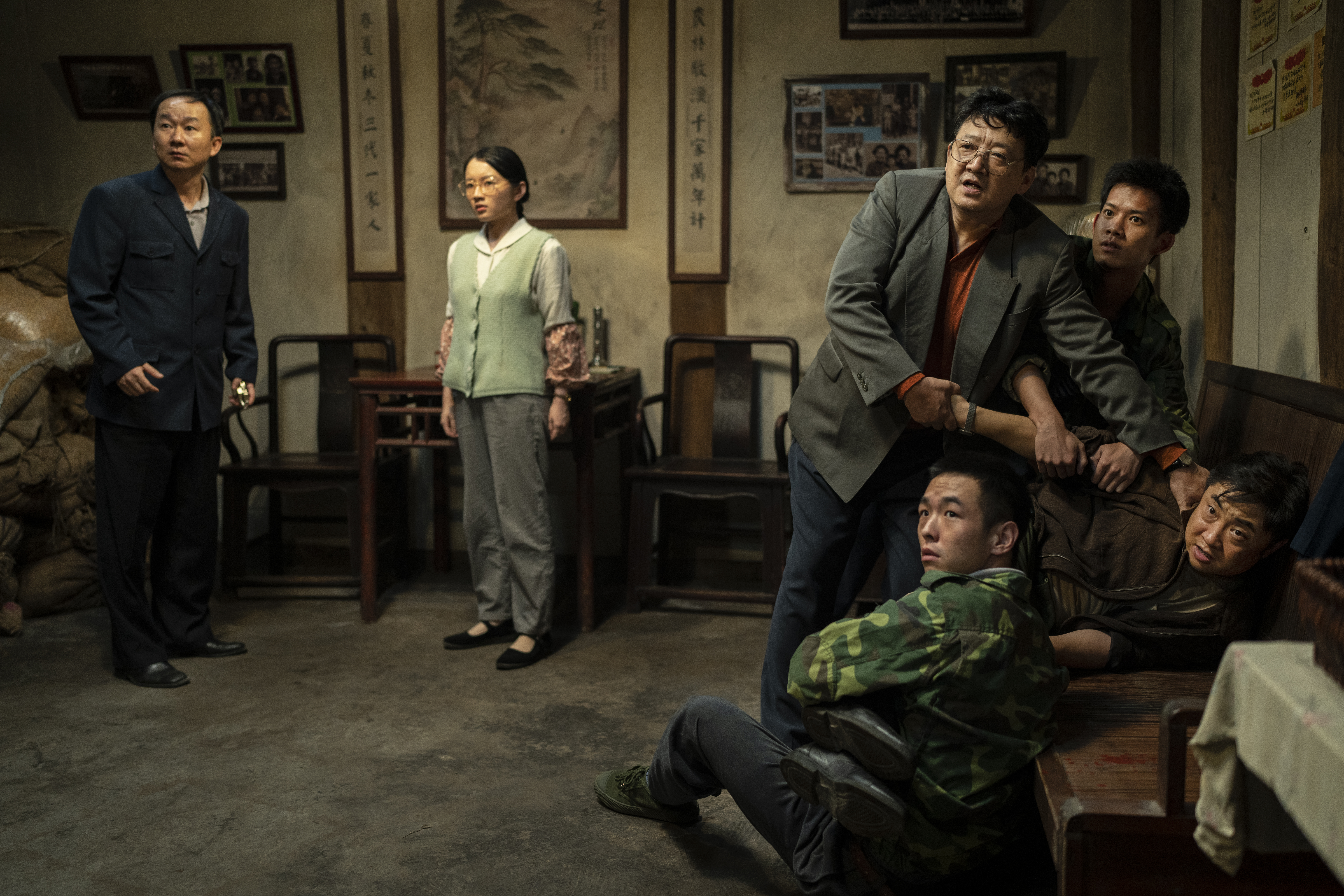
The problems begin when middle-aged former detective Yao (Qiao Shan), now working as a vehicle checker after being demoted for chasing a woman he thought was a missing person while in his underpants which frightened her so much she ran into traffic, is knocked out by criminal mastermind Ge Wenyong (Wang Yanhui) and the pair are taken into custody by the current village chief’’s daughter. She hopes that by catching the “thief” before the public security representative she can secure her succession to the role. As such, she’s inclined to believe Ge Wenyong when he says that he caught Yao breaking into his restaurant while as Yao came out in search of his missing friend on his off hours, he doesn’t have anything on him that proves he works in law enforcement. The villagers’ inability to believe him signals their declining faith in the authorities, while Ge Wenyong signals the rise of the new merchant class which is in this case quite literally bludgeoning the workers to death. 

As a vehicle checker, Yao is immediately suspicious when one of the fog light caps he fitted on a now-missing lorry turns up on another one. The increasingly nervous driver tells him there’s an out of the way place where people sell parts from scrapped vehicles on the black market. Amid the economic reforms of the 90s as the nation transitioned away from the planned economy to a market one, many lost their jobs along with, at least as far as the film goes, their moral compass. Infected by greed, they climb over each other in search of material wealth. In some ways repentant lorry driver Yang is symbol of this newly materialistic impulse. His business went bust and he’s racked up massive debts which is why he ended up becoming a long-distance lorry driver. Even if his gift of pretty white shoes for his wife hints at this new consumerist society in their frivolity, the fact that Yang is dying of pancreatic cancer suggest that he too has been poisoned by the corrupting influence of capitalism. Now his only wish is to clear his debts so that his wife and daughter won’t be burdened by them when he’s gone. 

There are a series of family photos that appear in the film besides the one that Yang keeps in his lorry beginning with the wedding photo which is dramatically shattered in the opening sequence. The “missing” woman we’re first introduced to is perhaps of this new China and looking for a more modern “freedom” in fleeing an abusive marriage to a man who tells the police that he didn’t hit her “that hard”. But unfortunately, she ends up running into Ge Wenyong who takes her prisoner and forces her to be a tool in his dark and exploitative criminal enterprise which involves knocking off lorry drivers and stealing their vehicles which are often carrying new consumerist goods such as televisions and video players. Yet, suave and manipulative, he manages to convince the villagers that he is actually an undercover public security agent while Yao is just a thief. 

Meanwhile, they squabble amongst themselves while ironically preparing to accept an award as a “civilised advanced village”. The title cards at the end of the film assure us they were all punished too for “obstructing official duties, picking quarrels and provoking troubles”, though they are perhaps symptomatic of the problems of the old China, which have not exactly gone away, in their petty politicking at the expense of the people they’re supposed to be protecting. Yao, however, is redeemed by solving the case, if not without a few casualties, and is rewarded with reinstatement as a detective. He continues to be plagued by anxiety about the “missing persons” of China’s transitionary period as a representative of an authority almost certainly a little less benevolent than it’s being made out to be if also positioned as the only real force of resistance towards the rise of rampant capitalism and heartless “entrepreneurs” like Ge Wenyong.


Deep in the Mountains screened as part of this year’s New York Asian Film Festival.

Panda Plan (熊猫计划, Zhang Luan, 2024)

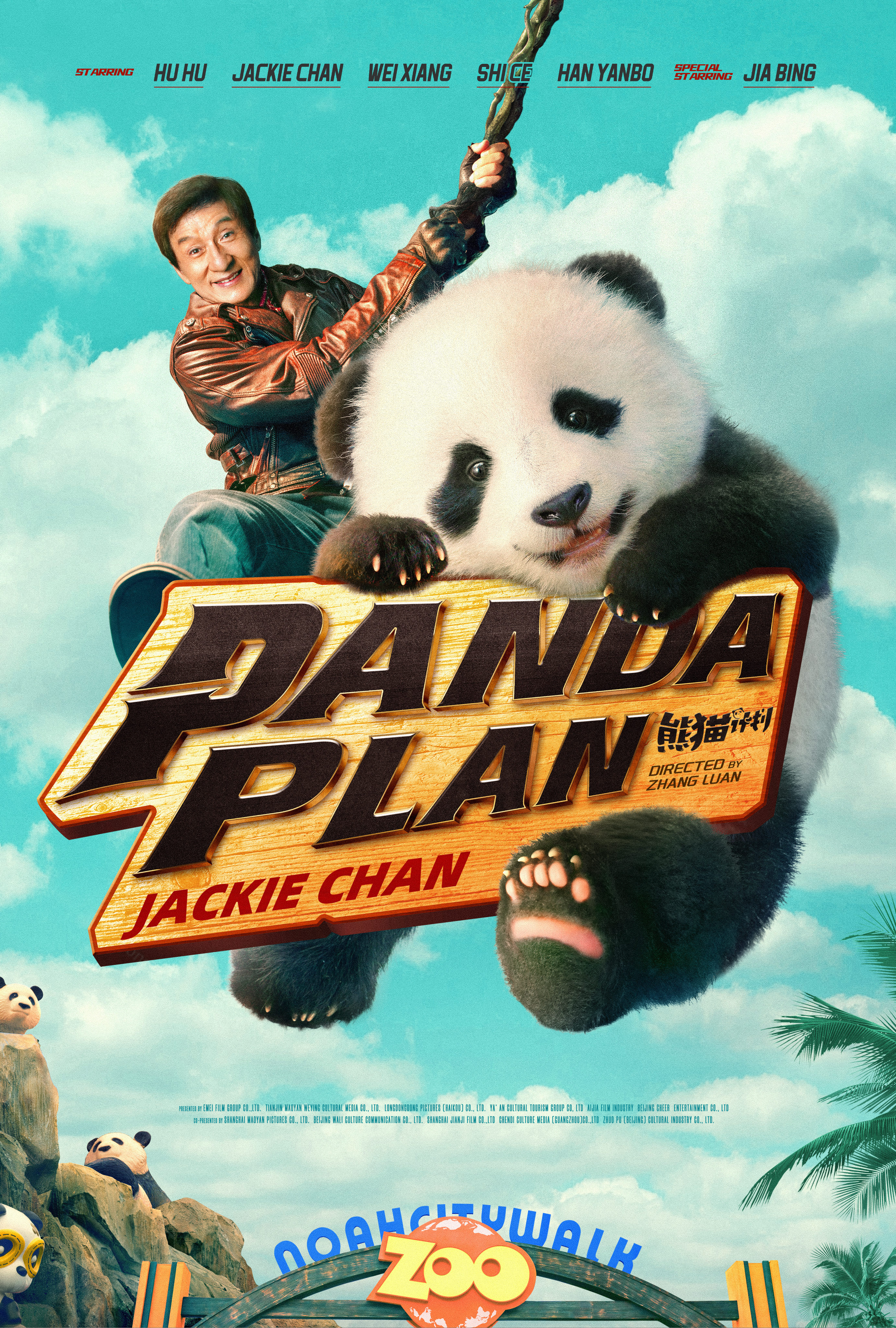
Now 70 years old, Jackie Chan’s later career has mostly seen him trying to find ways to mitigate his age. Often he’s played the role of a mentor figure taking part in a limited number of action scenes while a younger actor does the heavy lifting and takes care of any romantic subplots. Rest assured, there’s no romance in Panda Plan (熊猫计划, xióngmāo jìhuà) but it does otherwise see Chan trying to recapture past glory in seemingly appearing in lengthier action scenes while playing a version of himself.

As the film’s Jackie, he tells young panda nanny Zhuzhu (Shi Ce) that the reason he can’t bring himself to retire is that as soon as someone shouts “action” he can be an all powerful hero rather than a flawed human being that gets sad or tired or beaten down. He even pokes fun at himself with an early scene of Jackie shooting a movie and challenging the director that it’s unrealistic for him to take out all these bad guys all on his own. Though he is apparently sick of doing action, all of the directors future ideas for him sound like they will once again involve quite a lot of fighting. 

It is then a bit ironic that Panda Plan’s action scenes are often choppily edited because it’s obvious that they’re cutting back and fore between Chan and a stunt double with quite a lot of CGI filling in the blanks. You can even clearly see the heavy duty knee pads Chan is wearing under his suit, not that he shouldn’t have them, only that more care wasn’t taken to make them less visible considering there’s no situational explanation for why he’d be wearing knee pads to attend this ceremony marking his decision to “adopt” a baby panda at a random zoo in a fictional country where almost everyone speaks Mandarin. 

The baby panda has become a viral star because of its “unique” look with one eye patch smaller than the other. A sheik apparently decides he must have this panda and hires a bunch of mercenaries to kidnap it when his attempts to buy it fail. Of course, Jackie can’t let this happen and is determined to protect the baby panda from the international kidnappers. A panda is after all a symbol of China itself which can’t simply be bought by outside powers or the super rich while many of the mercenaries, who it’s implied are probably Eastern European, speak with American accents though in a stroke of luck, the main two turn out to be huge Jackie Chan fans and decide to help him so they aren’t that bad really while the leader actually seems to be Chinese anyway. That said, the guards at the zoo are both American and are shown to be slacking off at their job, eating donuts while remarking that they have an easy day ahead of them. It turns out the sheik had a heartrending reason for wanting the panda which wasn’t about the excesses of the super rich and Jackie’s decision to help him out paints China as generous and compassionate rather than coldhearted and possessive over its pandas.

In any case, despite the mild violence of the action scenes the film appears to be aimed at a family audience and has plenty of farcical humour as Jackie and Zhuzhu try to outsmart the kidnappers and save the panda who is eventually deposited at a panda park in China proper which is to say brought home again, where it belongs. The panda is rendered in unconvincing CGI but as using an actual panda would not be appropriate perhaps that really is the best solution and at least it’s a pretty cute CGI panda even if it’s obvious that it was added afterwards. The panda rescue being so successful, Jackie also gets asked to rescue the late Queen’s kidnapped corgis though it’s quite clear that he already has a very busy social calendar and is really getting fed up with doing action. Even so it has to be said that there’s already a Panda Plan 2 scheduled for release later this year, so he’ll presumably have to do some rescuing again.


Panda Plan is released in the US on Digital, Blu-ray & DVD February 18 courtesy of Well Go USA.

Trailer (English subtitles)

Successor (抓娃娃, Yan Fei & Peng Damo, 2024)

Embodying the contradictions of the modern China, Successor (抓娃娃, zhuā wáwa), the latest from the FunAge team sees a billionaire father recreate a utopian vision of crushing poverty amid the socialist values of China pre the 90s reforms but only so that his son can develop a desire to become a capitalist fat cat. For all that, however, it’s also a reaction against micromanaging parents, life under oppressive state control, and a high pressure, conformist society obsessed with very narrowly defined visions of success that are increasingly at odds with what a younger generation might want.

The surprising thing is how easily the young boy, Jiye, is able to straddle these two worlds while only gradually beginning to realise that it’s odd his neighbours keep asking him complex maths questions and he’s always running into foreigners who conveniently want to know the way to the local post office. Ostensibly, the Ma family live in an old-fashioned courtyard that according to the sign over the front entrance was constructed in 1958. As the film opens, Jiye’s teacher has brought a wealthy man to their home, in fact the father of one of Jiye’s classmates, who offers to sponsor his education while each of them look mystified around the flat which seems to exist in a kind of time warp. Jiye’s father, Chenggang (Shen Teng), sends them the packing explaining that they live exactly as they want to and don’t need anyone’s help. 

Yet Jiye is fascinated by his friend’s iPad and aware of the world outside works even as his parents try live like it’s the 1960s, sitting round reading good socialist literature which is also recommend to Jiye by the man who owns the bookshop downstairs and is actually one of Changgang’s many hidden “teachers”. But unbeknownst to him, there’s a lift behind his parents’ closet door that leads to a huge control centre where his every move is being monitored. Chenggang is actually a fantastically wealthy businessman who wants Jiye to develop good character so that he can take over his business after getting into a prestigious university.

In a very high tech and invasive way, it’s a reflection of the confused ideology being forced on Jiye by unseen external forces. Once he’s a little older and able to see that his world is definitely not normal, he begins to feel as if some mysterious force is indeed controlling his life but attributes it to vague notions of fate or cosmos rather than wider authoritarianism or parental manipulation. Chenggang is convinced this is the proper way to educate his son, to give him both old-fashioned socialist values and a heathy desire to overcome his poverty and live in a fancy mansion. He feels this way in part due to his dissatisfaction with a grown-up son from a previous relationship who failed his exams and was sent to America in disgrace. Somewhat uncomfortably, one of the reasons Chenggang is so disappointed in Dajun (Zhang Zidong) who continues to crave his approval is that he’s gay and in a committed relationship with an American man who probably should have given more thought to his Chinese name. 

In order to keep up the pretence, Chenggang never tells Jiye that he has a half-brother though he does allow him to see his maternal grandparents on occasion though they, evidently very wealthy themselves, do not approve of Chenngang’s parenting and resent being unable to spoil their grandson in the way they’d like. Chenngang may have a point here, though his chief objection being that the little Jiye was already quite chubby from being relentlessly pampered lands in the realms of fat shaming rather than a serious questioning of indulgent parenting in the wake of the One Child Policy.. He didn’t want him to grow up to be selfish and entitled or to have a distorted sense of the value of money but also seems to have a conviction that the boy will just laugh and say thank you when he finds out his entire life has been a lie and his parents made him suffer needlessly when they were in reality vastly wealthy. 

But what Jiye emerges with is, perhaps surprisingly, a more wholesome sense of rebellion, stepping out from the cosseted false reality his parents had given him and prepared to chart his own course. In an undercutting of the apparent homophobia which surrounds Dajun, the film also refreshingly, and perhaps subversively given the usual treatment of LGBTQ+ themes in mainstream Chinese cinema, suggests that he has done the same and was right to do so validating his relationship with Peter while a kind of solidarity emerges between the brothers in the shared defiance of the path their parents had set down for them. Often hilarious in its surreal humour and penetrating in its satire, the film echoes a sense of dissatisfaction amid contemporary youth no longer so hung up on outdated ideology and craving more individual freedom in a society in which lives can ultimately feel oppressively micromanaged by shady, unseen forces.


International trailer (Simplified Chinese / English subtitles)

Give Me Five (哥,你好, Zhang Luan, 2022)

A struggling 30-year-old begins to repair his relationship with the difficult father he believed never liked him after being unexpectedly thrown back to the past and almost erasing himself from history in Zhang Luan’s sci-fi-inflected tale of filiality, Give Me Five (哥,你好, gē nǐhǎo). What begins as a Chinese riff on Back to the Future eventually skews closer to recent hit Hi, Mom which the Chinese title subtly echoes as the hero comes to appreciate the power of maternal love and sacrifice through bonding with the younger versions of his parents. 

Now 30 years old, Xiaowu (Chang Yuan) explains that he was long estranged from his grumpy father Wu Hongqi (Wei Xiang) and rarely visited him but has since become his main carer now that he is living with Alzheimer’s. Xiaowu makes his living as an e-sports entrepreneur which is not something former engineer Hongqi can well understand and in truth Xioawu doesn’t seem to be that successful as he’s been putting off proposing to longterm girlfriend Huahua because of an anxiety about his finances. When Hongqi suddenly jumps off a bridge for no apparent reason and ends up in a coma, Xiaowu is at first oddly pleased and immediately begins raiding his office looking for his bankbooks only to find a mysterious ring and an old diary penned by his mother who died when he was a baby. Putting the ring on sends him back to 1986 where he manages to mess up his parents’ meet cute, endangering his own existence. In order to put things right he has to go back in time Marty McFly-style to ensure his mum and dad fall in love just like they were supposed to. 

Back to the Future is a film from the 1980s expressing nostalgia for an idealised 1950s small-town America. Give Me Five to a degree romanticises the China of the mid-1980s but does so from an entirely different angle than the recent trend in 80s nostalgia which has taken hold in the West in that, other than a brief romantic moment featuring Teresa Teng’s Tian Mi Mi along with a few other retro hits, it is largely uninterested in pop culture or revisiting childhood memories but is attempting to draw a comparison between China before economic reform and the ultra-capitalist society of today. In what some might see as a simpler time, Xiaowu’s mother Daliu (Ma Li) is, as she’s fond of saying, a “model worker” in a factory which is in danger of closure while the “Biff” character, Qiang (Jia Bing), is a former employee who was dismissed for stealing coal. Having become wealthy after almost certainly doing something dodgy in Hong Kong he’s returned with a prominent Cantonese accent to buy the factory as part of a public-private partnership. A feisty young woman, Daliu sends him packing insisting she won’t let anyone disadvantage her fellow workers. 

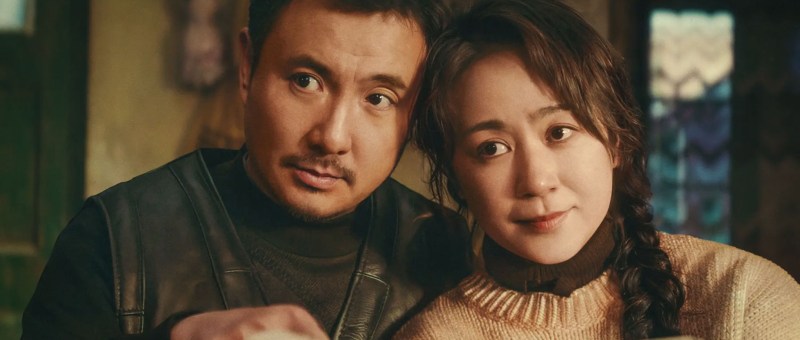
The comparison is further borne out by the melancholy figure of Qin (Huang Yuntong) who dated Hongqi after getting the meet cute that was supposed to go to Daliu but thew him over for the promise of riches with Qiang only to be left lonely in her old age having unwisely betrayed love for material gain. Meanwhile, there’s an interestingly progressive element to the relationship between Daliu and Hongqi in which Hongqi is somewhat feminised as the domestic partner cooking and shopping for his wife while Daliu is the uncompromising model worker as she proves during a high impact welding competition while eight months pregnant. The couple first fall in love talking over industrial plans with Daliu offering advice from the shop floor to help improve educated engineer Hongqi’s designs. While interacting with his parents before he was born, Xiaowu gains the familial experience he always felt he lacked in being able to share a family meal while touched by the love that existed between his mother and father and the knowledge that his parents were at least blissfuly happy with each other even if it was only for a short time. 

Xiaowu had been resentful of his father that he never really told him how his mother died. He decides to try saving his mother’s life too and through his various experiences comes to an appreciation of maternal love not least through somehow being able to time travel into the womb to forge a more direct connection with her. In part an advocation for a more traditional filiality in which Xiaowu develops an understanding of the interplay between love and sacrifice between parent and child while coming to understand his relationship with his father after learning his family history, the film also offers a subtle rebuke against the consumerist society in idolising Daliu and her model worker attitude insisting that everything was better when people worked together for the good of all rather than for personal gain. It might be a slightly disingenuous message, Daliu’s factory life is indeed somewhat idealised, but there is something touching in Xiaowu’s eventual conversion and belated bonding with his heartbroken father. 


Give Me Five is in cinemas across the UK, Australia and New Zealand courtesy of CMC and Well Go USA in the US and Canada.

International trailer (Simplified Chinese / English subtitles)