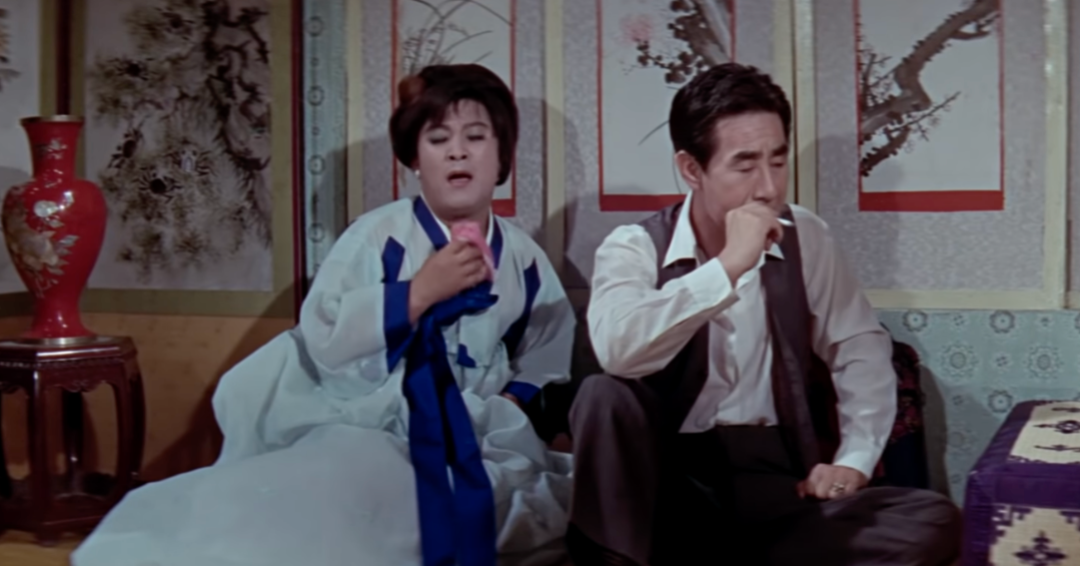
A Man and a Gisaeng (남자와 기생, Shim Wu-seob, 1969)

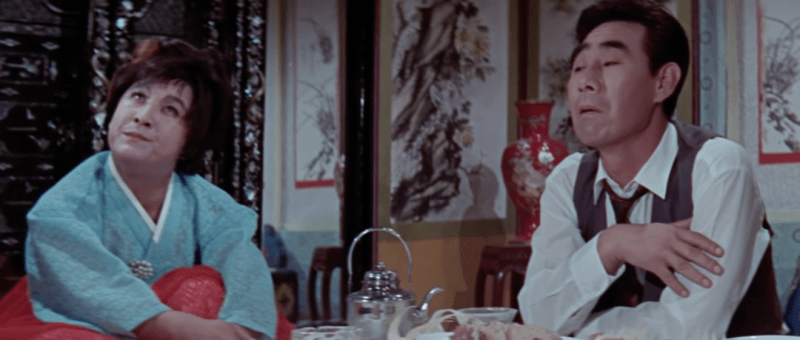
Under the authoritarian regime of Park Chung-hee, Korean Cinema was subject to increasingly stringent censorship and film was seen as an important means of moral instruction. The central message behind Shim Wu-seob’s raucous comedy A Man and a Gisaeng (남자와 기생, Namjawa Gisaeng) is that a man should be faithful to his family and avoid the double betrayal represented by drinking in the company of women which fritters away financial security and endangers his relationship with his wife. Yet the film is also subversive despite the underlying conservative message in making a mockery of so-called “traditional” gender roles.

Indeed, the film’s very thesis is that men are weak and women are strong. The men visit who gisaeng appear to have done so to reaffirm their dominant masculinity through their financial power in essentially paying women to be subservient towards them. Yet the gisaeng themselves are fully in control of the game they are playing as one makes clear when she tells a drunken businessman off after he gets handsy with her. She reminds him that a gisaeng is a person too, not a doll to be played with, and when he doesn’t listen she gets up and leaves proving who it is that has the upper hand in this situation. All the businessman can do is splutter and threaten the otherwise mild-mannered male manager. 

The hero’s boss, Heo (Heo Jang-gang), is a henpecked husband who visits gisaeng as a means of escape from his domineering wife (Do Kum-bong) who punishes him like a child. He asks Tae-ho (Gu Bong-Seo) to resign after catching him sitting at his desk darning socks to earn extra money and though it might be perfectly reasonable to fire an employee for brazenly doing another job on company time, Heo mainly lets him go because of his unmanliness. Tae-ho is a fully domesticated man who does work traditionally regarded as “feminine” in taking in sewing and looking after all of the domestic tasks such as cooking and cleaning as a “maternal” figure to his younger sister Tae-suk (Kim Chung-ja) who is then depicted as “manly” in her mastery of martial arts. 

It quickly becomes clear that the “effeminate” man Tae-ho is the film’s strongest character and the only one largely in control of his circumstances. He agrees to become a gisaeng partly because he needs to earn money after being fired, but also he claims as a “joke” before committing himself to punishing men who neglect their duty to their families by shaming them into changing their behaviour as he largely does with Heo who, bizarrely, develops a fascination with Tae-ho’s gisaeng persona San-wol as she apparently reminds him of the first love he was prevented from marrying because of her family’s disapproval. 

The gender subversion is in essence the joke, but there are also constant hints that it might not be and Tae-ho’s female persona is also authentic, not least among them the music cues which are extremely ironic. For example, the melody of “Don’t Fence Me In” plays over Tae-ho at the house of gisaeng, as do the strains of “Nature Boy” which also hint at a validation of Tae-ho’s expression of femininity. Before being fired, Tae-ho tells Heo that he’s repressing himself and it isn’t good for him, and there is a (joking) suggestion in the final scenes that Heo’s attraction to San-wol is partly born of her seeming masculinity. He did indeed unwittingly appreciate a drag performance from Tae-ho’s queer-coded musician friend, after all.

It’s also possible to read Heo’s reunion with his wife as a new appreciation for her own “masculine” qualities in her capacity to dominate him even if the film simultaneously suggests that the role of a “good wife” is to offer “affection” to her husband and if the husband visits gisaeng it’s the wife’s fault for not giving it to him. Even so, what the film’s conclusion implies is closer to a rebalancing than might be expected in allowing Jeong-mi, the gisaeng with whom Tae-ho falls in love to counter any suggestion of queerness, to open her own shop as an independent woman pursuing a relationship with Tae-ho who is then a travelling salesmen selling cosmetics. Jeong-mi asks Tae-ho to give up “knitting” before they get married which would signal a remasculinisation, but Tae-suk, though dressing in a more feminine fashion to meet her in-laws, is not directly asked to give up Taekwondo and it seems that her fiancé appreciates her feistiness rather than seeking to soften it. Even Heo’s wife if seeming more cheerful has not given up control in their marriage despite her own drag experience in the gisaeng house yet their relationship is now considered “repaired”. “Traditional” gender roles have ostensibly been reaffirmed, Heo’s marriage is saved and both Tae-ho and his sister are about to marry, but they’ve also been subverted and redefined in unexpected ways. Some of this may only be possible because A Man and a Gisaeng is an absurd comedy of the kind Shim was known for, but it nevertheless hints at an underlying plea for greater social freedom in an authoritarian era. 


A Man and a Gisaeng screened as part of this year’s Queer East .
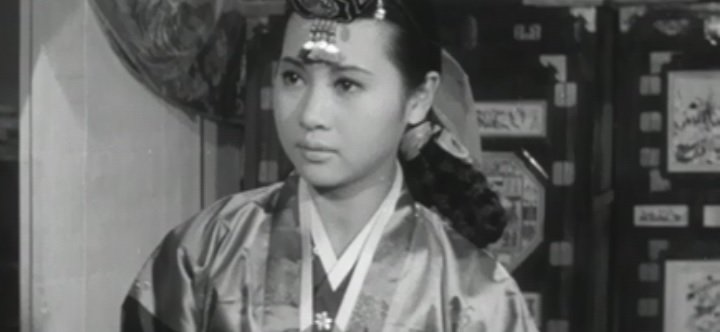
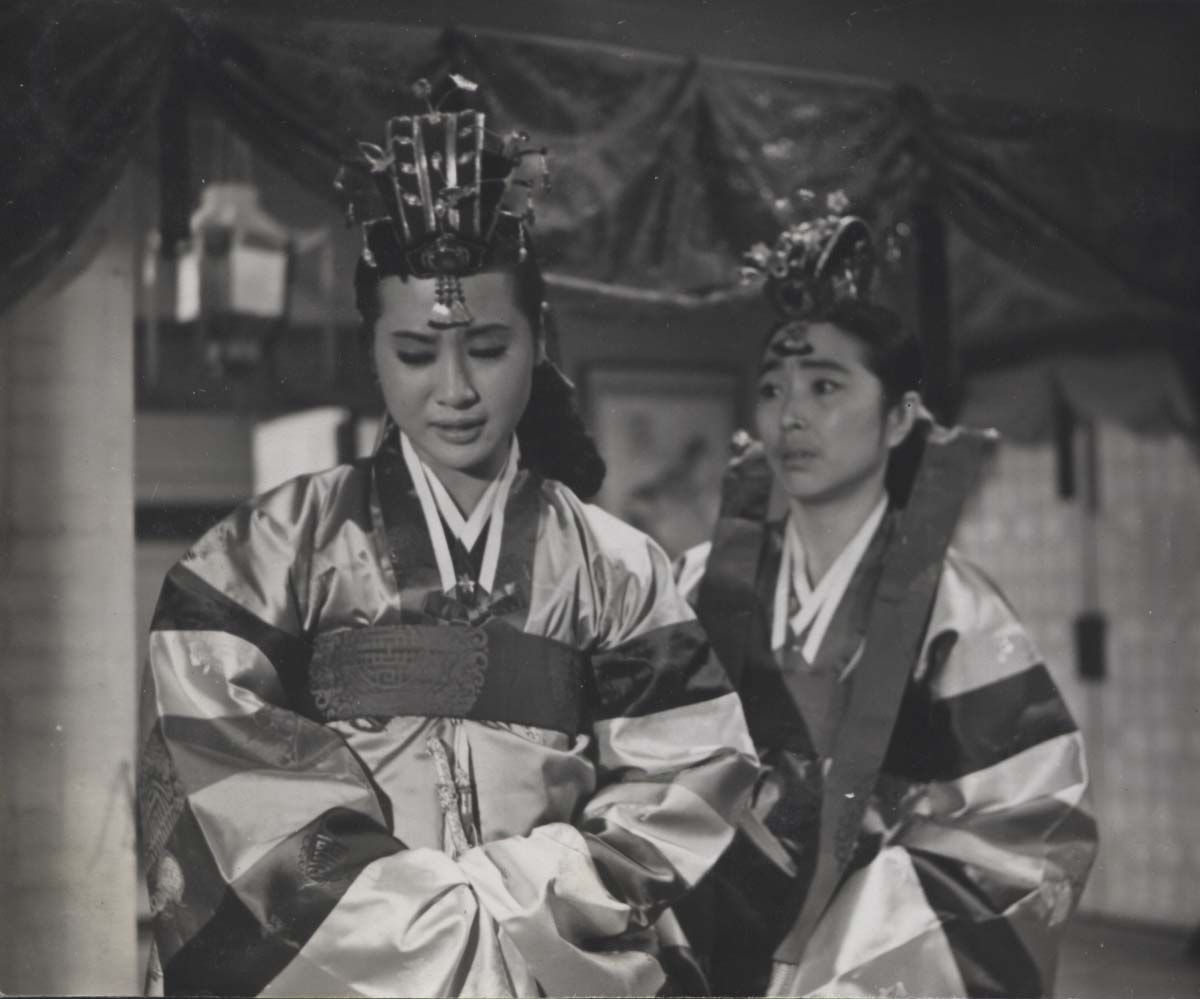
A Princess’ One-Sided Love (公主님의 짝사랑 / 공주님의 짝사랑, Choi Eun-hee, 1967)

“Those are the rules of the palace for a princess” the rebellious heroine of Choi Eun-hee’s second directorial feature A Princess’ One-Sided Love (公主님의 짝사랑 / 공주님의 짝사랑, Gongjunimui Jjaksarang) is told, though the “palace” is really the society and the “rules” those which all women are expected to “endure”. Quietly and perhaps subversively feminist, Choi’s humorous tale draws inspiration from Roman Holiday but unexpectedly engineers a happier ending for its lovelorn heroine who is permitted to transcend the constraints of her nobility if not quite of her womanhood. 

Tomboyish princess Suk-gyeong (Nam Jeong-im) is the youngest of six princesses and the last to remain at home in the palace yet to be married. Consequently, she is infinitely bored all the time and continually up to mischief in part because as a princess she is not permitted to leave the estate and has a natural curiosity about the outside world. That curiosity is further sparked when she lays eyes on handsome scholar Kim Seon-do (Kim Gwang-su) who picks up a shoe she had dropped while inappropriately running on the day of her mother’s birthday celebrations. Possibly the first young and handsome man she has even seen, Suk-gyeong cannot help but be captivated by him and manages to convince her sisters to help her escape the palace to venture in search of her probably impossible love under the pretext of visiting her grandparents whom she has apparently never visited before.  

Like Audrey Hepburn in Roman Holiday, what Suk-gyeong wants is a break from the “tedious and pathetic” life of a princess, but soon discovers herself to be entirely naive as to how the “real world” works. Her sisters agreed to help her in part because they acknowledge how difficult it was for them when they married and had to leave the palace with no understanding of how to live outside it. Having left in the clothes of a servant, the first thing that Suk-gyeong realises is that the outside world is governed by a different set of hierarchies and even if she’s a princess she is still a woman and therefore presumed to be “inferior” to men to whom she is expected to remain subservient. Her grandfather, who has never met her before, wastes no time exerting his patriarchal authority in his own, comparatively humble, home. “A woman, once married, must abide by the rules of her new family, the confucian ethics, and respect your father and husband and become a wise and obedient wife” he explains, striking her across the calves with a cane to teach her a lesson for her imperious tone in failing to pay him the proper respect. 

Failing to use appropriately polite language with those around her, forgetting that she should now be deferent both to men and to those who exceed her in age, gets her into constant trouble. Nevertheless, a trip to the marketplace gains her a further understanding of the extremes in her society firstly when she misunderstands a rice cake seller’s patter and assumes he intended to gift her some of his produce as he might to a princess, and secondly when she bumps into a woman with a baby on her back and breaks the pots she was hoping to sell to pay for her husband’s medical care. Introduced to such desperate poverty, the undercover princess knows not what to do but later gifts her a jade pin hoping perhaps to at least cure the husband’s malady, only to wander into another dangerous situation when she is mistaken for a sex worker by a trio of drunken noblemen who pull her into a drinking establishment which is in fact a brothel. Naively drinking with the men she mocks them for their attempts to play on their names each boasting of their famous fathers and personal connections to men she knows to be elderly cranks and obsequious fools. Shocked to discover what goes in establishments like these she tries to make her escape but is almost assaulted by one of the men, Shim, who is later posited as an ideal match by her unsuspecting mother laying bare another patriarchal double standard as Shim plays the part of the gentleman in order to effect his advancement. Luckily, she is saved by Seon-do who happens to be passing but mistakes her for a boy because of the disguise she is currently wearing. 

Selfish in her naivety, Suk-gyeong is warned that her impossible crush might end up harming Seon-do’s hopes of making it into the elite through success in the state exam while he, once made aware of the truth, immediately does the right thing by kindly rebuffing the princess’ inappropriate interest leaving her with a poetic love letter claiming he’s gone off to a temple for a spell of intensive study. Perhaps improbably it’s the love letter that eventually saves them, touching the king’s heart and convincing him to acquiesce to his sister’s wishes of escaping the gilded cage of nobility. Suk-gyeon’s pleas to renounce her royal title might also stand in for a desire to renounce womanhood in that it “stops us from doing anything we want. We are matched up with an unknown husband and we spend our youths in misery for our lives are tedious and pathetic”, reminding her brother that as a king but in truth as a man he cannot understand even while he reminds her that these are the “rules” endured by countless ancestors. The king is moved, he breaks with tradition and frees his sister yet he does so to allow her to become a wife even if he has also granted her the freedom to choose her husband and live in the outside world unconstrained by the strictures of nobility but nevertheless bound by oppressive patriarchal social codes. Nevertheless, it’s an unexpectedly progressive conclusion advocating for change and personal happiness over the primacy of duty and tradition. 


A Princess’ One-Sided Love streamed as part of the Korean Cultural Centre UK’s Korean Film NightsFilming Against the Odds 

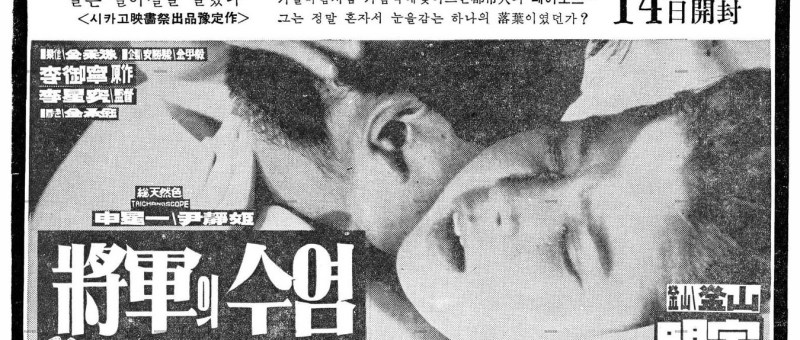
The General’s Mustache (장군의 수염 / 將軍의 수염, Lee Seong-gu, 1968)

General's Mustache posterBroken dreams of the post-war society prove too much for one man to bear in Lee Seong-gu’s masterpiece of Korean Modernism – The General’s Mustache (장군의 수염 / 將軍의 수염, Janggun-ui Suyeom). Adapted from the novel by Lee O-young, Lee’s film co-opts the procedural but subtly subverts it, taking a cue from the film noir to turn it in on itself and ask if we can truly ever know another person, or if we simply conjure an image of everyone we know based on a collection of external observations gathered by ourselves and others. Our hero, Cheol-hun (Shin Seong-il), is a melancholy man who has chosen to live in a world of his own creation but when his shield of artifice is pierced by a spear of reality he can endure it no longer. Cheol-hun is dead, but who, if anyone, killed him and can we ever really understand why he died without his words to guide us?

Lee opens with a scream as Cheol-hun’s landlady discovers his body, draped half naked over his bed next to a stove with the safety cover removed. Concluding that carbon monoxide poisoning is likely the cause of death, the police find the panicked landlady suspicious but leave with three clues – a ladies’ stocking, a missing camera, and the scar on Cheol-hun’s forehead. The stocking takes them to Cheol-hun’s ex, who tells them that Cheol-hun gave his camera to a “nude model” which was perhaps a point of tension between the two, but not apparently the reason they decided to separate. The scar, ruining the detective’s (Kim Seung-ho) theory, turns out to be an old one – received in infancy when his exhausted mother (Han Eun-jin) dropped an iron on his head after a long day at the press.

After the testimony from Cheol-hun’s mother, the scar seems incidental but turns out to be anything but. Cheol-hun’s mother blames herself for his childhood injury (as any mother would) and has spent her life worrying about him, believing that the scar itself has been the cause of all his misfortune and sent him off on an unlucky path. From Cheol-hun’s sister (Kim Sin-jae) we learn that the family was once wealthy – local landowners who valued their “aristocratic” blood. After the war all that ended. The land was given back to the people, and Cheol-hun’s family were stripped of not only of their prestige but of their means of living. Nevertheless, Cheol-hun’s austere father refused to let his children play with the “commoners”, and so little Cheol-hun’s loneliness was born.

The testimony of Cheol-hun’s former boss reinforces the view that Cheol-hun was an eccentric loner, ill equipped for life in the “real” world. A former photojournalist, Cheol-hun lost his job as a result of a disastrous interview with a recently returned scholar who had enjoyed some minor success in America. The scholar, having been abroad five years, peppers his speech with random English and puts up a pretence of having forgotten his Korean. He complains that Korean kimchee is too spicy, and suggests that the key to improving the “backward” nation lies in “reforming” the cuisine. Cheol-hun, becoming ever more irritated, offers a few barbed comments but cannot contain himself when the kids, “John” and “Mary” who do not speak any Korean, arrive. American names, he points out, are usually associated with dogs and sex workers – why would you give them to your children if you plan to live in Korea? Needless to say, the interview is over.

Cheol-hun has now been characterised as a man who cannot read the air, but it’s time to hear from him too though it will have to be second hand. Shin-hye (Yoon Jeong-hee), the girlfriend, radically changing under testimony broadly agrees with this view of the man she loved but could no longer live with. Cheol-hun told her that he’d never been good with people and had no real friends save one in the army – interestingly enough a man descended from royalty, but that he died leaving Cheol-hun alone again with the lingering guilt that he was unable to save his only friend. His tragedy is that he yearns for true connection, to truly become one with another person, but he cannot achieve it. His life with Shin-hye crumbles not because of “reality” but because Shin-hye craves the real – to live in the real world where people bleed and hurt. She cannot live with Cheol-hun in his escapist paradise, but he cannot bear to leave it.

The title of the film comes from the book that Cheol-hun wanted to write. In the story, a victorious general fighting for “independence” returns to his “liberated” country. The general is dashing and brave and he has on his face the most magnificent mustache. A weedy reporter giddily asks him if he too might dare to grow such a wonderful mustache to which the general cooly assents. Before long a mustache craze sweeps the nation. Even those who cannot grow a mustache of their own have taken to wearing wigs, but our protagonist says no. He doesn’t want a moustache and refuses to wear one. He loses his job, but it remains open whether the fact of his not having a mustache (which no one forces him to have) or his melancholy loneliness in not wanting to have one and not understanding why everyone else does is the cause of all his suffering. 

The quote at the film’s beginning, painted on Cheol-hun’s maddeningly crowded walls, reads “I refuse to, That’s why I’m alive”. Yet it isn’t quite a refusal so much as a lack of capacity. Cheol-hun’s boss had a point when he said that Cheol-hun was fundamentally unsuited to living in human society, as did Shin-hye when she described him as a lonely child in need of a guardian. If anything killed Cheol-hun, it was loneliness – a revelation which profoundly shakes the conviction of the veteran detective. After all, you can’t put handcuffs on spiritual isolation. The detective thinks of his family, and decides to take a watermelon home to share with them as means of reinforcing his own shallow connections but it’s clear that his conception of the world, of his abilities as a detective and the entire framework of his existence have been irreparably compromised by his investigation into the life and death of Kim Cheol-hun.

Partly a satirical swipe at post-war conformity, Lee’s film also subtly subverts a popular trope from the anti-communist genre in its apparent sympathy for landlords. Cheol-hun’s loneliness is posited as a direct result of his “fall” from his rightful position – the only friend he ever makes is also a fallen nobleman, and he struggles to adapt himself to the “classless” society of the “democratic” era. Yet it’s precisely these outdated ideas of “class” that have ruined his life in his father’s refusal to let him play with the other children. Cheol-hun retreats to a fantasy childhood world to avoid the harshness of modern life, but cannot escape his loneliness or his longing and when he realises Shin-hye is not the soulmate with whom he thought he could forge a new, perfectly isolated paradise, his entire existence becomes impossible.

Lee conjures a mosaic of Cheol-hun composed of the memories of those around him, gradually thickening in texture and finally coming into focus but always only a simulacrum of a man and not the man himself. Adopting a standard procedural narrative, Lee adds in extensive flashback and hypothetical dramatisations as the police investigate, switching to black and white for raw hypotheses and even breaking into elegantly drawn animation to recreate the surreal world of Cheol-hun’s putative novel. Dark and sad, The General’s Mustache seems to imply that there is no answer for solitude, that you can never really know another person fully, and that the loneliest man of all is the one born without a “mustache”, already naked of face in having no final mask to expose but finding that no one wants to see his true self only the one which is demanded he wear to appear just like everyone else.


The General’s Mustache is the third film included in the Korean Film Archive’s Lee Seong-gu box set. Also available to stream via the Korean Film Archive’s YouTube Channel.

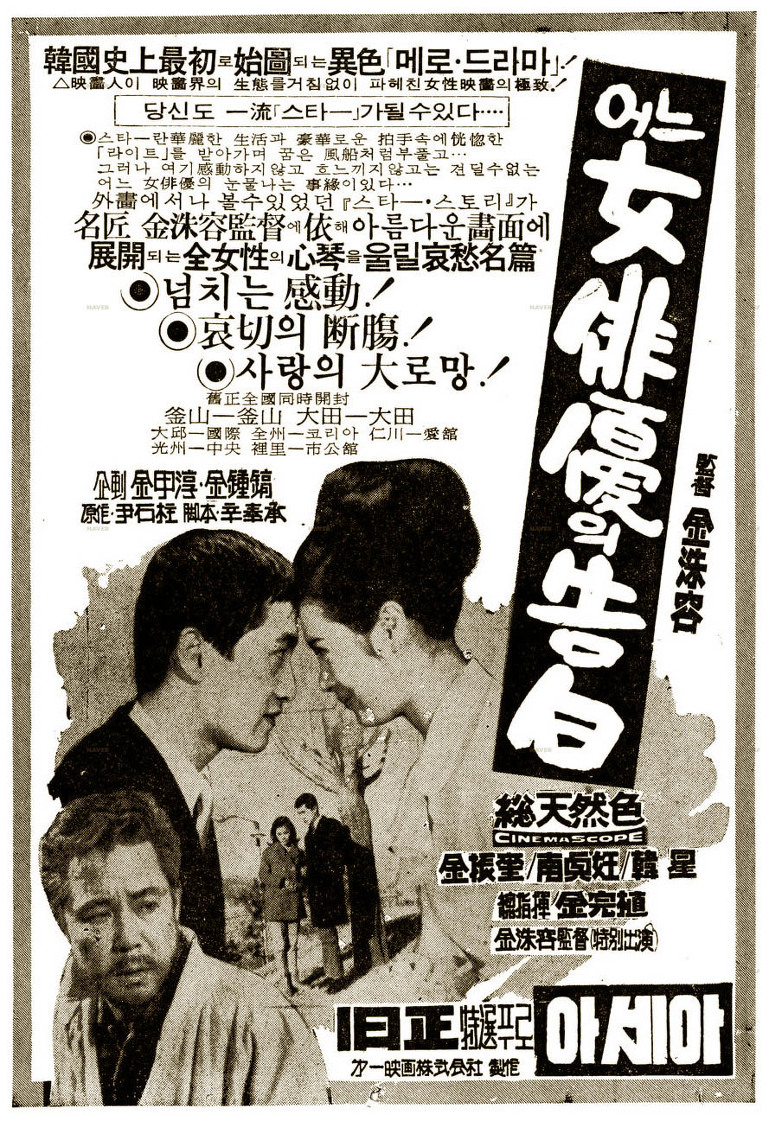
Confession of an Actress (어느 여배우의 고백 / 어느女俳優의告白, Kim Soo-yong, 1967)

Confession of an actress posterKorean filmmaking of the 1960s is sometimes referred to as a “golden age”, but the reality is that films were often churned out at a rapid pace for immediate distribution. Producers got an advance from local distributors, picked a scenario, assigned a suitable director and slotted in big name stars they already had under contract. For this reason production values are often low, but performance standard high despite the fact that many stars are bouncing around from one film to another shooting a scene here and a scene there. Director Kim Soo-yong filmed 10 features in 1967 – including his masterpiece Mist. Confessions of an Actress (어느 여배우의 고백 / 어느女俳優의告白, Eoneu Yeobaeu-ui Gobaek), inspired by a novel by Yun Seok-ju, is the kind of straightforward melodrama that was going out of style – a virtual remake of Chaplin’s Limelight with a little Phantom of the Opera thrown in, but Kim neatly repurposes it as a meta take on the Korean film industry of the day.

Kim Jin-kyu (played by the actor of the same name) was once a famous movie star, but heartbreaking tragedy ruined his career and now he’s a washed up drunk dreaming of the past. Hearing the dreaded “hey mister, didn’t you used to be somebody?”, Jin-kyu wanders into a film shoot and is thrown back to a happier time when he starred in prestige pictures with his regular co-star who was also his lover. Sadly, Miyong died of an illness leaving their last picture unfinished. The studio producers wanted to replace her and complete the movie, but Jin-kyu wouldn’t have it. They sued him for obstruction and his career was ruined. Jin-kyu was told that the child Miyong was carrying had died, but unbeknownst to him, a daughter was born and Miyong asked her friend Hwang Jung-seun to give the baby up for adoption and save it from the stigma of being illegitimate. Running into Jung-Seung at the shoot, Jin-kyu finds out his daughter is alive and determines to turn her into a great star – the only thing he can do for her as her father now that he is in such a sorry state.

Almost all of the characters in the film are named for their actors, though they are obviously not playing themselves in any biographical sense. Nevertheless, there is an intentional reflexivity in Kim’s decision to shift away from his literary source to towards one more immediately cinematic. Much as in Chaplin’s Limelight which does seem to provide a blueprint for the narrative, the arc is one of tragedy and redemption as Jin-kyu attempts to make up for lost time by imparting all his professional knowledge to the daughter he never knew and ensuring her success even at the cost of his own. Ashamed to introduce himself to her as a father given that long years of lonely drinking have reduced him to a broken old man, Jin-kyu gives his advice via letter and avoids seeing Jeong-im, longing to embrace her but afraid he’ll bring shame on her growing fortunes.

When Jin-kyu gets Jeong-im into show business, Kim gets a chance to put the Korean film industry on screen. He starts with a mildly sleazy producer and the established star who’s getting too old for ingenue roles but is desperate to hang on to her leading lady status. Nevertheless, she does have the option, as she points out, of a dignified escape through marriage should her career fail – something that is not an option for her male co-stars. As a young hopeful with no experience and nothing to recommend her beyond a pretty face, Jeong-im’s entry into the world of film is a baptism of fire. Rushed through makeup with its uncomfortable fake eyelashes and into an unfamiliar costume, Jeong-im’s rabbit in the headlights performance does not endear her to the director or more particularly the producer who is looking on from the wings in exasperation quietly calculating how much all of these extra takes are costing in wasted film. Nevertheless, the film is a success and, thanks to Jin-kyu’s careful tutoring, Jeong-im is on track for stardom.

Kim fetishises the camera, the process of filming with its bright artificial lights, tricks and techniques from the ice cold studio shoots to the difficult trips out on location. He makes full use of the relatively rare colour format utilising frequent superimpositions and montages, overlaying the bright neon lights of Seoul with the interior journey of our leading lady as she begins to find her voice. Making a final self cameo, Kim gives in to the inherently melodramatic quality of the underlying narrative but he does so somewhat ironically, rolling his eyes at the need for overly dramatic emotionality while actively embracing it, and lamenting the hardships of filmmaking while churning out his third picture in as many months. Confession of an Actress is not the salacious exposé promised by the title, but it is an illicit look at the decidedly unglamorous side of film production a world away from the bright lights and glossy magazines. 


Available on DVD as part of the Korean Film Archive’s Kim Soo-yong box set. Not currently available to stream online.