Pilot (파일럿, Kim Han-gyul, 2024)

“You can’t say things like that anymore,” the men of Pilot (파일럿) are fond of chuckling but still they think them and on a baseline level are unable to understand what’s wrong with what they see as merely offering a compliment. Adapted from the 2012 Swedish film Cockpit, Kim Han-gyul’s non-romcom takes its cues from films like Tootsie and Mrs Doubtfire to explore the inherent sexism and misogyny at the heart of contemporary Korean society if perhaps problematically doing so through the means of a male redemption story.

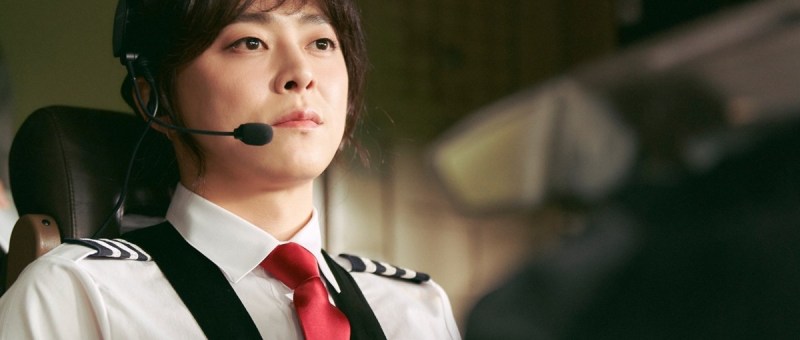
In any case, Han Jung-woo (Jo Jung-suk) is mindless more than anything else later claiming that sometimes it’s better “to say yes and go with the flow” than risk creating unpleasantness. Seemingly excelling at everything, he graduated top his class at the Korean Air Force Academy and was fought over by several large airlines becoming a minor celebrity and apparent pilot influencer. But behind the scenes, he’s somewhat false and self-involved as evidenced by his attempt to show off a video of himself tearfully paying tribute to his mother for raising him and his sister alone but refusing to answer a telephone call from her at the same time. His celebrity fame comes back to bite him when a video of team dinner in which he rejected his boss’ comment about the new intake of stewardesses not being pretty enough by referring to them as a beautiful bouquet is leaked online. The clip goes viral with his boss getting the brunt of the abuse and while he is not visible many are able to identify him by his voice. The airline soon goes bust and unsurprisingly no one else is willing to hire him. 

The issue is that neither his boss nor Jung-woo understand what was wrong with what they said. They just parrot back that what they said was nice so they can’t see the problem with it but fail to understand that their comments are demeaning because they belittle women’s talents and reduce them to objects for male appreciation. Hyun-seok (Shin Seung-ho), who attended the Air Force Academy with Jung-woo, gets him an interview at his airline but it’s run by a female CEO (Seo Jae-hee) who happens to be the sister of his old boss and is apparently on a mission to make her company more egalitarian by having at least 50% female pilots so she’s only hiring women. Nevertheless, she also asks sexist questions at the interview looking closely at a female candidate’s age and asking her if she is married or in a relationship, whether she intends to have children and when. The female candidate fires back a pre-prepared speech that she’s uninterested in marriage and is not planning to have her eggs frozen or anything like that so she can devote herself fully to the job. 

Hyun-seok expresses sympathy, echoing Jung-woo’s earlier comment that all that matters in flying is skill and people should be hired for their merits not their gender. But it’s impossible not to read into his words that he thinks women are inherently not as capable as men and wouldn’t be getting the job at all if it weren’t for this affirmative action, which is to say it’s all about gender after all and only men are suited to the job. He says as much later on when the plane he’s piloting runs into trouble while he’s unwittingly co-piloted by Jung-woo in his female persona Jung-mi, having posed as a woman in order to pass the interview. “Men should step up during times of emergency, not women,” he screams while losing the plot as the plane plunges and refusing to hand over the controls to his female co-pilot until Jung-woo takes them by force. 

Despite being slightly younger and believing himself to be a modern man, Hyun-seok is still incredibly sexist and openly flirts with Jung-mi to the point of sexual harassment even while she bluntly tells him that she isn’t interested. Jung-woo had been flattered and overjoyed the first time someone called him “miss” on the street and alluded to his unconventional, broad-shouldered beauty but quickly discovers that that gets old and becomes aware of how “annoying” or even scary some men can be in their entitled treatment of women, and by extension the various ways in which his own treatment of women may not have been appropriate. Becoming Jung-mi allows him to become himself, rediscovering his love of flying no longer so hung up on the external validation of internet fame and more interested in and considerate of those around him in the absence of the kind of toxic masculinity that infects men like Hyun-seok.

Though his wife divorces him when he loses his job if more because of his persistent emotional neglect than disappointment or financial worry, he becomes more aware of and sympathetic towards his son who, just as he had says yes and goes with the flow by saying a toy aeroplane was fine despite having been engrossed in the Barbie aisle seconds before but presumably afraid of disappointing his father if he told him he’d rather have a doll instead. Nevertheless, the film strangely refuses to engage with ideas of gender and sexuality and becoming Jung-mi does not really unlock Jung-woo’s femininity even if it evidently makes him a better and more considerate person, while his sometime love interest Seul-gi (Lee Ju-myoung) is more or less queer coded and her attempts to stand up for herself as a woman and an equal are not always well respected by the film. Even so the betrayal of CEO Noh who is revealed to be a ruthless businesswomen perfectly willing to exploit other women and throw them under the bus if necessary highlights the ways in which entrenched patriarchy pits women against each other. 

Thus the underlying misogyny of the present society is fully exposed, if ironically by a man experiencing what it is really like to live as a woman which is to be ignored and disrespected, judged by appealingness to men and obedient temperament while skills go undervalued or worse are viewed as a threat to often fragile masculinity. Though the film largely avoids making Jung-woo’s cross-dressing a joke in itself, it does find humour in the absurdity of the demands of performative femininity in a rigid and conformist society in which a woman is rarely permitted to sit in the cockpit of her own life.


International trailer (Simplified Chinese & English subtitles)

The Drug King (麻藥王 / 마약왕, Woo Min-ho, 2018)

Drug King posterKorean cinema has been in a reflective mood of late, keen to re-examine the turbulent post-war era in the wake of a second wave of democratic protest and political turmoil. Even so, dealing with the difficult Park Chung-hee era has remained sensitive with the legacy of life under a repressive regime apparently very much still felt. Woo Min-ho’s Drug King (麻藥王 / 마약왕, Mayakwang) is first and foremost a crime doesn’t pay story, but it’s also a subtle condemnation of authoritarianism and the corruption and cronyism that goes along with it. Painting its hero’s rise as a consequence of the society in which he lives, it perhaps implies the new wind of egalitarian democracy made such amoral venality a thing of the past but then again is at pains to show that nothing really changes when it comes to greed and resentment.

Our hero, Lee Doo-sam (Song Kang-ho), starts out as a jeweller dabbling in smuggling in Busan in 1972. Just as the smuggling business starts to take off, Doo-sam’s boss falls out with his friends in high places and decides to throw him to the wolves while he escapes abroad to safety. Doo-sam, not one to be beaten, starts coming up with ideas. Mobilising his wife (Kim So-jin) to get him out of jail through a combination of bribery and blackmail, he teams up with the area’s smuggling king to act on a tip-off he got from a Korean-Japanese yakuza and begins producing popular drug Crank for export to Japan.

As the opening voice over explains, Crank is a dangerous stimulant developed by the Japanese during the war and given to factory workers and kamikaze pilots because of its ability to eliminate both fear and fatigue. It is also highly addictive and provides an extreme high which have made it a popular recreational drug but, crucially, the real value is economic. The rising Japan is keen to make use of foreign labour, and Korea is keen to up its export capability. This, coupled with poor regulation of the workforce, has led to extreme exploitation in which factory workers are encouraged to hop themselves up on stimulants to keep working overtime for the sake of economic expansion. Thus, the influx of Crank is, in many ways, simply another facet of ongoing Japanese imperialism.

Not that Lee Doo-Sam cares very much about that. An honest prosecutor later puts it to him that he’s contributing to the exploitation of ordinary workers who might earn a few pennies extra for working a few more hours but at the cost of their health and wellbeing, while he gets filthy rich off the back of their misery. Doo-sam is, however, unrepentant. In the beginning he just wanted to provide for his wife, children, and unmarried sisters, but perhaps he also wanted to kick back against his reduced circumstances and he certainly did enjoy playing the big man. In any case, it has paid off. Doo-sam too has friends in high places and they won’t want to let him sit in a police cell for long in case he starts feeling chatty.

Times change, however, and whatever standing and influence Doo-sam thought he’d accrued his life is built on sand. When Park is assassinated by a member of his own security team, all those contacts are pretty much useless because the cronies are now out in the cold. There are protests in the streets and the wind of a new era is already blowing through even if it is still a fair few years away. That bold new era will, it hopes, do away with men like Doo-sam and their way of thinking, eradicating corruption and backhanders in favour of honest meritocracy. Naive, perhaps, and idealistic but it is true enough that Doo-sam is a man whose era has passed him by while he, arrogantly, burned all his bridges and gleefully sacrificed love and friendship on the altar of greed and empty ambition.

Hubris is Doo-sam’s fatal flaw, but he remains a weasel to the end only too keen to sell out his associates in order to save his own skin. He may claim he was only trying to live a “decent” life, but his definition of “decent” may differ wildly from the norm. Nevertheless, perhaps he was just like many scrappy young men of post-war years, desperate, hungry, and left with few honest options to feed his family if one who later found himself corrupted by backstreet “success” and the dubious morals of the world in which he lived which encouraged him to disregard conventional morality in favour of personal gain. Much more about life in Korea in the authoritarian ‘70s than it is about crime, The Drug King is nevertheless an ironic tragedy in which its drug peddling hero eventually enables the birth of a dedicated narcotics squad and helps to dismantle system which allowed him to prosper all while grinning wildly and, presumably, planning his next move.


Currently available to stream online via Netflix in the UK and possibly other territories.

International trailer (English subtitles)

Key tracks from the (fantastic) soundtrack:

Jung Hoon-Hee – Flower Road

Kim Jung Mi – Wind

EXIT (엑시트, Lee Sang-geun, 2019)

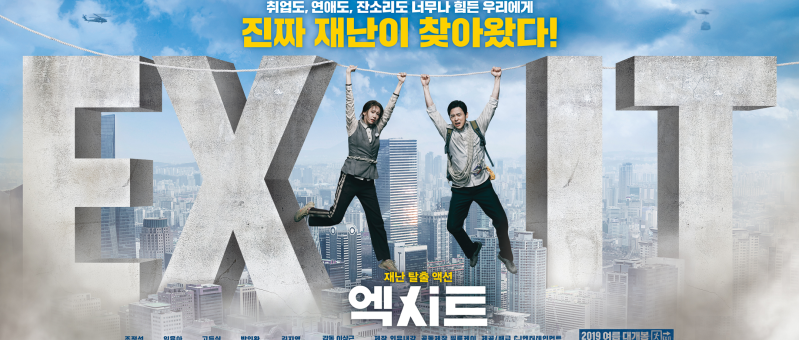
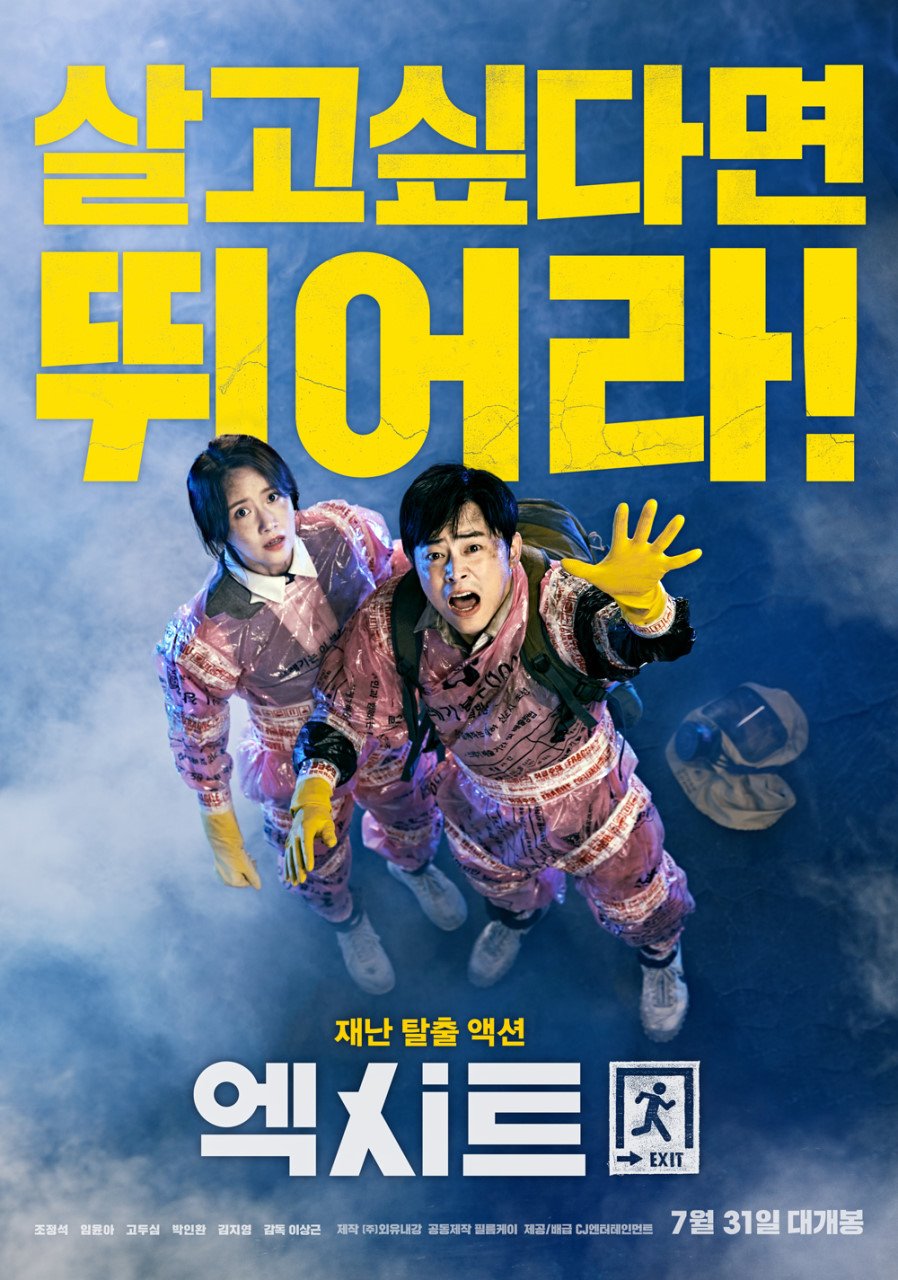
Exit poster 2“Hell Joseon” manifests as “toxic gas” in Lee Sang-geun’s Exit (엑시트). Millennial “slackers” losing out in Korea’s increasingly cutthroat economy find themselves consumed by their own sense of failure while those around them only compound the problem by branding them useless, no-good layabouts, writing off the current generation as lazy rather than acknowledging that the society they have created is often cruel and unforgiving. Yet, oftentimes those “useless” skills learned while having fun are more transferable than one might think and the ability to find innovative solutions to complex problems something not often found in the world of hierarchical corporate drudgery.

30-something Yong-nam (Jo Jung-suk) spends his days in the park surrounded by grannies and has earned the nickname “IBM” – Iron Bar Man, for his athletic pursuits. The local kids have even come up with an origin story for him that his girlfriend must have died after falling off one and so now Yong-nam is some kind of “village idiot” with an overwhelming need to master the monkey bars. The truth is, however, that Yong-nam has nothing much of anything else in his life. His continual failures to find employment are an embarrassment to his family, and even his little nephew (Kim Kang-hoon) is so ashamed of him that he routinely blanks Young-nam in the street. With mum’s (Go Doo-shim) 70th coming up, everyone is very keen that Yong-nam look the part and try not to embarrass them.

Yong-nam is also quite invested in not being an embarrassment because the only reason he booked this fancy restaurant that’s a two hour drive away is that he’s heard his university crush Eui-ju (Im Yoon-ah) works there. Back in uni when they were both members of the rock climbing club, Yong-nam asked Eui-ju out but she was only interested in friendship so he started avoiding her out of embarrassment. Not really any more mature, he lies that he’s a high flying hedge fund manager rather than admit that his life has not been going well. Eui-ju, meanwhile, is the vice-manager of this events centre but shrugs the job off as not much better than part-time when in reality she’s really running the place while her sleazy boss (Kang Ki-young) who’s only in the position because it’s his dad’s company constantly sexually harasses her and shows no signs of taking no for an answer.

When toxic gas floods the city, however, the pair are instantly in their element. They know how to conjure makeshift stretchers from stuff that’s lying around and how to try and draw attention to yourself when you’re in need of rescue, but find their ideas dismissed by Yong-nam’s confused, conventional family members well used to ignoring crazy uncle Yong-nam. To survive they’ll have to trust him and his rock climbing prowess as he shins his way to the top of the building where salvation seems more of a possibility.

Crisis aside, Yong-nam lives in a world of constant anxiety where he’s forever receiving disaster alerts on his phone for things he never thought he’d have to worry about, and his mother spends her evenings diligently copying down ways to prevent cancer from TV documentaries. Yong-nam’s dad (Park In-hwan) would rather chill out with some soap operas, but it seems you can’t drown out existential dread with vicarious drama. Having more or less given up, Young-nam hasn’t even been going to his climbing club. After all, if you can’t get a foot on the ladder, what use is the ability to climb? “Our lives are the disaster” Yong-nam’s similarly troubled friend exclaims, but the sudden threat of toxic gas does at least give the dejected young man motivation to prove himself in demonstrating that his skills are useful, even essential, rather than frivolous or eccentric as his family members previously believed them to be.

Eui-ju, meanwhile, is kept in her place by a combination of sexism and the demands of a hierarchical society which prevent her from fulfilling her true potential by convincing her that she has to be polite to her odious boss. Teaming up with Young-nam, the pair work as equals and support each other as they try to find ways to survive. No damsel in distress, Eui-ju is finally able to take an active role in her own destiny while also making sure to save other people along the way, often at the expense of the pair’s own chance to escape.

In a loose moment, Yong-nam declares that he’s only applying for jobs in one of the shiny skyscrapers from now on because those guys probably got saved first, but in the end it’s their plucky never say die spirit which saves them, in more ways than one, as their exploits go viral with their millennial brethren who eventually motivate the drone squad to try and keep them safe. There may be no exit from Hell Joseon, but as Yong-nam and Eui-ju discover, you don’t have to listen when people tell you there’s no way out because the only way is up and you won’t know unless you go.


EXIT was screened as the opening night gala of the 2019 London East Asia Film Festival.

Original trailer (English subtitles)

https://www.youtube.com/watch?v=BssmJFpXtTQ

Intimate Strangers (완벽한 타인, Lee Jae-kyoo, 2018)

Intimate Strangers poster 1Middle-aged malaise and technophobia collide with potentially catastrophic consequences in brutal comedy of manners Intimate Strangers (완벽한 타인, Wanbyeokhan Tain). The hugely popular Italian film Perfetti Sconosciuti has already been remade in several territories, proving the universality of its conceit. The Korean edition, cleaving closely to the original, demonstrates once again that nowhere is safe in the modern wired world where public and private personas are beginning to blur as lives lived online become realer than real.

The action takes place (almost) entirely within a swanky Seoul apartment owned by plastic surgeon Seok-ho (Cho Jin-woong) and his psychiatrist wife Ye-jin (Kim Ji-soo). The couple, along with their teenage daughter (Ji Woo), have been living in the apartment for some time but haven’t gotten around to inviting their dearest friends so this evening’s celebration will be something like a belated housewarming. The other guests will be friends of Seok-ho’s from all the way back in elementary school – elite lawyer Tae-soo (Yoo Hae-jin) and his wife Soo-hyun (Yum Jung-ah), “entrepreneur” Joon-mo (Lee Seo-jin) and his much younger wife Se-kyung (Song Ha-yoon), and recently divorced Young-bae (Yoon Kyung-ho) who is supposed to be bringing his new girlfriend, but disappoints everyone by turning up alone. Part way through the evening, Ye-jin suggests a kind of party game in which they’ll all put their phones face up on the table and agree to share any messages or calls that come in. Of course, this is a game you can’t afford to refuse to play lest everyone think you’ve something to hide, but total honesty is not always advisable even amongst friends.

Despite their supposed intimacy built up over a couple of decades of similar evenings and get togethers, everyone is very much in public mode and maintaining appropriate levels of decorum. Which is why Tae-soo and Soo-hyun are at great pains to hide the fact their relationship is at breaking point thanks to the recent arrival of Tae-soo’s mother while Ye-jin and Seok-ho also have obvious problems, especially when it comes to the upbringing of their teenage daughter. Despite being a psychiatrist with full knowledge of boundaries and the harm that can be done crossing them, Ye-jin has been going through her daughter’s things and not liking what she finds. Nevertheless, everyone wants to have a pleasant evening, so the fights are on hold and politeness very much in the ascendent.

And then the phones start ringing. It might be a matter of debate exactly how much privacy one should want or expect in a marriage, with friends, or from the world in general, but everyone has something or other they’d rather wasn’t brought up at a dinner party and so showcasing one’s phone is likely to be quite a bad idea. That might be the attraction of the game, but no one seriously wants marital breakdown across the dinner table, nor do they want to hear about medical procedures, outings they weren’t invited to, workplace drama, or familial strife.

The messages, as pregnant with melodrama as they might be, begin to expose the simmering conflicts between this now disparate group of “friends”. The petty class resentments and awkward political differences that politeness sees fit to gloss over become harder to ignore when flashed up by an inconvenient notification or a call the other party is not aware is being broadcast (breaching their privacy too in the process). Realising secrets have been kept from you can be hurtful, but it’s even worse realising that you disappoint yourself in proving exactly why the secret was kept in the first place.

It’s tempting to blame everything on technology, that if no one had a phone no one would be hurt but the truth is that married or not everyone has a right to their secrets and a separate, individual life to which no one but themselves is privy. Perhaps it isn’t so much lies which are the enemy, but the expectation of intimacy and that sharing your life with someone necessarily means the entirety of it. In any case, the film (like the other incarnations) opts for an ironic ending which undoes everything which had gone before, erasing the awkwardness of exposed secrets with a return to a more comfortable reality in which everyone is superficially happier pretending to be happy in blissful ignorance. Perhaps sometimes it really is better not to ask too many questions.


Intimate Strangers was screened as part of the 2019 Udine Far East Film Festival.

International trailer (English subtitles)