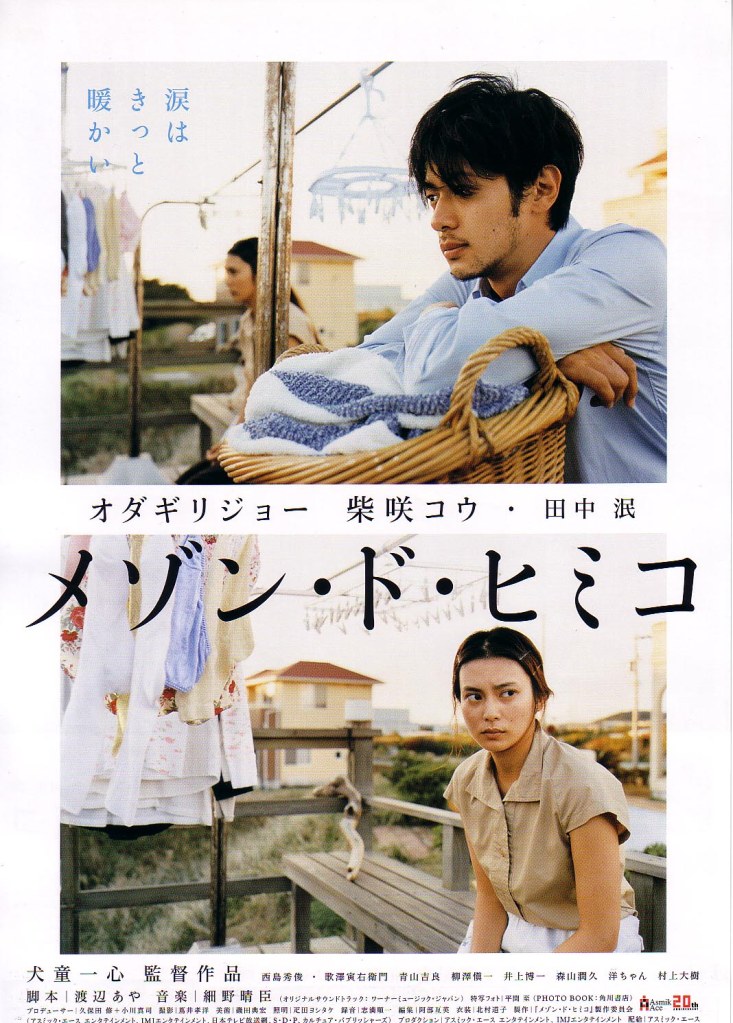
 In Japan’s rapidly ageing society, there are many older people who find themselves left alone without the safety net traditionally provided by the extended family. This problem is compounded for those who’ve lived their lives outside of the mainstream which is so deeply rooted in the “traditional” familial system. La Maison de Himiko (メゾン・ド・ヒミコ) is the name of an old people’s home with a difference – it caters exclusively to older gay men who have often become estranged from their families because of their sexuality. The proprietoress, Himiko (Min Tanaka), formerly ran an upscale gay bar in Ginza before retiring to open the home but the future of the Maison is threatened now that Himiko has contracted a terminal illness and their long term patron seems set to withdraw his support.
Haruhiko (Joe Odagiri), Himiko’s much younger lover and the manager of the home, is determined to reunite his boss with his estranged daughter, Saori (Kou Shibasaki), before it’s too late. Saori is a rather sour faced and sullen woman carrying a decades long grudge against the father who abandoned her as a child and consigned her mother to a life of misery and heartbreak, so Haruhiko’s invitations are not warmly received. Haruhiko is not the giving up type and manages to sweet talk Saori’s colleague into revealing her desperate financial situation which has her already working two jobs with a part-time stint in a combini on top of her regular work during which she finds herself looking at lucrative ads for work on sex lines. When Haruhiko offers her a well paying gig helping out at the home, she has no choice but to put her pride aside.
The exclusively male residents of La Maison de Himiko lived their lives during a time when it was almost impossible to be openly gay. Consequently many of them have been married and had children but later left their families to live a more authentic life. Unfortunately, times being what they were, this often meant that they lost contact with their sons or daughters, even if they were able to keep in touch with their ex-wives or other family members for updates. For these reasons, La Maison de Himiko provides an invaluable refuge for older men who have nowhere else to go as they enter the later stages of their lives. The home provides not only a safe space where everybody is free to be themselves but also a sense of community and interdependence.
Though the situation is much improved, it is still imperfect as the home and its residents continue to face prejudice from the outside world. Saori, still carrying the pain of her father’s rejection, views his choice as a selfish one which placed his own desires above the duty he should have felt towards his wife and child. Partly driven by her resentment, Saori has a somewhat negative view of homosexuality on arriving at the home, offering up a selection of homophobic slurs, and is slow to warm to the residents. Gradually getting to know her father again and through her experiences at the home, her attitude slowly changes until she finds herself physically defending her new found friend when he’s set upon by a drunken former colleague who publicly shames him in a nightclub.
The home is also plagued by a gang of bratty kids who often leave homophobic graffiti scrawled across the front wall. One of their early tricks involves throwing a bunch of firecrackers under a parked car to stun Saori so they can hold her captive for a bit because they have really a lot of questions about lesbians and they wondered if she was one, though one wonders what they’d do if someone answered them seriously. Predictably, the leader of the bratty kids may be engaging in these kinds of behaviours because he’s confused himself. Thankfully La Maison de Himiko is an open and forgiving place, welcoming the boy inside to offer support to a young man still trying to figure himself out.
This is not a coming out story, but it is a plea for tolerance and acceptance through which Saori herself begins to blossom, easing her anger and resentment and sending her trademark scowl away with them. One of her closest friends at the home is a shy man who lived most of his life in the closet but makes the most beautiful embroidered clothes and elegant dresses. Sadly, the most lovely of them is reserved for his funeral – he’s too ashamed to wear it alive because he doesn’t like the way he looks in the mirror. Eventually he and Saori end up having an unconventional fancy dress party in which they both break out of their self imposed prisons culminating in a joyous group dance routine in a local nightclub.
Joe Odagiri turns in another nuanced, conflicted performance as the increasingly confused Haruhiko who finds himself oddly drawn to Saori’s sullen charms though the film thankfully avoids “turning” its male lead for an uncomfortable romantic conclusion. A young man among old ones, Haruhiko is somewhat out of place but has his own empty spaces. Revealing to Saori that he lives only for desire he betrays a nagging fear of his own emptiness and journey into a possibly lonely old age. Nevertheless, La Maison de Himiko is generally bright and cheerful despite some of the pain and sadness which also reside there. A warm and friendly tribute to the power of community, La Maison de Himiko is a hymn in praise of tolerance and inclusivity which, as it makes plain, bloom from the inside out.
Original trailer (no subtitles)
And the fantastic dance sequence from the film
Plus the original version of the song (Mata Au Hi Made) by Kiyohiko Ozaki
 The somewhat salaciously titled Black Kiss (ブラックキス) comes appropriately steeped in giallo-esque nastiness but its ambitions lean towards the classic Hollywood crime thriller as much as they do to gothic European horror. Directed by the son of the legendary father of manga Osamu Tezuka (not immune to a little strange violence of his own) Macoto Tezuka, Black Kiss is a noir inspired tale of Tokyo after dark where a series of bizarre staged murders are continuing to puzzle the police.
 Yaro Abe’s manga Midnight Diner (深夜食堂, Shinya Shokudo) was first adapted as 10 episode TV drama back in 2009 with a second series in 2011 and a third in 2014. With a Korean adaptation in between, the series now finds itself back for second helpings in the form of a big screen adaptation.
 Windows on Worlds