The Fort of Death (五人の賞金稼ぎ, Eiichi Kudo, 1969)

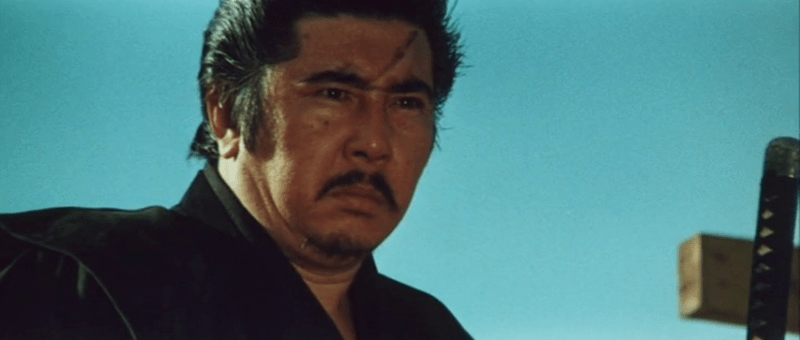
Shikoro Ichibei (Tomisaburo Wakayama) returns yet this time seemingly on the opposite side in the second in the Bounty Hunter series, The Fort of Death (五人の賞金稼ぎ, Gonin no Shokin Kasegi) this time directed by Eiichi Kudo. If the first film had been an Edo-era take on James Bond, the second is very much Spaghetti Western and feudal tragedy as Ichibei finds himself coming to, if not quite the rescue of the oppressed farmers, then at least moral support in taking stand against corrupt and self-interested lords.

This might be surprising in that in the first film Ichibei had been a shogunate spy and seemingly close friend of the man himself, yet this time around he’s working as a doctor while taking bounty hunter jobs to earn extra money to support the poor people who come to him for help. Like a true western hero, he has a small posse which includes the ninja lady, Kagero (Tomoko Mayama), from the first film only she’s being played by the actress who previously starred as his other love interest. In any case, he’s approached by a young man from a small village which is making a last-ditch appeal to the local lord to lower their tax burdens so they don’t all starve, though so far the lord’s response has been to add additional taxes and kill people for not paying them. 

On his arrival, Ichibei soon realises that the man who recommended him was actually the leader of the government forces during a previous peasant uprising at which Ichibei had also tried to help the farmers. In that case, Bessho (Shin Tokudaiji) had won, but it didn’t do him any good. His clan was dissolved and he became a wanderer, taken in by the village and now indebted to them, hoping Ichibei can help but fully aware of the brutality with which such challenges to the feudal order are put down. 

The lord later suggests it’s not really his fault. He has to curry favour with Edo to protect the domain, which is why he agreed to participate in a construction project that led him to confiscate all of his farmers’ rice and wheat. But then it’s also true that he is vain, and cruel. On realising the village has hired a man like Ichibei, some of the retainers suggest reopening negotiations but others complain that they must now crush the farmers or face ruin themselves while trying to ensure the strife in their domain does not come to the attention of the government in Edo. 

Part of their problem is that Ichibei simply has better technology in the form of gatling guns. Tying into the western themes, Ichibei is well versed in the use of firearms, while the samurai are mostly reliant on traditional weaponry such as arrows and swords. The lord later insists on using some canons, but is oblivious to the risk as the shogun has banned the use of gunpowder and using them may end up bringing him to his attention and thereby landing him in a lot of possible fatal trouble. 

In any case, it’s the villagers who suffer. Ichibei encounters a woman who has lost her mind, refusing to give up her baby who has died of malnutrition while her husband was executed for non payment of taxes. Meanwhile, some of the other ronin they hired attempt to rape a villager, and a young couple are prevented from marrying because the headman is worried that it would send the wrong message in a time so much strife. Then again, a woman basically attempts to rape Ichibei, descending on him while he’s still asleep which otherwise leads into a fairly comic sequence in which Ichibei must fight of a bunch of ninjas intent on stealing the gatling gun while dressed only his underwear.

Darkly comic it may be, but also surprisingly violent with a ninja at one point using a dead body as a Molotov cocktail not to mention the severed heads and limbs of the battle scenes. Ichibei is fully aware that the battle is a forlorn hope, but also that the villagers have no choice and perhaps this is better for them than simply accepting their fate and starving to death. Even so, he reserves his final words for the Edo inspector who arrives only when the battle is done to survey the scene, berating him that he ought to know what happened here from looking at the battlefield and deducing that this domain has not been run particularly well. It’s a tragedy of feudalism that provokes a tearful rage from the compassionate bounty hunter trying his best to heal the sickness in his society, though perhaps like the patient who visits him with a venereal complaint concluding the best solution is to cut it right off.


Ninja’s Mark (忍びの卍, Norifumi Suzuki, 1968)

Many have tried to end the Tokugawa line. Few have done so by covering a courtesan’s legs in fish scales to put the Shogun off his stride. Based on a book by Futaro Yamada, Norifumi Suzuki’s Ninja’s Mark (忍びの卍, Shinobi no Manji) is at heart a romantic tale in which love is “part of the game” but also apparently the one trick a ninja can’t escape. Perhaps that’s why Shogun Iemitsu at the comparatively late age of 30 has failed to produce an heir with any of the beautiful yet emotionally distant courtesans of the inner palace many of whom also seem to be ninjas, therefore provoking a constitutional crisis.

Aside from that, it seems the ninja plot is a kind of revenge against the Tokugawa carried out by the last remnants of a house that was dissolved by the Toyotomi. There are in fact three ninja clans all clustering around the palace, Iga, Koga, and Negoro, each of whom have different kinds of skills. Technically, some of them are in the employ of the Shogun’s disinherited younger brother Tadanaga (Shingo Yamashiro), but others of them are working strictly for themselves and their revenge. In any case, their plan is to prevent Iemitsu from fathering an heir by putting him off sex essentially by making it freaky (in a bad way). Thus one of the ninjas uses his ability to transform objects so that the courtesan’s legs are covered in fish scales. Another plan sees a ninja body swap with one of the women so that Iemitsu’s sperm ends up inside him where it obviously has nowhere to go. Meanwhile others hatch a plan to steal some of Tadanaga’s seed to use on the women in the inner palace to cover up Iemitsu’s potential infertility seeing as it is after just as good being of the Tokugawa line. 

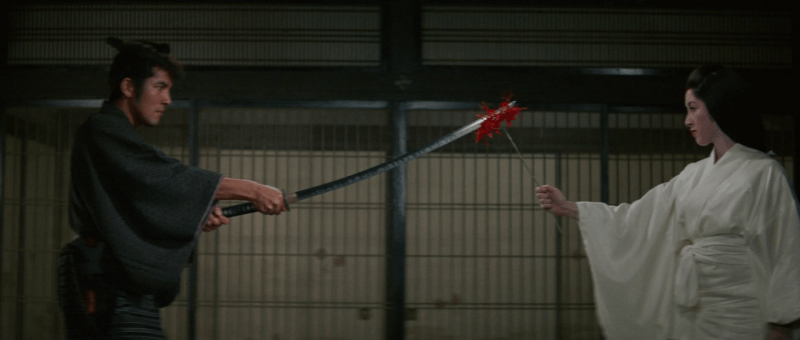
This particular ruse is suggested by Toma (Isao Natsuyagi), the disenfranchised former member of the Yagyu school turned ninja ronin they bring in to solve the problem. He quickly homes in on Kageroi (Hiroko Sakuramachi), a female ninja, as the villainess whose special power is poisoning men with love and desire by means of the spider lily plant. But as Toma points out to her, she is also a prisoner of her skill in that if she were to fall in love she would inevitably kill her lover. Of course, he survives her first attempt to kill him, leading her to fall in love with Toma and become conflicted in her mission while he plays on her emotions to escape but eventually realises they may be more genuine than he first realised. 

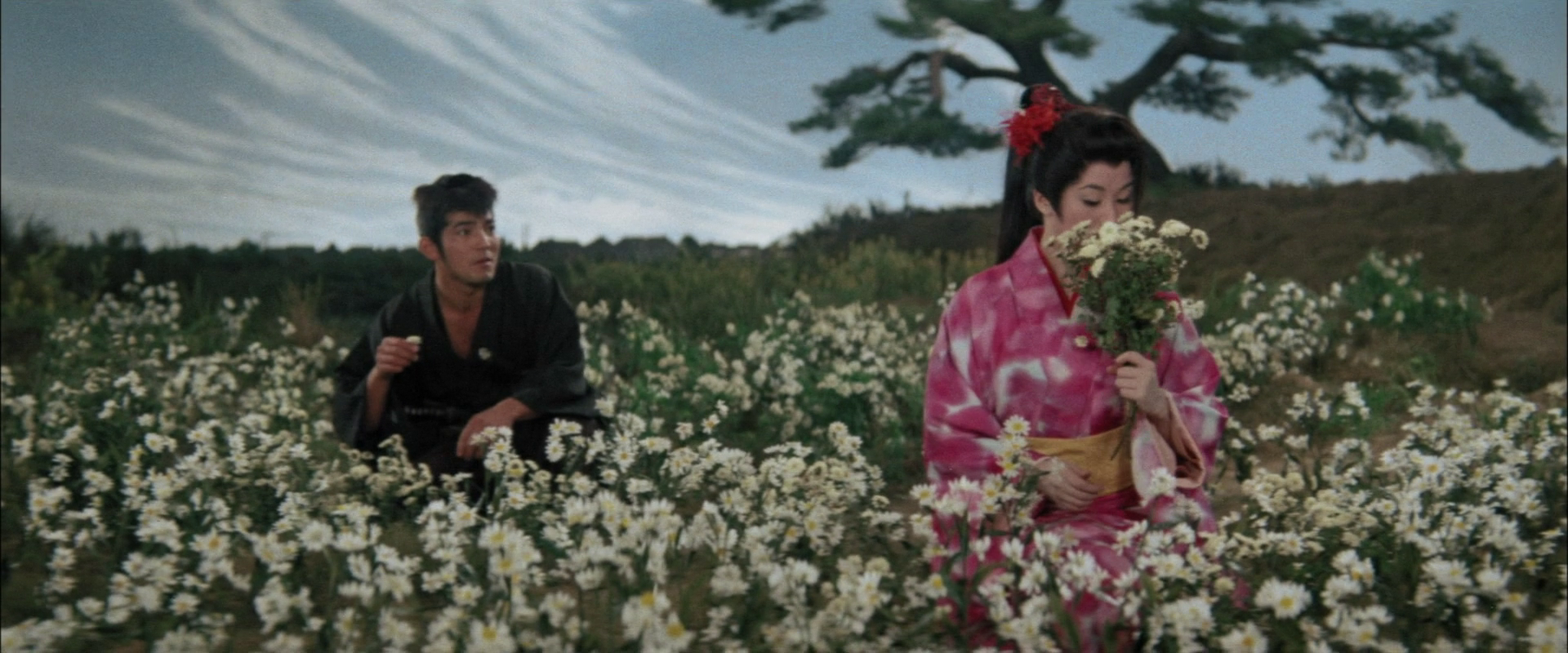
In this, Suzuki brings some of his trademark romanticism particularly in the colourful art nouveau aesthetics and frequent use of rose imagery. Though the film is clearly designed to lean into the erotic with frequent use of nudity and salacious scenes including a brief moment of lesbian seduction, it eventually heads towards romantic tragedy in which the debauched and nihilistic Toma and the wronged Kageroi discover a love made impossible by their ninja code and the times in which they live. Having been ordered to kill her, Toma declares that he will marry Kageroi in the next life and returns to her the Buddhist Manji that is the “ninja mark” of the title. 

Nevertheless, the dialogue is often suggestive as in Kageroi’s curse that Toma’s “sword” will rot, while it’s also Toma’s “sword” that alerts him to the danger she presents. Toma too claims to derive his ninja powers from his “sword” having apparently concentrated them by repressing his sexual desire and swearing off women. He says that he seals all his “distracting” thoughts into a virgin, closing off all her senses and placing her into a coma until he breaks the spell. Even so, he admits that without his “sword” he is just a man, and as a man claims to love Kageroi, but as long as he has his “sword”, and she her “lily”, their love is impossible. 

But this repressed love seems to pose less threat to the social order than the lack of it in Iemitsu who is bored with his courtesans and cannot conceive an heir. Constitutional crisis is averted only through a little ninja trickery and a convenient ruse to overcome Iemitsu’s infertility so that in time he produces five sons and a daughter, which honestly seems like it might just present another set of problems in about 30 years’ time. Like similarly themed ninja pictures, Suzuki makes good use of surrealist imagery and colour play alongside the kind of onscreen text later used in jitsuroku yakuza films to name each of the ninja’s key skills and which clan they belong to. What he always returns to, however, is the sense of romantic tragedy in a world seemingly poisoned by ambition in which love itself is rendered an impossibility. 


*Norifumi Suzuki’s name is actually “Noribumi” but he has become known as “Norifumi” to English-speaking audiences.

Bohachi Bushido: Code of the Forgotten Eight (ポルノ時代劇 忘八武士道, Teruo Ishii, 1973)

A nihilistic ronin falls into the hellish trap of the Yoshiwara in Teruo Ishii’s dazzlingly psychedelic period drama, Bohachi Bushido (ポルノ時代劇 忘八武士道, Porno Jidaigeki: Bohachi Bushido). Adapted from a manga short by Kazuo Koike, the film once again tackles Edo era corruption as a brothel owner with a special connection to the shogun attempts to wipe out the competition presented by an enterprising merchant class only to find himself hoist by his own petard.

Ishii signals his intentions early on with the artfully staged opening scequence in which wandering ronin Shino (Tetsuro Tanba) is attacked on a bridge at dusk. As he turns to slash at an opponent, the blood splatter morphs into the film’s title while the clang of swords gives off little blue sparks that turn into the listings for the cast and crew. By the time the title sequence has concluded, night has descended on the bridge and Shino finds himself engulfed in darkness. “To die is hell, but to live is also hell” he exclaims as he jumps into the water below, hoping to be free of his empty life of killing. 

Unfortunately, he is rescued and brought to the Yoshiwara where they try to persuade him to join the Bohachi clan so called because to do so you must abandon all eight human virtues. The Bohachi’s main line of work is the sexual torture of women until they become docile dolls for their brothel. Shino describes them as “revolting” but then adds “just like me” and agrees to join anyway only to earn their mistrust when he refuses to play along with their games, buying but not sleeping with a woman brought in over a debt. Though Shirakubi, the guy who recruited him, tries to kick Shino out and calls the police on him for good measure, the big boss, Shirobe (Tatsuo Endo), decides he’ll take him in for use as an attack dog taking down anyone who interferes with business be they lords or officials. 

The irony is that the nihilistic Shiro enthusiastically takes to his work because he dislikes the debauchery of the Edo-era society even while working for the “legitimate” brothel owner who is at least “licensed” to exploit women for financial gain. What Shirobe resents is the rise of quasi-brothels in the various teahouses that are obviously selling more than just tea but continue to undercut his business by selling women even cheaper than he does. He also feels betrayed by the various samurai lords who choose to visit the teahouses over his own establishment and therefore seeks to have them frightened into submission by ordering Shino to kill any man found with one of the tea house sex workers. Later he even declares a kind of sex worker amnesty promising to pay five ryo for any of the teahouse women brought to him, no matter by who, and then joking that he’s actually killing two birds with one stone by getting his hands on a high quantity of new stock for a very low price. 

Shino refuses to sleep with the women and is most offended when his male assistant is killed in an attack by the rival brothel owners yet the team of warrior women sent to protect him did nothing to help because their orders were only to protect Shino and Shirobe’s orders must be followed to the letter on the pain of death. He seems to know he’s living on borrowed time and Shirobe probably intends to finish him off once he’s finished his mission of removing all opposition and restoring Shirobe’s power to manipulate the shogun but barely does anything to resist until faced with the rather ironic punishment of being given opium and then forced to participate in a never-ending orgy intended to result in his death in an extraordinary psychedelic sequence from Ishii . 

Of course, what they didn’t reckon on was Shino’s ironic desire to live or at least not to be beaten in which he actively begins stabbing himself to overcome withdrawal symptoms and carry on fighting even when they try to ram him with a giant spear cart. Ears are cut off, flying across the screen followed by arms and then heads. Ishii lends a poetic sheen to the closing moments as Shino is caught in a hero pose alone in the snow but still standing, if barely, and freed at least from one kind of hell if not from many others.