The Greatest Challenge of All (喜劇 一発勝負, Yoji Yamada, 1967)

A prodigal son rocks the social order in Yoji Yamada’s anarchic nonsense comedy, The Greatest Challenge of All (喜劇 一発勝負, Kigeki: Ippatsu Shobu). The greatest challenge may be trying to manage Kokichi (Hajime Hana), a roguish Del Boy-like figure with an impossible dream of striking it rich. While in some senses he anticipates the equally  anarchic yet basically goodhearted Tora-san, he also represents a modernising and aspirant Japan determined to leave behind dusty old tradition for a new “deluxe” future.

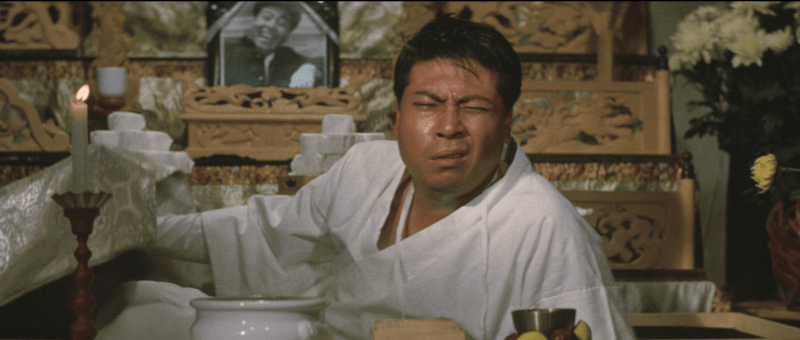
Having taken to the road after being disowned by his conservative father (Daisuke Kato), Kokichi returns 15 years  later a middle-aged man with seemingly nothing to show for his many years of wandering. He has no idea that he has a daughter, Mariko, by a local woman that his parents took in and raised as if she were theirs which was not an especially uncommon solution to the problem of illegitimate birth in the post-war era. Nor did he know his mother had passed away before walking in on her annual memorial service. This sense of parental disconnection one level reflects a lack of filiality that marks him out as a “modern” man uninterested in these familial obligations or a sense of duty towards his family, but it’s also true that it’s to family that he’s returned having mellowed in middle-aged and in a way looking to settle down.

In any case, his life seems to have been a series of crazy episodes from briefly becoming a sumo wrestler to meeting a mysterious woman on a bridge who gets him a job as a snake charmer. When two yakuza types kick up a fuss about not being able to have their usual room at the inn during his mother’s memorial service, Kokichi manages to frighten them off just with bluster, hinting at the way he may have lived for the last 15 years. He also has two friends who turn up to see him, one of whom is a former yakuza who refers to Kokichi as if were his boss and they were a little trio of crime-adjacent buddies.

But it does appear that Kokichi has come with a business plan in mind, convinced that he can find the source of a hot spring in the town and build a resort hotel on top of it. To do this, he tries to convince his father to sell him his land and the inn the family run so he can knock it down and build a “deluxe” modern, Western-style hotel in its place. Kokichi’s father obviously isn’t keen. This inn has been in the family for generations, he really wouldn’t want to ruin that and especially not for one of Kokichi’s harebrained schemes. Yet again this brings us back to the battle between the conservatism of Koikichi’s father, and Kokichi’s own consumerist modernism that is more individualistic and no longer sees beauty in the past, only backwardness and stagnation. When he finally does find his hot spring, he builds a vast modernist complex with a botanical water park housed in a giant Hawaiian-themed conservatory complete with dancing hula girls. 

His corrupting presence is most discernible in the changing role of Fumi (Tanie Kitabayashi), the family’s housekeeper who generally dressed in kimono but on moving to Kokichi’s mansion she begins wearing Western dress. Fumi had at one time left the family because Kokichi had unwittingly forced her to betray it in helping him get his hands on a precious family heirloom to pawn as capital for his new business venture. Having done so brings her to a confrontation with the contradictions of her role within the family, both a surrogate mother to Kokichi and also a servant who is expected to abide by a certain code with not stealing from your employers a key tenet. She feels she can no longer look Kokichi’s father in the eye and must now return to her home in the country even though she has likely not seen it since she was a young woman. Having undergone this change, she can no longer return to the inn but is brought back to Kokichi’s modernist home once he strikes it rich. 

But Kokichi too is later confronted by hypocrisies of his own position as a free-spirited man and finally a father on learning the truth about Mariko. Hanging out at the hot spring, the 16-year-old Mariko has attracted the attentions of a couple of fashionable young men and wants to leave with them to visit Tokyo. Despite the intrusion of the modern in the hot springs resort, Mariko doesn’t want to stay in this “deadbeat” town and longs for the bright lights of the big city. Kokichi’s father understandably says no, but Kokichi is originally all for it, perhaps seeing his own desire to be free of his father’s oppressive authority. However, he soon changes his tune on assuming his paternity. He too tells Mariko she can’t go and strikes her for talking back. But just as he had, she leaves anyway. His modernity is no longer modern enough, and the young will always walk towards the future.

One exception might be Kokichi’s painter sister Nobuko (Chieko Baisho) who appears to be happy enough living at the inn and with seemingly no intention of marrying which might be her own kind of rebellion against traditional mores. While other similarly themed films may have emphasised the importance of hard work and the reality of the salaryman dream, this one suggests that it really is possible to bumble along and then strike it lucky but also that you never really travel as far from home as you might think. The desire for patriarchal control rises in Kokichi, but is now ineffectual. Though he didn’t raise her, Mariko is a child of the world he’s created and simply chooses to leave with a final sock in the eye to traditional filiality. 


Trailer (no subtitles)
A Boy and His Samurai (ちょんまげぷりん, Yoshihiro Nakamura, 2010)

Boy and his samurai poster 1Edo/Tokyo – what difference can a name make? A lot, it seems, but then perhaps not so much as you’d think. “Edo” was the seat of power in Japan from 1603 until it was renamed “Tokyo” during the Meiji Restoration, heralding a brand new era of modernity following more than 200 years of self-imposed isolation. Logically, there must have been people who went to sleep in Edo and woke up in Tokyo, but most of them didn’t nap for nearly 200 years. The hero of A Boy and his Samurai (ちょんまげぷりん, Chonmage Purin) didn’t exactly nap either, but he’s fetched up 200 years in the future, which, you have to admit, is very disorientating.

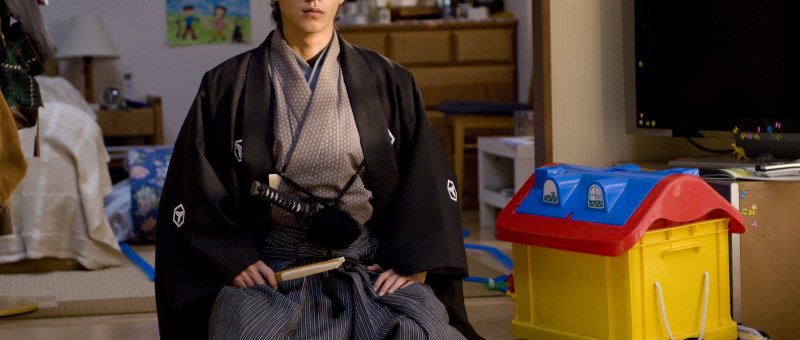
Divorced single mother Hiroko (Rie Tomosaka) is late getting her 6-year-old son Tomoya (Fuku Suzuki) out of the house and on his way to school so she’s less than interested when he suddenly stops in the street to stare at a severe man in samurai dress standing outside a supermarket. Assuming it’s some kind of advertising stunt, Hiroko drags her son away, but the man turns up again later wandering around their apartment block and seemingly very confused. Hiroko tries to help him, but he is extremely rude and intimidating, eventually demanding to be taken back to her apartment almost at sword point. Nevertheless, once everyone has figured out the man, who says his name is Kijima Yasube (Ryo Nishikido) and he’s a samurai retainer, is either quite mad or a time traveller, the trio being living together and trying to bridge their very different social values.

Those values have obviously changed a lot, but in many ways not enough. Hiroko has a regular job at an advertising agency but is disrespected by some of her colleagues because she can’t work overtime and has to leave early to make sure someone picks up Tomoya. We learn that the reason she divorced her husband two years ago is that while he pretended to be modern and progressive, he was unwilling to share his portion of the domestic burden and secretly wanted his wife to quit work and look after the house despite superficially encouraging her with her career. Hiroko figured it made no difference if he was around or not, so she left him and took Tomoya with her. Hiroko likes her job, but working also reinforces her individual identity (even if blending into the corporate) aside from that of wife and mother which has all too often been all that a woman is in a rigid and conformist society.

Indeed, when Yasube first arrives he adopts a superior tone and refers to Hiroko only as “woman”, viewing her as necessarily inferior by reason of sex while also reasserting himself as a samurai communicating with someone he assumes to be of the lower orders. Yasube is stunned to learn that Hiroko has a surname – a reminder that those of the lower orders did not (officially) have surnames until the Meiji Restoration. He now thinks she must be very noble, adopts a suitably humble tone, and resigns himself to accepting her hospitality in the absence of other options. He can’t get his head around her family situation or process the various motions towards sexual equality the modern world has produced. To him women manage the house and men protect it from outside. He finds Hiroko’s desire for independence strange and this new world uncivilised.

Nevertheless, he decides to give the Tokyo way a go by stepping briefly beyond himself – in return for room and board, he’ll effectively become Hiroko’s “wife”, managing all the domestic chores while she concentrates on her career. Yasube finds a strange affinity for domesticity, quickly getting to grips with white goods and taking recipe notes from cooking TV (to write them down with ink and a brush using classical Japanese script). Despite never tasting them before, he finds himself a natural baker providing sweet treats for all. However, Hiroko perhaps disappoints herself by accidentally slipping into the role of workaholic salaryman, suddenly embracing the art of overtime and leaving everything at home in the capable hands of Yasube without really considering his feelings even if he never seems to resent it.

Trouble brews when Yasube gets the opportunity to build a career of his own as a pastry chef. Hiroko, true to her word, is encouraging and obviously wants to give him the opportunity to fulfil himself, but the same situation recurs – Yasube becomes obsessed with his professional development leaving little Tomoya brokenhearted and missing his surrogate dad. The problem isn’t so much gender roles as a reluctance to fully commit by agreeing to share domestic responsibilities equally in recognition of equal commitment to a mutual endeavour. Then again, Yasube disappoints – his Edo ethics reassert themselves. he answers Hiroko’s pleas that he spend more time with Tomoya by suggesting she quit her job so he won’t be lonely while his wages can support them as a family. He thinks he’s saying something nice, confirming his loyalty to them as a father figure who will protect and provide, but it’s the wrong the thing to say and only goes to show that his “ancient” way of thinking is sadly not quite archaic enough.

Likewise, his old-fashioned parenting style of fatherly authority advanced with shouts and stares would likely not be approved by most today but it does uncomfortably seem to be accepted by the film, as if Tomoya needs male parental input rather than just benefiting from having a mum who’s less tired and stressed out for having someone to share her life with. He does, however, soften on exposure to Tokyo liberality, willingly embracing modern equalities in realising that there’s nothing wrong with a man supporting a woman and a child in ways other than the financial even if he eventually goes back on it when presented with the opportunity to reassert his male pride as a provider, declaring that domestic matters “no longer concern” him now that he has “other duties”. “Tokyo” still has a ways to go (where doesn’t?), but it’s moving in the right direction even if there are some who are content to be slow in catching up.


Original trailer compilation (no subtitles)

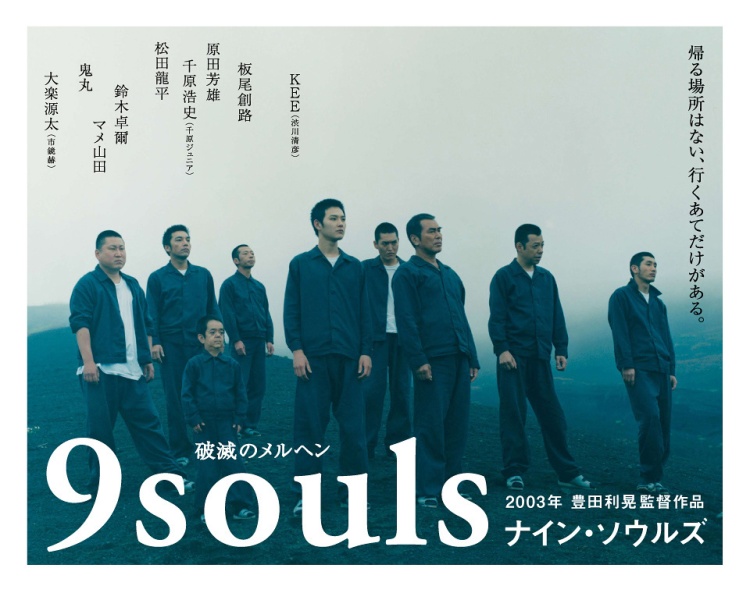
9 Souls (ナイン・ソウルズ, Toshiaki Toyoda, 2003)

9-soulsToshiaki Toyoda has never been one for doing things in a straightforward way and so his third narrative feature sees him turning to the prison escape genre but giving it a characteristically existential twist as each of the title’s 9 Souls (ナイン・ソウルズ) search for release even outside of the literal walls of their communal cell. What begins as a quirky buddy movie about nine mismatched misfits hunting buried treasure whilst avoiding the police, ends as a melancholy character study about the fate of society’s rejected outcasts. Continuing his journey into the surreal, Toyoda’s third film is an oneiric exercise in visual poetry committed to the liberation of the form itself but also of its unlucky collection of reluctant criminals in this world or another.

Former hikkikomori Michiru (Ryuhei Matsuda) is being thrown in at the deep end as the 10th prisoner in a crowded communal cell to which he has been consigned after the murder of his father. Not long after he arrives, one of the veteran inmates who had been assigned to him as a mentor and goes by the nickname of The King of Counterfeiters (Jun Kunimura), suddenly has some kind of psychotic episode where he goes off on a long monologue about a buried time capsule and the key to the universe before being dragged off somewhere by the guards. Right after that, a little mouse turns up signalling the probability of a mouse hole somewhere in the cell. Master escape artist Shiratori (Mame Yamada) somehow comes up with a plan to use this information in order for everyone to escape, which they do, emerging from a pipe into the blue tinted landscape and making a break for freedom.

Commandeering a camper van from a young man terrified of ghosts, the gang of nine hit the road heading for a primary school where their cellmate’s time capsule promises an untold fortune in counterfeit currency. What they find there is unimpressive except for a strange looking key which they decide to give to Michiru because they’re a bunch of guys who appreciate irony. At a loss again, each begins to think about the circumstances which brought them to this point, wondering if there’s a way back or if anyone is still waiting for them.

Less than a prison break movie, 9 Souls shares more in common with the return to Earth genre in which a recently deceased person is given a second chance to deal with some unfinished business until they are finally able to accept the inevitable. Though the prisoners have each committed heinous, often violent or unforgivable crimes, they each have dreams and aspirations which were previously denied to them but may just be possible now given their extremely unusual circumstances. Sometimes those dreams are heartbreakingly ordinary – falling in love, getting married and opening a small cafe in the countryside, for example, or attending your daughter’s wedding and being able to give her a wedding present in person. Try as they might, the prisoners are only able to gain a small taste of their hopes and dreams before they all come crashing down again, leaving them with only their fellow escapees to rely on.

Looking forward to Toyoda’s next film, The Hanging Garden, 9 Souls also takes a sideways view of that most Japanese of topics – the family. Michiru came from an extremely dysfunctional environment in which his mother abandoned him and he was forced to kill his own father only for his younger brother to then betray him. Veteran prisoner Torakichi (Yoshio Harada) unwillingly becomes the “father” of the group though he was imprisoned for the murder of his son. This perfect symmetry of a fatherless son and sonless father adds to the circularity of Toyoda’s tale as each is forced to reassume their familial roles within the equally forced genesis of the prison cell family. In the outside world, each of the prisoners is searching for only one thing – acceptance, but each finds only that which they feared most, rejection. Once again cast out from mainstream society as they had been all their lives, the prisoners are left with nowhere else to go but the mystical destination offered to them by the counterfeiter’s magic key.

The truck driver’s strange fear of ghosts comes back to haunt us at the end of the film as the van, now painted a peaceful sky blue complete with fluffy clouds as opposed to the hellish red of the ironically named “lucky hole”, begins to fill up with departing spirits each finding their exit in one way or another. A man who helped his son to die will now have to save another, while a boy who locked himself inside his room will have to turn the key and open a door on eternity. Swerving from absurd comedy to deeply melancholic meditations on guilt, redemption, and a failing society, 9 Souls is among the most poetic of Toyoda’s early works swapping the rage which imbued the young of Pornostar for the sorrowful resignation of experience.


Available now in the UK as part of Third Window Films’ Toshiaki Toyoda: The Early Years box set.

Original trailer (English subtitles)