12.12: The Day (서울의 봄, Kim Sung-soo, 2023)

Sometimes, the bad guys win. Kim Sung-soo’s long-awaited return after superb underworld drama Asura, 12.12: The Day (서울의 봄, Seoul-ui Bom) explores one of the darkest hours of recent Korean history as all hopes for democracy and freedom are dashed by a 1979 coup by General Chun Doo-hwan whose reign turned out to be far worse than that of his predecessor, Park Chung-hee who had been assassinated by a member of his own security team some months previously.

Yet Kim is less concerned with the coup itself than why so few people tried to stop it. Though everything appears to be going very badly for Chun (Hwang Jung-min), he eventually succeeds in taking Seoul by force while opposed by a solo general who is the lone guardian of justice and righteousness. Lee Tae-shin (Jung Woo-sung) first turns down a promotion to command the Seoul garrison and accepts it only when it’s explained to him that Jeong (Lee Sung-min), the army chief of staff, hopes to use him as a bulwark against Chun whom he fears is indeed preparing for an insurrection. Sure enough, Jeong is eventually abducted by Chun’s minions, who run the security division, on a trumped up charge of being involved with Park’s murder while Chun desperately needs the duly elected president of a democratising Korea to sign his arrest warrant so his blatant power grab will be legitimised rather than branded a “coup”.

Only the president doesn’t play along. He insists on following proper protocol and getting the approval of the defence minister all of which is vexing for Chun who is left humiliatingly standing in his office while the president holds his ground. The defence minister has, as it turns out, fled to the American embassy in his pyjamas where he finds little sympathy while the film subtly implies that the Americans advise him to return and back Chun who is doubtless considered much more useful to them politically.

Though Tae-shin and another officer at HQ try to warn of a brewing coup, their orders are often overruled by superiors either because they do not take the situation seriously or are actively siding with Chun whose “Hanahoe” faction has taken over a significantly large proportion of the military. Kim zooms in on militarism as the fatal flaw in this botched defence system as it seems no one can act without first receiving an order from above nor are they equipped to make critical decisions on a personal level as to whether or not an order should be obeyed. Tae-shin calls on countless devisions for backup but finds them either actively allying with Chun or refusing to get involved believing it is a hopeless battle. Tae-shin asks what the army is for if it refuses to fight at the crucial moment and abandons its responsibility to protect the interests of its citizens in simply allowing Chun to seize power but receives no real answer. 

Chun has already aroused suspicion for his handling of the investigation into Park’s death, reportedly bringing in countless people with no obvious connection to the case and torturing them. The men who support him want to continue Park’s “glorious revolution” which was in itself a repackaging of Colonial-era Japanese militarism, and fiercely resist the idea of “democracy” advocating totalitarian views that the ordinary person longs for a strong hand at the wheel and to be absolved of the responsibility of choice which ironically fits perfectly with hierarchal structure of the Army. The film paints Chun, slight, small, and bald, as a man with a chip on his shoulder apparently resentful of military elites and the wealthy. He craves power because of his own insecurity and a desire to get one over on righteous men like Tae-shin which might be why his line about Chun being unworthy of the uniform of a Korean solider seems to get to him. 

Using the film language of the 1970s such as heavy grain and split screens, Kim keeps the tension on a knife edge even though the conclusion is all too inevitable. Tae-shin cuts a heroic figure, standing alone on a bridge and forcing back the advancing tanks solely with his imperious righteousness but in the end it’s not enough, there are too few like him and too many like Chun whose maniacal laughter is intercut with scenes of Tae-shin in the torture facility which lies beneath the facade of government. Bleak, but also angry, Kim’s extraordinarily controlled political thriller is damning in its condemnations of a militarising culture and the ever present threat which accompanies it.


International trailer (English subtitles)
Ajoomma (아줌마, He Shuming, 2022)

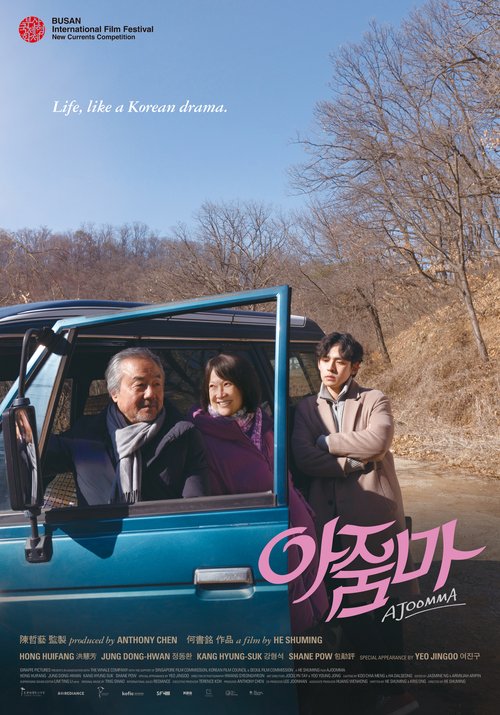
A middle-aged Singaporean woman begins to rediscover her sense of self after making an unexpected solo trip to Korea in He Shuming’s heartwarming dramedy, Ajoomma (아줌마). “Ajoomma” is the generic term for an older woman in Korean, and even in her native Singapore, the heroine Bee Hwa (Hong Hui Fang) is known largely as “Auntie” no longer possessing much of a name or identity and obsessed with Korean TV dramas in thrall to their larger than life emotions just hoping to feel something again in the midst of her loneliness. 

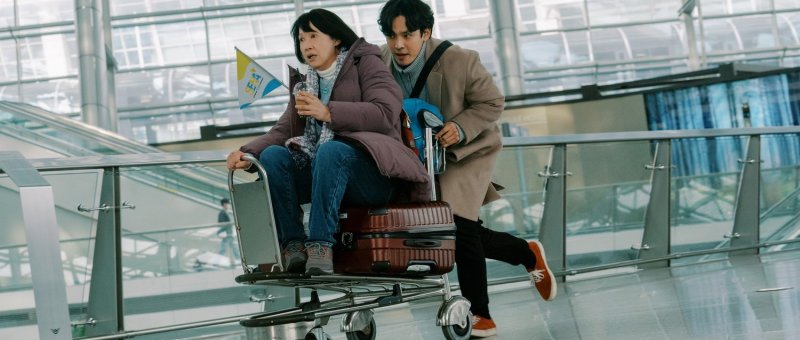
Bee Hwa has a grown-up son, Sam (Shane Pow), but he remains somewhat distant towards her. “He never shares anything with me” she later complains to a mother and daughter duo on the Korean tour together after a few drinks. Sam was supposed to come on the trip with her, but he got an interview for a big job in America and tried to get her to cancel. Bee Hwa would rather Sam didn’t go abroad, but her sense of loneliness is only deepened with the dawning realisation that Sam may be gay and has chosen not to share that part of himself with her. When she realises the tour is not refundable as Sam said it would be, she makes a bold decision to go on her own despite never having travelled alone before. Her confusion at the airport is palpable as she’s suddenly confronted with unexpected bureaucracy, trying to fill in landing cards and find her way to the tour group which turns out to be led by a handsome man with the look of a K-drama star but a defeated and cynical air unsuited to his role as a tour guide. 

Just as Bee Hwa longs for a closer relationship with her son, Kwon-woo (Kang Hyung-seok) is desperately trying to win back his wife and daughter who have moved in with his disapproving mother-in-law following his difficulties with employment and subsequent debts to loansharks. Kwon-woo wants to show them that he can be a responsible husband and father by holding on to his tour guide job and making enough to pay off the debts so they can get an apartment of their own, but is also his own worst enemy and prone to making mistakes not least the one leaving Bee Hwa behind after failing to make sure everyone was back on the bus before it left. 

It’s only thanks to sympathetic security guard Jung Su (Jung Dong-hwan), himself a lonely widower whose sons live far away, that Bee Hwa doesn’t freeze to death in the middle of Seoul. Just like Bee Hwa, he’s lonely even with his beloved pet dog Dookie and mainly bides his time carving figures of animals out of wood. He helps her because he doesn’t know what else to do and despite the language barrier, Bee Hwa only understands the kind of words that come up a lot in Korean drama and he doesn’t know Mandarin or much English, the pair quickly find a sense of mutual solidarity bonding in their shared sense of loss mixed with mild disappointment in life’s ordinariness. Kwon-woo asks Bee Hwa if she regrets the choices that she made that left her little room for herself, and she says she doesn’t but does perhaps hanker for something more in her life than just being a faceless ajoomma who likes Korean dramas but has lost sight of herself. 

The trip to Korea reminds her that she can do things on her own and doesn’t necessarily need Sam there to help her, finally buying something nice just for herself rather than getting it someone else. As she dances in the snow she realises that she can still have new experiences and feel childlike joy, even if she is “an auntie” she has plenty of time in front of her to do whatever she wants with no longer subject to social expectations, patriarchal husbands, or judgemental sons. Billed as the first co-production between Singapore and South Korea, He’s heartwarming drama celebrates not only the simple power of human kindness but the resilience of women like Bee Hwa seizing the freedom of age and resolving to live the rest of her life on her own terms.


Ajoomma screens in Chicago March 25 as part of the 16th season of Asian Pop-Up Cinema.

Original trailer (English subtitles)

Svaha: The Sixth Finger (사바하, Jang Jae-hyun, 2019)

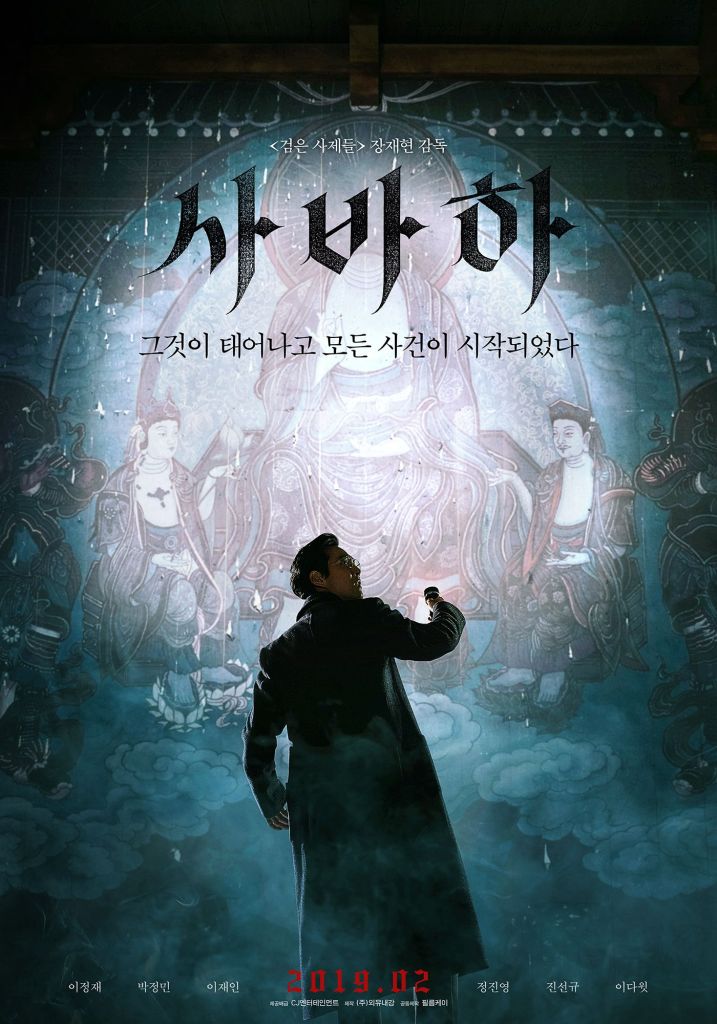
The thing about prophesies and the prophets who proclaim them, is that they only have power if people choose to believe in them. “Faith” can become a convenient cover for those who’d rather not explain themselves, a mechanism for manipulating sometimes vulnerable people looking for a greater truth or a purpose in their lives. Svaha: The Sixth Finger’s (사바하) dogged pastor is intent on investigating religious crimes and exploiting spiritual charlatans but he of course has his own agenda, that mostly being that he’s keen to get money off his clients who are in turn hoping to bolster their authority by rooting out “heresies”.

Leader of the Far Eastern Religious Research Institute, a kind of religious detective agency employing only himself, an undercover assistant, and a “deaconess” secretary, Pastor Park (Lee Jung-jae) makes his money flagging up dodgy and/or exploitative practices connected with organised religion. According to him, freedom of religion is “overly” protected, and he is alone on the frontlines of a spiritual war against unscrupulous cultists. Though some kind of protestant, he often works for/against the Catholic Church and is good friends with a Buddhist monk who gives him a tip off about a weird sect he can’t get a handle on, Deer Hill. 

Meanwhile, a young girl, Geum-hwa (Lee Jae-in), explains to us that she was born with an “evil” twin clamped to her leg. The twin wasn’t expected to survive, but is still living with Geum-hwa and her family who keep her locked up in a shed like a beast. Rightly or wrongly, Geum-hwa connects her sister with the deaths of her parents which occurred fairly soon after the children were born. Her grandfather, with whom Geum-hwa now lives, never even registered the birth of a second child out of fear and shame, never expecting her to survive this long. When a truck hits a bridge and exposes the hidden body of a murdered teenager, the police start investigating too, eventually leading them to two young men loosely connected with the shady Buddhist cult. 

“This world is one big muddy mess”, according to the cultists at Deer Hill. It’s not difficult to see why people might be looking for spiritual reassurance in such a chaotic world, but it’s exactly that need that places like Deer Hill may be seeking to exploit. Nevertheless, the only thing that Park’s undercover agent turns up is that there doesn’t appear to be anything untoward. Deer Hill doesn’t accept offerings from its members and even gives money away to the needy. Tellingly, the real nitty gritty to Park’s clients is in doctrinal deviation, they only really want to know what kind of Buddhism it is that they do and if it’s in line with broader teachings of the faith. 

A further tip off leads them to the mysterious Je-seok (Jung Dong-hwan), a legendary Buddhist priest who studied in Japan but apparently devoted himself to the Independence movement and is said to have achieved enlightenment. Je-seok’s teachings are dark in the extreme, “Pain is the fruit of faith” goes his mantra, “pain purifies your blood”. He believes that he is the “light” that will conquer the “darkness” by snuffing out “snakes”. One of his disciples, brainwashed as a vulnerable young man and encouraged to do terrible things in the name of good, begins to doubt his teachings when confronted with a possible hole in his logic and the very real human cost of his strategy. 

Not quite as cynical as he seems, Park retains his faith. It’s ironic that all this is taking place at Christmas and centres on the prophesied birth of a child that threatens someone’s sense of personal power. Unlike most, Park has always regarded Christmas as a “sad” holiday, unable to forget that Jesus’ birth was accompanied by the mass murder of innocent baby boys. He wonders where God is now and why he permits these things to happen. Park has faith that God sent Jesus into the world for the greater good, but Je-seok has convinced his followers that the same is true of him, that he has come to banish the darkness and that all their pain and suffering is fuel in a holy war. Their faith has been redirected and misused for the benefit of a false prophet, while his opposite number has been made to live a life of bestial misery solely because of superstitious prejudice. The police is a fairly irrelevant presence in this series of spiritual transgressions, but there is much less clarity to be had in “truth” than one might hope with “faith” the only solution in an increasingly uncertain world.


Svaha: The Sixth Finger is currently available to stream on Netflix in the UK (and possibly other territories).

International trailer (English subtitles)