Belonging (とりつくしま, Kahori Higashi, 2024)

What if you could come back after you died and watch over those close to you while possessing a familiar if inanimate object? Her second film this year, Kahori Higashi’s Belonging (とりつくしま, Toritsukushima) adapts a novel by her mother in which the recently deceased are asked to choose a “belonging” to sink into given that they seemingly still have lingering attachments to this world. Yet simply watching can itself by painful while it might not do to linger too long in a place where everything is moving on except you.

That’s a possibility that comes to mind the second story featuring a little boy who asks to inhabit the blue climbing frame at the park. He wistfully watches other kids he used to play with pass by and later meets a little sister for the first time, but all these other children will grow up while he will not even if other children will their place. The kindly woman (Kyoko Koizumi) sitting in the school room that doubles as Belonging’s office doesn’t mention what happens if the object is destroyed or moved as something like a climbing frame might be though we later discover that depleted objects can no longer hold their charges which are then dragged back to the afterlife. 

Of course, there’s always the possibility that an object that was precious to you was not so precious to others and may end up being sold or given away as one old woman discovers realising the beloved grandson she hoped to spend eternity with has sold the camera she gave him. The heroine of the first sequence, Koharu, installs herself in a coffee cup featuring a design of a triceratops she and her husband bought on a trip to the museum which he continues to fondle and treasure though Koharu watches him being a tentative relationship with another woman who urges him to buy new mugs as a symbolic moving on from his late wife. 

For Wataru, the coffee cup may already in a sense have been possessed by her spirit though he sees her more in a plant he keeps watering unaware that it’s artificial. Objects can have a kind of presence and carry something of their former owners with them even if not literally possessed but being trapped inside an inanimate object is also frustrating and at times painful. They can no longer act or interact but are mere passive observers at the mercy of their loved ones who may be readier to move than they’d assumed or otherwise dispose of or lose the objects the deceased assumed would be precious to them. 

The heroine of the final sequence might have this right when she chooses to possess an item she knows will only give her a limited time, not even minding when she’s denied the full resolutions of her anxieties in seeing her teenage son win a baseball game while he continues to call her number and recite pleasantries like some kind of mantra. She acknowledges that it might not be good for her or her son to stay too long, she just wants to see he’ll be alright before moving on to the afterlife. The woman from Belonging seems to approve of her choice though her own backstory remains unclear, present both in this world and in the other. 

Making brief detours to introduce us to some strange people in the part such as a female banzai double act and a not-quite-couple, the film is at pains capture both everyday life and the poignancy of loss as the various spirits look for new places to belong while the world around them continues to change and evolve in ways they no longer can. In the park, an old man dances comically much to the dismay of his female companion who is trying to read her book, claiming that he’s going to keep living to the very end which at least expresses a vibrant desire for life in some ways free of the lingering attachments that bind the recently deceased to our world but perhaps also trap them here in solitary museums of past love in which their presence may be felt but also unacknowledged. 


Belonging screened as part of this year’s Nippon Connection

Original trailer (English subtitles)
Memories of His Scent (においが眠るまで, Kahori Higashi, 2024)

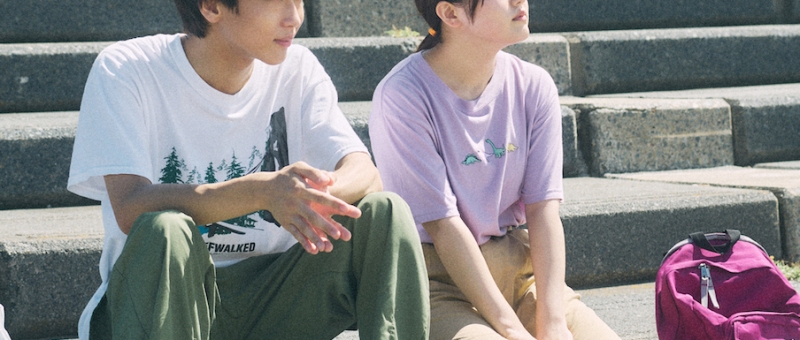
The link between scent and memory is incredibly strong to the extent that they are often inextricable from one another. For Hinoki, what she fears is that her father’s scent will fade from the world around her and she’ll no longer be able to feel his presence either externally or within herself. She tries to recapture and recreate it artificially only to realise that there was a crucial component that she never thought to include but was always central to her memories of her late father.

We can see the way she immortalises him in her dream sequence in which she walks through a gallery looking at a series of small exhibits marking out her father’s life until his hospitalisation at age 45 and subsequent death from illness. The last box appears empty but turns out to contain a simulacrum of his scent in the same way some museums offer the opportunity to experience what it may have felt like to live in a place through breathing in its ambient smells. It’s this sense of intimacy that Hinoki longs to recapture as she attempts to deal with her grief and the series of upheavals to her life in the wake of her father’s death including closing his coffee shop and bean roastery. She’s horrified that her mother’s put his favourite apron in the to go pile as if she were throwing away an essential part of him she can’t recover. It’s this along with a diary dropped off by the owner of a mini theatre he used to deliver coffee to that sends Hinoki on a summer holiday road trip adventure looking for traces of her father in the places he visited and trying to identify that behind a poetic entry at the end of the diary. 

The film then doubles as another in a series of films elegising the dying culture of boutique cinemas in small towns often catering to small but dedicated audiences who have formed a kind of community around their love of film. These smaller screens generally show older and indie films and are key to the success of independent filmmakers whose work often wouldn’t be shown in larger multiplexes, yet audiences have often not returned after the enforced break of the pandemic era while they also face competition from streaming and other forms of entertainment. The first cinema Hinoki visits is closing down in 42 days though she marvels at the scent and atmosphere of this retro space which has its own elegiac quality. Whilst there she also coincidentally runs to a scent scientist who gives her some pointers about how to preserve and recreate her father’s scent before it fades. By the time she reaches the end of her journey the final cinema has already closed down and rather depressingly been replaced by an entirely empty open air car park. 

Even so what she begins to realise is that nothing really disappears and experiences can be recreated to an extent as she discovers when they put a movie on in the car park leading to a very personal epiphany. The people she meets along her way teach her various things such as the importance of clearly stating how you feel while there’s still time even if her best friend’s attempt to do just that doesn’t quite go to plan. A single father raising a small daughter brings back painful memories for her of her own childhood and her father’s now continuing absence while also reminding her that those experiences live on in her memory along with the various things her father taught her throughout her life. 

Though suffused with melancholy, the film is ultimately uplifting in its determination that life goes on and nothing really disappears. Originally diffident and describing herself as someone who doesn’t particularly like interacting with others, through her partly solo road trip Hinoki learns to open herself up to the world around her along with its myriad fragrances and what they say about the people who inhabit a place. She thinks she’s looking for her father, but she’s really looking for herself and the path towards the rest of her life lived in his absence while discovering the richness of life as its lived in addition to that which has passed.


Memories of His Scent screened as part of this year’s Osaka Asian Film Festival.

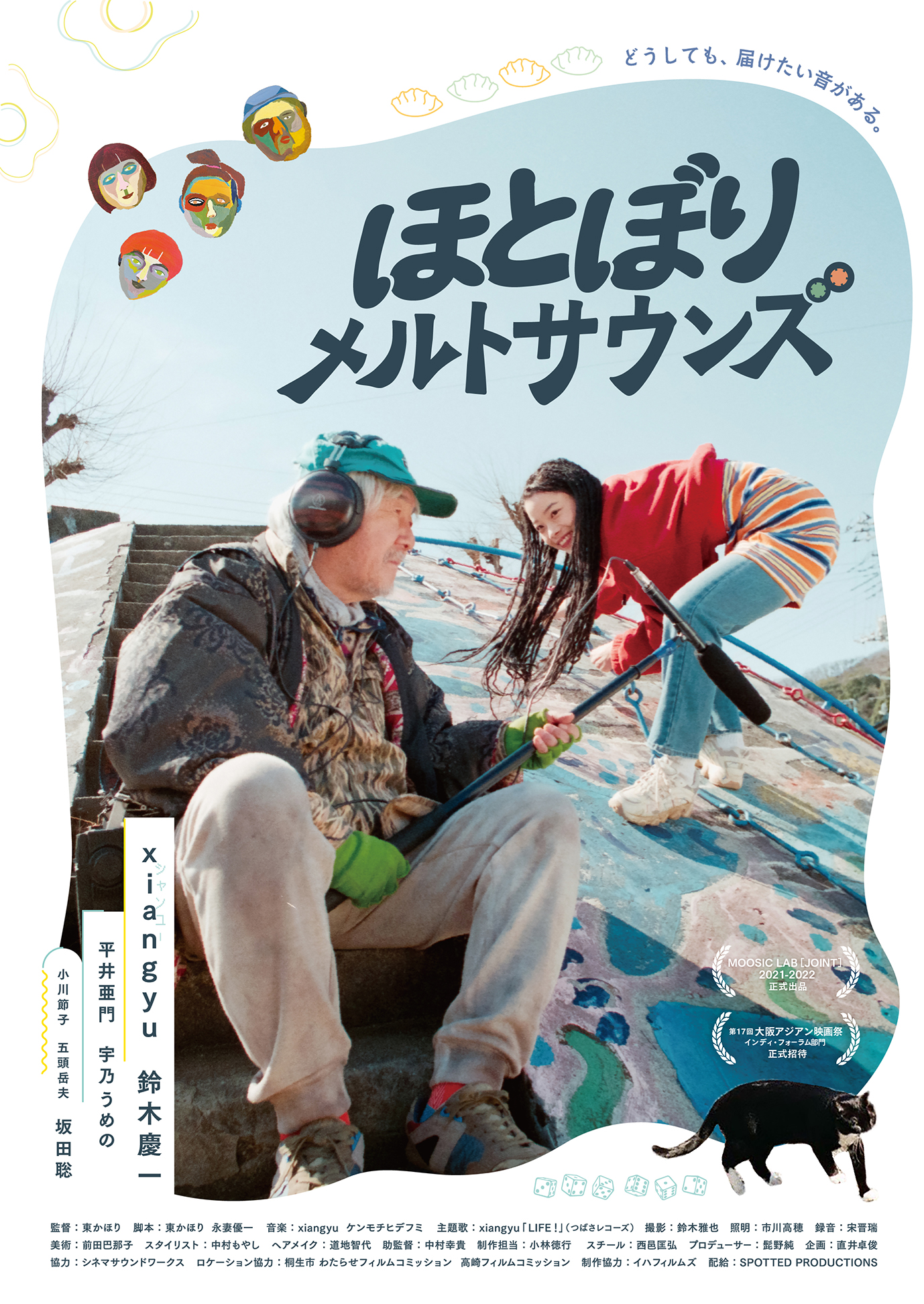
Melting Sounds (ほとぼりメルトサウンズ, Kahori Higashi, 2021)

“They’re all dealing with something. They have nowhere to go back to” an old man sighs watching a cohort of similarly aged men doing callisthenics in a local park knowing that they’re about to lose this place too. A Moosic Lab production, Melting Sounds (ほとぼりメルトサウンズ, Hotobori Melt Sounds) is about what you keep and what you have to let go as the heroes try to preserve a disappearing soundscape while unable to resist the march of progress as even their little backwater finds itself at the mercy of modernising developers. 

Hoping for a solo getaway, Koto (xiangyu) arrives at the rural home of her late grandmother only to discover a strange man, Take (Keiichi Suzuki), camping in the garden. As she will repeatedly, rather than enlist the authorities Koto invites Take into the house where it’s warmer and discovers that he’s in the middle of an important project recording ambient noise from around the village attempting to capture the banal sounds of everyday life such as someone going to the dentist or a young couple having a pointless argument in the street. Meanwhile, the pair receive a visit from a young man, Yamada (Amon Hirai), bearing a tablet featuring the face of a woman, Hiroko (Umeno Uno), trying to explain to them that the house needs to be knocked down so they should hurry up and move out. Unfazed, Koto once again asks Yamada to come and sit under the kotatsu where it’s warm, the young man later taking a break from his job to stay with them under the pretext of convincing them to leave while they’re later joined by Hiroko who also becomes increasingly conflicted and decides to join their small family. 

Just as Take had said they’re all dealing with something, Koto having become estranged from her father whom she no longer talks to, Take as we discover recording the sounds on old-fashioned speaker walkmans for his late sister who was killed in a landslide, and Hiroko and Yamada each conflicted in their work for a greedy amoral developer who reveals that he too was responsible for evicting mostly elderly people from their homes in a town that has since become famous for bubble tea. The four of them are already displaced by the modern society, as are the men doing callisthenics in the park as they watch their town gradually dismantled around them, pushed out even from disappearing and depopulated rural Japan by an encroaching modernity. The developer claims he wants to rejuvenate the town to attract young people to return but is indifferent to what is being lost such as the recording of the nostalgic five o’clock chimes which so moves Hiroko, adding only that they no longer have them where they are only for Hiroko to suggest that you can only hear them if you’re pure of heart. 

Take claims he’s making a “grave of sounds” but he’s also capturing a moment in time and with it the essence of life. As he puts it everything has a sound from a flower blooming to air conditioners and church bells, each of them a part of something bigger immersed in the now. As he points out, everything comes to an end eventually, be it love or friendship or even family. The recordings are a kind of proof of life, but paradoxically also its passing the final implication being that all things have their season and it’s best to enjoy them while there’s time. Small-town Japan may be disappearing or at least changing even if the promised bubble tea might not be quite what you’d expect but that doesn’t necessarily mean it all has to go. 

Thanks to Koto’s warmheartedness, inviting each of them into the house despite having arrived for a “solo” getaway, the trio of youngsters find a new solution to their sense of lonely disconnection discovering a kindred spirit in their shared desire for something simpler and more wholesome as they play boardgames together by candlelight, making curry and gyoza sure to record the sound of them sizzling. A warm and quirky ode to the various ways life can be improved by the simple act of stopping to listen, Kahori Higashi’s laidback debut may be about learning to let things go but also appreciating what you have while you have it and taking what you can with you while being kind and openhearted even in the face of those attempting to run you out of town.


Melting Sounds screened as part of Osaka Asian Film Festival 2022

Original trailer (no subtitles)