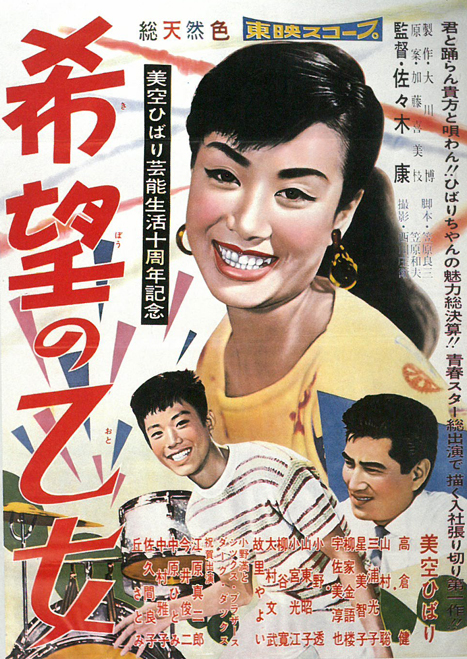
 Another vehicle for post-war singing star Hibari Misora, With a Song in her Heart (希望の乙女, Kibo no Otome) was created in celebration of the tenth anniversary of her showbiz debut. As such, it has a much higher song to drama ratio than some of her other efforts and mixes fantasy production numbers with band scenes as Hibari takes centre stage playing a young woman from the country who comes to the city in the hopes of becoming a singing star.
After beginning with a rural, almost cowboy-style number in which Hibari appears as the well dressed lady of the manor, Sayuri, riding her horse across the wide pastureland, the action quickly moves to the city when Sayuri’s mentor finally convinces her uncle that her future lies in showbiz and not an early marriage as he had envisioned. However, once she gets there she finds her potential tutor extremely unwilling to fulfil his promise to take her on. After winning him over, she quickly makes friends with the locals who also want the singing teacher to become the leader of a band they’ve formed in the hopes of raising some money to build a proper children’s playground to stop them playing in dirty ditch land nearby which is a well known health hazard. Soon enough the band takes off but there’s more trouble ahead for Hibari and co. as they are betrayed by those closest to them.
Working as a celebration of Hibari’s career so far With a Song on Her Heart is filled with excuses for Hibari to sing both as a music student and band vocalist as well as fantasy production numbers some of which are even bigger on dance than on song. The plot is quite simple but there is a lot of it, in contrast to other films of this kind, as Hibari sets about healing the grief stricken heart of her bandleader and fulfilling the hopes of the ordinary people turned musicians through the power of song. The romance element is a light one and not the focus of the film but bears mentioning as Hibari’s love interest is played by Ken Takakura – the archetypical star of the yakuza movie who was to marry fellow singing sensation (and frequent Hibari Misora co-star) Chiemi Eri the following year.
Despite its nature as a celebratory project, With a Song in Her Heart doesn’t quite meet the high production standards of other Misora starring films. Shot in colour and in 2.35:1, the majority of the film is studio bound (often very obviously so) with simple sets and a straightforward directing style. Nevertheless, even if it fails to impress on a technical level, With a Song in Her Heart knows what it’s about and so it makes sure to fill its relatively short duration with as many songs as possible, light romance and a cheerful atmosphere of people coming together to try and solve a social problem through spreading love and joy in the form of music. The musical styles are unusually varied embracing Hibari Misora’s regular ballads as well as mixing in world influences from mariachi to african drums with a strong big band jazz undercurrent.The overall feeling is one of goodnatured wholesomeness and even if low on impact With a Song on Her Heart is a decent showcase for Hibari Misora’s talents as she celebrates her tenth year in the business at the age of only 21.
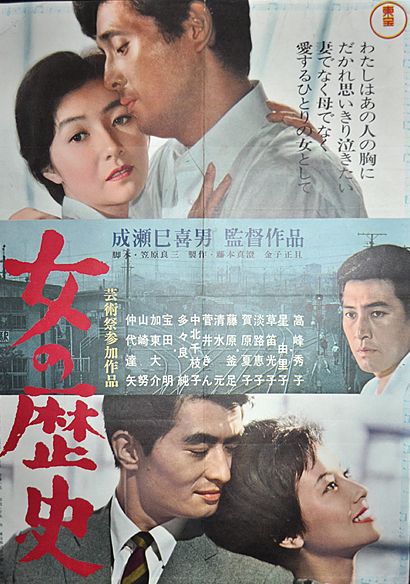 Mikio Naruse made the lives of everyday women the central focus of his entire body of work but his 1963 film, A Woman’s Story (女の歴史, Onna no Rekishi), proves one of his less subtle attempts to chart the trials and tribulations of post-war generation. Told largely through extended flashbacks and voice over from Naruse’s frequent leading actress, Hideko Takamine, the film paints a bleak vision of the endless suffering inherent in being a woman at this point in history but does at least offer a glimmer of hope and understanding as the curtains falls.
 Windows on Worlds